
It's tempting to think of ChatGPT and Perplexity as variations on the same theme. Both answer questions. Both cite sources. Both increasingly drive buying decisions. But when you look at which brands each one actually recommends for the same query, the overlap is surprisingly thin. SE Ranking found that 89% of citations come from different domains depending on whether you ask ChatGPT or Perplexity. That isn't a margin of error. That's two fundamentally different ranking systems.
The headline difference: what each engine optimizes for
ChatGPT was trained as a general assistant first and a search engine second. Its retrieval layer pulls in fresh web content when commercial intent is detected, but the underlying judgment about which brands deserve to be named leans heavily on the patterns baked into its training data. That means established brand mentions, Reddit threads, YouTube transcripts, and well-distributed earned media carry significant weight.
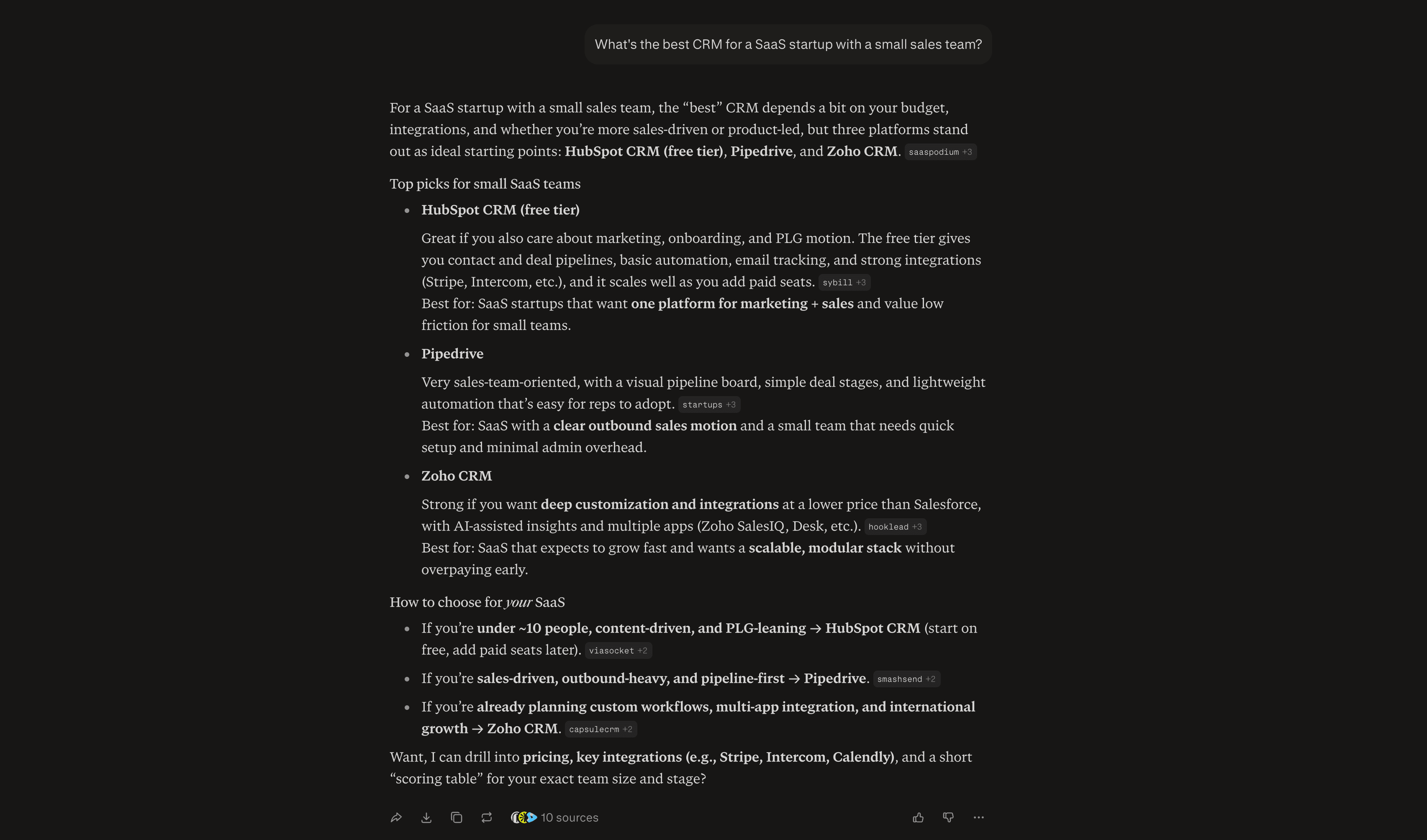
Perplexity, if you need a primer on what Perplexity AI is, was built from day one as an answer engine. Its citation-first design means every recommendation is grounded in a retrievable source at query time. The ranking signal is closer to a real-time index than a long-memory model. Authoritative list articles, recent reviews, and structured comparison content punch above their weight.
The Perplexity weighting, in numbers
SE Ranking's analysis of Perplexity's recommendation behavior surfaced three dominant factors and gave them rough weights. Treat the numbers as directional rather than absolute, but the ordering is consistent across multiple independent studies.
- Authoritative list mentions: roughly 64% of the recommendation signal
- Online reviews on platforms like Trustpilot, G2, and Capterra: roughly 31%
- Awards, certifications, and badges: roughly 5%
What's missing from that list is just as telling. Your own homepage copy, your product page, and your blog content barely register as ranking factors on Perplexity unless they're being referenced by a third party. The platform is essentially asking: who do the lists say is best, and what do reviewers say about them?
ChatGPT's center of gravity: third-party validation plus community
ChatGPT's pattern looks different. Brands are 6.5x more likely to be cited through third-party sources than their own domains, and domains with millions of Quora and Reddit mentions have roughly 4x higher chances of being cited. The signal stack is broader. It rewards brands that show up in conversation, not just in lists.
ChatGPT also weights content structure heavily. 44.2% of LLM citations come from the first 30% of text, and listicles get cited at a 25% rate compared to 11% for blogs and opinion pieces. If your top-of-page content doesn't make a clear, citable claim, ChatGPT often skips you even when the rest of the article is strong.
There's also a recency wrinkle. Commercial intent prompts trigger web search in ChatGPT 53.5% of the time, compared to 18.7% for informational queries. So the more transactional the query, the more your real-time presence on review sites and product directories matters.
Where the engines actually disagree
The cleanest way to see the divergence is to run the same prompt on both engines and compare the cited domains. A few patterns show up repeatedly.

Want to get recommended by AI?
Check your AI search visibility, then let the Honeyb agent write, fix, and earn what gets you recommended. Free to start.
- Perplexity over-indexes on editorial roundups from publications like Forbes, TechRadar, and PCMag
- ChatGPT over-indexes on Reddit threads, YouTube reviews, and long-tail blog posts
- Perplexity tends to name 4-6 brands; ChatGPT has tightened to 3-4 after recent updates
- Perplexity citations skew toward content published in the last 12 months; ChatGPT happily cites evergreen sources from years back
These differences mean a brand can be highly visible on one engine and effectively invisible on the other. The fix is rarely 'do more SEO.' It's a different set of moves for each engine.
What this means for your strategy
If you want to win on Perplexity, your priorities are clear. Get into authoritative list articles in your category. Build and maintain review profiles on the platforms your buyers actually use. Pursue category awards and analyst mentions. The single highest-leverage action is usually outreach to the editors writing 'best of' roundups in your space.
If you want to win on ChatGPT, the playbook overlaps but tilts further toward community. Reddit presence, where it's authentic and on-topic, is a meaningful asset. YouTube reviews carry weight. Structured comparison content on your own site is worth building because ChatGPT will cite it when nothing better exists. And the first 200 words of every page need to do real work.
Both engines reward third-party validation. Neither rewards self-promotional homepage copy. The difference is in which third parties matter most.
The cross-model reality
Optimizing for one AI engine and assuming the others will follow is a recipe for blind spots. A brand that's mentioned in 60% of relevant ChatGPT queries can still be mentioned in only 10% of Perplexity queries for the same topic. That gap is invisible without measurement. For more on the underlying ranking signals, see our deeper write-up on how AI models choose which brands to recommend.
This is also why occasional spot-checks fail. AI Overview content changes 70% of the time for the same query, and SparkToro's research found a less than 1-in-100 chance that two identical queries return the same brand list. Pattern recognition only happens with repeated measurement. The methodology is detailed in why spot-checking AI visibility doesn't work.
Closing thought
Treating ChatGPT and Perplexity as one channel is the most common strategic mistake in AI visibility. They share a category, not an algorithm. The brands that earn share of voice on both are the ones that measure each engine separately and build a strategy for each. If you've never compared your brand side by side across the two, the free AI visibility checker runs the same prompts against both in 30 seconds. The gap is usually bigger than teams expect.