

The SaaS buying journey has always started with research. What changed in the last 18 months is where that research happens. A buyer who used to open Google and type 'best CRM for small teams' now opens ChatGPT and asks the same question in natural language. The answer is no longer a list of ten blue links. It's a synthesized recommendation that names three or four products. Being one of those three or four is the new top-of-funnel.
The shape of a SaaS recommendation
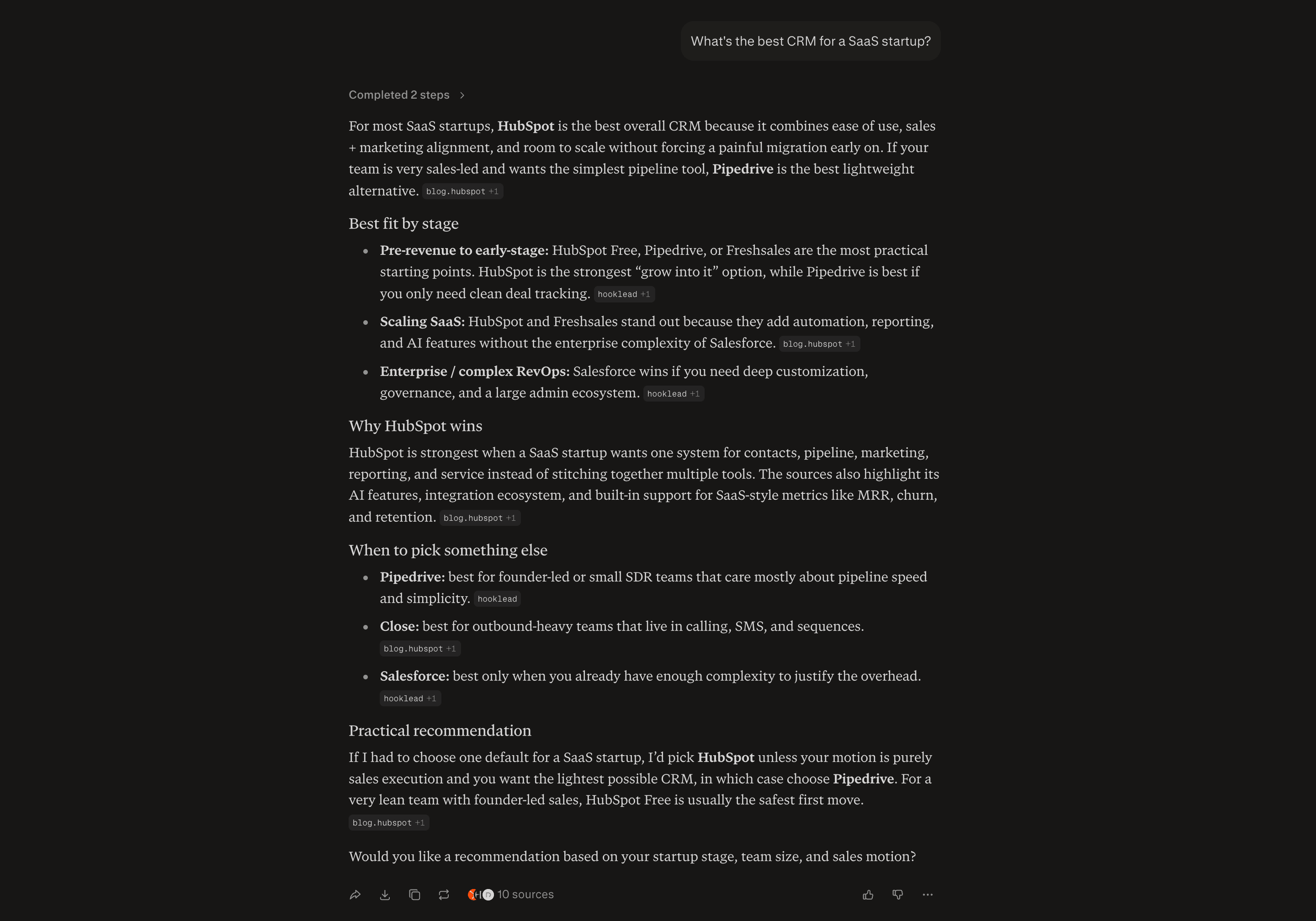
When a SaaS buyer asks ChatGPT a category question, the response usually follows a predictable pattern. A short framing paragraph, then a numbered or bulleted list of three to four named products, each with a one-sentence positioning summary, often with caveats about company size, budget, or use case.
Two structural facts shape this. First, ChatGPT has tightened from 6-7 brand mentions per response to 3-4 after recent updates. The slot count is smaller. Second, commercial intent queries trigger live web search 53.5% of the time, compared to 18.7% for informational queries. Which means the recommendation set is partly drawn from training data and partly assembled in real time from current web sources.
What earns a slot
Five factors show up repeatedly in research on SaaS-relevant AI citations.
- Active, healthy profiles on G2, Capterra, TrustRadius, and similar B2B review platforms
- Inclusion in authoritative category roundups from publications buyers trust
- A meaningful presence in Reddit threads and community discussions where buyers ask for recommendations
- Structured comparison content on your own site that LLMs can extract from
- Domain authority backed by genuine industry coverage, not just link-building
Notice what's not on that list. Aggressive SEO keyword targeting on your own blog. PPC budget. The number of feature pages on your site. These matter for traditional search. They don't move the needle nearly as much in AI recommendations.
The G2 and Capterra question, for SaaS specifically
For B2B SaaS, the review-platform signal is unusually strong. Domains with active G2 or Capterra presence have 3x higher chances of being cited by ChatGPT. For Perplexity, online reviews weight around 31% of the recommendation signal.
What 'active' means is specific. It means a profile that's been claimed and maintained, with reviews from the last 6-12 months, with responses to negative feedback, and ideally with category badges that demonstrate market position. A profile with 30 reviews from this year often outperforms a profile with 300 reviews from three years ago.
The Reddit factor for SaaS buyers
B2B SaaS buyers, especially in technical categories, rely heavily on Reddit and Hacker News for real opinions. Subreddits like r/sysadmin, r/saas, r/marketing, and category-specific communities are common stops in the consideration process.
Domains with substantial Reddit mention volume are roughly 4x more likely to be cited by AI models. For SaaS, this manifests as authentic discussion in relevant subreddits, where actual users describe their experience with your product, often unprompted.
The trap to avoid is heavy-handed promotion. Reddit moderators and communities flag and remove promotional content quickly, and AI models increasingly weight thread quality and comment depth. The brands that win on Reddit are the ones building products good enough to be recommended unprompted, and whose teams participate authentically when relevant.

Want to get recommended by AI?
Check your AI search visibility, then let the Honeyb agent write, fix, and earn what gets you recommended. Free to start.
Comparison content that gets cited
Listicles and comparison content have a 25% citation rate compared to 11% for blogs and opinion pieces. For SaaS, the highest-yield content categories are clear.
- Honest 'X vs Y' comparison pages, including against direct competitors
- 'Best [category] for [use case]' roundups written from a buyer's perspective
- Pricing breakdowns that include real numbers, not 'contact sales'
- Integration directories with substantive detail
44.2% of LLM citations come from the first 30% of text. The first paragraph of every comparison page needs to make a direct, citable claim. Lead with the answer, then explain.
The technical foundation
AI crawlers need to access your site. GPTBot, ClaudeBot, PerplexityBot, and Google-Extended should be allowed in your robots.txt. Page speed matters: pages with FCP under 0.4 seconds average 6.7 citations from ChatGPT compared to 2.1 for pages over 1.13 seconds. Structured data on product pages, pricing pages, and comparison pages gives AI models clean, extractable signal.
A quarterly playbook for SaaS teams
In any 90-day window, the highest-leverage moves for AI visibility look roughly like this.
- Audit and refresh your G2, Capterra, and TrustRadius profiles. Set up a sustainable review-request cadence tied to customer success milestones.
- Identify the three or four authoritative category roundups buyers cite most. Reach out to editors with substantive product information and recent customer evidence.
- Build or refresh two or three head-on comparison pages against your most-mentioned competitors.
- Encourage subject-matter experts on your team to participate in relevant Reddit and community discussions in their personal capacity, with affiliation disclosed.
- Monitor weekly. Track which queries surface your brand, which surface competitors, and how the pattern shifts.
For a fuller treatment of the underlying mechanics, see our writeup on generative engine optimization and the deeper data in how AI models choose which brands to recommend.
The competitive frame
AI search compresses category competition. When the recommendation set shrinks from ten links to three brands, the gap between being mentioned and being invisible widens. SaaS categories where 30 viable vendors exist often see the same three or four brands recommended over and over by AI models. The brands that earn those slots are the ones treating AI visibility as a dedicated discipline.
Closing thought
If your category has more than five viable competitors and ChatGPT only names three, the math is unforgiving. The shortlist is shrinking, and the brands earning a slot are the ones treating AI visibility as a real channel rather than a 2027 problem. Start with a free check of where your SaaS currently surfaces across the four major engines. The picture is usually different from what the team expects.