
A prospect deciding between you and two rivals no longer opens ten blue links and forms their own view; they ask ChatGPT or Perplexity which tool is best for their situation, read the three names it returns, and quietly discard the rest before you ever knew the question had been asked. The instinct, once you realise this is happening, is to treat it like the old search problem and track your rank: open a tool on Monday, note that you sit second for the query that matters, check again on Friday to see whether you have moved. That instinct is why most brands measure their AI visibility badly, because the number they are chasing does not sit still long enough to be chased.
So here is the case this guide makes before it ranks a single tool. An AI rank tracker (software that watches where your brand lands when an engine answers a buyer's question, the answer-engine cousin of the keyword rank tracker every SEO team already runs) earns its price only if it abandons the one thing its name promises: a fixed position. AI engines resample, so the same question returns a different answer roughly 70% of the time (SparkToro), and even the brand named first changes between 28% and 44% of identical reruns depending on the engine (our own measurement, below), which means a tool that reports you as "number two" has told you the result of one coin toss, not where you stand. The trackers worth their price report a distribution instead: how often you appear across many repeated runs, how often you place first, and which page taught the engine to say it. For most founders the honest path is a free check followed by a low-cost monitor that samples repeatedly and shows its sources; the deepest analytics belong to Profound and are priced to match; teams already running an SEO suite have a quieter option we reach below.
Why AI has no rank to write down
~70%
of repeat questions return a different answer
The position you read once is a sample of one. SparkToro.
<1 in 100
chance two identical questions return the same brand list
There is no fixed order to write down. SparkToro.
28% to 44%
of identical reruns change the number-one brand, depending on engine
Even first place moves between runs. Honeyb, 13 July 2026.
Why AI has no rank to track
The phrase rank tracking carries a promise inherited from the old web, where a keyword sat at position four on Tuesday and held there long enough that opening a tool on Friday to check for movement was a sensible thing to do. AI answers break that promise at the root, because the engine does not store a ranked list it serves you from; it generates a fresh answer each time you ask, sampling from a range of plausible responses, so the same question changes its answer roughly 70% of the time and two identical questions return the same brands in the same order less than one time in a hundred (SparkToro). The number you would write down, your position, is not stable enough to be a number. Check once and see yourself second, and you have learned what one buyer saw in one session, not where you stand; check again on Friday and all you have learned is that the dice were rolled again, which is the same false comfort that leaves teams staring at a dashboard asking why their AI visibility suddenly dropped when nothing has really changed.
Two smaller forces make the shuffle worse. Engines that ground their answers in a live web search, Gemini and the AI answers now sitting above Google's links chief among them, redraw their sources every time the underlying results move, so your position drifts as the search beneath it drifts. And a logged-in account carries your own history into the prompt, which flatters you, so the rank you read from your own desk is the most generous one anyone will ever get. The machinery behind the shuffle is worth understanding before you buy anything to measure it, and our explainer on why the same AI question does not give everyone the same answer sets it out; the practical upshot is blunt, that a single reading is not a measurement of anything, and a tool that dresses one reading up as a rank is selling you false precision.
What a rank tracker actually has to measure
Once you accept that a single position is noise, the job changes shape. A rank tracker built for AI is not asking where am I today but, across many runs of the questions my buyers ask, how often am I named, how often am I named first, and why, and the tools separate cleanly by how many of those they actually answer.
| Signal | What it tells you | Why a single check gets it wrong |
|---|---|---|
| Presence rate | How often you are named at all across repeated runs | One answer changes about 70% of the time (SparkToro), so a lone yes or no is a coin toss |
| Rank distribution | How often you place first, mid-list, or last across runs | Two identical questions match the same order under 1 in 100 (SparkToro), so an average beats a snapshot |
| Share of voice | How your presence compares with named rivals over the same runs | A rival can be losing the run you happened to see and winning the nine you did not |
| Source | Which page the engine built the claim on | ChatGPT and Gemini often hide their citations; Perplexity and Claude show theirs (Semrush) |
The middle two rows are where the useful tools live, because presence and rank only mean something as frequencies, and the frequency that unsettles people most is how often the very top of the answer changes. We put twenty buyer-intent questions to the four main engines, three times each, in July 2026, and counted how often the brand named first changed between identical reruns.
Top-pick change rate
How often the top recommendation changes between identical runs
Read that as the ceiling on precision any rank tracker can honestly offer. On Gemini the number-one recommendation changed in 44% of identical reruns and on Perplexity 43%, while even the steadiest of the four, Claude, reshuffled its top pick 28% of the time. A tool that reports your rank as a single position on engines this volatile is reporting noise with a decimal point attached; a tool that reports how often you take the top slot across fifty runs is reporting something a buyer would actually recognise. The fourth row, the source, is the one that quietly defeats home-made tracking, because you can eyeball presence and rank but you cannot see the page that set the answer unless the engine chooses to show it, and our fuller treatment of whether ChatGPT cites its sources explains why that trail so often runs cold.
The 6 best AI rank trackers for 2026
With the criterion set, distribution over snapshot and source over score, here is how the field looks in 2026, priced from the vendors' own pages and positioned by what each is genuinely best at. Honeyb is our own tool and sits first because this is our list; read its caveat as closely as anyone else's.
| Tool | Entry price | What it is | Best for |
|---|---|---|---|
| Honeyb (our tool) | Free check, then from $29/mo | A dedicated AI visibility monitor with a free instant check and daily scans | Founders who want presence, rank and sources on a budget |
| Profound | About $399/mo, demo-only | The deepest analytics of the set, with API access and white-label output | Enterprises and agencies needing depth and portability |
| AthenaHQ | About $295/mo, free 10-minute audit | A monitoring platform you can trial without a sales call | Teams wanting a fast read before they commit |
| Peec | About $89/mo | A mid-priced European monitor built around competitor sets | Small teams tracking a defined rivalry |
| Otterly | $29/mo | One of the cheapest paid monitors across the main engines | The lowest-cost way to start sampling |
| SE Ranking | AI module about $55/mo | An AI-visibility module inside an established rank-tracking suite | Teams already running SE Ranking for search |
Honeyb: distribution and sources on a founder's budget
Honeyb, our tool, is built around the shift this guide argues for, so rather than a single position it reports how often each engine names you across repeated scans, how often you land first, and the cited pages behind the answer, with a free instant check so you can see today's answers before paying anything and daily re-scans so a real move surfaces in days rather than whenever you next remember to look. The honest caveat is that it is a focused monitor rather than an enterprise analytics suite, so if you need dozens of seats, bespoke dashboards and procurement-grade controls the depth lives further down this list. For a founder or lean marketing team who wants presence, rank and source in one place without a five-figure contract, it is the tool we would point you to, and the free AI visibility check runs in the time it takes to read the next entry.

Want to get recommended by AI?
Check your AI search visibility, then let the Honeyb agent write, fix, and earn what gets you recommended. Free to start.
Profound: the deepest analytics, if you can clear the gate
Profound is the most powerful platform here and does not pretend otherwise: its analytics run deeper than anything else in this roundup, it offers API access and white-label output that let an agency fold the numbers into its own reporting, and it has the funding to keep the product ahead of the field. All of that sits behind a demo call and a price around $399 a month, so it is not a swipe-a-card purchase, and for a solo founder it is more tool than the problem needs. Where it earns the ticket is inside organisations that must track rank and share of voice across every engine and then carry those numbers into board decks and client reports, a case we weigh in full in our comparison of Honeyb and Profound.
AthenaHQ: a fast read before you commit
AthenaHQ's most useful feature for a rank-tracking buyer is the one that costs nothing, a free ten-minute audit that shows where you stand before any contract, which is exactly the read you want when you suspect you are slipping but cannot yet prove it. Beyond the audit it is a capable monitoring platform at around $295 a month. The caveat is that the entry price sits at the top end of this list, so it suits teams who have already decided AI rank is a funded line item rather than those still testing the water, for whom the free audit alone may be the whole of the first month's work.
Peec: a mid-priced tracker for a named rivalry
Peec, built in Berlin, sits in the sensible middle at about $89 a month, and its strength is competitive framing, because it is designed around watching how you place against a named set of rivals rather than in the abstract, which is the right lens for rank tracking, since rank is meaningless in isolation and tells you something only relative to the brands you are being ranked beside. The caveat is scope. A tightly drawn competitor set is a feature when you know exactly who you are fighting and a limit when the engine keeps naming a rival you never thought to add to the list.
Otterly: the lowest-cost way to start sampling
Otterly matches the cheapest paid tier here at $29 a month and earns its place by removing the excuse not to start, because for the price of a couple of coffees you get scheduled sampling across the main engines, which is the difference between a real presence rate and a spreadsheet you update when you happen to remember. It is lighter on analytics than the pricier entries, so treat it as the tool that gets you sampling rather than the one that runs a deep forensic investigation, and for many small brands consistent sampling is the ninety per cent of the job they were not doing at all.
SE Ranking: AI rank inside the suite you already run
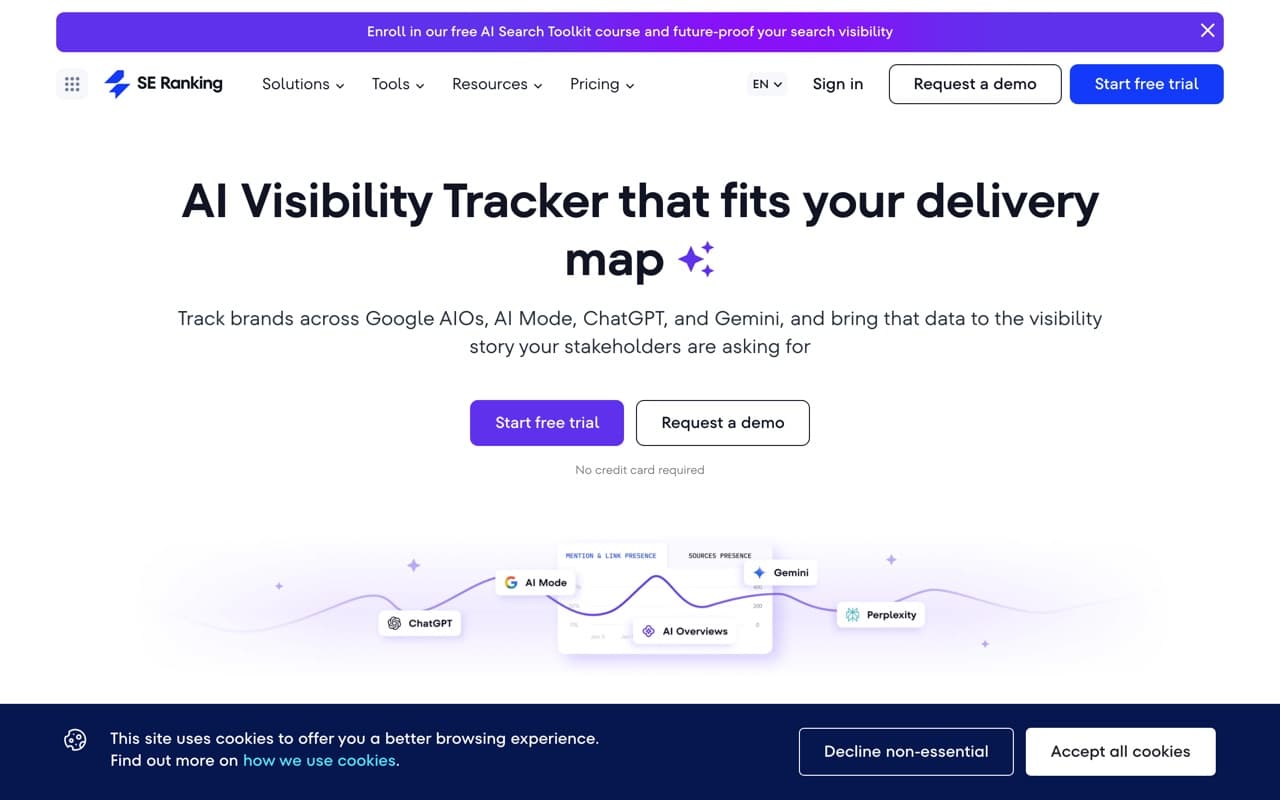
SE Ranking is the entry that arrives at AI rank tracking from the old kind, bolting an AI-visibility module priced around $55 a month onto a mature and well-regarded SEO suite, and that heritage is exactly its appeal, because if your team already lives in SE Ranking for keyword positions, adding an AI-answer view avoids yet another login and another invoice. The trade is focus. It is a search-rank suite that also watches AI answers rather than a tool built solely for the AI job, so its source-tracing is narrower than the dedicated monitors, which is a fair price for consolidation when AI rank is one concern among many rather than the main event.
Also at the door: Semrush AI Visibility and Ahrefs Brand Radar
Two more names belong in the conversation without quite earning a numbered slot. Semrush AI Visibility is an add-on to a Semrush subscription with a free checker anyone can try, and for the many teams already paying for Semrush it is a small addition rather than a new relationship, though as a bolt-on to a broad suite it optimises for coverage across many jobs rather than the forensic source-tracing a dedicated tracker is built for, a trade we weigh in our review of the Semrush AI Visibility toolkit. Ahrefs Brand Radar rides on Ahrefs' existing plans and is a strong fit for teams already using Ahrefs for links and content. Both are credible, and both make more sense as part of a wider toolkit than as a first, focused AI rank tracker, which is why they sit here rather than in the ranked six.
Which one should you actually buy
So, verdicts, because a list without them is just a menu. If you are a founder or small team who suspects AI is quietly routing buyers to rivals and wants to confirm it today, start with a free check and, if the answers warrant paying, a low-cost monitor such as Honeyb (our tool) or Otterly that samples repeatedly and shows its sources, because that is the whole method and it does not need a big budget. If you are an agency or enterprise that must track rank and share of voice across every engine and carry the numbers into someone else's reporting, Profound's depth and portability justify its gate. If your team already runs an SEO suite, the AI module in SE Ranking or the Semrush add-on saves you a login and is the pragmatic pick. The one choice that never pays off is the tool you buy for a single tidy position number, because that number is the one thing this category cannot honestly give you. We keep fuller, tested comparisons in our roundups of the best AI visibility tools and the tools built for monitoring brands in chat engines, both of which judge Honeyb on the same criteria as everyone else, and the method for one engine at a time is laid out in our guide to rank tracking in Gemini. The fastest way to see where you actually stand, across the main engines and with the sources shown, is to run the free AI visibility checker against your own category, and if it turns out you are missing rather than mid-ranked, our guide on why your brand isn't showing up in ChatGPT is the better next read.