

ChatGPT brand monitoring is the practice of tracking how ChatGPT names, describes and recommends your brand, and which sources it draws on, so you can see whether buyers who ask it for a recommendation hear about you or a competitor. ChatGPT is the largest AI answer engine, which makes it the one reading that matters most, and it is also the hardest to monitor because it often answers without showing where its recommendation came from.
This guide ranks the nine best tools for 2026 specifically on how deeply and reliably they cover ChatGPT, and how each one handles ChatGPT hiding its sources. Full disclosure up front: Honeyb, first on the list, is the tool behind this blog, so weigh the rest on their own merits. For the wider category across all four engines, see the best AI brand monitoring tools.
Why ChatGPT is the hardest engine to monitor
ChatGPT is where the most buyers ask, and where you can see the least about why it answers the way it does. Two things make it hard. First, its recommendations frequently arrive without attribution: 62 per cent of AI citations never name the brand behind them (Semrush), so a source can shape an answer about you while staying invisible. Second, when ChatGPT does lean on sources, they are concentrated and shifting. Reddit alone is 40.1 per cent of all AI citations, the single most-cited source across engines (Semrush).
ChatGPT also cites differently from the other engines. It shows its sources less openly than an engine like Perplexity, so the content shaping its answers is both harder to see and harder to influence. That is the gap a ChatGPT monitoring tool has to close.
Monthly searches (US)
Search demand for AI optimisation terms (US)
There is a moving-target problem on top of the hidden-source problem. Reddit's share of ChatGPT citations fell from roughly 60 per cent to about 10 per cent in a fortnight in late 2025 (Semrush). What ChatGPT trusts this week is not what it trusted last week, which is exactly why a single manual check is misleading and why scheduled monitoring matters more here than on any other engine.
How we ranked tools for ChatGPT coverage
We judged each tool on the things that decide the quality of a ChatGPT reading, not on general feature lists. That means: whether ChatGPT tracking runs on an automated daily schedule rather than on demand, how much a tool can tell you about the sources behind a ChatGPT answer given that ChatGPT often hides them, which other engines it also covers so you are not blind on Gemini, Claude and Perplexity, and price relative to who it fits.
AI visibility correlates most with third-party mentions and video, not on-page work (Ahrefs), so a tool that surfaces the sources behind a ChatGPT answer is worth more than one that only scores you.
| Tool | ChatGPT tracking | ChatGPT source visibility | Also covers | Starting price |
|---|---|---|---|---|
| Honeyb | Daily, automated | Citations tracked | Gemini, Claude, Perplexity | Free visibility check |
| Profound | Daily, enterprise | Deepest citation analytics | Major answer engines | Pricing on request |
| Otterly AI | Automated | Prompt and link tracking | Perplexity, AI Overviews, Gemini, Copilot | $29/mo |
| Peec AI | Automated, multilingual | Citations tracked | Gemini and others | $95/mo |
| AthenaHQ | Automated | GEO source workflows | Major answer engines | $295/mo |
| SE Ranking | Automated | Inside SEO suite | Gemini, AI Overviews | $129/mo (suite) |
| Semrush AI Visibility | Automated | Add-on tracking | Major answer engines | Free checker |
| Ahrefs Brand Radar | Automated | Share of voice and mentions | Web and YouTube plus AI | Ahrefs plans |
| Scrunch AI | Automated | AEO source focus | Major answer engines | $250/mo |
The 9 best ChatGPT brand monitoring tools
1. Honeyb. Honeyb monitors how ChatGPT names and describes your brand every day, and tracks the citations behind those answers so you are not left guessing why ChatGPT recommends who it recommends. Because it runs the same fixed set of buyer questions on a schedule, it reads the ChatGPT trend rather than a single volatile snapshot, and it covers Gemini, Claude and Perplexity in the same view so a strong ChatGPT reading does not hide a weak one elsewhere.
It adds sentiment, competitor tracking and specific recommendations, and you can start with a free AI visibility check. Because this is our product, treat the rest of this list as the real test of whether we are being fair.
2. Profound. Profound is the enterprise standard and has the deepest analytics for pulling signal out of ChatGPT, backed by more than $155M in funding. If your priority is understanding the sources and prompts behind ChatGPT's answers at scale, this is the most thorough option, and it covers the major answer engines alongside it. It publishes no price: a free trial, then custom Enterprise pricing on request, which tends to put it out of reach for smaller teams. Our Honeyb vs Profound comparison has the detail.
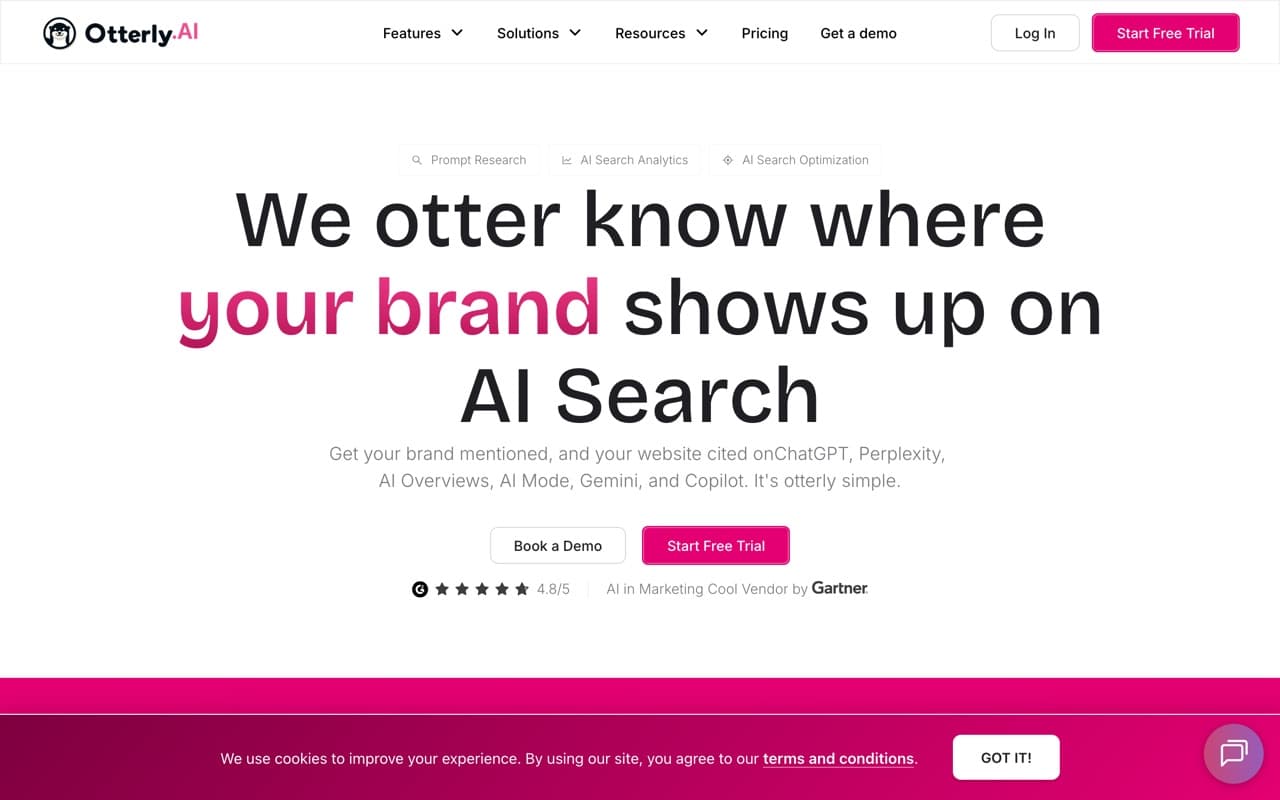
3. Otterly AI. Otterly is the cheapest way to keep an eye on ChatGPT, from $29 a month with a free trial. It tracks your prompts and the links ChatGPT surfaces across ChatGPT, Perplexity, AI Overviews, Gemini and Copilot, which is unusually broad engine coverage for the price. It earned a Gartner Cool Vendor nod and holds a 4.9 out of 5 on G2.

Want to get recommended by AI?
Check your AI search visibility, then let the Honeyb agent write, fix, and earn what gets you recommended. Free to start.
For SMBs and individual marketers who want ChatGPT monitoring without a big commitment, it is the lowest starting price in this list. Honeyb vs Otterly has the side by side.
4. Peec AI. Peec AI is the pick if your buyers ask ChatGPT questions in more than one language. It tracks ChatGPT and other engines with genuine multilingual coverage and citation tracking, aimed at mid-market brands and agencies, from $95 a month with a trial. If ChatGPT visibility in English is your only concern, it is more than you need, but for multi-market teams the language coverage is the differentiator.
5. AthenaHQ. AthenaHQ wraps ChatGPT monitoring in generative engine optimisation workflows built for teams, from $295 a month, with a free 10-minute audit to start. Its focus is turning what ChatGPT cites into a repeatable process of work rather than a dashboard you glance at, so it suits marketing teams and agencies running GEO as a service. For a solo marketer it is heavier than the job needs.
6. SE Ranking. SE Ranking folds ChatGPT visibility into an affordable, established SEO suite, from $129 a month with a 14-day no-card trial. It also tracks Gemini and Google's AI surfaces, so SEO professionals already standardised on SE Ranking can watch ChatGPT next to their rankings and keywords without adding a vendor. As a suite add-on it is less specialised on ChatGPT source depth than the dedicated tools above.
7. Semrush AI Visibility. Semrush added ChatGPT visibility to its SEO suite as an add-on, with a free checker so you can get a first ChatGPT reading at no cost. It suits existing Semrush customers who want AI presence tracked alongside backlinks and rankings in one login. Like other suite bolt-ons, its strength is consolidation rather than ChatGPT-specific source depth.
8. Ahrefs Brand Radar. Ahrefs Brand Radar brings ChatGPT share of voice and brand mentions into the Ahrefs ecosystem, on existing Ahrefs plans. Given that AI visibility tracks most closely with third-party mentions and video (Ahrefs), having ChatGPT mentions next to your backlink and YouTube data in one tool is a natural fit for teams already on Ahrefs. Its appeal is consolidation rather than dedicated ChatGPT citation analytics.
9. Scrunch AI. Scrunch AI approaches ChatGPT from the optimisation side, focusing on answer-engine optimisation so your site is more likely to be cited in ChatGPT's answers in the first place. Pricing is custom. It is worth a look for teams whose priority is influencing what ChatGPT cites rather than only measuring it. Check the vendor for current plans and engine coverage.
How to choose for ChatGPT
Match the tool to your situation. If you are an enterprise that needs to dissect ChatGPT's sources and prompts at scale, Profound is the deepest option. If you are price-sensitive and want broad engine coverage cheaply, Otterly is the value play. If your buyers ask ChatGPT in several languages, Peec AI. If you run GEO for clients, AthenaHQ. If you already live in Semrush, Ahrefs or SE Ranking, their add-ons keep ChatGPT in a familiar dashboard.
And if you want daily ChatGPT monitoring with the citations behind each answer, the other three engines covered in the same view, plus sentiment and competitor tracking without enterprise pricing, that is where Honeyb fits.
The volatility caveat that applies to every tool here
No tool can make ChatGPT hold still. The result for the same query changes roughly 70 per cent of the time, and there is under a 1-in-100 chance that two identical queries return the same brand list (SparkToro). Combined with ChatGPT hiding its sources, that means a single manual check tells you almost nothing. What a good tool does is run a fixed set of buyer questions through ChatGPT on a schedule, surface whatever sources it can behind the answers, and show you the trend. Judge any tool on this list, ours included, on how well it does that.
The fastest way to see where you stand is to run your brand through a free AI visibility check and see whether ChatGPT names you, which competitors it names instead, and what it cites.