AI search competitive analysis tools track how ChatGPT, Gemini, Claude and Perplexity answer the buying questions in your category, then show you which brands the models name, which they leave out, and where a rival is quietly taking the recommendation that should be yours. This is a different job from self-monitoring. A monitoring tool tells you that you are missing from an answer. A competitive analysis tool tells you who is standing in your place and why.
Honeyb is our own tool, so we have listed it first and flagged it throughout. If you want the wider category before you narrow down, start with the best AI visibility tools.
Why self-monitoring loses you the AI answer
When a buyer asks an AI model for a recommendation, the model returns a short list of brands. If you are watching only yourself, you see your own absence but not the name that replaced you, and you cannot see the source that put them there. The reason competitors win these slots is structural.
Reddit alone accounts for 40.1% of all AI citations, the single most-cited source (Semrush), and 62% of AI citations never name the brand behind them (Semrush), so a model can recommend a rival off the back of a forum thread you have never read. Ahrefs finds AI visibility correlates most strongly with third-party mentions and video, not on-page work, which means your competitors are being cited in places your own website never touches.
Monthly searches (US)
Search demand for "perplexity ai"
Benchmarking has to be continuous, because a single reading is close to worthless. The same AI query changes roughly 70% of the time, and two identical queries return the same brand list under a 1-in-100 chance (SparkToro). Sources shift just as fast: Reddit's share of ChatGPT citations fell from about 60% to about 10% in a fortnight in late 2025 (Semrush). Check once and you have a snapshot.
Track daily against named rivals and you have a trend. That is why the columns below rank each tool on three things: how deeply it tracks named competitors, whether it surfaces the specific gaps and opportunities you can act on, and whether it puts you and your rivals in one side-by-side view.
The 9 best AI search competitive analysis tools, side by side
| Tool | Competitor tracking depth | Gap and opportunity surfacing | Side-by-side view | Engines tracked | Starting price |
|---|---|---|---|---|---|
| Honeyb (ours) | Deep, named rivals daily | Yes, with recommendations | Yes | ChatGPT, Gemini, Claude, Perplexity | Free check, then paid |
| Profound | Deep, enterprise-grade | Yes | Yes | Major AI models | Pricing on request, free trial |
| AthenaHQ | Deep, GEO team workflows | Yes | Yes | Major AI models | From $295/mo, free 10-min audit |
| Peec AI | Moderate, multilingual | Yes | Yes | Major AI models | From $95/mo, trial |
| Ahrefs Brand Radar | Share of voice and mentions | Yes | Yes | AI models and AI Overviews | On Ahrefs plans |
| Otterly AI | Moderate | Yes | Yes | ChatGPT, Perplexity, AI Overviews, Gemini, Copilot | From $29/mo, free trial |
| SE Ranking | Basic, inside SEO suite | Limited | Within suite | Major AI models | From $129/mo, no-card trial |
| Semrush AI Visibility | Moderate, suite add-on | Yes | Yes | Major AI models | Free checker; from $199/mo |
| Scrunch AI | AEO-focused | Yes | Yes | Major AI models | From $250/mo |
Honeyb (our tool)
Honeyb, which we build, runs your prompt set across all four major models, ChatGPT, Gemini, Claude and Perplexity, every day, and reports not just whether you appear but which competitors appear alongside you, how each is described, and which sources the models cite for them. Because the readings are daily rather than one-off, you see the trend line that the 70% query volatility (SparkToro) otherwise hides, and you can watch a rival's share of voice rise before it costs you deals.
Sentiment and citation tracking sit next to competitor tracking, so a gap comes with the reason behind it and a concrete recommendation. There is a free check to start, so you can see your competitive picture before you pay. For the head-to-head with the enterprise incumbent, see Honeyb vs Profound, and for the underlying metric read how to measure your AI share of voice.

Want to get recommended by AI?
Check your AI search visibility, then let the Honeyb agent write, fix, and earn what gets you recommended. Free to start.
Profound
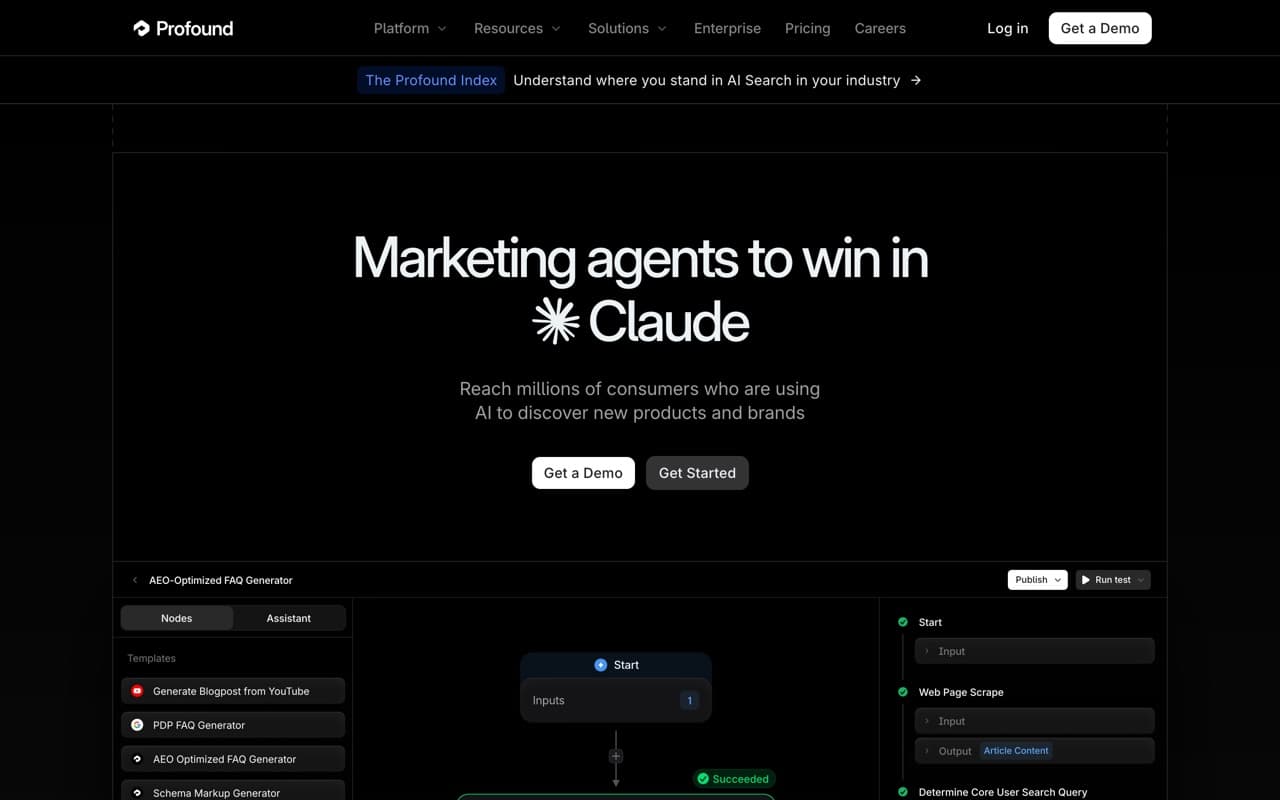
Profound is the enterprise standard and carries the deepest analytics in the category, backed by $155M in funding. For a large brand tracking many competitors across many markets, its depth of analysis across many prompts and competitors is the deepest in the category, and it puts competitors in a clear side-by-side view. The trade-offs are access and price: it publishes no price, so after a free trial you are buying on custom Enterprise terms, with no self-serve checkout and no free check to test a competitor question before you commit. It suits teams with a budget and a procurement process rather than an operator who wants an answer this afternoon.
The specialist benchmarking tools: AthenaHQ, Peec AI and Scrunch AI
These three treat competitor benchmarking as the main event rather than a side panel. AthenaHQ is built around GEO workflows for teams, with strong competitor tracking and gap surfacing, from $295/mo, and it offers a free 10-minute audit so you can pull a first competitive read without a sales call. Peec AI targets the mid-market and is the pick when your rivals rank in more than one language, with multilingual competitor tracking from $95/mo and a trial.
Scrunch AI is AEO-focused and organises its analysis around the questions buyers ask and who wins them, on custom pricing, which fits a team that wants a bespoke setup rather than a fixed plan. All three give you the named-competitor view; they differ mainly in language coverage, workflow depth and how you buy.
The all-in-one suites: Ahrefs Brand Radar, Otterly AI, SE Ranking and Semrush
If your rivals are already in an SEO tool you pay for, the cheapest way to add competitor benchmarking is often the suite you use. Ahrefs Brand Radar reports AI share of voice and mentions inside Ahrefs, so you can compare your reach against competitors next to your backlink and keyword data on your existing plan. Semrush AI Visibility is an add-on to the Semrush suite with a free checker to start, useful because Semrush also publishes the citation research behind much of this post.
SE Ranking folds AI visibility into an affordable SEO suite from $129/mo with a no-card trial, though its competitor depth is the most basic here and better as a supplement than a primary lens. Otterly AI is the cheapest dedicated option at $29/mo with a free trial, a Gartner Cool Vendor rated 4.9 on G2, and it covers ChatGPT, Perplexity, AI Overviews, Gemini and Copilot, which makes it a strong entry point for a small team that wants competitor tracking without a suite commitment.
Turn the gaps into a plan of attack
The point of competitor analysis is not the dashboard, it is the move it triggers. Pick the ten questions your best buyers actually ask, run them daily across the four models, and for every answer note the brand that appears instead of you and the source cited for them. Because third-party mentions and video correlate with AI visibility more than on-page work (Ahrefs), the pattern usually points at a Reddit thread, a review roundup or a comparison page you can go and earn a place in. Start with the free AI visibility check to see who is currently winning your category's answers, then decide where to close the gap first.