
A buyer asks ChatGPT which tool to trust, or types your company name into Perplexity to see what comes back, and the answer names you and then quietly undercuts you: powerful but clunky, capable but overpriced, fine unless you happen to need the one thing you are worst at. Nobody at your company wrote those words. They were lifted from a review page or, more often than not, a community thread, because Reddit alone is the single most-cited source in AI answers at 40.1% of all citations (Semrush). That is the awkward shape of reputation in the age of answer engines: the sentence a prospect reads about you was very likely typed by a stranger, and the tools in this guide exist because you cannot manage what you cannot see.
So here is the verdict this guide defends before it ranks anything. An AI reputation management tool (software that watches how AI engines describe your brand and helps you do something about it, the answer-engine descendant of old-fashioned online reputation management) earns its price only if it closes a loop: catch a damaging answer early, trace the tone back to the off-site page that set it, and prove the fix landed on the next scan. Most tools stop at the first step and hand you a mood ring. The ones worth paying for get you to the third. For most founders the honest path is a free check to see the damage, then a low-cost monitor that exposes its sources and re-scans on a schedule; the deepest analytics belong to Profound and are priced to match; agencies and enterprises weigh different things, and we say who should buy what by the end.
Why an AI reputation is not yours to write
40.1%
of all AI citations point to Reddit
The single likeliest place your reputation is being written. Semrush.
62%
of AI citations never name the brand
The answer is built from pages that discuss you without crediting you. Semrush.
~60% to ~10%
Reddit's ChatGPT citation share, inside one fortnight
The sources behind your reputation reshuffle in weeks, late 2025. Semrush.
Why a mention counter is not a reputation tool
It is tempting to equate a mention with a good reputation and move on, but the two come apart constantly. Being named is visibility; the adjective that follows your name is reputation, and an engine can put you in nine answers out of ten while framing you as the weaker choice in every one. The reason you cannot simply edit your way out of it is that the opinion is not formed on your website: Ahrefs' analysis of what correlates with AI visibility found the strongest relationship with third-party mentions and video rather than with anything you publish yourself, and Semrush found that 62% of AI citations never name the brand at all, so a page can colour an answer about you without ever crediting you. A reputation tool, then, is not a search box that tells you whether you appear. It is an instrument for finding whose words the engine is putting in its mouth. If you are still at the stage of measuring tone rather than shopping for software, our method for tracking AI model sentiment and the wider roundup of AI sentiment tracking platforms cover the measurement discipline this guide assumes.
The three jobs a reputation tool has to do
Strip away the dashboards and every tool here is judged on three jobs, and most buying decisions go wrong by scoring the first and ignoring the other two.
| Reputation job | What it means | Where the difficulty sits |
|---|---|---|
| Catch a damaging answer | Notice a tone turn before your buyers do | The same question changes its answer roughly 70% of the time (SparkToro), so a single check misses it |
| Trace it to the source | Find the off-site page that set the tone | Perplexity and Claude show their citations; ChatGPT and Gemini often hide theirs (Semrush) |
| Prove the fix landed | Confirm the tone actually moved after you act | Sources reshuffle fast; Reddit's ChatGPT-citation share fell from about 60% to about 10% in a fortnight, late 2025 (Semrush) |
Read down that middle column, because it is the one that separates a reputation tool from a novelty. Catching a bad answer is table stakes and every tool here does it; tracing that answer to the page that caused it is where the engines, not the tools, set the ceiling, since a tool can only show you the sources the engine chose to reveal; and proving a fix worked is the step almost nobody designs for, even though it is the only one that tells you whether the money you spent earning a better Reddit thread changed the answer at all.
One more piece of context decides how much of this you will even be able to fix, and that is how heavily each engine leans on community voices in the first place.
Community citation share
Community citation share by AI engine
Perplexity draws close to a fifth of its citations from community and social sources, several times what ChatGPT, Claude or Gemini pull, and that cuts both ways: it is the engine where an angry Reddit thread does the most damage, and, because it also shows its sources, the one that hands you the exact link to go and address. The reputation you can fix fastest is the one on the engine that shows its working.
The seven best AI reputation management tools
With the criteria set, here is how the field looks in 2026, priced from the vendors' own pages and positioned by what each one is genuinely best at. Honeyb is our own tool and sits first because this is our list; read its caveat as carefully as anyone else's.
| Tool | Entry price | What it is | Best for |
|---|---|---|---|
| Honeyb (our tool) | Free check, then from $29/mo | A dedicated AI visibility monitor with a free instant check and daily scans | Founders who want to catch, trace and re-check on a budget |
| Profound | About $399/mo, demo-only | The deepest analytics of the set, with API access and white-label output, valued around $155m | Enterprises and agencies needing depth and portability |
| AthenaHQ | About $295/mo, free 10-minute audit | A monitoring platform you can trial without a sales call | Teams wanting a fast read before they commit |
| Peec | About $89/mo | A mid-priced European monitor built around competitor sets | Small teams tracking a defined rivalry |
| Otterly | $29/mo | One of the cheapest paid monitors across the main engines | The lowest-cost way to start watching tone |
| SE Ranking | AI module about $55/mo | An AI-visibility module inside an established SEO suite | Teams already working in SE Ranking |
| Semrush AI Visibility | Add-on to a Semrush plan, with a free checker | An AI-answer view bolted onto a suite many teams already pay for | Existing Semrush users adding an AI lens |
Honeyb: the cheapest way to close the loop
Honeyb, our tool, is built around the three jobs above rather than a wall of charts: a free instant check so you can see today's answers before paying anything, daily scans so a tone change surfaces in days rather than at the next manual audit, and the cited sources laid out so you can go and fix the page that set the mood. The honest caveat is that it is a focused monitor, not an enterprise analytics suite; if you need bespoke dashboards, dozens of seats and procurement-grade controls, the depth lives further down this list. For a founder or a lean marketing team who wants to catch, trace and re-check without a five-figure contract, it is the tool we would point you to, and you can run the free AI visibility check in the time it takes to read the next entry.

Want to get recommended by AI?
Check your AI search visibility, then let the Honeyb agent write, fix, and earn what gets you recommended. Free to start.
Profound: the deepest analytics, if you can clear the gate
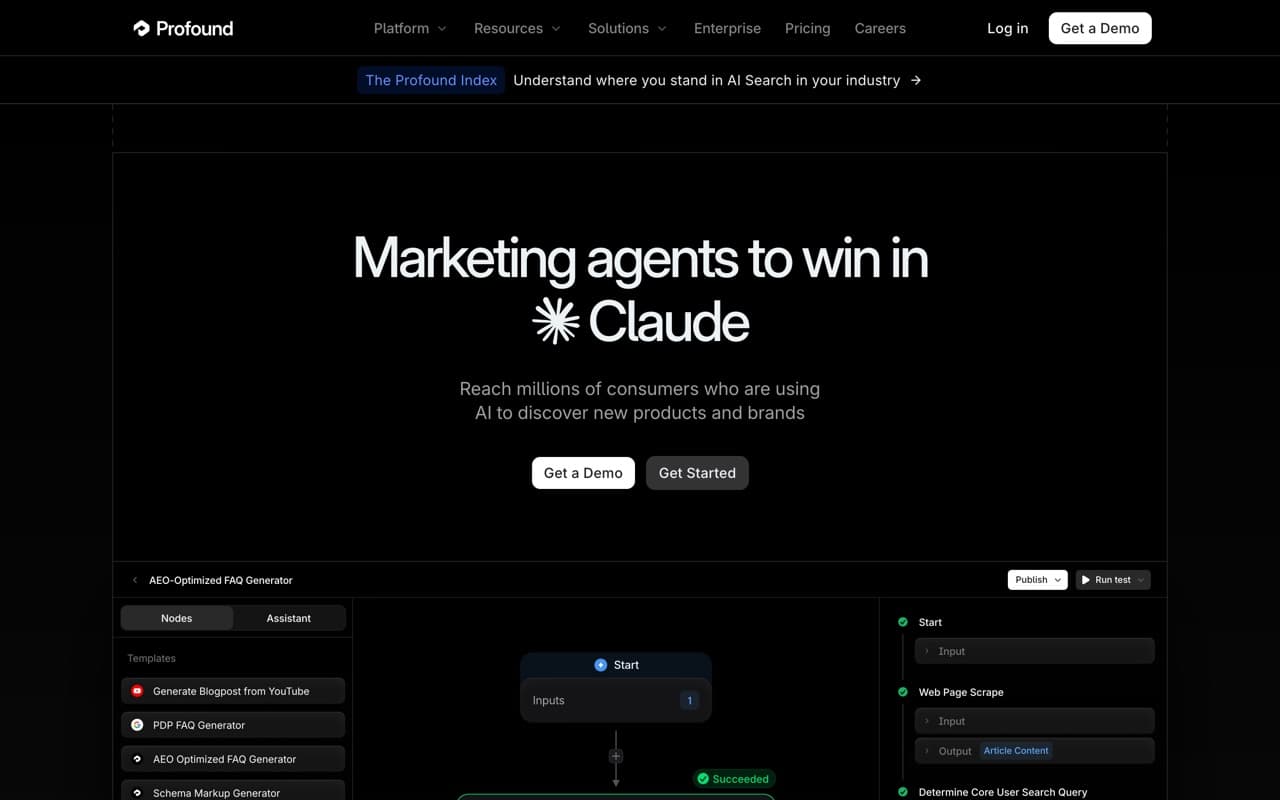
Profound is the most powerful platform in this roundup and does not pretend otherwise. Its analytics run deeper than anything else here, it offers API access and white-label output that let an agency or enterprise fold the data into their own reporting, and its roughly $155m valuation buys a team that keeps the product ahead of the pack. All of that arrives behind a demo call and a price around $399 a month, so it is emphatically not a swipe-a-card purchase, and for a solo founder it is more tool than the problem needs. Where it earns the ticket is inside organisations that must both trace reputation across every engine and carry the numbers into board decks and client reports, a case we weigh in full in our comparison of Honeyb and Profound.
AthenaHQ: a fast audit before you commit
AthenaHQ's most useful feature for a reputation buyer is the one that costs nothing: a free ten-minute audit that shows you where you stand before any contract, which is exactly the read you want when you suspect a problem but cannot yet prove it. Beyond the audit it is a capable monitoring platform at around $295 a month, with sentiment squarely in view. The caveat is that the entry price sits at the upper end of this list, so it suits teams who have already decided reputation is a line item worth funding rather than those still testing the water, for whom the free audit alone may be the whole of the first month's work.
Peec: a mid-priced monitor for a defined rivalry
Peec, built in Berlin, sits in the sensible middle of the market at about $89 a month, and its strength is competitive framing: it is designed around watching how you fare against a named set of rivals rather than in the abstract, which is precisely the lens a reputation problem usually arrives in, because reputations are relative and an answer that praises your competitor is doing you quiet harm even when it never mentions you. The caveat is scope: a tightly drawn competitor set is a feature when you know who you are fighting and a limitation when your reputation is being shaped by voices you never thought to add to the list.
Otterly: the lowest-cost way to start watching
Otterly matches the cheapest paid tier here at $29 a month and earns its place by removing the excuse not to start: for the price of a couple of coffees you get scheduled monitoring across the main engines, which beats the spreadsheet-and-good-intentions approach most teams default to. It is lighter on analytics than the pricier entries, so treat it as the tool that gets you watching rather than the one that runs a deep forensic investigation, and for many small brands watching is the ninety per cent of the problem they were not doing at all.
SE Ranking: reputation inside the SEO suite you already run
SE Ranking bolts an AI-visibility module, priced around $55 a month, onto a mature and well-regarded SEO platform, and that is exactly its appeal: if your team already lives in SE Ranking for keywords and rank tracking, adding an AI-answer view avoids yet another login and another invoice. The trade is focus. It is an SEO suite that also watches AI answers rather than a tool built solely for the reputation job, so its source-tracing is narrower than the dedicated monitors, which is a fair price to pay for consolidation when AI reputation is one concern among many rather than the main event.
Semrush AI Visibility: an AI lens for a suite many already pay for
Semrush AI Visibility is an add-on to a Semrush subscription, with a free checker anyone can try, and its logic mirrors SE Ranking's: for the large number of marketing teams already paying for Semrush, an AI-answer view is a small addition rather than a new relationship. The strength is reach into an existing workflow and a well-resourced data operation behind it. The caveat, again, is that a bolt-on to a broad suite optimises for coverage across many jobs rather than the forensic source-tracing a dedicated reputation tool is built for, so heavy Semrush users will get far more from it than teams signing up for the suite solely to watch their AI reputation.
Also at the door: Ahrefs Brand Radar and Scrunch
Two more names belong in the conversation without quite earning a numbered slot for the reputation job specifically. Ahrefs Brand Radar rides on Ahrefs' existing plans and is a strong fit for teams already using Ahrefs for links and content, and Scrunch is a custom-quoted platform aimed at larger generative-engine-optimisation programmes. Both are credible, and both make more sense as part of a wider toolkit than as a first, focused reputation monitor, which is why they sit here rather than in the ranked seven.
Which one should you actually buy
So, verdicts, because a list without them is just a menu. If you are a founder or a small team who suspects AI is quietly talking you down and wants to confirm it today, start with a free check and, if the answers warrant paying, a low-cost monitor that shows its sources and re-scans on a schedule; that is the loop, and it does not require a big budget. If you are an agency or an enterprise that must trace reputation across every engine and carry the numbers into someone else's reporting, Profound's depth and portability justify its gate, while the suite add-ons make sense chiefly where you already pay for the suite. The one choice that never pays off is the tool you buy for its dashboard and never wire into a decision, because a reputation you measure and do not act on is just a more expensive way to worry. The fastest way to find out which camp you are in is to run the free AI visibility checker against your own category and read the answers it pulls back, and if it turns out you are missing rather than mischaracterised, our guide on why your brand isn't showing up in ChatGPT is the better place to start.