

LLM Pulse's cheapest paid plan is $60 a month for 50 prompts tracked across five AI engines, refreshed once a week. Honeyb, our product, starts at $29 a month for 10 prompts scanned every day on one engine of your choice, and reaches all eight of its engines at $199. The two tools are built on opposite bets. LLM Pulse hands you breadth at the entry price, the same five engines on every plan, and updates the numbers weekly. Honeyb meters how many engines you track but scans whichever ones you pick every day. Which bet suits you depends on how many engines your buyers actually use, and how often you need the reading to move. Every figure below comes from both vendors' public pricing pages on 3 August 2026, with the arithmetic shown rather than inferred.
LLM Pulse earns the comparison. In Honeyb's own first-party citation data, llmpulse.ai was cited 309 times across 31 URLs by AI engines answering questions in our category, which is the sort of footprint that makes buyers run into a tool and then ask what else does the same job. The product describes itself as a way to "grow your brand across AI search", tracking brand visibility, citations, sentiment and the traffic AI sends to a site. On the axes that matter to a buyer, here is how the two line up.
Honeyb vs LLM Pulse at a glance
| Spec | Honeyb (ours) | LLM Pulse |
|---|---|---|
| Entry paid price | $29/mo (The Minimum), $23 on annual | $60/mo (Starter), about $50 billed annually |
| Free entry point | Free AI visibility check, no account | 14-day trial, credit card required; no free plan |
| Prompts at entry paid tier | 10, scanned daily | 50, refreshed weekly |
| Engines at entry paid tier | 1 of 8, your choice | 5 fixed: ChatGPT, Perplexity, Gemini, Google AI Mode, Google AI Overviews |
| Refresh cadence | Daily on every paid tier | Weekly on every tier |
| Cheapest path to Claude | $29 (selectable model) | Enterprise, custom price |
| Price for eight or more engines | $199 (Full Spectrum, all 8) | Enterprise, custom (10+ models) |
| Seats | 1 at $29, unlimited from $79 | Unlimited team members on every plan |
| Trial | 3 days on the $79 and $199 tiers | 14 days, card required |
| Content output | 10, 30 or 80 articles a month, published to your CMS | 3, 5 or 15 GEO Writer tasks across Starter, Growth, Scale |
| API | Enterprise | From Scale ($361) |
| White-label and SSO | Enterprise | Enterprise |
Where LLM Pulse's page does not state something, the table says so rather than guessing. Its prices are set in euros (the header reads "Plans from EUR 49/month") and the plan cards default to a US-dollar conversion, which is the figure we have quoted throughout; a buyer paying in another currency should read the price in their own. None of the "Enterprise, custom" cells mean a capability is missing, only that it is not on a published price a buyer can check without a sales call.
The real difference is how often the number moves
Refresh cadence sounds like a footnote and is closer to the whole point. Both tools ask an AI engine the same buyer questions on a schedule and record what it says; the schedule decides how much you can trust any single reading. LLM Pulse refreshes weekly on every tier. Honeyb scans daily on every paid tier. That gap matters because AI answers are unstable in a way that on-page rankings are not.
SparkToro found the same AI query changes its answer roughly 70% of the time, and that two identical queries return the same list of recommended brands less than once in a hundred attempts. Honeyb's own measurement on 13 July 2026, running 20 buyer prompts three times each through four engine APIs, found the single top-picked brand changed between back-to-back identical runs 44% of the time on Gemini and 28% on Claude.
Top-pick change rate
How often the top recommendation changes between identical runs
Read against that volatility, a weekly refresh means one unlucky run sets your reading for seven days, and a genuine change can sit unseen for almost a week before it shows up. A daily scan gives you roughly seven times as many data points a month to average the noise out of. Neither cadence makes the underlying answer any more stable; the faster one just gives you more shots at seeing the true picture. The method for turning noisy runs into a defensible number is in how to measure AI share of voice.
What each plan actually buys
Both vendors price on how many questions they track, so the honest common unit is responses a month: prompts multiplied by engines multiplied by how often each is refreshed. LLM Pulse publishes its prompt counts as "50 AI responses per week, per model", so a monthly figure means multiplying by the roughly 4.33 weeks in a month. Honeyb scans daily, so its multiplier is 30. Laying both out on the same unit shows where the money goes.
| Plan | Price | Prompts | Engines | Refresh | Responses a month (approx) |
|---|---|---|---|---|---|
| Honeyb, The Minimum | $29 | 10 | 1 of choice | Daily | 300 (10 x 1 x 30) |
| Honeyb, Multi-Model | $79 | 50 | 3 of choice | Daily | 4,500 (50 x 3 x 30) |
| Honeyb, Full Spectrum | $199 | 100 | 8 | Daily | 24,000 (100 x 8 x 30) |
| LLM Pulse, Starter | $60 | 50 | 5 fixed | Weekly | ~1,080 (50 x 5 x ~4.33 wks) |
| LLM Pulse, Growth | $120 | 150 | 5 fixed | Weekly | ~3,250 (150 x 5 x ~4.33 wks) |
| LLM Pulse, Scale | $361 | 450 | 5 fixed | Weekly | ~9,750 (450 x 5 x ~4.33 wks) |
Two things fall out of the table, and they cut in different directions. On raw volume the daily cadence pulls hard for Honeyb: its $79 Multi-Model tier turns 50 prompts into 4,500 responses a month, more than LLM Pulse's $120 Growth tier manages on weekly refresh, and Full Spectrum's 24,000 at $199 is more than double LLM Pulse Scale's roughly 9,750 at $361. On breadth-per-dollar the entry price pulls for LLM Pulse: $60 gets all five of the mainstream engines at once, where matching that on Honeyb means either the $79 tier (three engines) or the $199 tier for the full set. Neither is better in the abstract; one sells depth of sampling, the other sells engine coverage up front. The wider price field sits in our AI visibility software pricing breakdown.









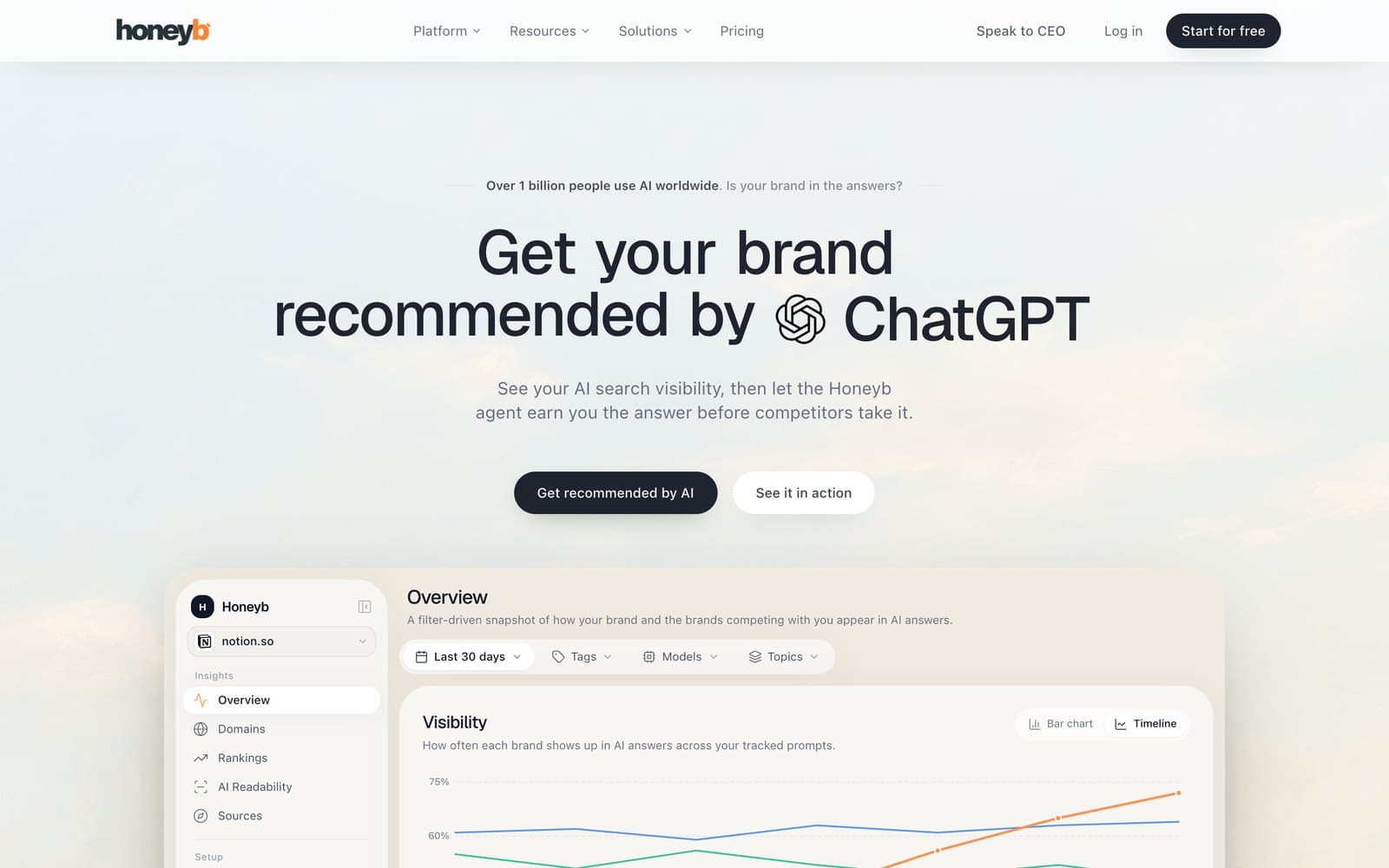
Want to get recommended by AI?
Check your AI search visibility, then let the Honeyb agent write, fix, and earn what gets you recommended. Free to start.
Engine coverage, engine by engine
LLM Pulse includes the same five engines on every paid plan and puts everything else, Claude, Copilot, Grok, DeepSeek, Meta AI and the rest of its 10-plus roster, behind a custom-priced Enterprise tier. Honeyb meters how many engines you track rather than which ones, so any single engine is reachable on the $29 plan as your chosen model. The practical effect is clearest when you ask what each engine costs to reach.
| Engine | Cheapest Honeyb tier that can include it | Cheapest LLM Pulse tier that includes it |
|---|---|---|
| ChatGPT | $29 | $60, Starter |
| Perplexity | $29 | $60, Starter |
| Gemini | $29 | $60, Starter |
| Google AI Mode | $29 | $60, Starter |
| Google AI Overviews | $29 | $60, Starter |
| Copilot | $29 | Enterprise, custom |
| Grok | $29 | Enterprise, custom |
| Claude | $29 | Enterprise, custom |
| DeepSeek | Not offered | Enterprise, custom |
Claude is the sharpest example. A buyer whose audience leans on Claude can select it on Honeyb's $29 plan, but on LLM Pulse it sits behind Enterprise, so there is no published price to reach it. Going the other way, DeepSeek is on LLM Pulse's roster and Honeyb does not track it at all, and LLM Pulse's five-engine entry plan is genuinely broader than Honeyb's single-engine $29 tier for the mainstream set. Read the table against your own buyers rather than as a scoreboard; if you are still drawing up a shortlist, our AI visibility tracker comparison covers the wider field.
Both tools also generate content
Neither product stops at measurement. LLM Pulse bundles what it calls GEO Writer tasks, GEO being generative engine optimisation, or the work of getting named inside an AI answer rather than a list of links: 3 tasks a month on Starter, 5 on Growth and 15 on Scale, alongside recommendations drawn from your visibility data. Honeyb's Content Agent researches article ideas from your own tracking data, drafts them and publishes them straight to WordPress, Ghost, Shopify, Webflow, Wix or a custom endpoint, at 10, 30 and 80 articles a month across its three tiers.
| Capability | Honeyb (ours) | LLM Pulse |
|---|---|---|
| Content units at the entry paid tier | 10 articles a month ($29) | 3 GEO Writer tasks ($60) |
| Content units at the top published tier | 80 articles a month ($199) | 15 GEO Writer tasks ($361) |
| Publishes directly to a CMS | Yes: WordPress, Ghost, Shopify, Webflow, Wix, custom endpoint | Not stated on its pricing page |
| Sentiment analysis | Included | Growth and up |
| AI traffic analytics | Included | Growth and up |
Whether either output is worth having depends on what actually moves an AI answer. Ahrefs found AI visibility correlates most strongly with third-party mentions and video rather than on-page work, and Semrush puts Reddit at 40.1% of all AI citations, the single most-cited source. Both vendors' content features aim at the on-page half of that, which is the easier half to influence and the smaller lever. The honest caveat sits on top: Semrush found 62% of AI citations never name the brand behind them, so more published pages is not the same as more recommendations, and each has to be measured on its own.
Which one fits your team
Three questions settle it. First, which engines your buyers use: if Claude, Copilot or Grok is on that list, Honeyb reaches them from $29 while LLM Pulse puts them behind Enterprise, whereas if you only need the five mainstream engines, LLM Pulse's $60 Starter covers all five at once. Second, how much you trust a weekly number: if you are making decisions off the data, the daily cadence and higher response volume favour Honeyb, and if a weekly trend line is enough, LLM Pulse's entry breadth is cheaper. Third, seats, since LLM Pulse gives unlimited team members on every plan while Honeyb keeps its $29 tier to a single seat and opens up from $79. We ran the same spec exercise against two other tools in Honeyb vs Siftly and Honeyb vs Dageno, and the full category sits in best AI brand monitoring tools.
Before committing to either subscription, get the baseline for free. Run a free AI visibility check and see which engines already name your brand and which ones do not.