Ahrefs, the SEO platform that runs one of the largest web indices in the market, spent six months analysing how AI search engines source, cite, and rank content. The output covered roughly 1 billion data points across 14 separate studies. Tim Soulo, the company's CMO, published the 10 headline findings on X in late May, with the underlying research available on the Ahrefs blog and a separate ChatGPT vs Google citation overlap study.
The findings are unusually rich because the sample size is large enough to draw real conclusions, the methodology is publicly documented, and the authors stand behind the data publicly. Several of the findings reinforce what brand teams running AI visibility programmes have been seeing anecdotally. Two of them are genuinely surprising and change how the work should be prioritised. One contradicts conventional wisdom (including some of what's been written on this blog), and the right response is to update the playbook rather than defend the older take.
AI search is moving fast enough that any single study is a snapshot, not a verdict, which is the broader point underneath the schema finding below.
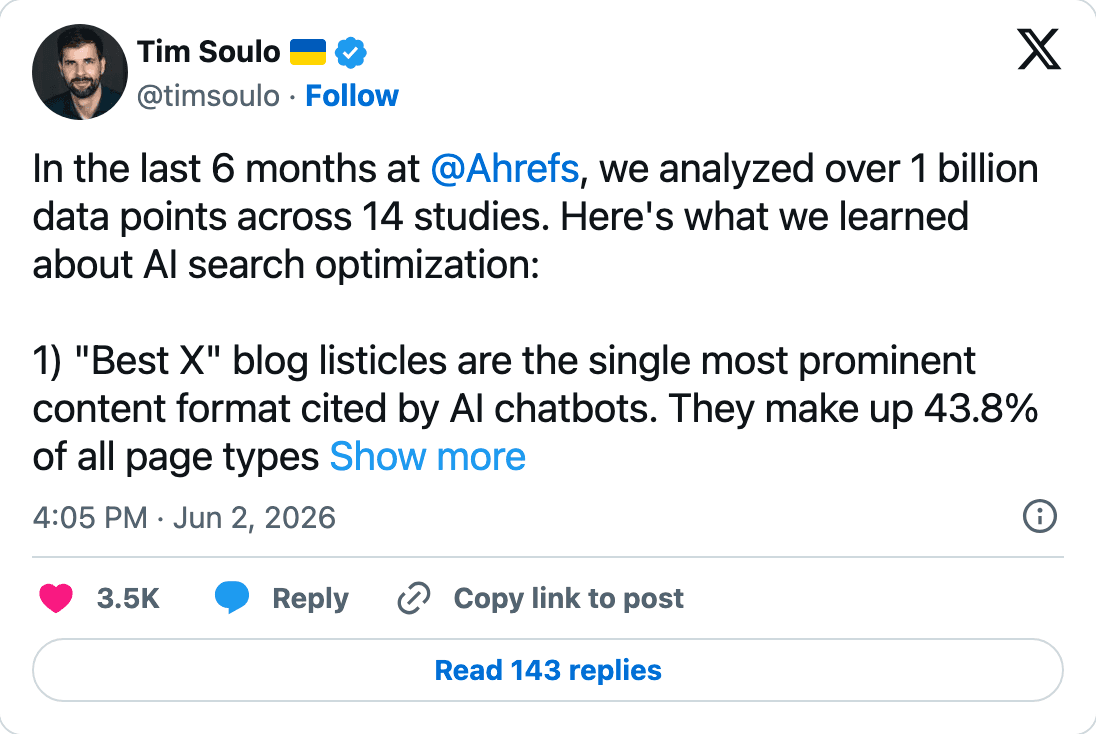
The headline came straight from the source. Ahrefs' chief marketing officer, Tim Soulo, summarised the study on X when it published, leading with the finding that surprised most people: “Best X” listicles are the single most-cited content format in AI answers.
The 10 findings at a glance
| # | Finding | Headline stat | What it changes for brand teams |
|---|---|---|---|
| 1 | 'Best X' listicles dominate citations | 43.8% of ChatGPT-cited pages | Editor outreach to category roundups is the highest-ROI placement |
| 2 | Two thirds of citations are off-limits to marketers | 67% from Wikipedia, homepages, app stores | Concentrate effort on the 32.3% influenceable surface |
| 3 | Most AI-cited pages don't rank on Google | 28.3% have zero Google traffic | AI visibility must be measured directly, not inferred from rankings |
| 4 | Retrieved is not the same as cited | ChatGPT cites ~50% of what it fetches | Background-context influence matters as much as visible citations |
| 5 | Broad schema markup didn't move citations | -4.6% to +2.4% across surfaces | Schema still matters for specific surfaces; the broad lift claim is overstated |
| 6 | YouTube has the strongest correlation with AI brand visibility | 0.737 correlation | Add a YouTube creator outreach track to your AI visibility programme |
| 7 | AI Overviews collapse clicks on the #1 result | -58% clicks (up from -34.5% in 10 months) | Optimise for citation inside AI Overviews, not just ranking above them |
| 8 | AI Overviews concentrate on informational queries | 99.9% informational, 3.2% shopping | Run citation strategy for top-of-funnel, click strategy for bottom-of-funnel |
| 9 | AI Mode and AI Overviews cite different sources | 86% same conclusion, 13.7% citation overlap | Measure and optimise both surfaces separately |
| 10 | AI Overviews are highly volatile | Changes every 2.15 days, 70% chance of change between observations | Daily monitoring is the minimum cadence for stable trend data |
Finding 1: 'Best X' listicles are the single most cited content format
The stat: 'Best X' blog listicles make up 43.8% of all page types cited by ChatGPT specifically.
What it means: when ChatGPT generates a recommendation answer for a buyer-stage query, the source it pulls from is overwhelmingly a 'best of' listicle. This is consistent with what brand teams have been observing for two years now. Inclusion in category-defining roundups (G2's best-of lists, Forbes Advisor roundups, niche publisher 'best 10' articles) is the single highest-leverage placement for getting cited.
For brand teams: outreach to the editors writing 'best of' roundups in your category is one of the highest-ROI activities in AI visibility work. Building your own 'best X' content (your own roundups, your own comparison pages) also captures citations directly.
Finding 2: 67% of ChatGPT's top citations are off-limits to marketers
The stat: 67% of ChatGPT's top 1,000 citations come from sources marketers can't influence: Wikipedia (29.7%), homepages (23.8%), app stores (6.6%). Only 32.3% are influenceable content like educational pages, reviews, news, and blog posts.
What it means: the meaningful surface for AI visibility work is a third of what shows up. The other two thirds is structural infrastructure (Wikipedia, official homepages, app stores) that brand teams either already have or genuinely can't move via marketing tactics.
For brand teams: this is actually freeing rather than discouraging. The actionable surface is smaller, which means the work should be concentrated. Inside the 32.3% influenceable share, the priorities order cleanly: review platforms (G2, Trustpilot, Capterra) first, editorial roundups second, news coverage third, owned blog content fourth. Trying to optimise across all four simultaneously is less effective than running them in sequence with concentrated effort on whichever one your brand is weakest on first.
Finding 3: 28.3% of ChatGPT's most-cited pages have zero Google organic visibility
The stat: 28.3% of the pages ChatGPT cites most frequently have zero traditional organic traffic from Google. They get cited repeatedly by ChatGPT despite not ranking in Google search at all.
What it means: AI search is structurally a separate discovery layer from Google search. The pages winning AI citations are partly the same pages winning Google rankings, but not entirely. Roughly three in ten cited pages are invisible to Google ranking metrics and yet do significant AI-visibility work for their brands.
For brand teams: this validates the case that AI visibility needs to be measured directly, not inferred from Google rankings. A brand that's invisible on Google for a category-defining keyword can still be cited heavily by ChatGPT for the same query if their content fits the AI engine's citation preference. Measurement tooling that only tracks Google rankings (Ahrefs Rank Tracker, SEMrush Position Tracking, Sistrix Visibility Index) misses about a third of what's actually happening on the AI-citation surface. AI-specific monitoring is the only way to see it.
Finding 4: ChatGPT cites only about 50% of the URLs it retrieves
The stat: ChatGPT fetches dozens of pages per query but only cites about half of them. The other half are used as background context without attribution.
What it means: being retrieved and being cited are different things. A page can be read and used by the model to shape its answer without ever appearing in the visible citation list. This has two implications. First, the visible citation list understates the actual influence of the broader source pool. Second, a brand's content can be influencing AI answers without showing up in any analytics dashboard that only tracks visible citations.
For brand teams: don't optimise solely for the visible citation surface. The work to make your content extractable, citable, and factually clean pays off even when the model uses it as background context rather than a named citation, because background context shapes how the model describes your category and your brand.
Finding 5: Schema markup had zero meaningful impact on AI citations
The stat: across the Ahrefs experiments, AI Overviews dipped 4.6%, AI Mode rose 2.4%, and ChatGPT rose 2.2% after schema markup was added. All three movements are indistinguishable from zero against the baseline noise.
What it means: the simple causal claim 'add schema markup, get more AI citations' does not hold up to controlled testing. Adding schema didn't move the citation needle in either direction.
Why this is a good example of needing continuous measurement, not one-time setup: an earlier post on this blog argued that schema markup helps with AI visibility. The Ahrefs run shows the broad-citation claim doesn't hold across their sample. Both takes can be defensible at different points in time, and both will shift again as the engines retrain. Anyone making a 2026 call from a study run in early 2025 is already working from stale data.
The targeted impacts still hold: Product, Offer, and AggregateRating schema is what feeds ChatGPT Shopping product cards correctly, FAQ schema is still used for direct-answer extraction, and Organization schema shapes Knowledge Panel content (which influences how AI describes your brand at the entity level). The broad 'schema = more AI citations' claim is the part that doesn't survive the Ahrefs data, and the schema markup post should be read with that correction in mind.
The general principle: when a finding contradicts something you previously believed about AI search, the answer is to update the belief and keep monitoring, not to pick a side. The engines change their citation behaviour faster than any one study can capture.
For brand teams: prioritise schema for the specific surface it serves (Product schema for shopping, FAQ for question queries, Organization for brand entity work). Don't expect a broad citation lift from adding it across the site.
Finding 6: YouTube mentions have the highest correlation (0.737) with AI brand visibility
The stat: YouTube brand mentions had a 0.737 correlation with AI brand visibility, higher than backlinks, page count, Domain Rating, or any other conventional SEO metric Ahrefs tested. The pattern held across both Google-owned and OpenAI products.
What it means: this is the most actionable single finding in the entire study. YouTube is dramatically underweighted in most brand teams' AI visibility work, but it produces the strongest correlated signal across the engines. The reason is structural: YouTube transcripts are heavily ingested into AI training corpora, YouTube comments serve as a form of multi-voice corroboration that AI models trust, and YouTube creators talking about a brand on video produce a citable signal at the entity level rather than a single-page level.

Want to get recommended by AI?
Check your AI search visibility, then let the Honeyb agent write, fix, and earn what gets you recommended. Free to start.
For brand teams: if your AI visibility programme doesn't have a YouTube creator outreach component, this is probably the highest-leverage addition you can make in 2026. Identify the YouTube creators in your category, build relationships, get your product into their hands, and aim for substantive on-screen mentions. The video doesn't have to be a paid placement; an organic mention in a review or category overview video tends to outperform sponsored content for AI citation impact.
Finding 7: AI Overviews reduce clicks to the #1 result by 58%
The stat: AI Overviews reduce clicks to the #1 organic result by 58%. This is up from 34.5% just ten months earlier. The trend is accelerating.
What it means: the click loss from AI Overviews has nearly doubled in under a year. The traffic that used to flow from Google's top organic position to brand sites is increasingly captured at the SERP itself by the AI summary. This is the single clearest piece of evidence that the click-driven SEO model is structurally compressing.
For brand teams: the click loss is permanent for the queries that trigger AI Overviews. The work shifts from 'get the click' to 'be cited inside the AI Overview itself'. A brand that ranks #1 organically and is not cited in the AI Overview now captures 42% of what they captured eighteen months ago for the same query. Measuring AI Overview citation share is now as consequential as measuring traditional ranking.
Finding 8: 99.9% of AI Overviews appear on informational queries
The stat: 99.9% of AI Overviews appear on informational intent queries. Transactional, navigational, and local searches are almost entirely AI-Overview-free. Shopping triggers AI Overviews just 3.2% of the time.
What it means: the click loss from finding 7 is concentrated on informational queries. Transactional traffic ('buy X', '[brand] login', 'pricing'), navigational traffic (brand name searches), and local traffic (near-me queries) are still flowing through to brand sites at roughly the pre-AI rates.
For brand teams: this changes prioritisation. Informational top-of-funnel content has lost most of its click value but retained its citation value (you want to be cited inside the AI Overview, not click through to your page). Transactional and branded content has retained its click value and should still be optimised the old way. The hybrid posture (citation optimisation for top-of-funnel, click optimisation for bottom-of-funnel) is now the right default for most B2B and consumer brands.
Finding 9: AI Mode and AI Overviews reach the same conclusion 86% of the time but cite different sources
The stat: for a given search query, Google's AI Mode and AI Overviews reach the same conclusions 86% of the time but cite almost entirely different sources. Only 13.7% citation overlap.
What it means: even within Google's own AI surfaces, the citation layer is largely independent. The 86% conclusion-level agreement reflects a shared underlying judgement about what's true; the 13.7% citation overlap reflects two largely separate decisions about which sources to credit for that judgement. Both decisions affect brand visibility.
For brand teams: appearing in AI Overviews is not the same as appearing in AI Mode, even on the same query. The two surfaces need to be measured separately and the citation work needs to address both. Honeyb tracks AI Mode and AI Overviews as distinct engines for exactly this reason.
Finding 10: AI Overviews change every 2.15 days on average
The stat: AI Overviews change every 2.15 days on average, with a 70% chance of changing between consecutive observations. Semantic similarity stays at 0.95, meaning the conclusions barely move even as the words, sources, and entities constantly shuffle.
What it means: the meaning is stable, the visible composition is volatile. A brand that appears in an AI Overview today may not appear in the same AI Overview tomorrow, even though the AI is reaching essentially the same conclusion about the query. This is the strongest empirical evidence for the case that one-off AI visibility checks are unreliable.
For brand teams: monitoring AI Overview presence on a weekly cadence misses meaningful share-of-voice movement that happens every two days. Daily monitoring is the minimum cadence that produces stable trend data. The case for continuous monitoring is now empirical rather than just intuitive.
The two findings that change how to prioritise
Most of the ten findings reinforce the current AI visibility playbook. Two of them genuinely change how brand teams should be prioritising their work.
The first is finding 6 (YouTube has the highest correlation with AI brand visibility). This is the single largest underweighted opportunity in most brand teams' programmes. The work is unfamiliar to most SEO and content teams (creator outreach is closer to influencer marketing than to traditional SEO) but the data says it produces the strongest correlated signal. Brands that move first on YouTube creator relationships in their category will be visibly ahead on AI visibility metrics within two quarters.
The second is finding 3 (28.3% of ChatGPT's most-cited pages have zero Google traffic). This is the strongest empirical case yet that AI search is a structurally separate discovery layer. A brand whose AI visibility measurement infrastructure only tracks Google rankings (most SEO platforms in the market) is blind to roughly a third of the AI citation surface. The fix is not adding another SEO tool; it's adding a dedicated AI visibility platform that measures the AI surface directly.
How this maps to Honeyb's positioning
Honeyb is the dedicated AI visibility platform Ahrefs' research implies brands should be running alongside their SEO stack. Across the ten findings, the platform's existing capabilities map cleanly: daily monitoring across all eight major AI engines (which addresses finding 10's 2.15-day volatility), per-engine tracking that treats AI Mode and AI Overviews as distinct surfaces (finding 9), citation tracking across the full surface visible plus inferred (related to finding 4), and share-of-voice measurement for buyer-stage queries that are usually informational (finding 8).
Two things Honeyb's product roadmap addresses that the findings raise directly: YouTube mention monitoring (finding 6) and AI Overview citation share tracking (finding 7) are both surfaces we're adding visibility for in coming releases. Run a free check on one live engine, then the full report sets your baseline across the eight major engines.
A note on Ahrefs as both data source and market competitor: Ahrefs launched their own AI visibility checker in early 2026. The research findings stand on their own credibility; the tool comparison is a separate decision. The advantage of Ahrefs' tool is integration with the rest of their SEO platform. The advantage of dedicated AI visibility platforms (Honeyb, Profound, and others) is depth-of-feature on the AI surface specifically, with monitoring across more engines and sentiment classification as a first-class metric rather than an add-on.
What we're watching change next
Every finding in the Ahrefs study is true at the moment of measurement and provisional after that. The list below tracks the signals where we expect the strongest movement over the next two to three quarters, and where brand teams should be cautious about treating today's number as permanent.
| Signal | Where it stands now | Why it's likely to move |
|---|---|---|
| Schema markup impact on broad citations | Indistinguishable from zero (Ahrefs, 2026) | Engines are actively re-weighting structured data; surface-specific lift (Product, FAQ, Organization) likely to grow |
| Citation share by engine | ChatGPT dominant, Gemini regaining ground | AI Mode rollout and Copilot integration changing the share split monthly |
| YouTube correlation strength | 0.737, highest single signal | Other UGC platforms (Reddit, podcast transcripts) are being ingested at higher rates; the relative ranking may compress |
| Citation overlap between AI Mode and AI Overviews | 13.7% | Google is signalling unification of the two surfaces; overlap will likely climb |
| AI Overview volatility | 2.15-day average refresh | Stability typically rises as engines mature; expect the refresh interval to lengthen |
| Sentiment as a leading indicator | Emerging discipline, under-instrumented | Will become standard the same way ranking became standard for SEO once the metric was operationalised |
The reason continuous monitoring beats periodic audits is that the underlying numbers move fast enough that a quarterly snapshot is already stale by the time it lands in front of the board.
Closing
The Ahrefs research is the most rigorous public dataset on AI search behaviour available in 2026. Most of the findings reinforce work brand teams should already be doing. Two of them (YouTube creator outreach and the AI-vs-Google discovery layer split) are large enough to genuinely reorder priorities for the next two quarters. For the underlying research, the Ahrefs blog post on most-cited ChatGPT pages is the right starting point.
For ongoing measurement of your brand's AI citation surface, run a free AI visibility check for a first read, with the full report setting your baseline across the major engines, and see our board template for how to translate the data into executive conversations.