
AI Overviews are the AI-written summary Google places at the top of a standard results page. AI Mode is a separate, conversational search tab that users open deliberately and can question across multiple turns. That is the short answer to the AI Mode vs AI Overview question. The two surfaces share Google's index but assemble answers differently, so a brand can be visible in one and invisible in the other. They also demand different tracking questions, which is where most monitoring setups go wrong.
What AI Overviews are
AI Overviews sit inside the normal search experience. The user types a query as usual, and on a subset of queries Google generates a summary above the organic results, with source links attached. The user never asked for an AI answer. The surface is ambient: it appears, or it does not, based on Google's judgement of the query.
That conditional firing matters for brands. On queries where the Overview does not appear, classic rankings still carry the click. On queries where it does, the summary answers first and the organic listings move down the page. Your visibility depends on two separate events: the block firing at all, and your brand being cited inside it.
What AI Mode is
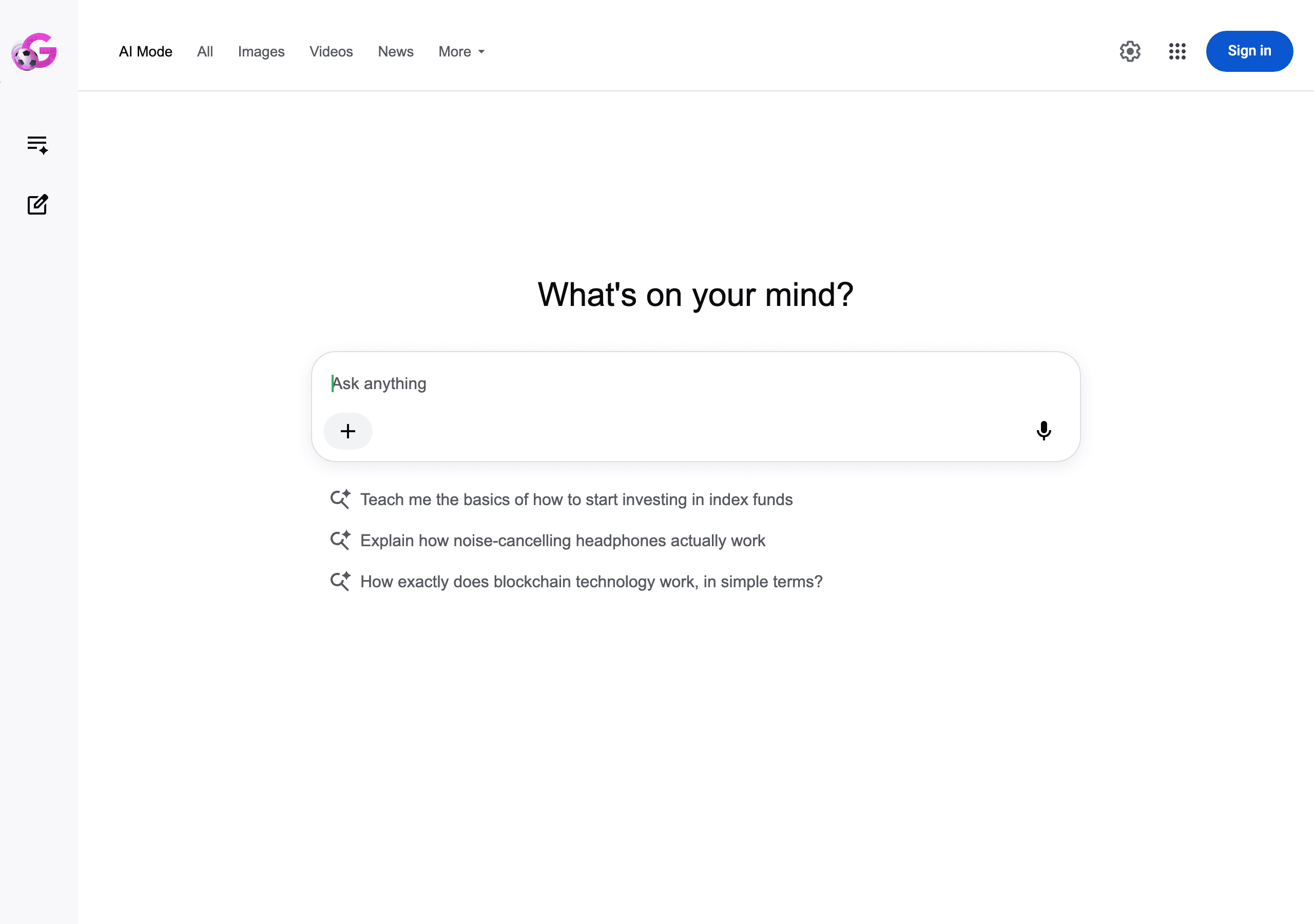
AI Mode is a dedicated tab within Google Search. The user chooses it, asks a question in natural language, and receives a full conversational answer with cited links. Follow-up questions keep context, so a buying decision can play out across several turns without a single traditional results page being shown. We cover the surface in more depth in our guide to what Google AI Mode is.
AI Mode vs AI Overview: the side-by-side
| Dimension | AI Overviews | AI Mode |
|---|---|---|
| Trigger | Fires automatically on a subset of queries | User opens the tab and asks |
| Placement | Summary block above organic results on the standard results page | Dedicated conversational interface, no traditional results page |
| Interaction | Read-only; the user scrolls past or clicks a source | Multi-turn; the user asks follow-ups in context |
| Citation display | Source links attached to the summary block | Links cited within the conversational answer |
| Opting out | No clean publisher opt-out; see how to turn off AI Overviews | No opt-out; users simply do not open the tab |
| Tracking question | Does the block fire on your queries, and are you cited when it does? See our AI Overviews tracker guide | Are you named and recommended within the conversation? |
The practical difference for a brand is structural. AI Overviews visibility is binary twice over: the block appears or it does not, and you are cited or you are not. AI Mode visibility behaves like every other answer engine, a synthesised recommendation set that shifts between sessions and rewards brands the model already associates with the category.
Why the tracking question differs for brands
Both surfaces pull from Google's index, but assembly differs, and so does measurement. For AI Overviews you track fire rate and citation share across a fixed query set. For AI Mode you track whether your brand gets named and recommended inside conversations, which means running the same buyer prompts repeatedly and watching the answer distribution, not a single snapshot. For the Overview half, an AI Overview API returns, for each query in the set, whether an Overview appeared, its full text and every source it cited.

Want to get recommended by AI?
Check your AI search visibility, then let the Honeyb agent write, fix, and earn what gets you recommended. Free to start.
Repetition is not optional, because answers move. In Honeyb's 13 July 2026 measurement (20 buyer prompts, three identical runs each, four engines via API, 240 answers), Gemini changed its top pick between identical runs 44% of the time, the highest of the four engines tested. SparkToro points the same way at larger scale, finding less than a 1-in-100 chance that two runs of the same prompt return the same list of brands.
Citation depth also varies sharply by engine, which affects how many chances your brand has to be sourced in any single answer. In the same measurement, ChatGPT averaged 15.0 sources per answer, Gemini 10.7, Claude 8.8 and Perplexity 8.3.
Sources per answer
Average sources cited per answer, by engine
| Item | Sources per answer |
|---|---|
| ChatGPT | 15 |
| Gemini | 10.7 |
| Claude | 8.8 |
| Perplexity | 8.3 |
One caveat on those figures. They come from API calls, where every engine returned sources on 100% of answers. Consumer interfaces often surface fewer links than the underlying model produces; Semrush notes that ChatGPT and Gemini often hide citations while Perplexity and Claude expose theirs. In our measurement, 74% of the URLs Gemini returned were wrapped in vertexaisearch grounding redirects, worth knowing before you build citation reports on raw Gemini output.
Tools that track Google's AI surfaces
| Tool | Entry price (US dollars, read 2 October 2026) | Google AI surfaces stated on pricing page |
|---|---|---|
| Honeyb (our product) | $29/mo Minimum (10 prompts daily, 1 model) | All 8 supported engines on Full Spectrum, $199/mo |
| LLM Pulse | About $59/mo Starter (50 prompts) | Google AI Mode and AI Overviews from Starter |
| Otterly | $29/mo Lite (15 prompts) | Google AI Overviews |
| Peec | $95/mo Starter (50 prompts) | AI Mode and AI Overviews on all tiers |
| Writesonic GEO | $99/mo Starter, $79 billed annually (50 prompts daily) | Google AI Overviews |
| Semrush | $199/mo SEO + AI Search Starter, $165.17 annual | AI visibility bundled; prompt counts not stated |
Two things stand out in that table. AI Overviews coverage is common because it extends existing rank-tracking infrastructure, while explicit AI Mode coverage is rarer and worth checking on the pricing page before you buy. And the surfaces are only part of the picture: if buyers in your category also ask ChatGPT, Claude or Perplexity, tracking Google alone leaves most of the answer landscape unmeasured.
The sensible first step costs nothing. Before deciding which Google surface deserves a paid tracker, find out whether AI engines mention your brand at all. Run a free AI visibility check and see where you stand across the engines your buyers actually use.