

If you have searched Google since May 2026, there is a good chance you have used AI Mode without choosing to. What began in 2025 as an opt-in experiment in Labs is now the default front door to Google Search. You type a question, you get a synthesised, conversational answer with a handful of cited sources, and you can keep asking follow-ups without leaving the page. For more and more people, that is now what Google looks like. This guide explains what Google AI Mode is in 2026, how it works under the bonnet, how it differs from the AI Overview you may already know, and the practical steps that make your pages eligible to be cited inside it.
The shift matters because the unit of visibility has changed. For a long time the goal was a high organic ranking. In an AI-first search experience, the page that ranks third can still be the page that gets named in the answer, and the page that ranks first can be skipped entirely if its content is harder to extract. Being retrievable is the entry ticket. Being clear, evidenced and trusted is what gets you quoted. The good news, set out below, is that Google has been unusually candid about the mechanics, and there are no secret AI-specific tricks to learn.
What is Google AI Mode?
Google AI Mode is the conversational, AI-generated search experience built into Google Search. Instead of returning a ranked list of links, it reads your question, gathers information from across the web and Google's live data, and writes a single synthesised answer with supporting links you can click through to. Crucially, it is conversational: you can ask follow-up questions and refine the query in a back-and-forth, and the context carries across each turn.
It launched on 5 March 2025 as what Google called "an early experiment in Labs", a limited, opt-in experience offered first to Google One AI Premium subscribers and powered at the time by a custom version of Gemini 2.0, as described in Google's original AI Mode announcement. It expanded through 2025, and the decisive move came at Google I/O in May 2026. Google upgraded AI Mode to run on Gemini 3.5 Flash as the new default model for everyone globally, and made the AI-first experience the standard across desktop and mobile worldwide. Google also reported that AI Mode had passed one billion monthly users just a year after its debut, with queries more than doubling every quarter, in its I/O 2026 Search update.
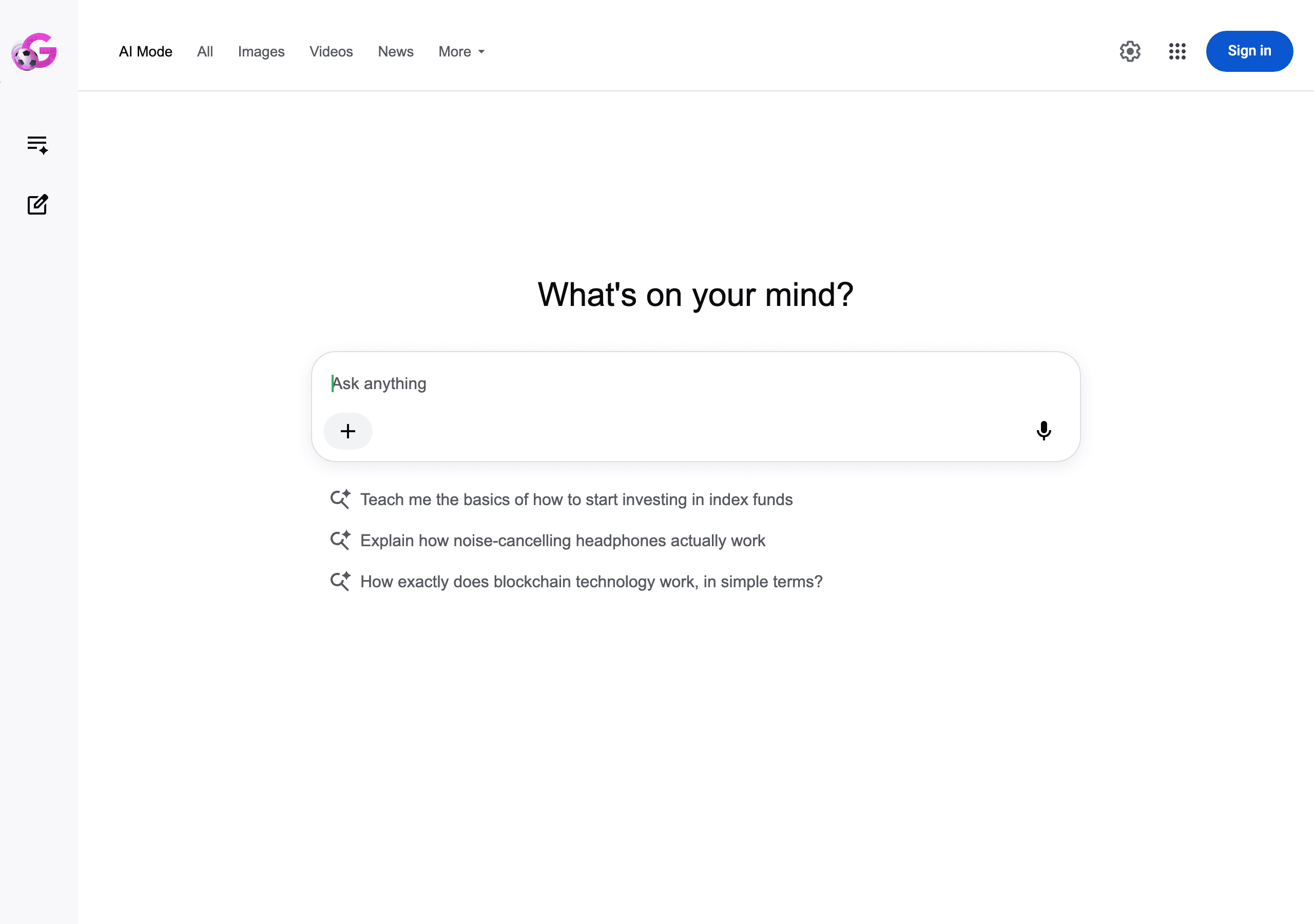
Two other changes from I/O 2026 are worth knowing because they shape what AI Mode can do. Google redesigned the search box for what it called the biggest upgrade in over 25 years, so it now accepts more than typed words. And it began rolling out Search agents, starting with information agents that work in the background to monitor the web and live data for answers to standing questions, alongside expanded agentic booking for local experiences and services. AI Mode is no longer just a way to read a summary. It is becoming a place where tasks get done.
Google AI Mode explained: how does Google AI Mode work?
Under the bonnet, AI Mode does not invent answers from the model's memory. It uses a technique Google calls query fan-out. Rather than running your single query once, it breaks the question into subtopics and, in Google's own words, issues "multiple related searches concurrently across subtopics and multiple data sources and then brings those results together to provide an easy-to-understand response", as set out in its AI Mode update. The model retrieves well-ranked pages for each of those sub-queries, then generates an answer anchored to them, with links back to the supporting sources. This is retrieval-augmented generation applied as the default behaviour of Search.
The practical consequence of fan-out is significant. A single question you type might trigger several behind-the-scenes searches, so to be cited your content has to satisfy not just your exact phrasing but the cluster of related sub-questions the system spins off. Depth and topical coverage, not keyword repetition, is what lets one page answer the whole cluster. The same fan-out mechanism underpins AI Overviews too, which is why a single optimisation approach serves both. We trace the full retrieval-to-answer journey in how does AI search work.
AI Mode also reaches beyond the static web index. Because it is the deeper, agentic surface, it pulls live signals such as finance data and sports scores, and it taps Google's Shopping Graph, which the company said reached 60 billion product listings at I/O 2026, for commercial questions. With explicit user permission, it can also bring in personal context from connected apps like Gmail and Google Photos. So the answer you see is assembled from three layers at once: the ranked web index, Google's freshest real-time data, and, when you opt in, your own information.
Google AI Mode vs AI Overviews: what is the difference?
People use the two terms interchangeably, but they are distinct surfaces that Google has now stitched together. An AI Overview is the AI-generated summary that appears at the top of a normal results page when Google judges a synthesised answer adds value. It is static, it shows up automatically without you choosing it, and it sits above the familiar blue links you can still scroll to. AI Mode is the fuller conversational interface: a dedicated experience for complex, multi-step or comparison-style questions, where you can ask follow-ups and the session remembers what you asked.
The scale of each tells the story. By May 2026 AI Overviews had reached more than 2.5 billion monthly users, as Google chief executive Sundar Pichai stated in his I/O 2026 keynote, building on the 2 billion Google reported in mid-2025, while AI Mode crossed one billion in its first year. The two are designed to flow into one another: you can ask a follow-up from an AI Overview and slide into a conversational exchange with AI Mode, carrying your context with you.
| AI Overviews | AI Mode | |
|---|---|---|
| What it is | AI summary above standard results | Dedicated conversational interface |
| How you reach it | Appears automatically on eligible queries | Default search experience; also entered from an Overview |
| Follow-up questions | No, it is a static summary | Yes, multi-turn with retained context |
| Best suited to | Quick informational and how-to questions | Complex, multi-step, comparison and research questions |
| Data sources | Indexed web content and Search signals | Index plus live data, Shopping Graph, and opt-in personal context |
| Model (mid-2026) | Gemini 3 family | Gemini 3.5 Flash |
The key point for brands is that both surfaces draw on the same Search index and the same ranking systems. You do not optimise separately for each. If you are eligible to be cited in one, the same work makes you eligible for the other. For the Overviews-specific walkthrough, see our companion guide on how to appear in AI Overviews. If you want to see how AI Mode sits alongside the standalone Gemini app and the other engines, which are different products, our roundup of the best AI search engines in 2026 draws the lines.
Because people routinely confuse the in-Search experience with the standalone assistant, our explainer on Google AI Mode versus the Gemini app sets out where the two surfaces overlap, where they diverge, and why being visible in one tells you little about the other.
For how AI Mode's grounded-by-default sourcing compares with an assistant that searches only when a question needs it, our Google AI Mode vs ChatGPT comparison sets the two approaches side by side.

Want to get recommended by AI?
Check your AI search visibility, then let the Honeyb agent write, fix, and earn what gets you recommended. Free to start.
Why being cited in AI Mode matters
The reason to care about all of this is what has happened to clicks. SparkToro's 2026 analysis of US Google searches from January to April, using Similarweb panel data, found that 68 percent of searches ended without a single click, up from roughly 60 percent in 2024. AI Overviews now appear on more than 20 percent of searches, and the analysis found that when they are present, click-through rates to the underlying results fall by close to 60 percent. The full breakdown is in SparkToro's report and the coverage at Search Engine Land.
Read plainly, this means the answer is increasingly the destination, not a stepping stone to your site. If a buyer asks a question and AI Mode names three brands in its reply, those three brands have won the moment of consideration, click or no click. Being the cited, named source has become a distinct visibility outcome worth optimising for in its own right. That is the broader practice of generative engine optimisation, of which Google's AI surfaces are now the largest single venue.
How to appear in Google AI Mode
Here is the part most guides overcomplicate. Google's AI features documentation is blunt about what it takes: "To be eligible to be shown as a supporting link in AI Overviews or AI Mode, a page must be indexed and eligible to be shown in Google Search with a snippet, fulfilling the Search technical requirements. There are no additional technical requirements." Google adds that you do not need to create machine-readable AI files, you do not need special markup, and there is "no special schema.org structured data that you need to add". Optimising for AI Mode is, in large part, optimising for Search done well.
That said, eligibility is best understood as a funnel with four narrowing gates. Classical SEO gets you through the first two. Clarity, evidence and trust get you through the last two, and that is where most brands lose ground.
- Indexed and snippet-eligible. The page is in Google's index, not blocked by robots.txt, noindex or nosnippet. Fail here and nothing downstream matters.
- Retrieved. The page ranks for at least one of the fanned-out sub-queries, so the system pulls it into the candidate set.
- Cited. A passage is clear and trustworthy enough that the model anchors part of its answer to it and links out.
- Named. Your brand or product appears in the synthesised text itself, which is the outcome that actually shapes what the searcher thinks.
The first move is therefore an unglamorous one: confirm you are retrievable. Make sure Googlebot is not blocked, that key pages are indexed with a usable snippet, and that you have not accidentally applied a nosnippet or noindex directive to pages you want surfaced. Those directives, set out in Google's documentation, remain the primary controls over whether your content can appear in these features. If your real goal is the opposite, to suppress your content from AI surfaces, our guide on how to turn off AI Overviews and AI Mode covers the searcher-side and publisher-side options and their trade-offs.
Once you are retrievable, the work that moves the needle is content quality applied with a sharper focus:
| Factor | Why it matters for AI Mode | What to do |
|---|---|---|
| Organic ranking | Pages must be indexed and snippet-eligible to be retrieved at all | Fix crawlability, indexation and page experience first |
| Extractable answers | Synthesis favours clear, self-contained passages it can lift | Lead each section with a direct answer in two or three sentences |
| Topical depth | Query fan-out tests your page against many sub-questions | Cover the question and its obvious follow-ups in one resource |
| E-E-A-T | Grounding leans on trusted, authoritative sources | Show authorship, credentials, citations and first-hand expertise |
| Freshness | Live data and recency carry weight in AI Mode | Keep facts, dates and statistics current; update timestamps |
| Off-page authority | Models weight claims that recur across independent sources | Earn citations on credible third-party pages and reviews |
Two of these deserve emphasis because they are where AI Mode differs most from old-style SEO. First, write extractable answers. Open a section with a two or three sentence response that would make sense quoted on its own, then expand beneath it. Write the passage you would want the model to lift verbatim. Second, build off-page corroboration. AI systems weight a claim more heavily when it recurs across independent, authoritative sources, so being mentioned on reputable third-party pages, industry references and well-moderated communities compounds your eligibility to be grounded. This is the same logic that governs how AI models choose which brands to recommend across every engine, not only Google.
Measure whether you actually appear
The uncomfortable truth in the click data is that ranking, and even being cited, will not show up cleanly in your traffic numbers, because so few people click through from an AI answer. You cannot manage what you cannot see, and a single manual check tells you almost nothing, since AI Mode answers vary by phrasing, location, model version, personalisation and time of day. The same question can name you on Monday and omit you on Tuesday.
To know whether AI Mode actually cites and names you, you need scheduled tracking across the queries that matter to your buyers, watching share of voice and how you are described, not just whether a link appeared once. Optimise with the steps above, then verify the outcome with measurement. In a search experience where the click increasingly does not happen, the citation is the result, and the citation is the thing worth counting.
The bottom line
Google AI Mode is no longer a feature you visit. As of I/O 2026 it is the default way the world's largest search engine answers questions: conversational, multimodal, grounded in a query fan-out of the live web, and increasingly agentic. The mechanics are not mysterious, and Google has said so plainly. There is no special file, no secret schema, no AI-only trick. There is a clean, indexable site, content written to be extracted, evidence the model can attribute, and a reputation that recurs across the web. Get those right, and you remain visible where the answer now happens. Then measure it, because the search box you grew up with has quietly become an answer engine, and the rules of being found have changed with it.
Sources cited in this report