
An AI search engine answers a question directly instead of returning a list of links. You type a full question in plain language, the engine reads across the live web, and it returns a written answer with the sources it used. The shift matters because a growing share of buyer research now happens inside these answers rather than on a results page. People ask ChatGPT which tool to buy, ask Perplexity to compare two vendors, or read Google's AI summary without ever clicking through.
This guide covers the 10 AI search engines worth using in 2026. We tested each on the same kinds of queries (product research, factual lookups, current events, coding help, and multi-step comparisons) and graded them on answer quality, source transparency, recency, and how well they handle follow-up questions. The list runs from the general-purpose engines most people should start with to the specialist and privacy-focused options worth knowing about.
If you are here as a marketer or founder rather than a searcher, skip to the last two sections. The same engines that answer buyer questions also decide which brands get named in those answers, and that is a measurable surface now.
The 10 best AI search engines at a glance
| Engine | Best for | Underlying model | Inline citations | Free tier |
|---|---|---|---|---|
| ChatGPT Search | General research and buyer-stage questions | GPT-class (OpenAI) | Yes | Yes |
| Perplexity | Sourced answers you need to verify | Multiple, user-selectable | Yes, prominent | Yes |
| Google AI Mode | Everyday search with the widest reach | Gemini | Yes | Yes |
| Google Gemini | Multimodal and Google Workspace work | Gemini | Yes | Yes |
| Claude | Reasoning, writing, and coding depth | Claude (Anthropic) | Yes | Yes |
| Microsoft Copilot | Free GPT-class search in Windows and Edge | GPT-class via Bing | Yes | Yes |
| Grok | Real-time and current-events queries | Grok (xAI) | Yes | Yes, rate-limited |
| Brave Search | Privacy with an independent index | Brave model on own index | Yes | Yes |
| DuckDuckGo AI | Anonymous access to several models | Multiple, anonymised | Limited | Yes |
| Kagi | Ad-free search with AI answers | Multiple, user-selectable | Yes | No, paid only |
The rankings below are not strictly ordered. The right engine depends on the job. ChatGPT and Perplexity are the two most people should reach for first, but the back half of the list is there because each one does a specific thing better than the leaders.
Market share (%)
The four leading AI assistants by market share
| Period | ChatGPT (incl. Copilot) | Gemini | Perplexity | Claude |
|---|---|---|---|---|
| Jan 24 | 76.4% | 16.2% | 2.7% | 2.1% |
| Feb 24 | 76.1% | 15.5% | 2.7% | 2.2% |
| Mar 24 | 75.8% | 14.8% | 3% | 2.4% |
| Apr 24 | 75.3% | 14.9% | 2.9% | 2.5% |
| May 24 | 75% | 14.5% | 3% | 2.6% |
| Jun 24 | 74.9% | 13.8% | 3% | 2.5% |
| Jul 24 | 74.4% | 13.3% | 3.8% | 2.5% |
| Aug 24 | 74.1% | 13.8% | 5.3% | 2.6% |
| Sep 24 | 73.8% | 13.6% | 5.5% | 2.8% |
| Oct 24 | 73.6% | 13.5% | 5.6% | 2.8% |
| Nov 24 | 73.8% | 13.5% | 5.8% | 2.9% |
| Dec 24 | 73.8% | 13.4% | 6% | 3.1% |
| Jan 25 | 74.2% | 13.5% | 6% | 3.1% |
| Feb 25 | 74.1% | 13.5% | 6.2% | 3.2% |
| Mar 25 | 74.1% | 13.7% | 6.1% | 3.3% |
| Apr 25 | 74.2% | 13.4% | 6.3% | 3.3% |
| May 25 | 74.9% | 13.4% | 6.2% | 3.2% |
| Jun 25 | 74.8% | 13.5% | 6.2% | 3.2% |
| Jul 25 | 74.5% | 13.5% | 6.5% | 3.5% |
| Aug 25 | 74.7% | 13.4% | 6.5% | 3.4% |
| Sep 25 | 74.7% | 13.5% | 6.6% | 3.6% |
| Oct 25 | 75.1% | 13.4% | 6.4% | 3.8% |
| Nov 25 | 73.9% | 14.6% | 5.5% | 4.7% |
| Dec 25 | 74.2% | 14.8% | 5.1% | 4.7% |
| Jan 26 | 73.9% | 15% | 5.8% | 4.1% |
| Feb 26 | 73.3% | 15.2% | 5.8% | 4.5% |
| Mar 26 | 73% | 15.3% | 5.5% | 4.9% |
| Apr 26 | 73.1% | 15.1% | 5.1% | 5% |
1. ChatGPT Search
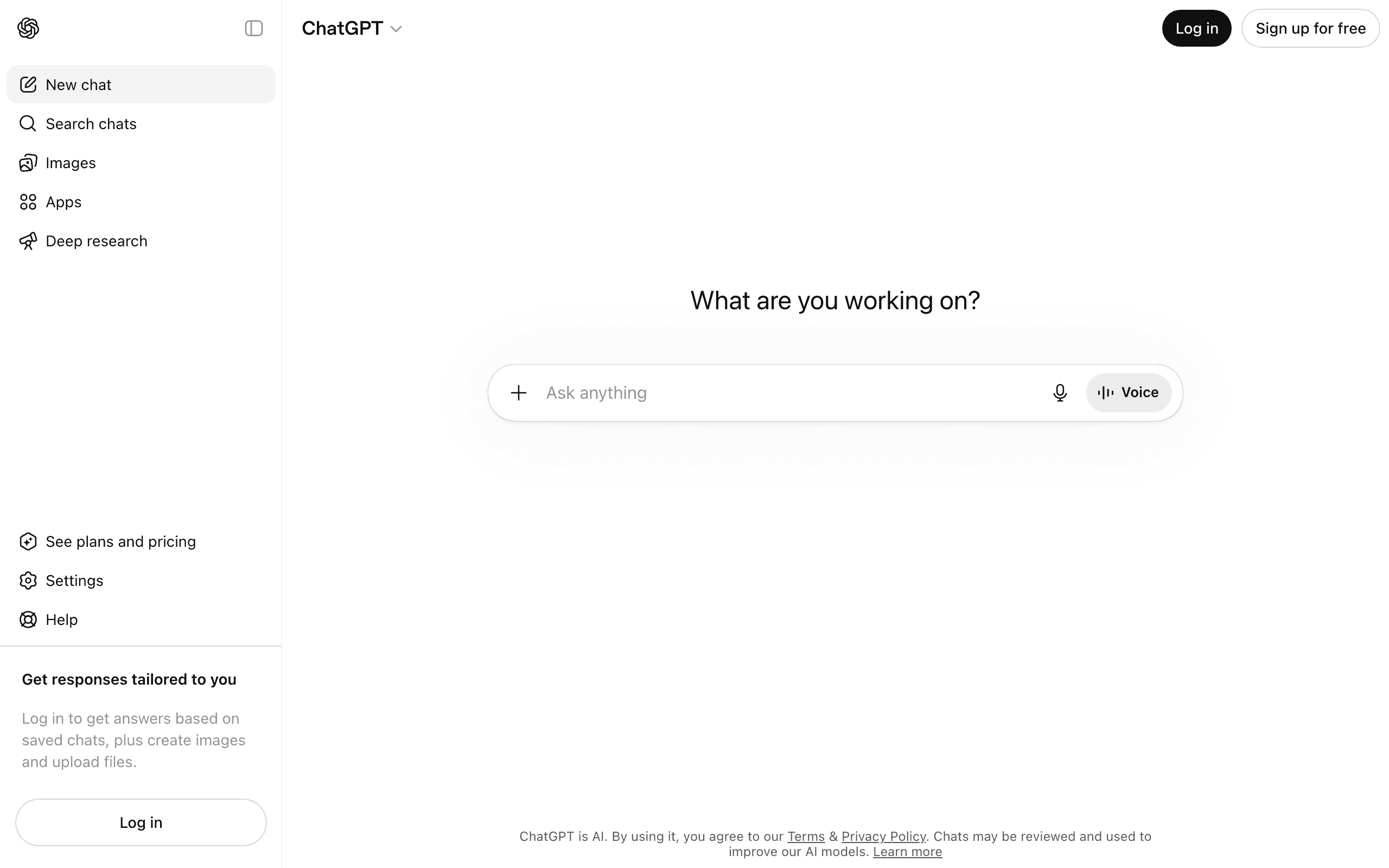
ChatGPT is the most widely used AI tool in the world, and its built-in search turned it into a genuine search engine rather than a closed chatbot. Ask a current question and it browses the live web, synthesises an answer, and links the sources inline. It is the strongest all-rounder: conversational, good at holding context across a long back-and-forth, and increasingly the default place buyers go to ask which product to choose. ChatGPT Shopping now surfaces product cards directly inside answers for commercial queries, which makes it the highest-stakes engine for brands selling anything.
- Best general-purpose answer quality across research, writing, and analysis
- Handles long multi-step conversations and follow-ups better than any rival
- Shopping cards and product comparisons built into commercial answers
- Huge install base, so it is where most buyer research actually starts
- Can still state wrong facts confidently, so verify anything that matters
- Recency depends on whether it decides to browse, which is not always obvious
- Citation list is shorter and less prominent than Perplexity's
2. Perplexity
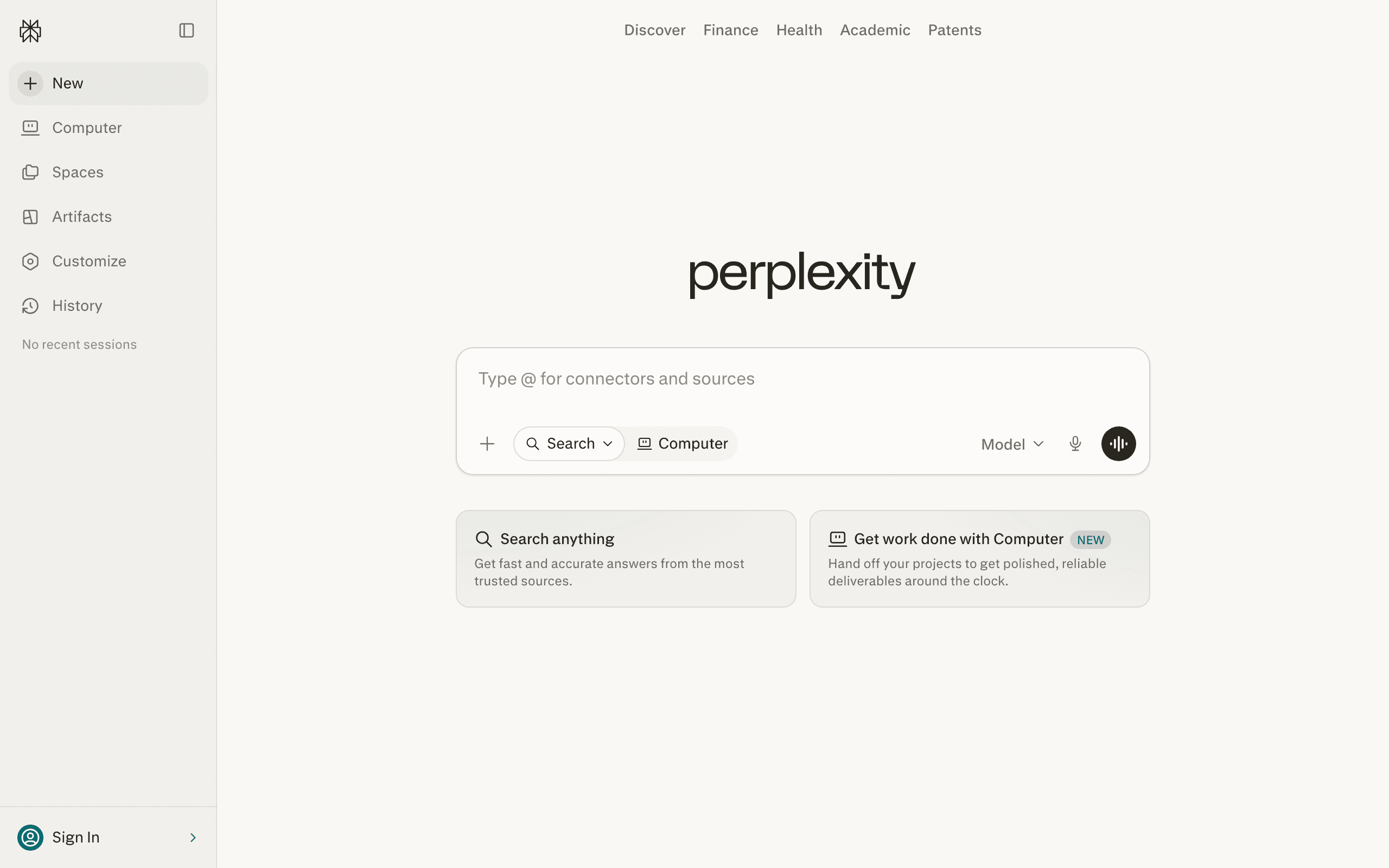
Perplexity, the answer engine built its whole product around the thing other engines treat as an afterthought: showing its work. Every answer leads with numbered citations, and the interface is designed so you can check each claim against its source in one click. That makes it the engine of choice when you need an answer you can trust and defend, such as research, due diligence, or anything you are going to repeat to someone else. Paid users can pick the underlying model, and the source controls let anyone scope a search to academic papers, social discussions, or the broader web.
Market share (%)
Perplexity market share
| Period | Perplexity market share |
|---|---|
| Jan 24 | 2.7% |
| Feb 24 | 2.7% |
| Mar 24 | 3% |
| Apr 24 | 2.9% |
| May 24 | 3% |
| Jun 24 | 3% |
| Jul 24 | 3.8% |
| Aug 24 | 5.3% |
| Sep 24 | 5.5% |
| Oct 24 | 5.6% |
| Nov 24 | 5.8% |
| Dec 24 | 6% |
| Jan 25 | 6% |
| Feb 25 | 6.2% |
| Mar 25 | 6.1% |
| Apr 25 | 6.3% |
| May 25 | 6.2% |
| Jun 25 | 6.2% |
| Jul 25 | 6.5% |
| Aug 25 | 6.5% |
| Sep 25 | 6.6% |
| Oct 25 | 6.4% |
| Nov 25 | 5.5% |
| Dec 25 | 5.1% |
| Jan 26 | 5.8% |
| Feb 26 | 5.8% |
| Mar 26 | 5.5% |
| Apr 26 | 5.1% |
- The most transparent sourcing of any engine, citations front and center
- Source controls let you restrict a search to the kind of source you trust
- Fast, clean answers with minimal filler
- Model choice on paid plans, so you are not locked to one provider
- Less capable than ChatGPT or Claude on open-ended creative or coding work
- Answer depth varies with the quality of the sources it finds
- Leans on a handful of sources per answer, which can narrow the view
3. Google AI Mode and AI Overviews
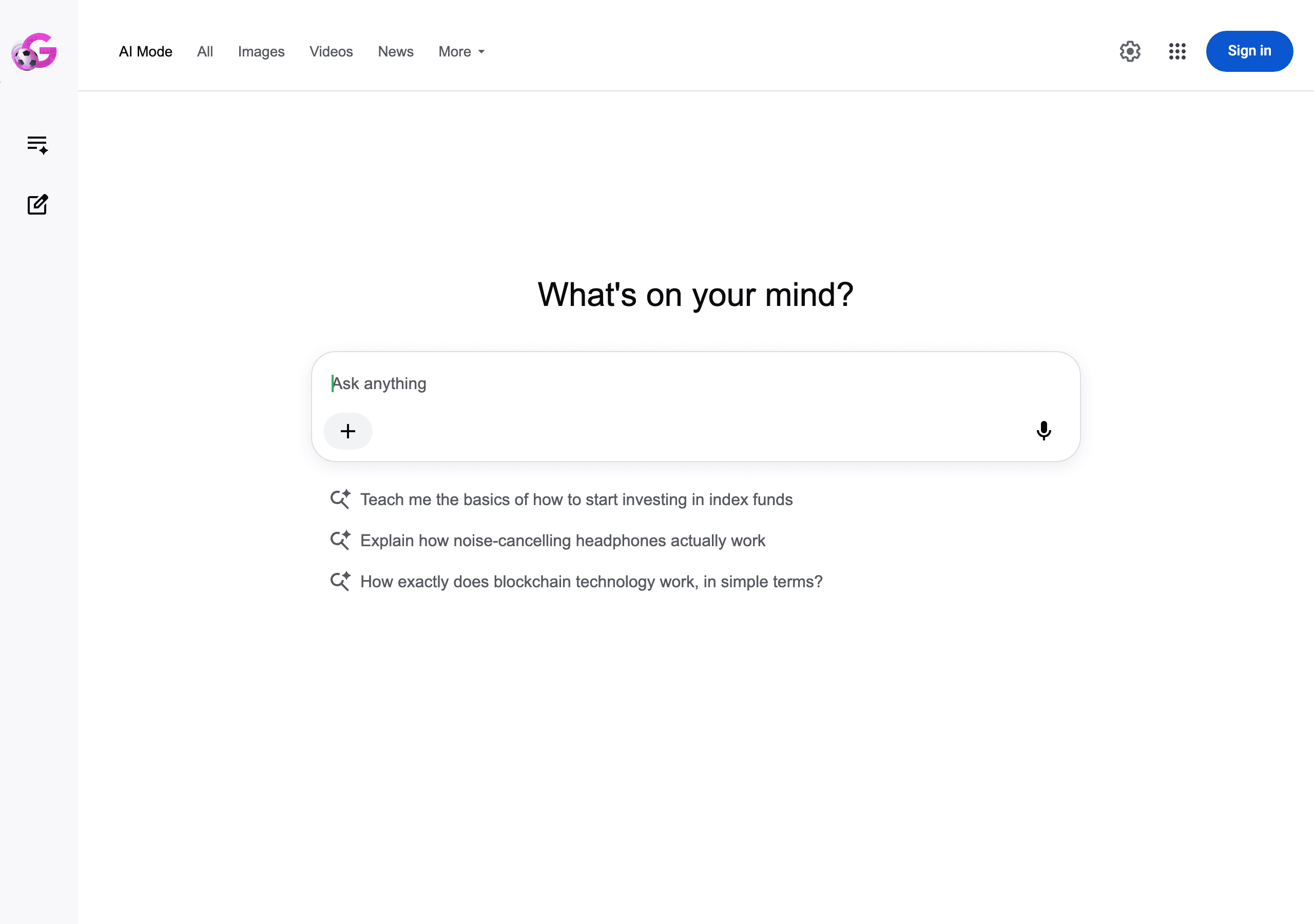
Google did not cede AI search to startups. AI Overviews now sit at the top of a large share of result pages, and AI Mode is a full conversational search experience inside Google itself, powered by Gemini. The reach is the story here: this is the AI answer that the most people see, often without realizing they have left traditional search. For everyday questions it is fast, grounded in Google's index, and good enough that many users stop reading before the blue links. For brands, it is also the surface that has cut clicks to the top organic result the hardest.
- The widest reach of any AI answer surface by a wide margin
- Grounded in Google's index, so coverage and recency are strong
- No extra app or login, it is just search for most users
- AI Mode handles genuine follow-up conversations, not just one-shot summaries
- Summaries collapse clicks, so being ranked is no longer the same as being read
- The set of sources cited is volatile and changes frequently
- Less conversational depth than a dedicated chat engine on hard questions
4. Google Gemini
Gemini is Google's standalone assistant, and it is a different product from AI Mode even though they share a model family. Its edge is multimodal range and integration. It handles images, long documents, and audio, carries a very large context window, and plugs directly into Gmail, Docs, and the rest of Google Workspace. Deep Research mode will run an extended, multi-source investigation and hand back a structured report. If your work already lives in Google's ecosystem, Gemini is the AI search engine with the least friction.
Market share (%)
Google Gemini market share
| Period | Google Gemini market share |
|---|---|
| Jan 24 | 16.2% |
| Feb 24 | 15.5% |
| Mar 24 | 14.8% |
| Apr 24 | 14.9% |
| May 24 | 14.5% |
| Jun 24 | 13.8% |
| Jul 24 | 13.3% |
| Aug 24 | 13.8% |
| Sep 24 | 13.6% |
| Oct 24 | 13.5% |
| Nov 24 | 13.5% |
| Dec 24 | 13.4% |
| Jan 25 | 13.5% |
| Feb 25 | 13.5% |
| Mar 25 | 13.7% |
| Apr 25 | 13.4% |
| May 25 | 13.4% |
| Jun 25 | 13.5% |
| Jul 25 | 13.5% |
| Aug 25 | 13.4% |
| Sep 25 | 13.5% |
| Oct 25 | 13.4% |
| Nov 25 | 14.6% |
| Dec 25 | 14.8% |
| Jan 26 | 15% |
| Feb 26 | 15.2% |
| Mar 26 | 15.3% |
| Apr 26 | 15.1% |
- Strong multimodal handling of images, documents, and audio
- Deep Research produces long structured reports from many sources
- Tight Workspace integration across Gmail, Docs, and Drive
- Large context window for working over long inputs
- Answer consistency varies more than ChatGPT or Claude
- Can be over-cautious and refuse reasonable requests
- The split between Gemini and AI Mode confuses where to go for what
5. Claude
Claude is built by Anthropic and is the strongest engine on the list for reasoning, long-form writing, and coding. It is more of an analytical assistant than a search box, but its web search makes it a real research tool, and its very large context window lets it work over entire documents, codebases, or research sets in one pass. Artifacts render code and documents in a side panel as it works, and Projects keep context across a body of work. When the task is to think carefully rather than just look something up, Claude is usually the best answer.
Market share (%)
Claude market share
| Period | Claude market share |
|---|---|
| Jan 24 | 2.1% |
| Feb 24 | 2.2% |
| Mar 24 | 2.4% |
| Apr 24 | 2.5% |
| May 24 | 2.6% |
| Jun 24 | 2.5% |
| Jul 24 | 2.5% |
| Aug 24 | 2.6% |
| Sep 24 | 2.8% |
| Oct 24 | 2.8% |
| Nov 24 | 2.9% |
| Dec 24 | 3.1% |
| Jan 25 | 3.1% |
| Feb 25 | 3.2% |
| Mar 25 | 3.3% |
| Apr 25 | 3.3% |
| May 25 | 3.2% |
| Jun 25 | 3.2% |
| Jul 25 | 3.5% |
| Aug 25 | 3.4% |
| Sep 25 | 3.6% |
| Oct 25 | 3.8% |
| Nov 25 | 4.7% |
| Dec 25 | 4.7% |
| Jan 26 | 4.1% |
| Feb 26 | 4.5% |
| Mar 26 | 4.9% |
| Apr 26 | 5% |
- Best-in-class reasoning, analysis, and long-form writing
- Very large context window for working over big documents and codebases
- Strong, careful coding with Artifacts for live output
- Measured tone and low rate of confident errors
- Web search is newer and less aggressive than Perplexity or ChatGPT
- Oriented toward deep tasks more than quick factual lookups
- Fewer consumer-facing search features than the search-first engines
6. Microsoft Copilot
Copilot is Microsoft's GPT-class assistant, grounded in Bing and woven into Windows, Edge, and Microsoft 365. Its main appeal is access: it puts a capable, free AI search engine one click away for anyone on a Windows machine, with no separate signup. Inside Microsoft 365 it can also reason over your own documents and email. For most users it behaves like a more convenient front door to the same class of model that powers ChatGPT.
- Free GPT-class answers built into Windows, Edge, and Microsoft 365
- Grounded in Bing's index with inline citations
- Can work across your own files and email inside Microsoft 365
- No extra account needed for Windows and Edge users
- Answer quality and tone are less consistent than ChatGPT direct
- The consumer experience sits close to ads and promoted content
- Less depth than dedicated engines on hard, multi-step questions
7. Grok
Grok, from xAI, is the engine to reach for when recency is the whole point. It has direct, real-time access to the firehose of posts on X, which makes it unusually good at current events, breaking news, and reading the live mood around a topic. It is more loosely filtered than the other major engines, which some users prefer and others find a liability.

Want to get recommended by AI?
Check your AI search visibility, then let the Honeyb agent write, fix, and earn what gets you recommended. Free to start.
As a general research tool it is competitive; as a real-time pulse on what is happening right now, it has a structural advantage the others cannot match.
- Real-time access to X gives it an edge on breaking news and live sentiment
- Strong on current events and fast-moving topics
- Looser content filtering than most rivals
- Capable general reasoning on top of the real-time data
- Source reliability skews toward social posts, which need scrutiny
- Best features sit behind xAI's SuperGrok subscriptions; the free tier is rate-limited
- Newer, with a smaller track record than the established engines
8. Brave Search
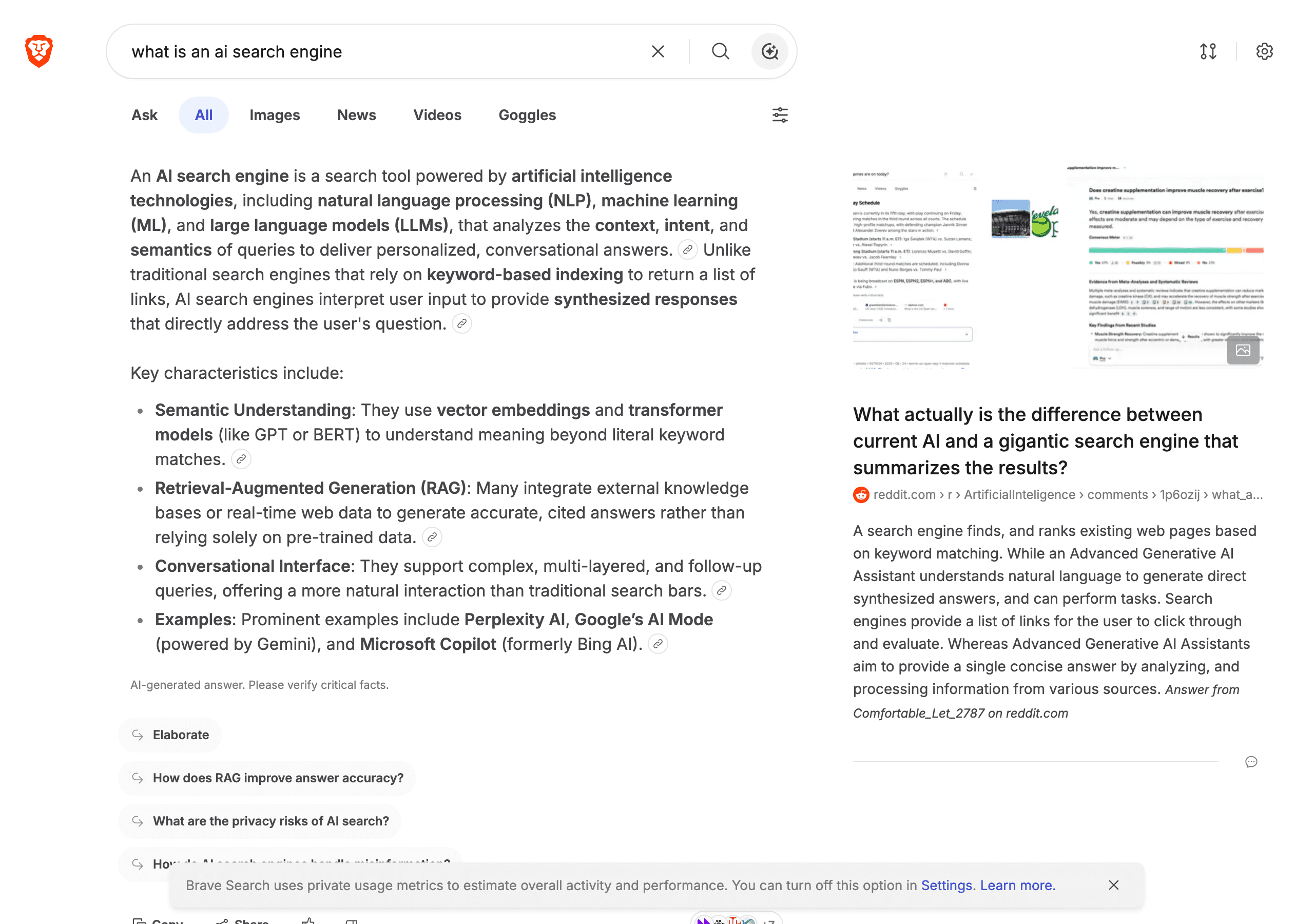
Brave Search is the privacy-first choice that does not depend on Google or Bing underneath. It runs on Brave's own independent web index, and its AI layer (AI Answers for inline summaries, the conversational Ask Brave mode, and the Leo assistant in the Brave browser) generates summaries without tracking you or building an ad profile. For users who want AI answers but not the surveillance that usually comes with them, Brave is the most credible option, because the independent index means it is genuinely not reselling another engine's results.
- Genuinely independent index, not a Google or Bing reseller
- No tracking, no profile building, no ad targeting
- AI summaries built into a fast, private search experience
- Bundled with a privacy browser that blocks trackers by default
- Index is smaller than Google's, so long-tail coverage can thin out
- AI answers are less deep than the frontier-model engines
- Smaller ecosystem and fewer power-user features
9. DuckDuckGo AI
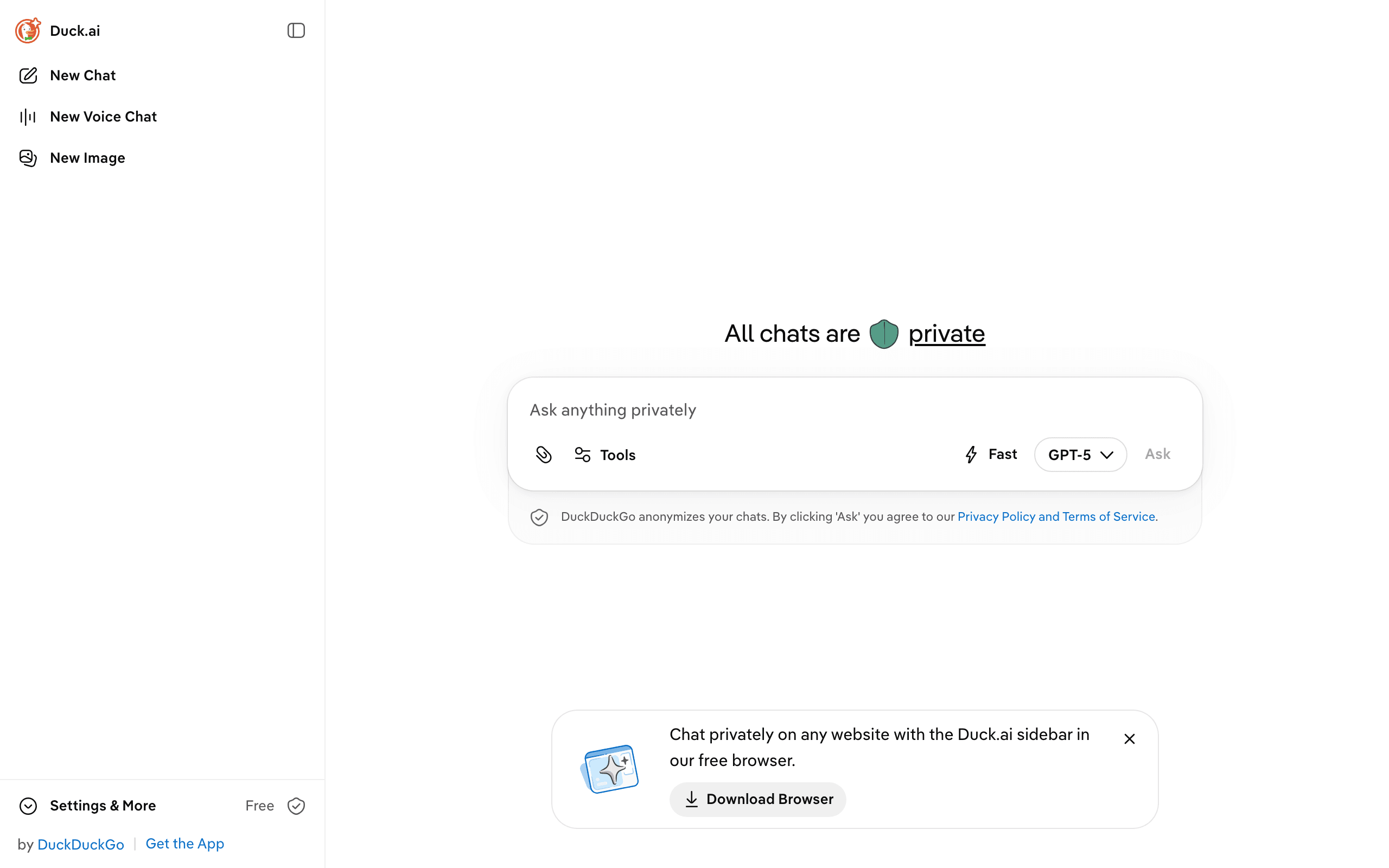
DuckDuckGo's Duck.ai gives you anonymised access to several well-known models through a single privacy-protecting front end. Your queries are not tied to an identity and are not used to train the models. It is less a search engine in its own right than a private doorway to chat models, paired with DuckDuckGo's traditional anonymous search. For privacy-conscious users who want to try different models without handing over their data to each provider, it is a clean, no-account option.
- Anonymous access to multiple models through one interface
- Queries are not stored against an identity or used for training
- Pairs with DuckDuckGo's established private search
- No account required to start
- Lighter web grounding than Perplexity or ChatGPT Search
- Functions more as a model proxy than a full answer engine
- Fewer advanced features and no deep-research mode
10. Kagi
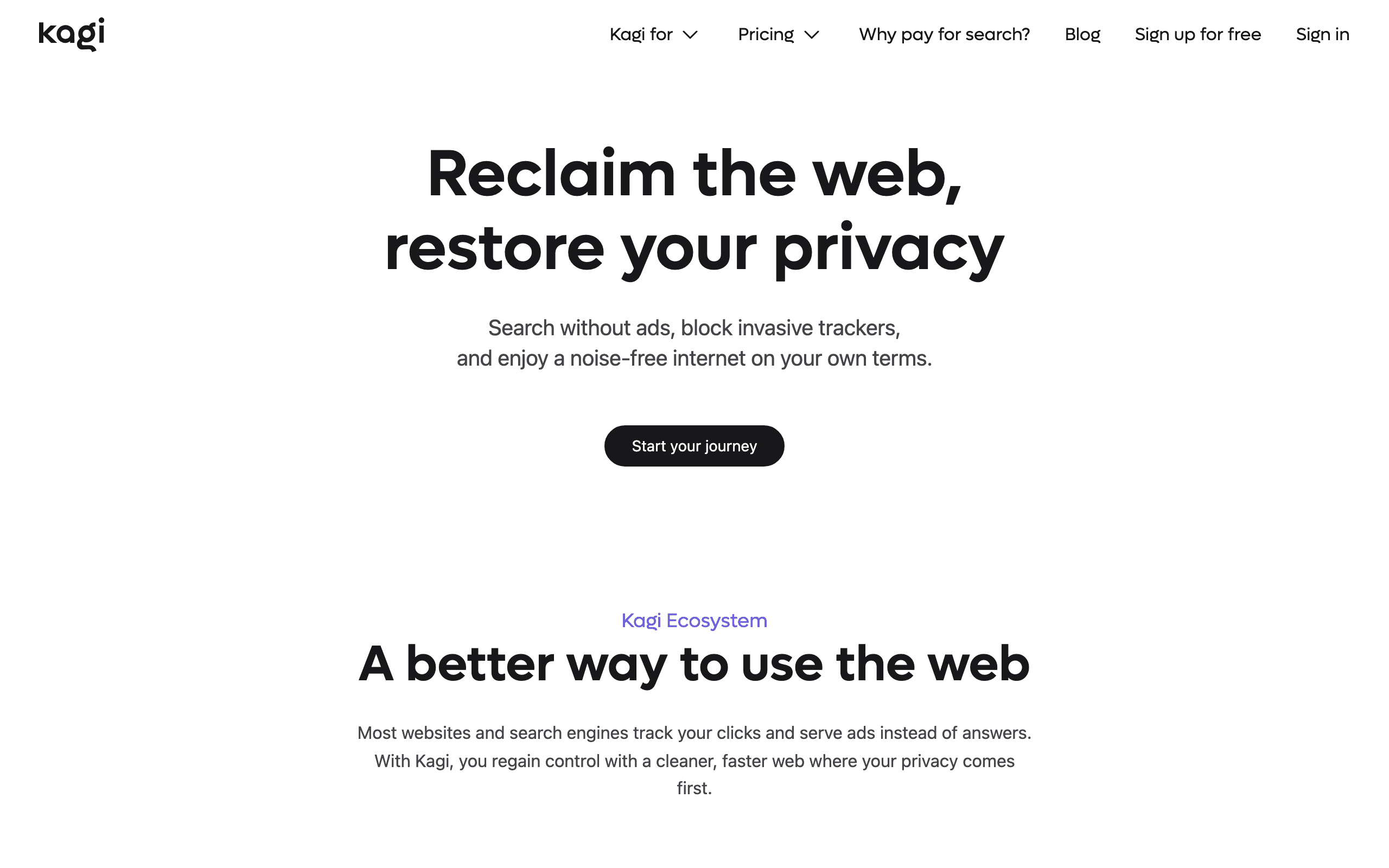
Kagi is the only engine on this list with no free tier, and that is the point. You pay a subscription, and in exchange you get search with no ads, no tracking, and no incentive to keep you scrolling. Results draw on Kagi's own index alongside other sources, Quick Answer generates a cited AI summary on demand, and the Assistant, included on every plan, gives you a choice of models grounded in Kagi's results, with the full frontier-model range on the top tier. It is the engine for people who concluded that if search is free, the searcher is the product.
- No ads, no tracking, and no ranking distortion from an ad business
- Quick Answer produces cited AI summaries on demand
- Assistant on every plan, with the full frontier-model range on the top tier
- Lenses and personalized ranking let you tune what you see
- No free tier, and the people most used to free search balk at paying
- Smaller index than Google for long-tail queries
- AI features are an add-on to search rather than the core experience
How to choose the right AI search engine
There is no single best engine, only the best one for a given job. The fastest way to choose is to match the engine to the task rather than picking one and forcing everything through it.
- For general research and buyer-stage product questions, start with ChatGPT Search.
- When you need sourced answers you have to verify or defend, use Perplexity.
- For everyday questions with the least friction, Google AI Mode is already in front of you.
- For multimodal work or anything inside Google Workspace, use Gemini.
- For deep reasoning, long writing, and coding, use Claude.
- For breaking news and live sentiment, use Grok.
- For privacy without giving up AI answers, use Brave Search or DuckDuckGo AI.
- For ad-free search worth paying for, use Kagi.
Most people end up running two or three. A common pattern in 2026 is ChatGPT or Claude for thinking and drafting, Perplexity for anything that needs a verifiable source, and whatever is built into the browser for quick lookups.
If you are weighing up the leading consumer assistants specifically, our ChatGPT vs Gemini vs Claude comparison sets the Big 3 side by side on where each one pulls ahead.
What AI search engines mean if you are a brand
Every engine above does the same thing from a brand's point of view: when a buyer asks which product to choose, the engine names a short list. If your brand is on that list, you are in the consideration set. If it is not, you were eliminated before the buyer ever saw your website, and no amount of traditional SEO catches it, because there was no click to measure.
This is a different surface from Google rankings. Recent research from Ahrefs found that 28.3% of the pages ChatGPT cites most often have zero Google organic traffic, which means AI search is partly a separate discovery layer with its own winners. A brand can rank well on Google and still be invisible in the AI answers where buyers now make shortlists. We covered the full set of findings in our breakdown of Ahrefs' AI search research.
The practical problem is that these answers are invisible to your existing analytics. A buyer who asks ChatGPT for the best option in your category, reads the answer, and never lands on your site leaves no trace in Google Analytics. The only way to know whether you are being recommended is to ask the engines the questions your buyers ask and record what they say, across every engine, on a regular cadence, because the answers shift week to week.
How to track your brand across AI search engines
This is what Honeyb does. It runs the buyer questions in your category across the major AI engines (ChatGPT, Perplexity, Gemini, Google AI Mode, Claude, and more), records which brands get named, measures your share of those answers against competitors, and tracks the sentiment of how you are described. Instead of guessing whether the engines recommend you, you get a measured baseline and a trend line.
The fastest way to see where you stand is to run a free AI visibility check. It queries the major engines for your brand and shows whether you are being cited, what is said about you, and where the gaps are. For a wider view of the measurement landscape, see our guide to search engine visibility tools in 2026.
The takeaway
The best AI search engine in 2026 is the one that fits the job in front of you. ChatGPT and Perplexity cover most needs, Google's AI surfaces reach the most people, and Claude, Gemini, Grok, and the privacy-first options each win a specific lane. For searchers, the move is to keep two or three in rotation and match each to the task.
For brands, the deeper shift is that these engines now decide who makes the shortlist, and the only way to manage that is to measure it. Start with a free check to see how AI describes you today.