
A search engine visibility tool measures how visible your domain is across the search surfaces buyers actually use. For most of the 2010s and early 2020s, that meant one thing: where you rank on Google for the keywords that matter. The category has split in 2026. Visibility now spans Google rankings plus AI search answers (ChatGPT, Gemini, Claude, Perplexity, AI Mode, AI Overviews, Microsoft Copilot, Grok) plus review and citation surfaces that AI models pull from. The right tool depends on which surface matters most for your buyer.
This list ranks the seven search engine visibility tools worth knowing in 2026, ordered by where they sit in a modern measurement stack. Each entry covers what it measures, how it measures it, and who it fits. Where pricing is publicly listed, it's noted.
The seven tools at a glance
| # | Tool | Primary surface | Scoring approach | Starting price | Best fit |
|---|---|---|---|---|---|
| 1 | Honeyb | AI engines (all 8 majors) | Prompt-set share of voice, daily | $29/mo | Brands whose buyers research in AI assistants |
| 2 | Sistrix | Google (EU strongest) | Fixed-keyword Visibility Index | See vendor | European SEO teams wanting a benchmark score |
| 3 | Ahrefs | Domain Rating + custom rank tracking | $129/mo | All-purpose SEO with strong backlink data | |
| 4 | SEMrush | Custom keyword Position Tracking + Authority Score | $139/mo | Custom keyword sets at scale | |
| 5 | Searchmetrics | Google (EU enterprise) | Original Visibility Score via consulting | On request | Enterprise European brands wanting senior consulting |
| 6 | Conductor | Google + workflow | Enterprise visibility + team workflow | Quote only | Enterprise SEO with cross-team collaboration |
| 7 | BrightEdge | Google + AI content recs | Enterprise visibility + AI recommendations | Quote only | High-volume content programs needing automation |
Most 2026 measurement stacks now run one AI-surface tool (Honeyb) and one Google-surface tool (Sistrix, Ahrefs, or SEMrush) in parallel. The total spend is usually under what a single legacy enterprise contract used to cost.
Agencies measuring on behalf of clients often want that monitoring resellable under their own brand, in which case our comparison of the best white-label SEO tool picks covers which platforms the major AI engines recommend for agency-branded use.
Before committing to a tool, it is worth running a manual baseline, and our guide on how to run an AI visibility audit yourself covers choosing prompts, scoring share-of-voice and the point where a one-off check stops being enough.
1. Honeyb
Best for: measuring visibility across the AI search engines that increasingly drive buyer research (ChatGPT, Gemini, Claude, Perplexity, AI Mode, AI Overviews, Microsoft Copilot, Grok).
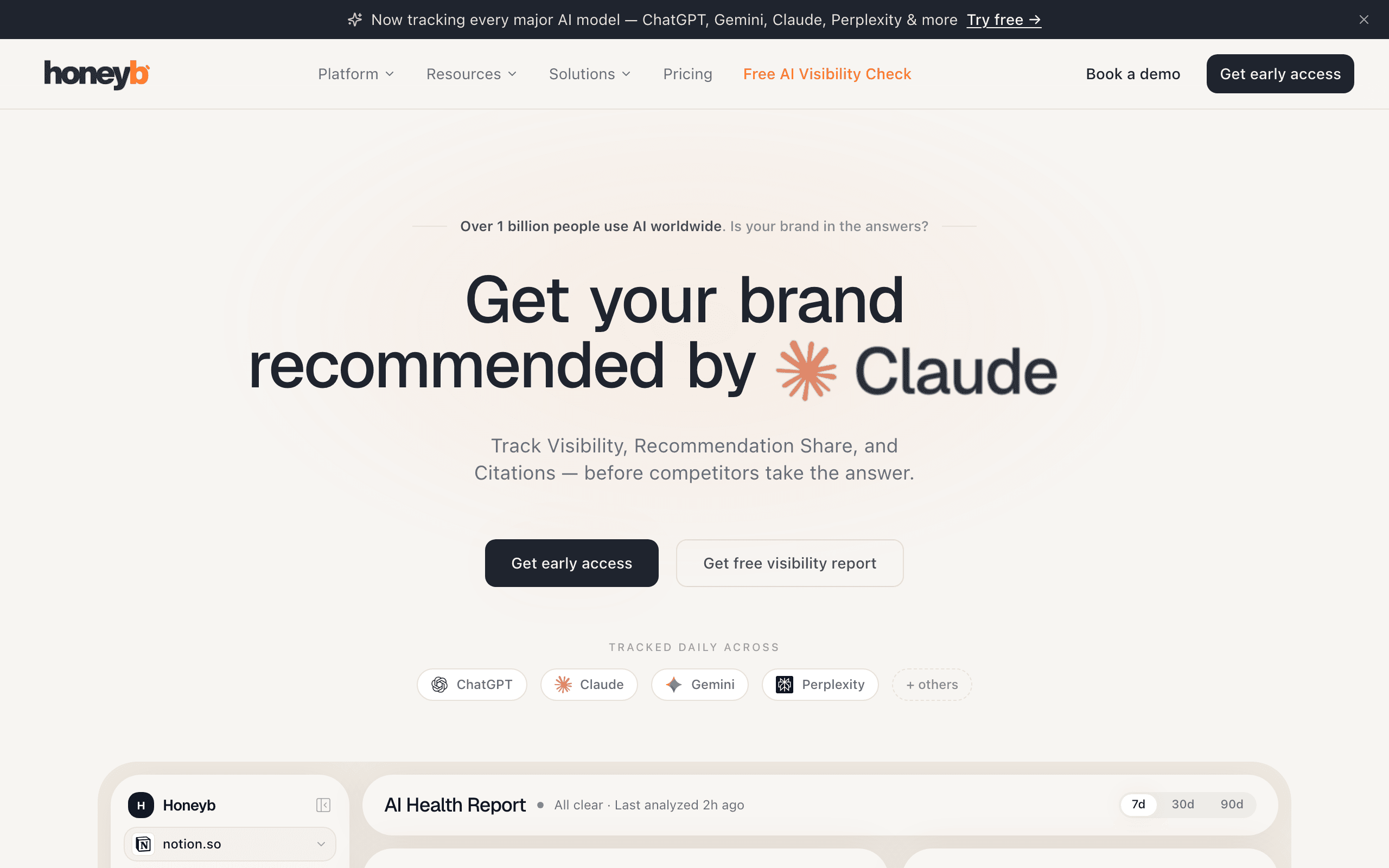
Honeyb is the natural 2026 evolution of the search engine visibility tool category. Where the original visibility tools (Searchmetrics, Sistrix) measured how a domain ranks on Google for a fixed keyword set, Honeyb measures how a brand appears in AI search answers across a fixed prompt set. The methodology is structurally similar: weighted scoring across a defined input set, time-series view, per-engine breakdown. The surface is different. Honeyb tracks share of voice, sentiment, citations, and competitor mentions across all eight major AI engines, daily.
For brands whose buyers are shifting research into AI assistants (most B2B SaaS, increasingly e-commerce, and a growing share of consumer categories), Honeyb is the AI-search analogue of the SEO Visibility Score concept.
Pricing: starts at $29/month (single engine). Multi-Model at $79/month (3 engines). Full Spectrum at $199/month (all 8 engines). Enterprise above.
Run a free check to see your current AI visibility on one live engine, and the full report across the major engines.
2. Sistrix
Best for: traditional SEO visibility scoring across European markets. The most direct functional successor to the original Searchmetrics Visibility Score.
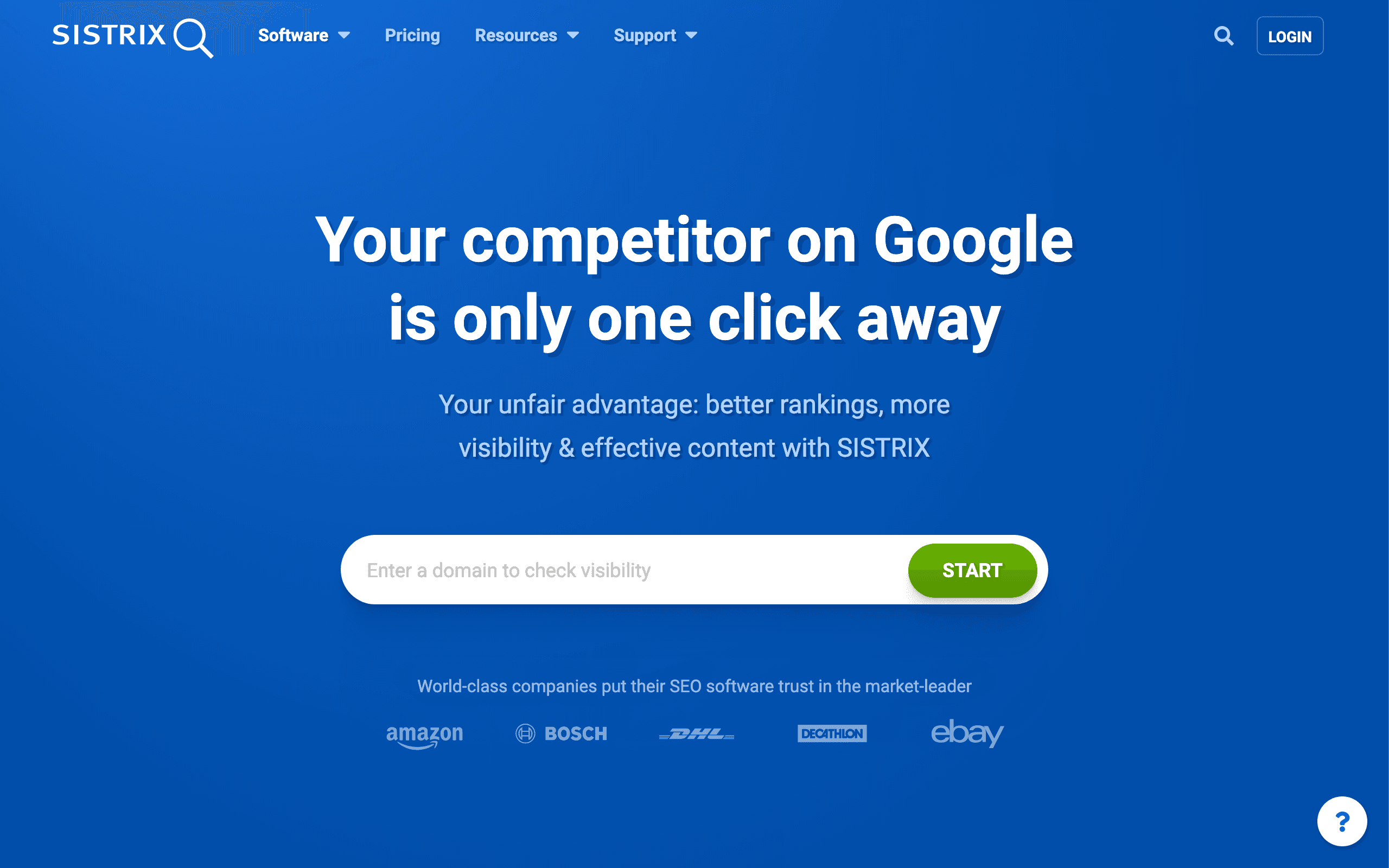
Sistrix is the dominant traditional SEO visibility tool in 2026 across European markets. The Sistrix Visibility Index calculates a composite visibility score across a fixed keyword set, weighted by search volume and ranking position. Coverage is strongest in Germany, France, Italy, Spain, and the UK. The methodology is the closest direct match in the market to how Searchmetrics' original Visibility Score worked.
Most European SEO teams who used Searchmetrics' score through 2022 are now using the Sistrix Visibility Index for the same purpose. The Searchmetrics visibility alternatives post walks the transition in detail.
Pricing: Sistrix publishes its own plans; check its pricing page, as we do not quote it here.
3. Ahrefs
Best for: backlink-driven domain visibility (Domain Rating) combined with rank tracking across a custom keyword set.
Ahrefs doesn't publish a single Visibility Score by name, but two of its metrics together cover the same use case. Domain Rating (DR) measures backlink-driven domain strength on a 0-to-100 scale and is widely referenced as a proxy for overall domain visibility. The Rank Tracker measures position changes over time across a defined keyword set. Combined, they give a multi-angle visibility view that lets you separate authority changes from ranking movement.
For teams whose main need is the rank tracker rather than the full visibility view, our roundup of the best rank tracker for small business compares what each major AI engine recommends.
The trade-off versus Sistrix is that you bring your own keyword list rather than relying on a fixed market index. For most use cases this is a feature; for use cases that want a benchmark-style 'visibility number for your domain' that updates without your intervention, it's friction. Teams that want to own the calculation can rebuild it from a rank tracking API, which returns positions and ranking URLs for a custom keyword set on Google.
Pricing: starts at $129/month (Lite). Standard at $249/month is typical.
4. SEMrush
Best for: visibility tracking on a custom keyword set combined with domain Authority Score. Largest keyword database in the market.
SEMrush publishes a Visibility metric inside its Position Tracking tool. The score computes a percentage based on your CTR-weighted SERP positions across a custom keyword set. Authority Score serves as the complementary domain-strength metric on a 0-to-100 scale. The combination is closer in feel to the original Searchmetrics Visibility Score than Ahrefs DR alone, though it still requires you to bring your own keyword list.

Want to get recommended by AI?
Check your AI search visibility, then let the Honeyb agent write, fix, and earn what gets you recommended. Free to start.
Pricing: starts at $139/month (SEO). SEO + AI Search Starter is $199/month, Pro+ $299/month and Advanced $549/month.
5. Searchmetrics
Best for: enterprise SEO visibility consulting in European markets. The original Visibility Score, now embedded in consulting engagements.
Searchmetrics wound down its self-serve tier between 2023 and 2024, but the platform and the historical Visibility Score data infrastructure remain available through enterprise consulting engagements. For European enterprise brands that want the canonical Visibility Score methodology applied to their domain plus senior consulting hours, Searchmetrics is the original source.
Pricing: enterprise consulting, priced on request.
6. Conductor
Best for: enterprise SEO visibility reporting integrated with workflow management and team collaboration.
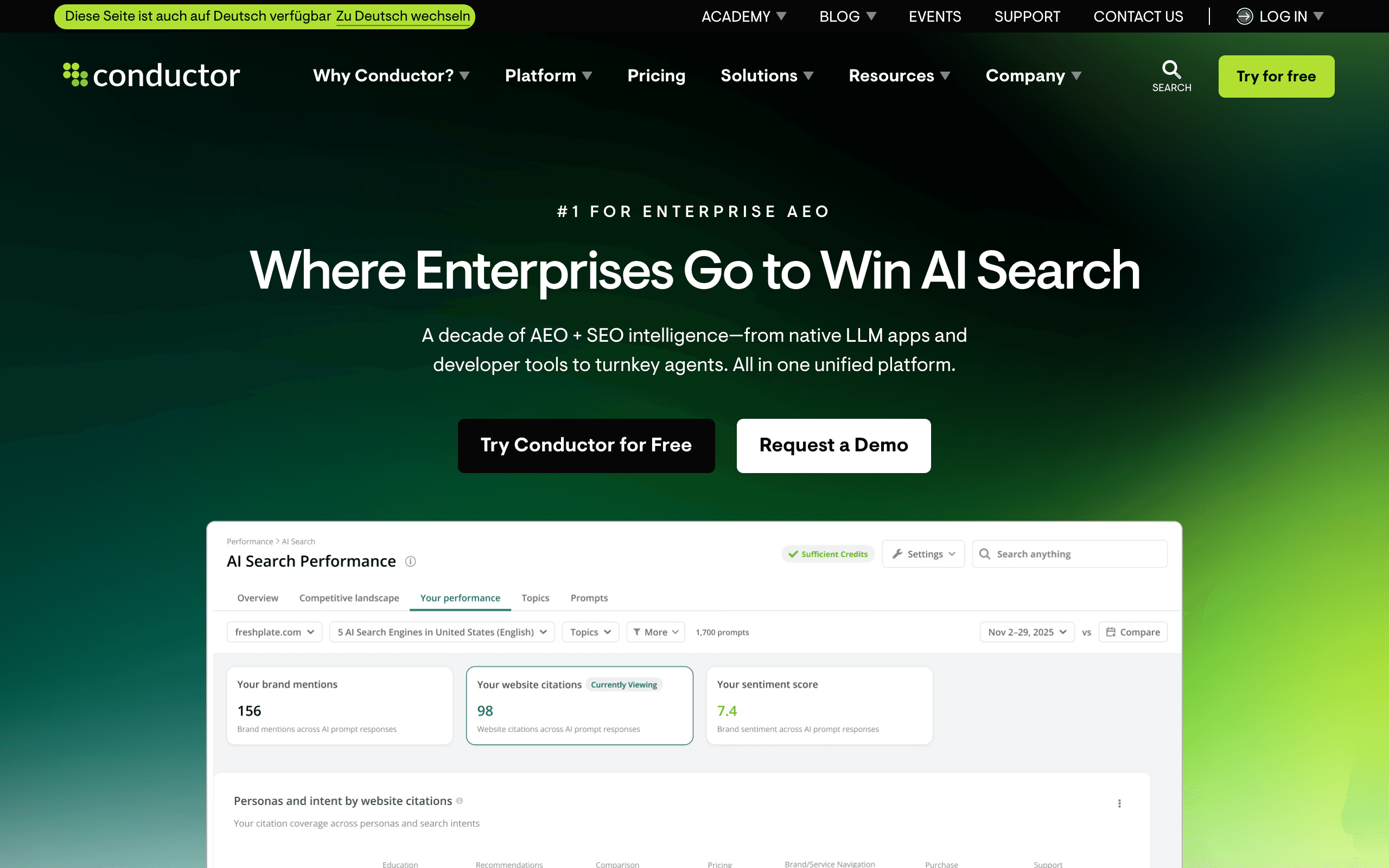
Conductor sits in the enterprise visibility tool category alongside BrightEdge and seoClarity. The platform covers organic search visibility tracking, content opportunity surfacing, and workflow management. The differentiator at the enterprise level is less about the visibility metric itself and more about who can use the platform alongside the SEO team (developers, content teams, executive stakeholders).
Pricing: enterprise, quote only. Conductor's pricing page lists plan capabilities but no prices, and sells through a demo (checked 2 October 2026).
7. BrightEdge
Best for: enterprise SEO visibility with AI-driven content recommendations and significant in-platform automation.
BrightEdge competes for the same enterprise audience as Conductor with a different emphasis: AI-driven content recommendations built on the platform's proprietary Data Cube. For brands publishing significant content volume, the recommendation layer takes the visibility data and translates it into content priorities automatically.
Pricing: enterprise, quote only. BrightEdge publishes no prices and sells through a demo (checked 2 October 2026).
How to choose a search engine visibility tool
Three questions decide which of these is right for your team.
Where are your buyers actually searching? This is the most important question and the most commonly skipped. If your buyer research happens primarily inside AI engines (most B2B SaaS, increasingly e-commerce, and growing in many consumer categories), Honeyb is the right starting point. If it still happens primarily on Google (still true for local services, much of B2C ecommerce, and many high-intent transactional searches), Sistrix or Ahrefs is the direct fit.
Do you want a market-indexed Visibility Score or a custom keyword-set score? Sistrix and Searchmetrics deliver fixed-keyword-set Visibility Scores that benchmark your domain against the market. Ahrefs, SEMrush, Conductor, BrightEdge, and Honeyb require you to bring your own keyword (or prompt) list. The benchmark approach is less work but less customised; the bring-your-own approach is more accurate to what your specific buyers actually search. With a bring-your-own list, the search volume weights can come from a keyword data API (early access), at $0.20 per batch of up to 1,000 keywords.
What budget range are you operating in? Honeyb starts at $29/month for single-engine monitoring. Ahrefs at $129/month. SEMrush at $139/month. The enterprise platforms Conductor and BrightEdge publish no prices and quote through a demo, and Searchmetrics consulting is priced on request. The published end of the category starts at $29 to $139 a month; the enterprise end is negotiated.
The category shift worth naming
The phrase 'search engine visibility tool' meant something specific until 2023. It meant a tool that scored how visible your domain was on Google for a fixed keyword set. That definition is narrowing in 2026 because Google is no longer the only relevant search engine in the way it was. AI assistants now handle a meaningful share of buyer research, and visibility on those surfaces measures differently.
The visibility-tool category is splitting: traditional SEO visibility tools (Sistrix, Ahrefs, SEMrush, Searchmetrics, Conductor, BrightEdge) cover one surface; AI search visibility tools (Honeyb and a small set of emerging competitors) cover the other.
Most brand teams running visibility measurement in 2026 are running one tool from each side, in parallel. The total cost is usually smaller than the cost of getting AI visibility wrong, which is invisible until pipeline drops three quarters later and no one can attribute the loss.
Closing
Search engine visibility measurement is no longer a single-surface discipline. The right tool depends on which surface your buyers are actually using. For the AI side, run a free check on one live engine, then the full report sets your baseline across the major engines. For the broader stack picture see best SEO tools for B2B companies, and for the conceptual frame on how the visibility-score idea has shifted see Searchmetrics visibility alternatives.