
There is no single best AI chatbot or best AI model in 2026, but there is a best one for what you actually do. ChatGPT, Gemini and Claude are the three consumer AI assistants most people are choosing between, and they have converged on a similar feature set while keeping distinct strengths. This guide compares the Big 3 head to head across the dimensions buyers care about, with verified mid-2026 model versions, prices and benchmarks.
The short answer
If you want one assistant for everything, ChatGPT remains the safe default: the broadest feature set, the largest user base, and a strong all-round model. Pick Gemini if you live inside Google Workspace, want the strongest free tier, or need long-document and video understanding. Pick Claude if writing quality, careful reasoning and serious coding matter most to you. All three are excellent, and the gaps between them are now measured in nuance rather than capability. The sections below go dimension by dimension, with a full comparison table and a best-for-X section near the end.
Who makes ChatGPT, Gemini and Claude
ChatGPT is made by OpenAI, the San Francisco lab that released the first ChatGPT in late 2022. After a 2025 restructuring, OpenAI operates as a public benefit corporation, OpenAI Group PBC, with Microsoft as its largest external shareholder, holding roughly a 27% stake following the October 2025 reorganisation, according to NBC News. So when people ask who owns ChatGPT, the answer is OpenAI itself, with Microsoft as a major investor rather than the owner.
That Microsoft tie runs deeper than ownership, because Microsoft Copilot is largely a second front door to the same OpenAI models, as our Copilot vs ChatGPT comparison sets out.
Gemini is made by Google, specifically Google DeepMind, the research division formed by merging DeepMind and Google Brain. Gemini is Google's family of multimodal models and also the name of its consumer assistant app, which replaced the earlier Bard product. Claude is made by Anthropic, founded in 2021 by former OpenAI staff including siblings Dario and Daniela Amodei. Amazon is Anthropic's largest investor and Google has invested heavily too, but per Wikipedia's Anthropic profile and multiple ownership analyses, Google is contractually capped at a minority stake with no board control, so Anthropic remains independently governed.
Latest models in mid-2026
Each provider ships a fast everyday model and a slower, more capable reasoning model. As of mid-2026 the consumer flagships are GPT-5.5 from OpenAI, Gemini 3.1 Pro from Google, and Claude Opus 4.8 from Anthropic, all large multimodal language models. If you want the background on how these systems are built and how they differ from image or video generators, see our explainer on generative AI models. Version numbers move quickly, so treat these as a snapshot rather than a permanent state.
| Provider | Everyday model | Flagship model | Released |
|---|---|---|---|
| OpenAI (ChatGPT) | GPT-5.5 Instant | GPT-5.5 / GPT-5.5 Pro | GPT-5.5 in April 2026 |
| Google (Gemini) | Gemini 3.5 Flash | Gemini 3.1 Pro | Gemini 3.1 Pro in February 2026 |
| Anthropic (Claude) | Claude Haiku 4.5 / Sonnet 4.6 | Claude Opus 4.8 | Opus 4.8 on 28 May 2026 |
OpenAI made GPT-5.5 Instant the default model in ChatGPT on 5 May 2026, replacing the previous default, according to OpenAI's help centre. Google's current flagship, Gemini 3.1 Pro, followed the November 2025 launch of Gemini 3 and is positioned as state of the art in reasoning and multimodality, per Google's Gemini 3 announcement. Anthropic released Claude Opus 4.8 on 28 May 2026 as its most capable model for complex reasoning and long agentic coding, as described in Anthropic's announcement.
Reasoning and maths
On the hardest reasoning and maths benchmarks, GPT-5.5 has an edge in mid-2026, with Gemini 3.1 Pro and Claude Opus 4.8 close behind. Independent comparisons compiled by reviewers such as DataCamp show GPT-5.5 leading on tests like FrontierMath and ARC-AGI-2, where it posts the strongest scores of the three. GPT-5.5 Pro, the most expensive variant, pushes those numbers higher still for research-grade problems.
That said, benchmark gaps rarely change the answer for everyday questions. All three handle multi-step logic, word problems and structured analysis competently, and each exposes an extended-thinking mode (OpenAI's reasoning models, Gemini's Deep Think, Claude's extended thinking) that trades speed for depth. So for the best AI for maths at the frontier, GPT-5.5 currently leads, while for typical quantitative work the differences are small. Maths benchmarks are also revised often: Epoch released a corrected FrontierMath in June 2026, so exact figures shift between reports.
Best AI for writing
Claude is the most widely praised for writing quality, with ChatGPT a close and more versatile second. Claude tends to produce prose that needs less editing: measured, coherent, and good at holding a consistent voice across long documents. ChatGPT is the most flexible, switching registers easily and following detailed style instructions well, which makes it a strong generalist for marketing copy, emails and scripts. Gemini has improved sharply and is competitive, particularly when a draft needs to pull in facts from the live web.
For a deeper look at how the two most popular writing assistants differ, see our Claude vs ChatGPT comparison. As a rule of thumb for the best AI for writing: choose Claude when you want the cleanest first draft, and ChatGPT when you want one tool that adapts to many formats.
Best AI for coding
For serious coding, Claude and GPT-5.5 are the front-runners, with Gemini strong on large codebases. Claude Opus 4.8 is built for long agentic coding tasks and scores around 88.6% on SWE-bench Verified, a widely cited measure of real-world bug fixing, according to benchmark roundups such as Fenxi's model comparison. Anthropic also offers Claude Code, a terminal-based coding agent included with paid Claude plans, which has made Claude a favourite among professional developers.
GPT-5.5 is an excellent coder too, particularly for one-shot problem solving and a smooth in-chat experience, and OpenAI's Codex tooling is mature. Gemini's advantage is context: its very large context window and multimodal input let it reason over big repositories, design files and screenshots in one pass, and Google bundles its Jules coding agent into paid tiers. For the best AI for coding, most professional developers in 2026 reach for Claude or GPT-5.5 first, then lean on Gemini when the task is repository-scale or visual.
Best AI for research, web search and citations
For research that needs current sources, Gemini and ChatGPT have the edge, because both connect tightly to the live web and cite their sources. Gemini draws on Google Search and underpins AI Overviews, which makes it strong at surfacing and linking recent material; our Gemini vs ChatGPT comparison goes deeper on how the two handle live search. ChatGPT browses the web and produces clickable citations, and its Deep Research mode compiles long, sourced reports. Claude can search the web too and is careful about what it claims, though it has historically been more conservative about browsing by default.
Each assistant also ships a long-form research mode that runs many searches and returns a structured, cited report. If verifiable sourcing is your priority, our guide to the best AI search engines in 2026 covers how these tools find and cite material, and our Perplexity vs Claude vs Gemini comparison adds a dedicated answer engine to the mix. For the best AI for research, Gemini is the natural pick inside the Google ecosystem, while ChatGPT's Deep Research is the most polished standalone report generator.
Multimodal, images and voice
All three are multimodal, but Gemini is the most complete across images, audio and video, while ChatGPT leads on image generation polish. Gemini accepts text, images, audio and long video in a single context window and generates images with Google's Nano Banana model, making it the most capable for analysing a video clip or a stack of screenshots. ChatGPT's native image generation is widely regarded as the most refined for creative output, and its Advanced Voice mode offers natural spoken conversation. Claude handles images and documents well and is excellent at reading charts, tables and PDFs, but it does not generate images and its voice features are less central.
On speed, the everyday models are close. All three now route simple turns to a fast model and engage a heavier reasoning model only when a question is hard, so in daily use the experience is more similar than different.

Want to get recommended by AI?
Check your AI search visibility, then let the Honeyb agent write, fix, and earn what gets you recommended. Free to start.
Agents and automation
All three assistants have moved beyond answering questions to taking actions on your behalf. Anthropic offers Claude Code, a terminal-based coding agent bundled with paid Claude plans, and Claude is widely used to drive multi-step agentic workflows. OpenAI has built agentic, task-running features into ChatGPT for paid users alongside its developer tooling, and Google bundles its Jules coding agent into paid Gemini tiers while wiring Gemini across Gmail, Docs and the wider Workspace suite.
If your work involves long, multi-step tasks rather than single answers, agentic capability is becoming a real point of difference, and Claude and ChatGPT currently lead it for developers. One caveat applies to all three: they still make confident mistakes, so treat any answer as a strong draft, lead with the cited source when accuracy matters, and verify anything you plan to act on.
Pricing, free tiers and privacy
All three offer a genuinely usable free tier and paid plans from around $20 per month, with Gemini currently the most generous at the low end. Prices below are consumer plans in USD as of mid-2026 and change often.
| Plan | ChatGPT (OpenAI) | Gemini (Google) | Claude (Anthropic) |
|---|---|---|---|
| Free | $0, GPT-5.5 with limits | $0, Gemini 3.5 Flash plus daily Pro | $0, Sonnet with limits |
| Entry paid | Go (budget tier) | AI Plus, $4.99/mo | Pro, $20/mo ($17 annual) |
| Mid paid | Plus, $20/mo | AI Pro, $19.99/mo | Max 5x, $100/mo |
| Top consumer | Pro, $200/mo | AI Ultra, $99.99/mo | Max 20x, $200/mo |
ChatGPT's Plus plan is $20 per month and its Pro plan sits at $200 per month for near-unlimited use of the strongest models, per OpenAI's pricing page. Google's lineup runs from AI Plus, recently reduced to $4.99 per month, through AI Pro at $19.99, to AI Ultra at $99.99 after Google cut it from $249.99 at I/O 2026, according to Google's subscriptions update. Claude offers Pro at $20 per month (or $17 billed annually) and two Max tiers at $100 and $200, as listed in Anthropic's Max plan help article.
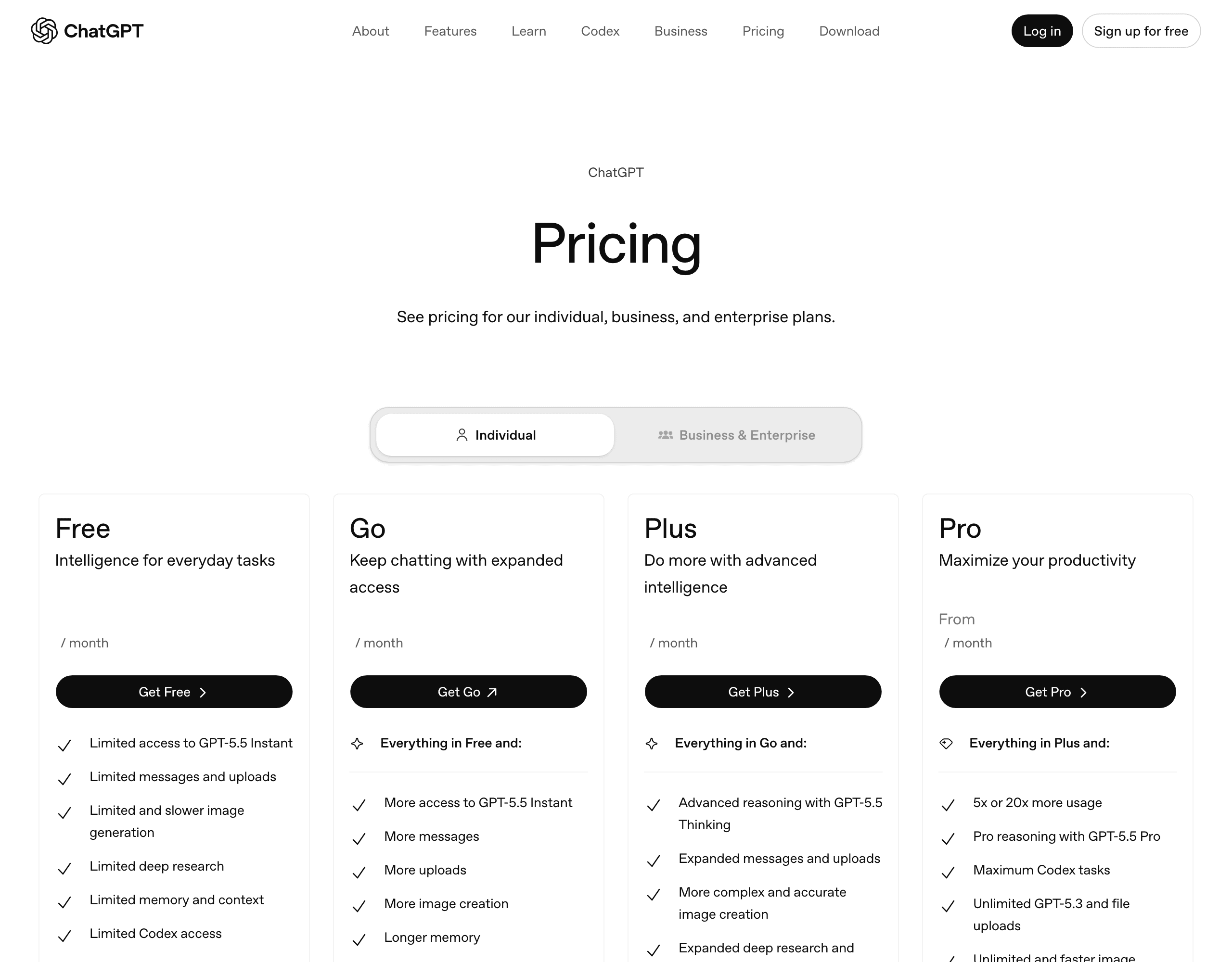
On free tiers, all three impose rolling usage caps that reset every few hours and can vary with demand. ChatGPT's free tier gives limited GPT-5.5 access before dropping to a lighter model, Gemini's free tier defaults to Flash with a daily allotment of its Pro model plus image generation and voice, and Claude's free tier runs on Sonnet with five-hourly limits. So yes, Claude AI is free to use, as are ChatGPT and Gemini, but heavy users will hit the caps. For value at the bottom of the range, Gemini's free and $4.99 tiers are hard to beat, partly because Google bundles storage and Workspace features.
On privacy, all three let consumers opt out of having their chats used to train models and publish detailed safety documentation. Anthropic has built its brand around safety research and constitutional AI, and Claude is often chosen for its cautious, well-aligned behaviour. OpenAI and Google both offer settings to disable training on your data and provide enterprise tiers with stronger guarantees. For an individual the differences are modest: check the data controls, turn off training if you prefer, and avoid pasting confidential information into any consumer chatbot.
The verdict at a glance
| Dimension | ChatGPT | Gemini | Claude |
|---|---|---|---|
| Maker | OpenAI | Google DeepMind | Anthropic |
| Flagship (mid-2026) | GPT-5.5 | Gemini 3.1 Pro | Opus 4.8 |
| Reasoning & maths | Strongest at the frontier | Very strong | Very strong |
| Writing | Most versatile | Improving fast | Cleanest prose |
| Coding | Excellent | Strong on large code | Best for agentic coding |
| Research & citations | Polished Deep Research | Best web grounding | Careful, conservative |
| Multimodal | Best image generation | Most complete (video/audio) | Strong document reading |
| Image generation | Yes | Yes | No |
| Free tier | Good | Most generous | Good |
| Entry paid price | $20 (Plus) | $4.99 (AI Plus) | $20 (Pro) |
Which AI is best for each task?
The best AI assistant depends on the task in front of you. Here is the quick answer for the most common jobs, drawn from the comparison above.
- Best all-rounder: ChatGPT, for the widest feature set and a strong model across every task.
- Best for writing: Claude, for the cleanest first drafts and consistent long-form tone.
- Best for coding: Claude Opus 4.8 or GPT-5.5, with Gemini for repository-scale and visual tasks.
- Best for research with sources: Gemini for live web grounding, ChatGPT for polished cited reports.
- Best for maths and hard reasoning: GPT-5.5 at the frontier, all three for everyday problems.
- Best for video, audio and multimodal: Gemini, for handling images, audio and long video in one context.
- Best value: Gemini, thanks to its strong free tier and low-cost AI Plus plan bundled with Google storage.
Adoption and why visibility now matters
ChatGPT is still the most used AI assistant by a wide margin, but Gemini and Claude are growing fast, and exact figures vary by methodology and source. Gemini benefits from Google's distribution across Search and Android, while Claude has grown sharply in 2026 and performs especially well in professional and developer settings. Our AI chatbot market share analysis for May 2026 covers how these shares are measured and where they are heading.
Market share (%)
The four leading AI assistants by market share
As buyers increasingly ask all three assistants which products and brands to choose, being recommended by all of them is becoming its own discipline. People no longer just search; they ask for a shortlist, and the names in those answers win the consideration set. Each model draws on different sources and reasons differently, so a brand can be recommended confidently by one assistant and missing from another. Understanding how AI models choose which brands to recommend is now as important as understanding traditional search ranking.
That is the gap Honeyb is built to close. Honeyb tracks how ChatGPT, Gemini, Claude and other assistants describe and recommend your brand, so you can see where you appear, where you are absent, and where the description is wrong. This emerging practice, often called generative engine optimisation, is explained in our guide to what GEO is. The Big 3 are now a distribution channel, and showing up accurately across all of them is the work.
The bottom line
ChatGPT, Gemini and Claude are all excellent in 2026, and the right choice depends on your priorities rather than any single winner. Choose ChatGPT for a versatile default, Gemini for value, multimodal depth and Google integration, and Claude for writing and serious coding. Many people end up using two of them, a fast generalist plus a specialist, because a second subscription is cheap and the strengths are complementary. Whichever you pick, the bigger shift is that these assistants now shape what millions of people buy, so being visible and accurately described across all three is no longer optional.
Sources cited in this report