
The gemini vs chatgpt comparison gets framed as a fight to the death, but the two products were built by companies with very different starting points, and it shows in how they behave. ChatGPT is the assistant that defined the category and still leads it: a general-purpose tool that answers from its own knowledge and reaches for the web when a question needs it. Gemini is Google's assistant, born inside the largest search index in the world and now embedded at the operating-system level across Android, which is a large part of why its usage has climbed so fast. By the end of May 2026, ChatGPT's share of global AI-assistant usage had slipped to 46.4 per cent, the first time it fell below half, with Gemini in clear second at 27.7 per cent, according to Sensor Tower data reported by TechCrunch. That trend is the backdrop to the question buyers actually ask: which one should I use, and for what. This guide compares the two across how they work, web access and citations, accuracy, models, context windows, and pricing, then gives a verdict by job.
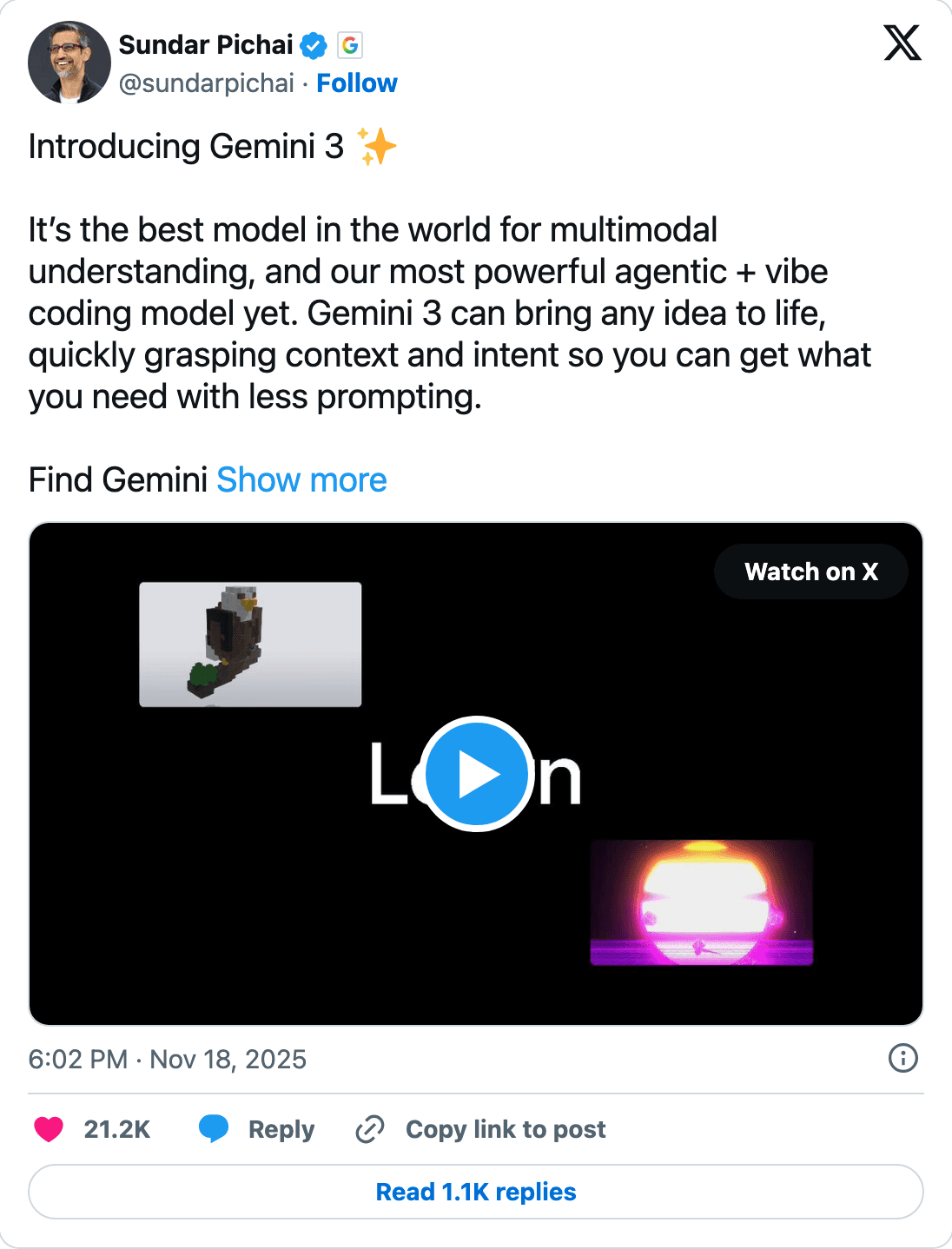
Google set the stakes plainly when it launched the latest generation. Chief executive Sundar Pichai introduced Gemini 3 as the best model in the world for multimodal understanding, a claim aimed squarely at ChatGPT.
How each one works, and what it optimises for
Both products are general-purpose assistants that can write, reason, code, and search the web. The differences are in the ecosystem each one is wired into and the defaults each one ships with.
ChatGPT answers from the model's own knowledge first and searches the live web when a question clearly needs fresh or specific information, or when you turn search on. That makes it a flexible generalist: it will draft, summarise, debug, brainstorm, or hold a long conversation without touching a source, and it pulls in the web when freshness matters. ChatGPT Shopping now surfaces product cards directly inside commercial answers, which makes it a high-stakes surface for anyone selling something. For the mechanics of how an answer engine retrieves and cites, see how AI search works.
Gemini starts from Google's home turf. Its grounding feature connects the model to live Google Search results, and Google's own developer documentation describes how the model analyses a prompt, decides whether a search would improve the answer, runs one or more queries, and returns a response with grounding metadata that links specific passages back to the web sources it used (Gemini grounding docs). On top of that, Gemini plugs into Gmail, Docs, Drive, and the rest of Google Workspace, and its Deep Research mode runs an extended multi-source investigation and returns a structured report. If your work already lives in Google's ecosystem, Gemini has the least friction of any assistant.
In short, ChatGPT optimises for being the most capable standalone assistant, with the largest install base and the deepest habit of use. Gemini optimises for reach and integration: it is grounded in the world's largest index, sits inside the products billions of people already use, and now ships with Android itself. For how the leading tools stack up across the wider field, see the rundown of the best AI search engines in 2026.
Web access and citations
This is where the two feel most alike on the surface and differ underneath.
Both engines search the live web, and both attach citations when they do. Gemini's edge is the index behind it. When Gemini grounds an answer, it is querying Google Search, the broadest and freshest crawl of the open web, and it returns grounding metadata that links specific passages back to the pages they came from (Gemini grounding docs). For everyday questions, local lookups, and anything where recency and breadth of coverage matter, that reach is a real advantage. It is worth separating Gemini the standalone assistant from Google's AI Mode and AI Overviews, which share the Gemini model family but live inside Search itself; this comparison is about the standalone Gemini app.
We unpack that split in full in our piece on Google AI Mode versus Gemini, which explains how the in-Search surface and the standalone app cite and name brands differently even on the same question.
ChatGPT cites when it searches, and free users can run web search. OpenAI's ChatGPT Search documentation describes inline citations you can hover and click, with a sources panel beneath the response. The difference is consistency. Because ChatGPT answers from training data by default and searches only when it judges the question needs it, a given reply may be fully sourced, partly sourced, or generated with no citations at all. For casual questions that is fine; for anything you plan to rely on, you have to confirm it actually searched, which adds a step.
One caution applies to both. A citation proves where a passage came from, not that the sentence above it is faithful to the source. Independent testing of AI search tools has repeatedly found that the dominant error is not invented links but misattribution: a real, working source credited with a claim it does not actually make. Citations make that easier to catch. They do not make checking optional. For why a single good answer does not prove durable visibility, see why spot-checking fails.
Accuracy and hallucination behaviour
Neither engine is hallucination-free, and anyone claiming otherwise is overselling. The useful question is how each one fails and how easy the failure is to catch.
ChatGPT's accuracy depends heavily on whether it searched. When it does, performance on current questions is strong and verifiable. When it answers from training data alone, it can produce a fluent, plausible answer that is wrong or out of date, with no source to check against. OpenAI has worked the problem hard. It reports that GPT-5.5 Instant, the default ChatGPT model since May 2026, significantly reduces hallucinations in high-stakes domains such as medicine, law, and finance, with the company citing a cut of more than 50 per cent against its predecessor on those prompts, as reported by The AI Insider. OpenAI attributes the improvement less to a smarter base model than to behavioural changes: better tool use, checking its own work, grounded search, and post-training penalties for overconfident wrong answers.
Gemini's accuracy is anchored by grounding. Because the standalone Gemini app can pull live Google Search results into an answer and link them, fact-seeking questions tend to arrive with sources attached, which lowers the rate of confident invention and makes the failure easier to spot. Google reports that Gemini 3 scores 72.1 per cent on SimpleQA Verified, a benchmark for factual accuracy, and tops the LMArena leaderboard, per its Gemini 3 announcement. Benchmarks are not the same as your specific question, and Gemini can still state something wrong with full confidence when grounding does not fire or the underlying sources disagree.
The honest read on both: grounding lowers the rate of confident invention, but it does not eliminate error, and the most common mistake is a real source pointed at the wrong claim. Treat citations as a head start on verification, not a substitute for it. The same selection logic that decides which sources an engine trusts also decides which brands it names, which we unpack in how AI models choose which brands to recommend.
Models offered
Both products run on their maker's own frontier models, packaged a little differently.
ChatGPT runs on OpenAI's model family. The default is GPT-5.5 Instant, which became ChatGPT's standard model in May 2026, with heavier reasoning variants for harder work and a Pro variant reserved for the paid Pro tiers. You are choosing between variants of one provider's models, tuned for speed versus depth, inside a tightly integrated single-vendor stack.
Gemini runs on Google's Gemini model family. The flagship is Gemini 3, launched on 18 November 2025, which Google describes as its most intelligent model, handling text, images, video, audio, and code natively, per the Gemini 3 announcement. The family has since extended to variants such as Gemini 3.1 Pro for advanced reasoning and Gemini 3.5 Flash for fast agentic and coding work, documented in Google's model list. A Deep Think mode adds heavier reasoning for the hardest problems. As with ChatGPT, you are choosing among one provider's models rather than mixing labs; for an engine that lets you pick the model yourself, see Perplexity vs ChatGPT.

Want to get recommended by AI?
Check your AI search visibility, then let the Honeyb agent write, fix, and earn what gets you recommended. Free to start.
Context windows and multimodality
Context window is the amount of text, code, and other input a model can consider at once, and it matters most for working over long documents, large codebases, or extended conversations.
Here the two are closely matched at the top. Gemini 3 carries a 1 million-token context window and native multimodality across text, images, video, audio, and code, which makes it strong for analysing long PDFs, video, and whole repositories in one pass (Gemini 3 announcement). GPT-5.5 also offers a context window of around 1 million tokens, bringing ChatGPT level on raw capacity for long-context work, per OpenAI's model documentation. The practical differences now come down to integration and consistency rather than headline window size. Gemini's multimodal range and Workspace hooks give it an edge for document- and media-heavy work inside Google's tools, while ChatGPT's long track record makes it the more predictable generalist across writing, coding, and reasoning. For more on how engines read images, voice, and video, see multimodal AI models.
Pricing and tiers (verified June 2026)
Both offer a real free tier and then several paid steps. The figures below are current as of June 2026. Pricing and limits change often, so check each provider before you commit.
ChatGPT spans Free, Go at around 8 US dollars a month, Plus at around 20 US dollars a month, a Pro line split across roughly 100 and 200 US dollars a month, plus Business at about 25 to 30 US dollars per seat a month and custom Enterprise pricing. Since 9 February 2026, the Free and Go tiers carry advertising for logged-in US adults, shown in clearly labelled sponsored boxes kept separate from the answer, with the pilot set to expand to more countries through the year, according to MacRumors. Every paid tier stays ad-free. Plus is the common choice for individuals who want the full model suite without ads.
Gemini, following an overhaul at Google I/O 2026, offers a free tier and then Google AI Plus at around 8 US dollars a month, Google AI Pro at around 20 US dollars a month, and Google AI Ultra starting at about 100 US dollars a month, with the top Ultra tier at 200 US dollars a month. The paid plans bundle Google One storage, higher usage limits, and YouTube Premium perks, and Google moved to consumption-based billing where heavier video or coding prompts use more quota than simple text, as reported by The Decoder. AI Pro is the closest analogue to ChatGPT Plus for an individual who wants the full assistant.
| Feature | Gemini | ChatGPT |
|---|---|---|
| Maker | OpenAI | |
| Core design | Assistant grounded in Google Search, deep Workspace integration | General assistant, search on demand, large install base |
| Web access | Grounding with live Google Search, broadest index | Browses when the question needs it |
| Citations | When grounded, linked to web sources | When it searches the web |
| Default model | Gemini 3 family | GPT-5.5 Instant |
| Context window | 1M tokens (Gemini 3) | ~1M tokens (GPT-5.5) |
| Multimodality | Native text, image, video, audio, code | Text, image, voice, with strong tooling |
| Free tier | Yes, full assistant with grounding | Full chat plus web search, ads for US logged-in users |
| Entry paid tier | Google AI Pro, around 20 USD per month | Plus, around 20 USD per month |
| Strongest at | Multimodal and document work, Google ecosystem, reach | Writing, coding, reasoning, long conversations |
A decision framework: which to use when
Rather than crown one winner, map the job to the tool. Both are capable generalists, so the split comes down to ecosystem, multimodality, and habit.
- Work that lives in Google Workspace, drafting in Docs, triaging Gmail, building in Sheets: Gemini, for the native integration.
- Everyday questions where breadth and freshness matter, local lookups, current events, quick factual checks: Gemini, for the live Google index behind grounding.
- Long-form writing, editing, and tone work: ChatGPT, which most users still find the steadier writer, though Gemini is competitive.
- Coding, debugging, and technical reasoning: either, with ChatGPT the more established default and Gemini 3.5 Flash strong on agentic coding.
- Multimodal analysis of video, audio, images, and long PDFs: Gemini, for its native multimodal range and 1M-token window.
- Extended, memory-heavy conversation and broad daily assistance: ChatGPT, for its maturity and habit of use.
- Shopping and commercial product research: ChatGPT, where Shopping cards surface inside answers.
The honest summary is that many people end up using both, often without paying for either. If you live in Google's tools, Gemini is the path of least resistance. If you want the most established standalone assistant, ChatGPT is still that. For a citation-first research engine that sits alongside both, our Perplexity vs ChatGPT comparison covers the third option most teams consider.
The verdict by job
Is Gemini better than ChatGPT? For multimodal work, Google-ecosystem tasks, and questions that benefit from the broadest live index, Gemini has a real edge. For general-purpose assistance, long conversations, and the deepest install base, ChatGPT still leads. The two are close enough on raw capability that the deciding factor is usually where your work already lives.
If you are weighing up a third contender rather than just these two, our ChatGPT vs Gemini vs Claude comparison puts the Big 3 consumer assistants side by side on web access, reasoning and price.
Choose Gemini when the value is in reach and integration: research grounded in Google Search, work inside Docs and Gmail, analysis of video or long documents, or simply the assistant your Android phone already ships with. Choose ChatGPT when the value is in a mature, flexible generalist: drafts, code, plans, extended back-and-forth, and commercial product research with Shopping built in. If you can only justify one paid subscription, pick the one that matches the work you do most days. If you can use both for free, do, and send each question to the tool built for it.
The market context reinforces the point. ChatGPT is still the largest AI assistant by usage, with over 1.1 billion monthly users, but its share slipped below 50 per cent for the first time in May 2026, to roughly 46 per cent, while Gemini reached about 28 per cent on the back of roughly 662 million monthly users and its embedding into Android, per TechCrunch. The chart below shows how the leading engines have moved over time, and the May 2026 market-share breakdown digs into the numbers.
That scale is also why the per-query footprint of these engines gets asked about, and the honest figures on how much water and energy one ChatGPT search uses put a single prompt at roughly 0.34 watt-hours against Gemini's 0.24, far below the viral claims.
Market share (%)
The four leading AI assistants by market share
What this means for brand visibility in AI answers
If you are a marketer or founder rather than an everyday user, the comparison reframes itself. Gemini and ChatGPT are two distinct surfaces where buyers form opinions about your brand, and they reward different things. For the wider picture of what AI search is and why it matters, see what is AI search.
Gemini, grounded in Google Search, leans on the same broad index that powers traditional ranking, so a brand with strong, well-structured, widely-cited content and a credible presence on the third-party sites and communities Google trusts is more likely to be retrieved and named. ChatGPT, which answers from model knowledge and searches selectively, rewards brands that are well-represented across the wider web that trains and grounds these models, so that you can be recommended even when no live search runs. Both increasingly weigh the same off-site signals: review profiles, authoritative lists, and community discussion. Our breakdown of how AI models choose which brands to recommend covers the signals that move both.
Because the two engines decide differently, a brand can be visible in one and absent in the other. Good standing in Gemini does not guarantee a mention in ChatGPT, and the reverse is just as true. The practical takeaway is to treat them as separate surfaces that happen to share a category: check both, and track how each one describes and ranks you over time rather than spot-checking once. You can get a quick read with our free AI visibility checker, then move to systematic monitoring once you know which engine is the priority. The comparison that matters for a brand is not which engine is better, but whether you show up well in each of them.
Sources cited in this report