Ask Google a question today and you might be talking to two different products that look almost identical and run on the same engine. One is Google AI Mode, the conversational answer experience built into Search. The other is the Gemini app, Google's standalone assistant. Both speak in the same confident, synthesised prose. Both are powered by the Gemini model family. And yet they are not the same thing, they are not used for the same jobs, and crucially for any brand, they decide differently which companies to name and which sources to cite. The google ai mode vs gemini question matters because being visible in one tells you almost nothing about being visible in the other. This piece sets out exactly where they overlap, where they diverge, and what each surface means for how buyers encounter your brand.
If you want the wider context for how generative answers are assembled before reading on, our explainer on how AI search works walks through the retrieve-then-synthesise pipeline that both of these surfaces sit on top of.
Is AI Mode the same as Gemini?
The short answer is no, and the longer answer is the useful one. AI Mode and the Gemini app share a brain but live in different bodies. Both draw on Google's Gemini models, and at Google I/O 2026 in May the same model, Gemini 3.5 Flash, became the default powering AI Mode in Search globally as well as the free Gemini app (Google). So when people ask whether AI Mode is the same as Gemini, the honest framing is that they are two distinct products built on a shared model, in the way that two cars can share an engine and still be very different vehicles.
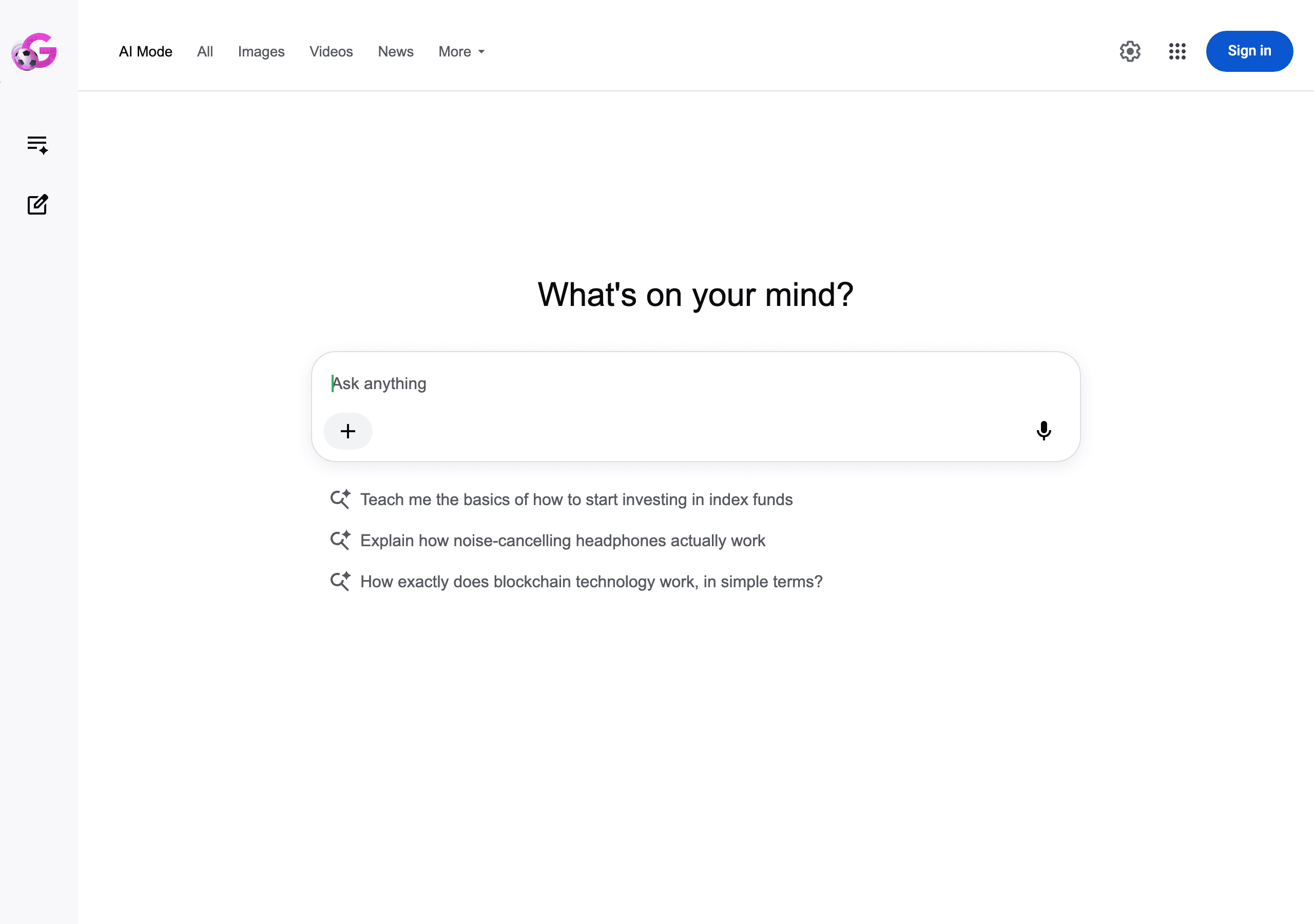
The differences are about surface, intent and behaviour. Surface is where you find it. AI Mode is a feature inside Google Search, reached from the search box. The Gemini app is a separate destination at gemini.google.com and a dedicated mobile app. Intent is what people open it to do. AI Mode answers search-style questions with live, cited results. The Gemini app is a working assistant for writing, coding, analysing uploaded files and sustained back-and-forth. Behaviour is the part brands care about. The two surfaces pull from different source mixes and surface different brands, even for the same question.
It also helps to separate AI Mode from AI Overviews, which are easy to confuse. An AI Overview is the generated summary that appears at the top of an otherwise normal results page. AI Mode is the fuller conversational experience you step into, which fans your question out into related searches and returns a synthesised answer with follow-ups. Our guide to how to appear in AI Overviews covers that specific surface in depth, and our piece on how to turn off AI Overviews and AI Mode covers the opt-out side for searchers who would rather have plain links.
If you want the full grounding before the comparison, our explainer on what Google AI Mode is sets out how the surface works, how it differs from AI Overviews, and the steps that make your pages eligible to be cited in it.
Where each one lives, and what it is for
Start with the practical map, because the surface decides almost everything else. AI Mode sits inside the product the largest share of the planet already uses to look things up. At I/O 2026 Google reported that AI Mode had surpassed one billion monthly users just a year after its debut, with queries more than doubling every quarter since launch (Google). It is reached from Search, it expects search-shaped questions, and it answers them with current web results and inline citations. AI Mode has also expanded to over 200 countries and territories and dozens of languages, which is why so many buyers now hit it without ever choosing to (Google).
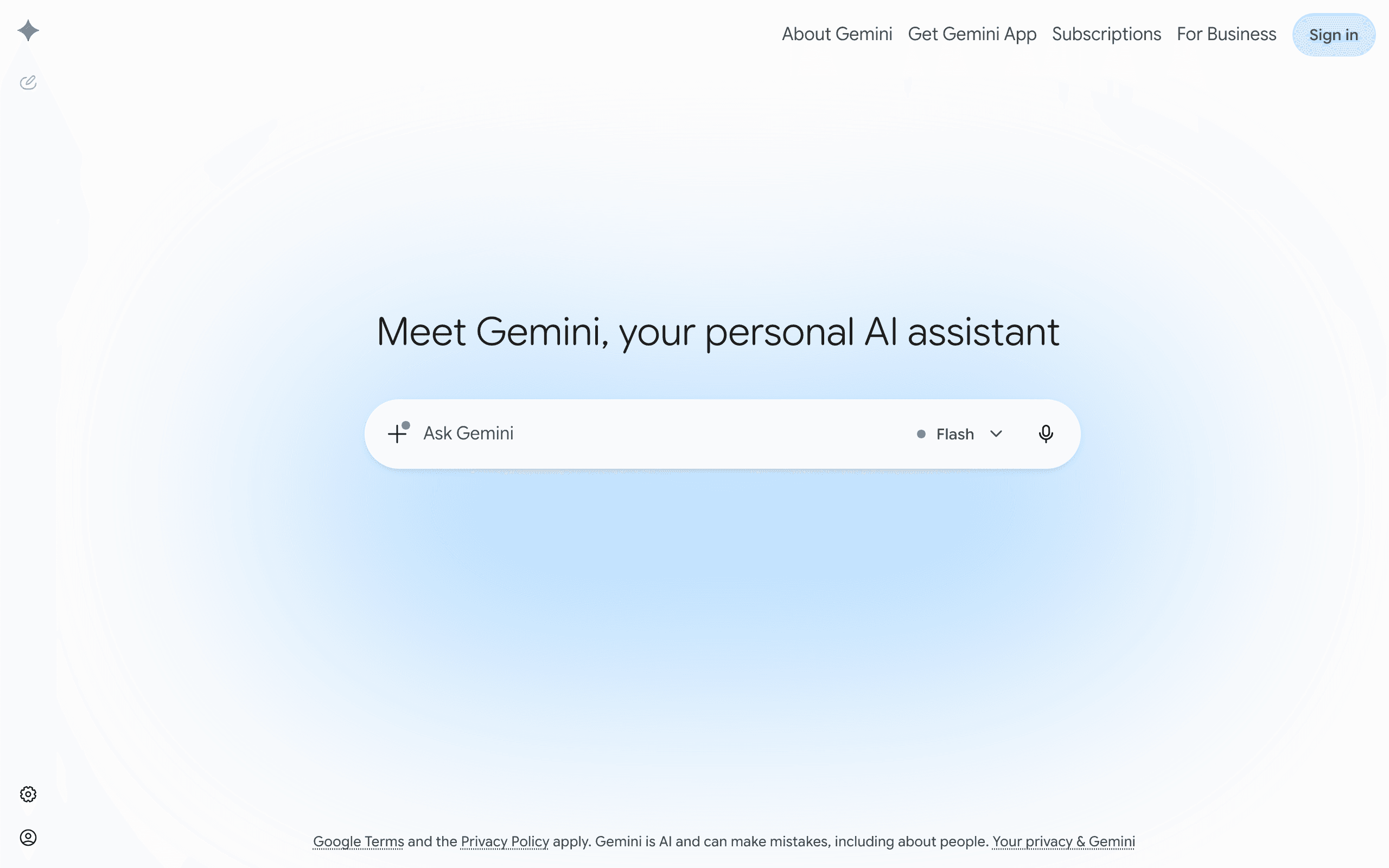
The Gemini app starts from a different premise. It is an assistant, not a search box. People open it to draft documents, write and debug code, summarise long reports, analyse a spreadsheet or an image they have uploaded, and hold a multi-step conversation that remembers context. It can search the live web and ground its answers in Google Search when a question benefits from it, but search is one capability among many rather than the whole point of the product. The redesigned 2026 app leans into this, with a workspace feel built around getting things done rather than returning links.
That difference in intent shows up in the queries each one receives. Google has said that with AI Mode it is already seeing people ask questions nearly three times longer than traditional searches, the comparison-and-research questions that suit a conversational answer (Google). The Gemini app, by contrast, fields the open-ended creative and analytical work that has nothing to do with finding a web page at all. The same person may use both in a day for completely different reasons.
gemini vs google ai mode: the side-by-side
Here is the comparison that resolves the question for most people. Treat it as a starting map rather than the last word, because Google iterates on both surfaces frequently.
| Dimension | Google AI Mode | Gemini app |
|---|---|---|
| Where it lives | Inside Google Search | Standalone app and gemini.google.com |
| Primary intent | Search-style questions, research, comparisons | Writing, coding, analysis, sustained tasks |
| Default model (mid-2026) | Gemini 3.5 Flash | Gemini 3.5 Flash, limited Gemini 3.1 Pro |
| Live web by default | Yes, every answer is grounded in web results | Yes, but grounding is one tool among many |
| Cites and links sources | Yes, prominent inline citations | Yes when grounded, but lighter linking |
| File and image upload | Limited | Yes, core capability |
| Memory across sessions | Within a session, resets after | Persistent memory and projects |
| Cost | Free, part of Search | Free tier, paid tiers add capacity |
Two rows deserve a note. On the model, the free Gemini app defaults to Gemini 3.5 Flash with limited access to the more capable Gemini 3.1 Pro, and paid tiers raise those limits (Google). AI Mode runs Gemini 3.5 Flash for everyone, which is why an answer in AI Mode and an answer in the free Gemini app can read so similarly. On cost, AI Mode is bundled into Search at no charge, while the Gemini app has a free tier plus paid Google AI subscriptions. At I/O 2026 Google cut the entry plan and restructured the top end: Google AI Plus dropped to 4.99 dollars a month from 7.99 dollars, Google AI Pro stayed at 19.99 dollars, and Google AI Ultra now starts at 99.99 dollars with a higher 200 dollar tier (Google, Engadget). The paid tiers buy more usage and higher-capability models, not a different search behaviour.
How brands appear, and why the two surfaces diverge
This is the section that matters if you are responsible for a brand rather than just searching. AI Mode and the Gemini app draw on different source mixes, so a brand can be named cleanly in one and absent from the other, even for the same buyer question. The mechanism behind AI Mode explains half of it.

Want to get recommended by AI?
Check your AI search visibility, then let the Honeyb agent write, fix, and earn what gets you recommended. Free to start.
AI Mode uses a technique Google calls query fan-out. Rather than running your question as a single search, it decomposes the query into a set of related sub-queries, runs them in parallel across the web, evaluates the returned content with Google's ranking and quality signals, then synthesises the strongest material into one answer with citations (Aleyda Solis). A standard question typically fans out into a handful of sub-queries, and more for deeper research. The practical effect is that visibility is no longer about ranking first for one phrase. It is about whether your content gets extracted as the authoritative passage for one of the many sub-queries the engine invents on your behalf. Independent tracking suggests passage extraction has already loosened the grip of top rankings: one analysis found that top-ten rankers accounted for around 76 per cent of Google AI citations in mid-2025, a share that had fallen to roughly 38 per cent by early 2026 (Green Flag Digital). A brand that ranks well for the head term can be invisible if its pages do not answer the adjacent questions the fan-out generates.
The two surfaces then behave differently when it comes to citing brands at all. The standalone Gemini app does not return links to your site in anything like the volume Search does, so much of the benefit there accrues indirectly, through how the model has internalised your brand from the wider web rather than through a live click-through citation (Green Flag Digital). Separate citation research has found Gemini leans heavily on brand-owned websites when it does cite, with roughly half of its citations coming from a brand's own domain, the highest rate among the major engines studied (Yext). Read those points together and the divergence makes sense. AI Mode behaves like a research engine that fans out and prefers independent corroboration. The Gemini app behaves more like an assistant that trusts a well-structured first-party site when it is grounding an answer, and otherwise speaks from what it has learned.
There is a second, quieter route into the Gemini app that has nothing to do with live citations. When someone asks the assistant about your category without prompting a web search, the model answers partly from what it learned in training and how it has internalised your brand from the wider web. That representation is shaped over time by consistent entity signals, accurate descriptions across the sources models read, and genuine third-party coverage. You cannot optimise a single page for it the way you can for a ranked result. You influence it by making the facts about your brand consistent and well-sourced everywhere a model might encounter them. The same selection logic that governs all of these engines is broken down in our piece on how AI models choose which brands to recommend.
What this means for visibility work
The headline implication is simple to state and easy to underestimate. You cannot treat Google as one surface any more. A brand might be cited generously in AI Mode because independent reviews and reputable publications describe it well, yet barely register in the Gemini app because its own site sends muddled entity signals. The reverse happens too. Good standing in one is not a proxy for the other, and neither is your Google rank a proxy for either, because being cited has displaced ranking position as the visibility that counts inside these answers.
A few practical priorities follow from the way the two surfaces behave. None of them are gimmicks, and all of them serve classic search as well.
- Answer the adjacent questions, not just the head term. Query fan-out rewards content that covers the sub-questions around a topic, so depth and genuine coverage matter more than a single optimised page.
- Earn independent corroboration. Because AI Mode leans on a wide pool of sources, third-party reviews, reputable directories and well-moderated communities feed the answers a buyer reads. Our look at why AI models cite Reddit covers why community signals carry so much weight.
- Keep your own facts consistent and clean. Because the Gemini app weights brand-owned sites heavily, a clear, accurate, well-structured site improves how the assistant represents you, both when grounded and when answering from memory.
- Measure both surfaces separately. Check how each one names and describes you over time rather than spot-checking once, since the same question can return different brands in AI Mode and the Gemini app.
Google's own guidance for appearing in its AI features is consistent with this and refreshingly unglamorous. It tells site owners there is no special markup or AI text file you need to add, and that the way to surface is to keep creating helpful, reliable, people-first content (Google Search Central). The work that makes you eligible for AI Mode citations and accurate in the Gemini app is largely the work that has always made for a trustworthy site, applied with an eye to how engines extract and synthesise rather than how they rank.
The bigger picture across engines
It is worth zooming out, because the Google AI Mode versus Gemini question is one instance of a pattern that runs across every major assistant. The same split exists between ChatGPT Search and the ChatGPT assistant, and between Perplexity and a general chatbot. Each engine has a search-shaped surface that cites the live web and an assistant surface that leans more on internalised knowledge, and each weights sources differently. Gemini's overall momentum is part of why this matters more by the month. By the end of May 2026, ChatGPT's share of global AI-assistant usage had slipped to 46.4 per cent, below half for the first time, with Gemini in clear second at 27.7 per cent, according to Sensor Tower data reported by TechCrunch. If you want the head-to-head on Google's assistant against the market leader, our Gemini vs ChatGPT comparison goes deep on web access, citations and pricing.
We unpack that ChatGPT instance of the pattern in our Google AI Mode vs ChatGPT comparison, which contrasts AI Mode's grounded-by-default sourcing with ChatGPT's search-on-demand approach.
The bottom line
Google AI Mode and the Gemini app share the Gemini model family but are not the same product. AI Mode lives inside Search, expects search-style questions, grounds every answer in the live web and cites prominently, leaning on a wide pool of sources through its query fan-out approach. The Gemini app is a standalone assistant built for writing, coding and analysis, which can search the web but cites brand-owned sites heavily when it does and also represents your brand from what it has learned. For a brand, the consequence is that these are two distinct surfaces to be visible in, governed by different signals, and good standing in one does not carry over to the other. Treat them separately, measure each, and build the consistent, well-corroborated presence that serves both at once.
Sources cited in this report