
The google ai mode vs chatgpt comparison looks like a head-to-head between two answer engines, and on the surface it is. Both take a question in plain language and hand back a written, cited response instead of a page of links. But the two were built from opposite ends of the search problem, and that origin shows in how they behave. Google AI Mode is a search surface that learned to generate answers: it grounds almost every reply in live Google Search results and is now the default experience inside Search. ChatGPT is an assistant that learned to search: it answers from the model's own knowledge first and reaches for the web when a question clearly needs it. That single difference, search-first versus assistant-first, ripples through everything that matters to a brand, including sourcing, citations, freshness and whether you appear at all. This guide compares the two on each of those, then sets out what the split means for visibility.
How each one works, and what it optimises for
AI Mode and ChatGPT both produce synthesised, cited prose, but they get there in genuinely different ways, and the defaults are the tell.
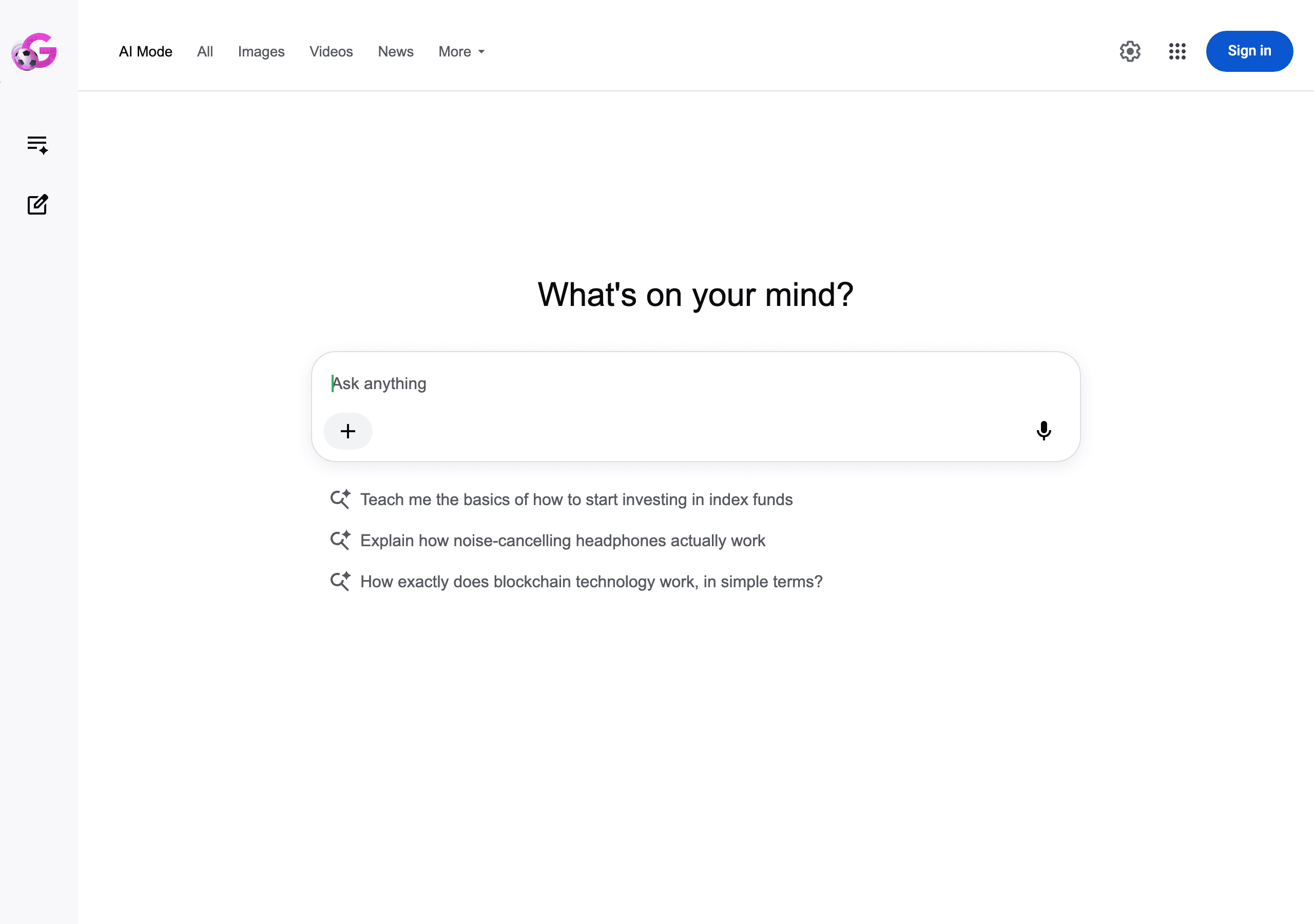
Google AI Mode sits inside Google Search. Since Google I/O 2026 it runs on Gemini 3.5 Flash, which Google describes as its newest Flash model and the new default model in AI Mode for everyone globally (Google). When you ask a question, AI Mode does not answer from the model alone. It uses a technique Google calls query fan-out: the model breaks your question into a set of concurrent, related searches, runs them through Google's core Search ranking systems, then synthesises the retrieved pages into one answer with links back to the sources. Google's VP of Product for Search, Robby Stein, has described it plainly, saying the system interprets your query and "it'll start Googling basically," combining the results into a single response with source links (Search Engine Journal). In other words, AI Mode is grounded by design. A live retrieval step runs on nearly every query.
For the fuller picture of how the surface works and how brands earn a citation inside it, our explainer on what Google AI Mode is walks through the mechanics in depth.
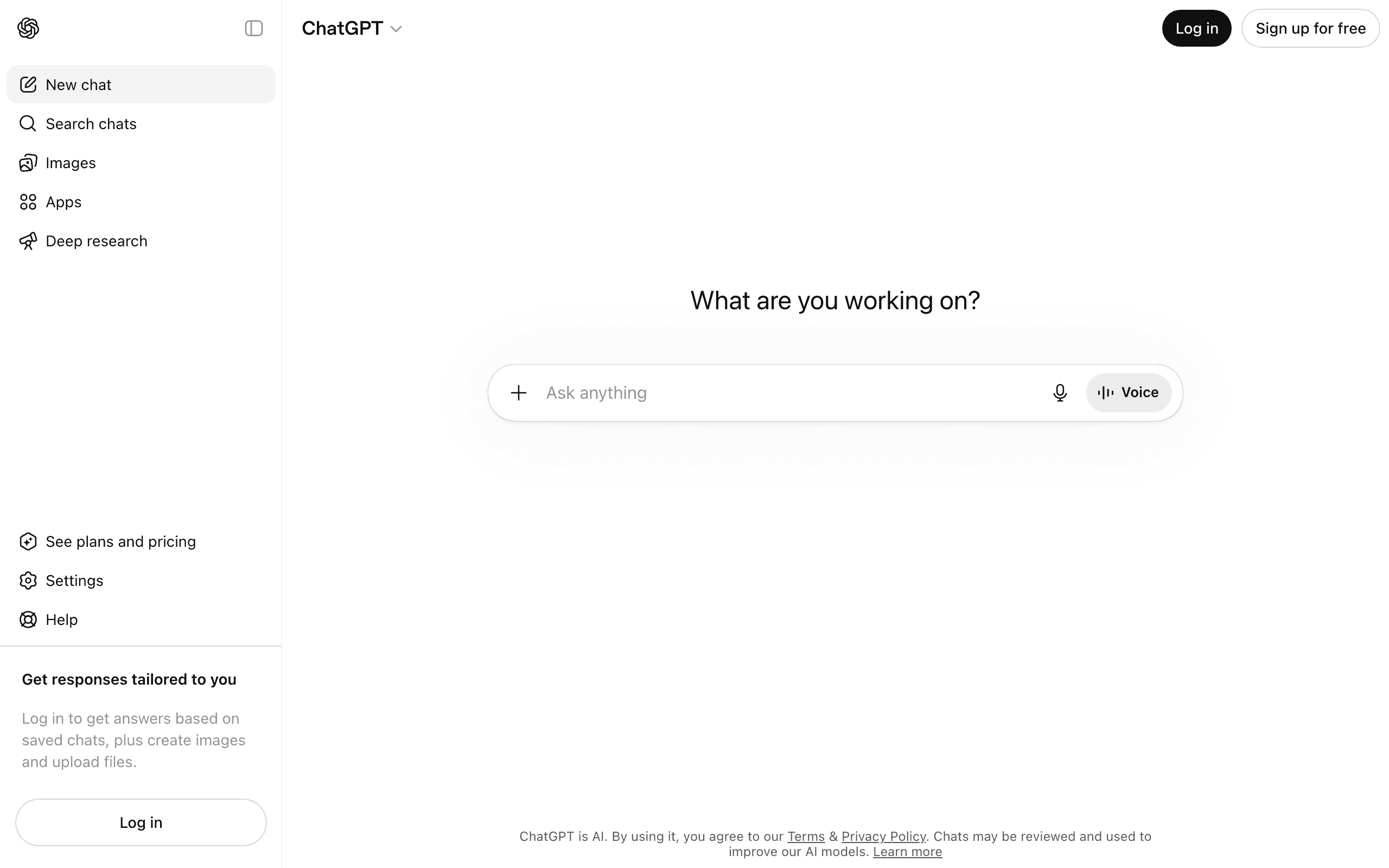
ChatGPT starts from the other side. It is a general-purpose assistant whose default model, GPT-5.5 Instant, became ChatGPT's standard model in May 2026 (TechCrunch). It answers from the model's own knowledge first and searches the live web when a question clearly needs fresh or specific information, or when you turn search on. That makes it a flexible generalist: it will draft, summarise, debug, brainstorm or hold a long conversation without touching a source, and it pulls in the web when freshness matters. The retrieval step is conditional, not automatic. For the mechanics of how an answer engine retrieves and cites in general, see how AI search works.
So the optimisation targets differ. AI Mode optimises for being the answer layer on top of the world's largest search index, where grounding in current pages is the whole point. ChatGPT optimises for being the most capable standalone assistant, where the model itself does most of the work and the web is a tool it calls when warranted.
Scale: two mass-market surfaces, reached differently
Both are now genuinely mass-market, which is why neither can be ignored. AI Mode surpassed one billion monthly users roughly a year after launch, with queries more than doubling every quarter since launch (Google). The broader set of AI search experiences that lean on query fan-out, including AI Mode, Deep Search and some AI Overviews, reaches around 1.5 billion users a month, according to figures Google's search team shared with Search Engine Journal. ChatGPT reached about one billion monthly app users in May 2026, the fastest app ever to hit the milestone, according to estimates from Sensor Tower reported by CNBC.
The routes to that scale say something about each product. AI Mode reached a billion users by becoming the default behaviour inside a surface people already opened every day. ChatGPT reached a billion by getting people to open a new app and form a new habit. For a brand, the practical reading is the same either way: these are two of the largest places where buyers now form opinions, and a presence in one does not transfer to the other.
Sourcing: grounded-by-default versus search-on-demand
This is the dimension that matters most, because it decides how often a real, current source even enters the answer.
AI Mode grounds nearly every query. Google describes the approach as retrieval-augmented generation, also known as grounding, used "to improve the quality, accuracy, and freshness of AI responses by relying on our core Search ranking systems to retrieve relevant, up-to-date web pages," after which the system reviews those pages to generate a response and shows "prominent, clickable links to relevant web pages that support the information in the response" (Google for Developers). Because query fan-out runs multiple searches per question, AI Mode often surfaces a wider and more diverse set of links than a classic results page would for the same query. The upshot: the candidate set behind an AI Mode answer is large, live and drawn from Google's index.
ChatGPT's sourcing is conditional. When it judges that a question needs the web, it searches, retrieves and cites. When it judges that its training data suffices, it answers without retrieving anything. That conditional logic is the right call for a great deal of what people ask an assistant, but it means a given ChatGPT reply may be fully sourced, partly sourced, or generated entirely from model knowledge with no live source behind it. The brand consequence is direct: in AI Mode you are competing to be retrieved on essentially every query, whereas in ChatGPT you are sometimes competing to be retrieved and sometimes competing to be remembered, baked into the model's training rather than fetched at question time.
Citations: how each shows its working
Both engines attach links when they ground an answer, but the consistency differs in a way that follows directly from the sourcing models above.
AI Mode shows links on the great majority of answers, because the great majority of answers are grounded. Those links are the supporting pages Google's ranking systems retrieved during fan-out, presented as clickable citations beside or beneath the synthesised text. If you want the detailed mechanics of how Google's in-search AI surfaces choose and display sources, our guide on how to appear in AI Overviews walks through the selection logic and what makes a page eligible.
ChatGPT shows citations when it searches and shows none when it does not. For casual questions that is fine. For anything you plan to rely on, you have to confirm that it actually searched, which adds a step the grounded-by-default surface does not require. One caution applies to both engines, and it is the one most people underestimate: a citation proves where a passage came from, not that the sentence above it is faithful to the source. The Tow Center for Digital Journalism at Columbia University tested eight AI search tools and found they returned incorrect answers more than 60 per cent of the time, with misattribution, a real source credited with a claim it does not make, a recurring failure alongside fabricated links (Columbia Journalism Review). Citations make that easier to catch. They do not make checking optional.

Want to get recommended by AI?
Check your AI search visibility, then let the Honeyb agent write, fix, and earn what gets you recommended. Free to start.
Freshness: live index versus model memory plus search
Freshness is where the architectural split becomes most visible to a searcher.
AI Mode is fresh almost by construction. Every grounded query pulls from Google's continuously updated index, so a question about something that changed this morning is answered against pages crawled close to now. Google leans on this explicitly, citing freshness as one of the reasons it grounds in core Search ranking. For time-sensitive questions, local lookups and anything where recency matters, that constant retrieval is a real advantage.
ChatGPT's freshness depends on whether it searched. When it does, current questions are answered well and verifiably. When it answers from training alone, the response reflects a knowledge cutoff and can be confidently out of date, with no source to check against. There is a second, subtler difference in what each engine treats as fresh enough to cite. One 2026 analysis of how the engines source information reports that ChatGPT mixes a large static training layer with selective live retrieval, and that around 29 per cent of its citations still point to content from 2022 or earlier, the weight of accumulated training data (Leapd). AI Mode, anchored to a live index and Google's freshness signals, skews newer. Google's own AI surfaces have also moved away from simply mirroring the classic results page: Ahrefs found the overlap between AI Overview citations and the organic top ten fell from around 76 per cent in July 2025 to roughly 38 per cent in early 2026, evidence that the AI layer is developing its own source preferences (Ahrefs).
A side-by-side summary
The table below condenses the comparison. Treat the rows as tendencies, not absolutes, since both products change often.
| Dimension | Google AI Mode | ChatGPT |
|---|---|---|
| Maker | OpenAI | |
| Core design | Search surface that generates answers, grounded by default | Assistant that searches the web on demand |
| Where it lives | Inside Google Search, the default experience since I/O 2026 | A standalone app and website |
| Default model | Gemini 3.5 Flash | GPT-5.5 Instant |
| Sourcing | Live retrieval on nearly every query via query fan-out | Searches only when the question needs it |
| Citations | Links shown on most answers | Links shown when it searches, none when it does not |
| Freshness | Anchored to Google's live index | Fresh when it searches, otherwise model cutoff |
| Reach | ~1 billion monthly AI Mode users | ~1 billion monthly app users |
| Best fit | Current, fact-seeking and local questions | Drafting, reasoning, coding, extended conversation |
Which to reach for, and when
Neither is strictly better. The honest framing is search-first versus assistant-first, and the right choice depends on the job.
- Current, fact-seeking questions, local lookups, prices, news, anything that changed recently: Google AI Mode, for the grounded-by-default retrieval and live index.
- Drafting, editing and tone work: ChatGPT, which most users still find the steadier writer over long passages.
- Coding, debugging and step-by-step reasoning: ChatGPT, the more established default for technical back-and-forth.
- Comparisons and recommendations you want sourced: either, but verify ChatGPT actually searched, since AI Mode grounds automatically.
- Quick research woven into ordinary searching: AI Mode, because it is already the surface you land on inside Google.
- Extended, memory-heavy conversation and broad daily assistance: ChatGPT, for its maturity and habit of use.
Many people use both without choosing, and that is reasonable. AI Mode is the path of least resistance for anything you would have Googled anyway. ChatGPT is the tool you open when you want an assistant to make something with you. For the two standalone assistants compared directly, see Gemini vs ChatGPT.
Market share (%)
The four leading AI assistants by market share
What this means for brand visibility
If you are a marketer or founder rather than an everyday user, the comparison reframes itself. AI Mode and ChatGPT are two distinct surfaces where buyers form opinions about your brand, and the way each one sources answers tells you exactly where the work has to land. For the wider picture of what this category is and why it matters, start with what AI search is.
Because AI Mode grounds nearly every answer in live Google Search results, the signals that earn traditional retrieval also decide whether you are named there: crawlable, well-structured pages that answer specific questions cleanly, plus a credible presence on the third-party sites and communities Google's ranking systems already trust. Query fan-out widens this further, since your brand can be retrieved on a sub-query you never anticipated rather than only on the headline question. The practical playbook overlaps heavily with classic search, which is why our guide on how to appear in AI Overviews is the right starting point for the Google side.
ChatGPT is partly a different game. When it searches, the same retrieval logic applies and credible, well-cited pages win. When it answers from training, visibility is decided by how well your brand is represented across the broad web that trained and continues to ground the model, so you can be recommended even when no live search runs. That makes durable, widely-referenced presence, on review platforms, in authoritative lists, and in community discussion, matter more than any single page you control. The selection signals that move both engines are unpacked in how AI models choose which brands to recommend.
The consequence is that a brand can be visible in one surface and absent in the other, and strong standing in AI Mode does not guarantee a mention in ChatGPT. The two also disagree on freshness, with ChatGPT willing to lean on older sources while AI Mode skews to the live index, so the version of your brand each engine knows can be months apart. The only reliable way to manage that is to treat them as separate surfaces: track how each one describes and ranks you over time rather than spot-checking once, because the same prompt can name different brands next month. You can get a quick read with our free AI visibility checker, then move to systematic monitoring across engines once you know which surface is the priority.
The takeaway
Google AI Mode and ChatGPT have converged on the same output, a written answer with links, from opposite directions. AI Mode is a search surface that grounds nearly every reply in live results and now greets a billion-plus people as the default inside Google. ChatGPT is an assistant that searches when a question needs it and otherwise answers from a vast model memory. That difference is not cosmetic. It changes how often a current source enters the answer, how consistently citations appear, how fresh the response is, and, for brands, where the work of being found actually has to happen. Learn which engine fits which question, and if your business depends on being discovered, measure what both answers say about you, because the shortlist is written before anyone reaches your site.
Sources cited in this report