
For twenty years the job was easy to state, if not to do: rank on Google. The new job is stranger. It is to be the brand an AI names when nobody asked for you by name. Type "best CRM for a small agency" into ChatGPT and you get a short list of names and a paragraph of reasoning, not ten blue links. Whether you make that list has surprisingly little to do with where your homepage sits in Google.
The numbers explain why a whole category of software appeared almost overnight. Roughly 62% of the citations behind AI answers never name the brand they draw on (Semrush), so you can be shaping an answer and stay invisible inside it. Ask an engine the same question twice and the answer changes about 70% of the time (SparkToro). And when Ahrefs went looking for what actually correlates with being cited, the strongest signals were third-party mentions and video, not anything on your own site. Reddit by itself accounts for 40.1% of all AI citations, the single most-cited source on the web (Semrush).
AI search optimisation tools are the software built to cope with all of that. They measure whether AI engines name you, show you which pages and communities are steering those answers, and in some cases help you change them. Think of them as the analytics-and-optimisation stack for a search box that answers back. You will meet two acronyms constantly: GEO (generative engine optimisation, the craft of getting named inside the answer the model writes) and AEO (answer engine optimisation, the same craft aimed at one-answer engines such as Perplexity). This is a guide to the category, what these tools do, how they differ and what they cost, rather than a ranked shortlist. For the shortlist, we sorted the field by job and budget in our guide to the best GEO and AEO tools.
What an AI search optimisation tool actually does
Peel off the label and the category splits into four jobs. Most products do one or two of them well and wave a hand at the rest, so the useful question in any demo is which job you are actually buying.
| Job | What it does | Example tools | Where the price starts |
|---|---|---|---|
| Measurement and tracking | Runs buyer-intent prompts across the engines on a schedule and scores whether, and how, you get named | Honeyb (ours), Profound, Otterly, Peec | Free check, then from about $29/mo |
| Off-site and citations | Surfaces the third-party pages, Reddit threads and videos the engines actually cite, so you know where to earn a mention | Ahrefs Brand Radar, Semrush AI Visibility | Included on existing Ahrefs or Semrush plans |
| Content and on-page | Restructures pages so a model can lift a clean, quotable answer straight out of them | AthenaHQ and most GEO suites | From about $295/mo |
| Technical and crawlability | Checks that AI crawlers can reach and parse your pages at all, llms.txt included | Site auditors, llms.txt checkers | Often free or bundled |
A word on that last row. llms.txt is a plain-text file you place at the root of your site (think robots.txt, but written for the machines that compose answers rather than the ones that crawl links) listing the pages you would most like an AI to read. It is a young, voluntary standard, and no major engine has promised to honour it, so treat it as good hygiene rather than a lever. The pattern across all four rows is the same: a tool that claims to be brilliant at every job usually turns out to be competent at one and packaging the others.
How they differ from the SEO tools you already own
Your existing SEO suite answers a question that is quietly losing importance: where do I rank for this keyword. An AI search optimisation tool answers the one replacing it: when an engine writes an answer in my category, does it name me, and which sources talked it into doing so. The two overlap, since both ultimately reward being cited by pages the web trusts, but the unit of measurement is different. A rank tracker counts positions on a results page; an AI visibility tool (visibility here meaning how often and how prominently a model names you, not where a blue link sits) counts mentions inside a generated paragraph. That gap is why bolting an "AI" tab onto an old rank tracker rarely does the job. If the vocabulary is still slippery, we pull search, answer and generative optimisation apart in SEO vs AEO vs GEO, and the hands-on method lives in our practical guide to AI search optimisation.
Do you really need a separate tool for each engine?
Short answer: no, but you do need one that samples properly. The engines behave differently enough that coverage still matters. Perplexity and Claude show their citations, so a good tool can tell you precisely which pages earned you the mention. ChatGPT and Gemini often hide theirs, and no tool can conjure a source an engine refuses to reveal, so treat any product claiming complete citation coverage across all four with polite suspicion.

Want to get recommended by AI?
Check your AI search visibility, then let the Honeyb agent write, fix, and earn what gets you recommended. Free to start.
The stronger reason to weigh method over logo count is instability. Because the same prompt returns a different answer roughly 70% of the time, a tool that checks once a week, or shows you a single live query, is handing you a coin toss dressed as a dashboard. What you want is repeat sampling: the same prompts, run many times, and averaged into something that moves like a trend rather than a mood. Our note on tracking AI model responses about your company walks through building the prompt set that makes any of these tools worth the money.
What they cost
Pricing splits along the same lines as the jobs. Measurement tools tend to be self-serve and cheap enough to expense without a meeting; the deeper analytics and content platforms are demo-gated and priced for a budget line. The figures below are each vendor's public entry point, or demo-only where the vendor sells that way. Demo-gating is not a mark against a tool, it is simply how most enterprise software is bought.
| Tool | Entry point | Best known for |
|---|---|---|
| Honeyb (ours) | Free check, self-serve from about $29/mo | Daily scans, ranked actions and accuracy flags |
| Otterly | From about $29/mo | Simple prompt tracking for smaller teams |
| Peec AI | From about $89/mo | Multilingual, multi-market tracking |
| AthenaHQ | Free 10-minute audit, then from about $295/mo | GEO content workflows for teams |
| Semrush AI Visibility | Add-on to the Semrush suite, free checker | Sitting beside reporting teams already run |
| Ahrefs Brand Radar | Included on Ahrefs plans | AI mentions alongside backlink data |
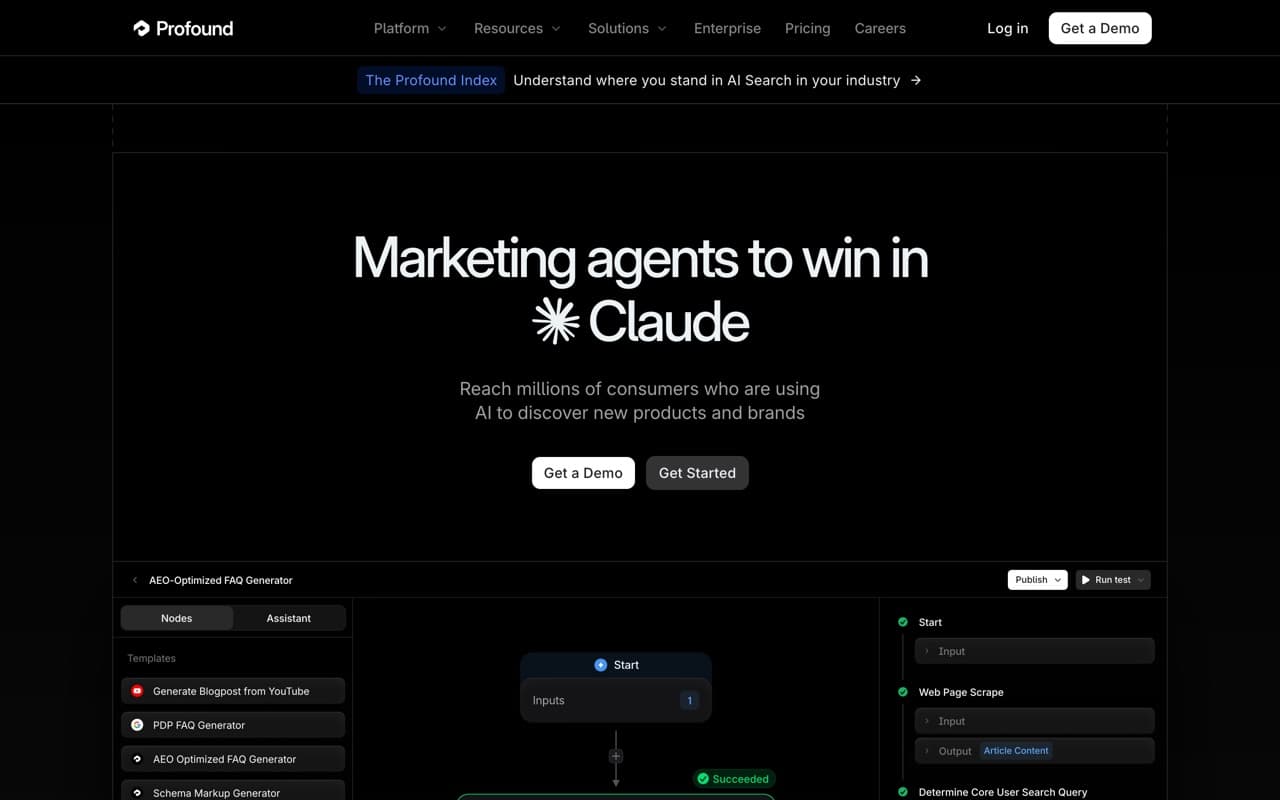
| Profound | Demo only, enterprise-priced | The deepest analytics, API and white-label |
The right number is not the smallest one. If your buyers only ever ask one or two engines, a $29 tracker that samples daily beats a $300 platform sampled weekly. If you are running this across languages and markets, multilingual coverage earns its premium. And if you need forensic source analysis and an API to feed your own systems, that is where the enterprise tools justify themselves. We put rough budgets against each job in the best GEO and AEO tools guide, and the underlying metric is defined in what AI visibility actually is.
The short version
AI search optimisation tools do one of four jobs: measure whether engines name you, map the sources that shape those answers, rewrite content so models can quote it, or check that the crawlers can read your site at all. Pick the job before you pick the brand. Demand for the category is real but choppy, the competition to rank is still thin, and the prices run from free to enterprise. The single feature that separates a useful tool from an expensive one is not the engine count on the box, it is whether it samples each prompt enough times to tell a signal from a coin toss.
The cheapest way to find out which category you even need is to look at your own results first. Run a free AI visibility check to see which engines name your brand today, and which quietly recommend someone else, before you spend a penny on a tool.