

Search behaviour has changed faster than most optimisation playbooks. A growing share of questions now end inside an AI answer rather than on a list of blue links. When Google shows an AI summary, users clicked a traditional search result in only 8% of visits, against 15% when no summary appeared, and clicked a link inside the summary itself in just 1% of visits, according to a Pew Research Center study that tracked the real browsing of 900 US adults (Pew Research Center, 2025). The page named inside the answer wins the attention. The page that merely ranks below it often does not. AI search optimisation is the discipline of becoming the source that answer engines read, trust, and cite.
This guide is a practical, end-to-end framework. It is deliberately vendor-neutral and built around five stages that run in order: be findable and crawlable, structure content for extraction, earn citations and third-party validation, manage entities and schema, and then measure what is actually happening across engines. None of it is magic. Most of it is disciplined fundamentals applied to a new retrieval layer, plus one thing classic SEO never demanded: you have to be talked about somewhere other than your own site.
What AI search optimisation actually is
AI search optimisation is the work of making your content easy for generative engines to find, parse, trust, and reproduce in their answers. It overlaps heavily with classic SEO but is not identical. Traditional SEO optimises for a ranked list a human scans. AI search optimises for a synthesised answer a model writes, where your content may be quoted, paraphrased, or cited with a small attribution link. We unpack that split in detail in AI search versus traditional search.
Two adjacent terms describe slices of the same work. Generative Engine Optimisation (GEO) focuses on influencing what generative engines say and which sources they pull from. Answer Engine Optimisation (AEO) focuses on structuring content so it can be lifted cleanly into a direct answer. We treat them as facets of one practice. For the deeper conceptual background, read our explainer on what GEO is. This page is the framework that ties them together.
The academic foundation is worth knowing. The original GEO paper introduced the term and tested concrete content tactics against a benchmark of real queries, reporting that optimisation methods could boost source visibility in generative responses by up to 40% (Aggarwal et al., KDD 2024). The methods that performed best were not keyword tricks. They were adding relevant statistics, quoting credible sources, and writing with clarity and authority. The paper found statistics addition lifted visibility most in domains like law and government, while quotation addition worked best for explanatory and historical queries. That finding shapes everything below.
Monthly searches (US)
Search demand for AI optimisation terms (US)
Stage 1: Be findable and crawlable
Nothing else matters if engines cannot read your pages. Generative engines build answers from publicly accessible, crawlable content, and Google states plainly that to be eligible as a supporting link in AI Overviews or AI Mode, a page must be indexed and eligible to be shown in Google Search with a snippet (Google Search Central). The baseline checks are unglamorous and non-negotiable.
- Allow the right crawlers. AI answer engines use named user agents such as GPTBot and OAI-SearchBot (OpenAI), ClaudeBot and Claude-SearchBot (Anthropic), PerplexityBot, and Google-Extended. Decide deliberately which to allow in robots.txt, because blocking a crawler removes you from that engine's answers, and blocking one does not block the others. See our AI crawler user-agents reference for the full list and the canonical allow patterns.
- Serve content in HTML, not only JavaScript. Many AI crawlers do not execute client-side JavaScript reliably. Render meaningful content server-side or pre-render it.
- Keep pages indexable. Avoid stray noindex tags, login walls, and aggressive bot blocking on pages you want quoted.
- Maintain fast, stable pages. Slow or error-prone pages get sampled less and trusted less.
A note on llms.txt, the proposed file for guiding language models to your key content. Adoption is rising, yet analyses of AI bot traffic show major crawlers overwhelmingly skip the file and read HTML directly: an Ahrefs study of more than 137,000 domains found 97% of valid llms.txt files received no bot requests at all in May 2026 (Ahrefs, 2026). Google has stated on the record that it does not support the file, and no major provider has committed to using it as a production signal. The honest position for 2026: it is low-cost to publish and may help with a documentation site or specific tooling, but it is not a substitute for crawlable HTML.
Stage 2: Structure content for extraction
Once a page can be read, the goal is to make the answer easy to lift. Generative engines reward content that resolves a question quickly and cleanly. This is where AEO discipline earns its keep.
- Lead with the answer. State the direct response in the first sentence or two of a section, then expand. Models extract the concise statement and cite it.
- Use clear, descriptive headings. Phrase headings as the questions a buyer would actually ask. This helps both retrieval and human scanning.
- Write self-contained passages. Each section should make sense on its own, because engines often quote a single passage out of context.
- Add structure with lists and tables. Comparisons, steps, and specifications are easier to parse and reproduce when formatted explicitly.
- Include relevant statistics and named sources. This is the single best-evidenced tactic from the GEO research, and it doubles as a trust signal.
The table below maps the difference between optimising for a ranked list and optimising for a synthesised answer. The practical takeaway is that AI search rewards extractable, well-evidenced passages over keyword density.
| Dimension | Traditional SEO | AI search optimisation |
|---|---|---|
| Primary goal | Rank in a list of links | Be cited or quoted inside an answer |
| Unit of value | The ranking page | The extractable passage |
| Strongest signals | Backlinks, keywords, on-page relevance | Clarity, statistics, citations, entity authority |
| User click behaviour | Click expected to reach content | Often no click; answer consumed in place |
| Measurement | Rankings and organic clicks | Mentions, citations, share of voice across engines |
If your goal is specifically to be quoted by a given engine, focus on passage structure: a clean, self-contained answer near the top of each section, supported by a statistic or a named source, is the pattern that travels best across ChatGPT, Perplexity and the rest.
Stage 3: Earn citations and third-party validation
Engines do not only read your site. They synthesise across the web, and the evidence is now blunt about where they look. In a study of 36,268 citations across five engines over 30 days in mid-2026, Reddit and Wikipedia were each cited more often than the most-cited vendor blog, and owned vendor sites made up only about 1.5% of all citations against 11.2% for user-generated sources such as Reddit, YouTube and forums (SolCrys, 2026). Your owned content is necessary but rarely sufficient. You also need to be discussed and corroborated elsewhere.
The engines weight those sources differently, and knowing the bias is half the work. Profound's analysis of 6.8 million citations across 1.6 million responses found that Gemini leans heaviest on brand-owned sites, taking about 52% of its citations from them, while ChatGPT pulls roughly half its citations from third-party directories and consensus sources, and Perplexity leans on industry expertise and reviews. Across the wider research, Reddit is the single most-cited domain on every major engine. So a Gemini-first strategy rewards a clean, authoritative owned site, while a ChatGPT-first strategy rewards being talked about across independent sources.

Want to get recommended by AI?
Check your AI search visibility, then let the Honeyb agent write, fix, and earn what gets you recommended. Free to start.
- Earn mentions on sources engines already trust. Industry publications, reputable directories, and well-moderated communities feed answers. Reddit and review sites appear constantly in AI citations because they carry first-hand experience; we cover the mechanics in why AI models cite Reddit.
- Get the facts about you consistent across the web. Models reconcile claims across sources. When your description, category, and key facts match everywhere, you are easier to summarise correctly.
- Earn genuine third-party reviews. Validation from independent sites supports the trust layer that determines eligibility for citation.
- Publish original, non-commodity content. Google's guidance is explicit that the way to surface in its AI features is to keep creating helpful, reliable, people-first content rather than chasing the features directly (Google Search Central).
This is why a citation-first mindset matters more than a keyword-first one. For the mechanics of how models weigh these inputs, see how AI models choose which brands to recommend.
Stage 4: Manage entities and schema
Answer engines reason about entities, not just pages. An entity is a clearly defined thing: a company, a product, a person, a concept. When a model can resolve your brand to a distinct entity, it retrieves and describes you more confidently and consistently.
- Establish entity clarity. Use consistent naming, a clear description of what you do, and unambiguous category language across your own site and external profiles.
- Build presence in knowledge sources. A well-sourced, accurate presence on Wikipedia and Wikidata, where your organisation genuinely meets notability requirements, strengthens entity recognition. Never fabricate or pay for entries.
- Use structured data sensibly. Google is clear that you do not need to add any special markup for AI features: there is no special schema.org structured data that you need to add, and you do not need new machine-readable or AI text files (Google Search Central). Schema still helps machines classify your content, supports rich results, and reduces ambiguity. Organisation, Product and Article schema remain worthwhile for the clarity they provide.
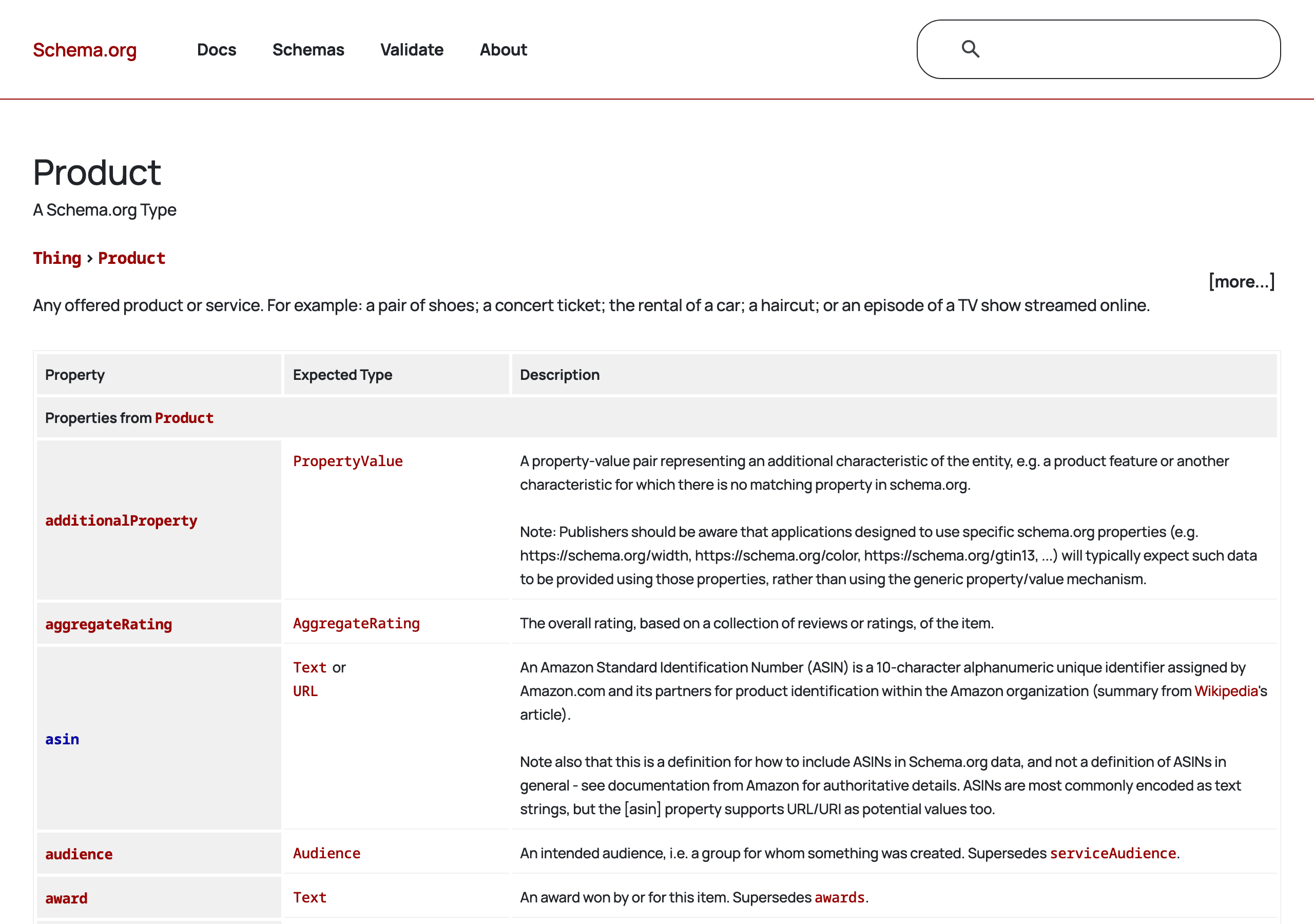
The order matters: get the entity clear first, then layer schema to reinforce it. Schema on a page no engine can resolve to a distinct entity adds little. We go further on the markup specifics in schema markup for AI visibility.
Stage 5: Measure AI visibility
You cannot optimise what you cannot see. Traditional rank tracking does not capture whether ChatGPT mentions you, whether Perplexity cites your page, or how Gemini describes you against competitors. With ChatGPT alone serving more than 900 million weekly users by early 2026 and Gemini taking a fast-growing share, the answer layer is now too large to manage by guesswork (latest figures). AI visibility measurement closes that gap, and it is the stage most teams skip.
Spot-checking by typing a question into one chatbot is not measurement. Answers vary by phrasing, by session, by region, and by model version, so a single look tells you almost nothing reliable, a problem we quantify in why spot-checking fails. The practical approach is to track a defined set of buyer prompts on a schedule across the engines that matter, then watch the trend.
- Define your prompt set. The real questions buyers ask in your category, including comparison and recommendation prompts.
- Track across engines. ChatGPT, Perplexity, Google AI Mode and AI Overviews, Gemini, Claude and Copilot each behave differently, as the best AI search engines breakdown shows.
- Measure the right things. Whether you are mentioned, whether you are cited with a link, how you are described, and your share of voice against named competitors.
- Watch sentiment and accuracy. Being mentioned inaccurately or negatively is a different problem from not being mentioned at all.
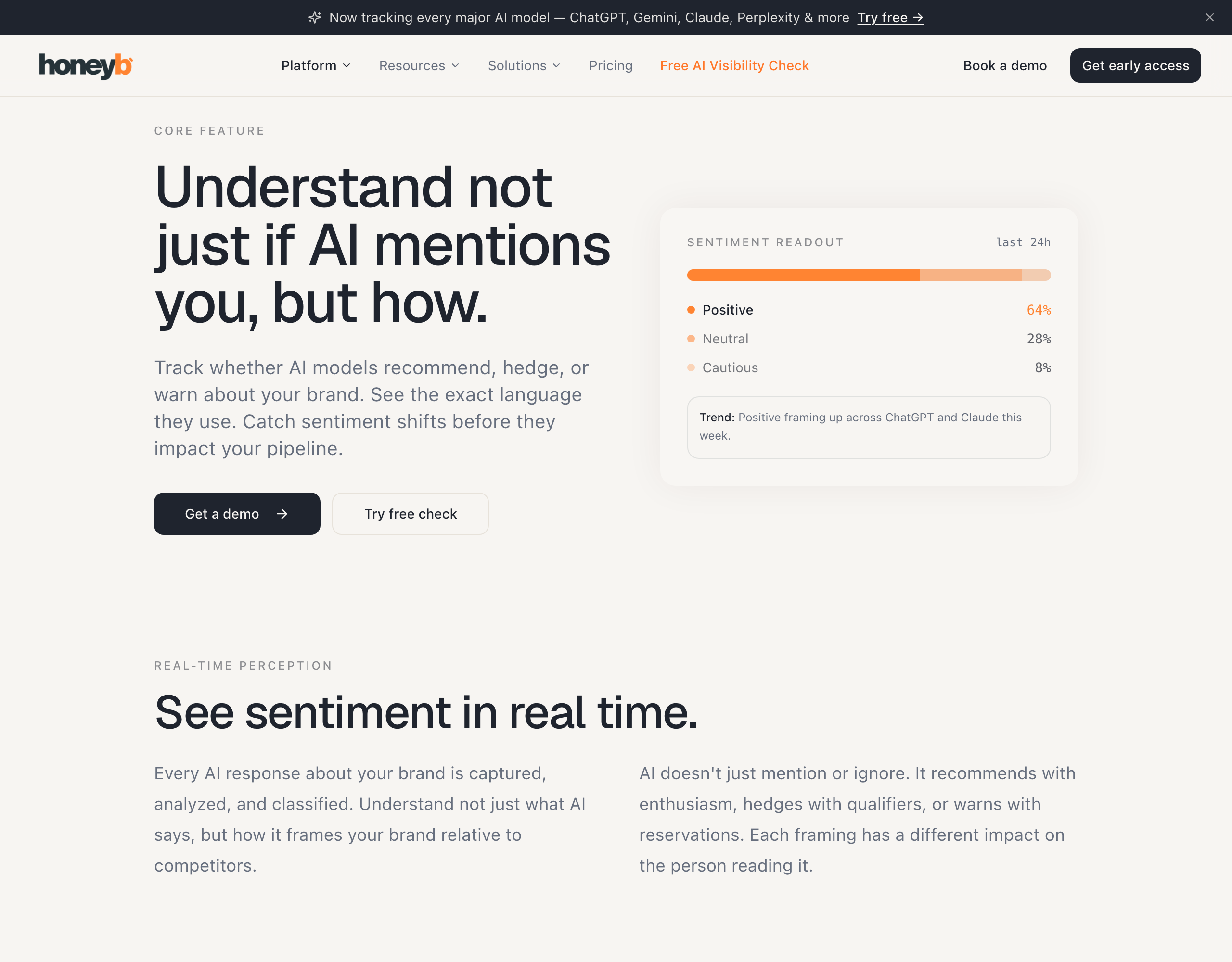
This is the work Honeyb is built for: scheduled scans across engines, citation and mention tracking, sentiment, and competitive benchmarking, so you can connect the changes you make in Stages 1 to 4 to measurable movement. Measurement is what turns AI search from a guessing game into a channel you can manage.
A practical optimisation checklist
Use this as a working checklist. It runs in the same order as the framework, because each stage depends on the one before it.
| Stage | Action | Quick check |
|---|---|---|
| Findable | Allow chosen AI crawlers, serve HTML, stay indexable | Pages return content to bots without JS execution |
| Structured | Lead with answers, use question-led headings, add lists and tables | A model could quote one passage cleanly out of context |
| Cited | Earn third-party mentions, keep facts consistent, publish original content | Independent sources corroborate your key claims |
| Entity | Consistent naming, knowledge-source presence, sensible schema | Engines resolve your brand to one clear entity |
| Measured | Track a prompt set across engines on a schedule | You can see mention and citation trends, not guesses |
Where to start
If you do nothing else, do three things. Confirm your important pages are crawlable and indexable so engines can read them at all. Rewrite your top commercial pages to lead with clear, evidence-backed answers, since statistics and citations are the best-evidenced lever from the GEO research. And start measuring, because optimisation without feedback is guesswork. The teams pulling ahead in 2026 are not the ones chasing tricks. They are the ones treating AI search as a measurable channel and improving it deliberately. The fastest gains usually come from Stage 3: if the strongest engines cite Reddit and independent sources over owned blogs, the brands being recommended are the ones being talked about, not just the ones publishing.
Sources cited in this report