

Traditional search returns a ranked list of links and leaves the reading to you. AI search reads the sources itself and returns a written answer, with citations standing in for the familiar blue links. That single change rewires everything downstream: how people phrase questions, how often they click through, and how a brand gets found at all.
The two share more plumbing than the headlines suggest, which is why this post covers what stayed the same as well as what changed. For the wider story of where AI search came from and where it is going, start with the pillar guide to what AI search is. This one stays on the comparison.
The short answer
Six dimensions capture most of the shift. Everything else in this post is detail on one of these rows.
| Dimension | Traditional search | AI search |
|---|---|---|
| Input style | Short keyword strings | Full questions in plain language, plus follow-ups |
| Output | A ranked list of links | A written answer with citations |
| Clicks required | At least one, usually several | Often none |
| Freshness | A continuously updated index, fairly stable results | Answers regenerated per query, often changing day to day |
| How trust is signalled | Position on the results page | Being quoted and cited inside the answer |
| How visibility is measured | Keyword rank tracking | Mention and citation tracking across engines and prompts |
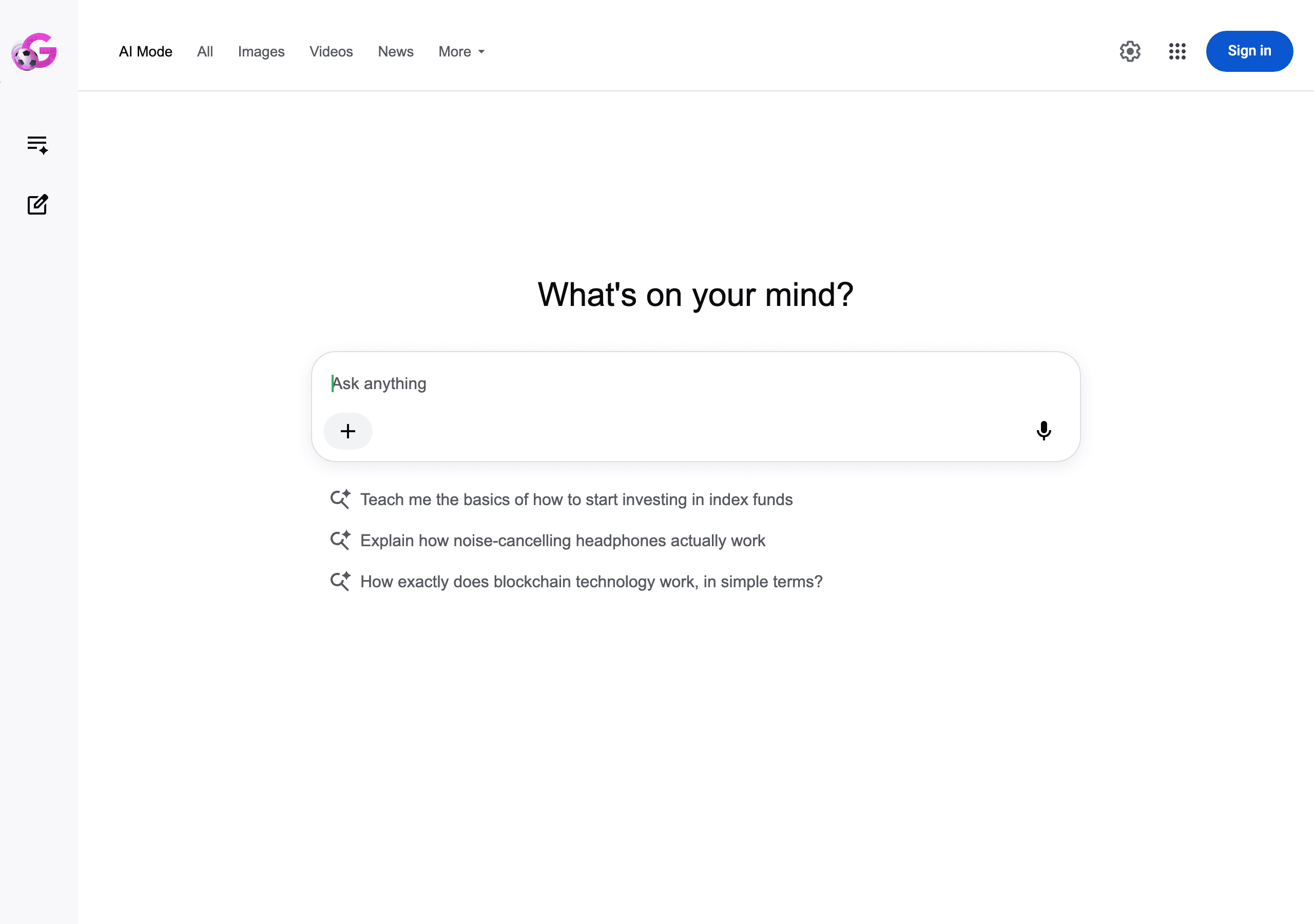
Google now ships both models inside one product. The classic results page sits under the All tab, and AI Mode runs a full conversational session one tab away.
What stayed the same
It is tempting to frame AI search as a clean break. Underneath the prose, most of the machinery is familiar.
- Crawling still comes first. AI engines run their own crawlers or lean on an existing search index, and a page that cannot be crawled cannot be cited.
- Retrieval still decides the candidate set. Before the model writes a word, a retrieval layer pulls a shortlist of relevant pages, and that shortlist behaves a lot like a results page nobody sees.
- Relevance signals still matter. Clear structure, topical depth and pages that answer one question well are what get retrieved in the first place.
The practical upshot: sound technical SEO is still the entry ticket. What changed is everything that happens after retrieval, which is where the next four sections live.
Answers instead of links
The most visible change is the optional click. A traditional results page is a menu, and the value sits behind the links. An AI answer is the meal. The engine reads the sources, writes a synthesis and most users stop there.
The click data backs this up. Ahrefs research found that an AI Overview cuts clicks to the number one organic result by 58%, up from 34.5% only ten months earlier. The trend line matters more than the snapshot. The cost of sitting beneath an AI answer is rising quickly, even for pages that hold the top ranking.
Zero-click results are not new. Featured snippets and knowledge panels were absorbing clicks years before AI answers arrived. The difference is scope. A snippet lifted one fact from one page. An AI answer can cover an entire query end to end, leaving nothing that requires a visit.
The takeover is uneven, though. Ahrefs found that 99.9% of AI Overviews appear on informational queries, while shopping queries see them just 3.2% of the time. The classic results page is not disappearing evenly. It is being eaten from the informational end first, while commercial searches still look much as they did.
Conversation instead of keywords
Decades of traditional search trained people to compress intent into keyword shorthand. Nobody ever wanted to know "best crm saas". They wanted a recommendation for their specific team, budget and stack, and learned to strip all of that out because the engine could not use it. AI search reverses the training. You ask the full question, constraints included, and the engine works with all of it.
Follow-ups change the unit of measurement. A traditional query is a single event. An AI session is a dialogue where each turn inherits context from the last, so the third question can be three words long and still be understood precisely. For anyone tracking demand, this is the awkward part: many conversational queries are unique phrasings that no keyword tool has ever recorded.
Synthesis instead of ranking
A traditional engine ranks documents, and the order is the product. An AI engine retrieves documents and then writes over them. Ranking still happens inside the retrieval step, but the searcher never sees it, because the model decides which of the retrieved sources actually make it into the prose. The full pipeline from question to cited answer is covered in how AI search works.
That editorial step is selective. Ahrefs measured that ChatGPT cites only around half of the URLs it retrieves. Being fetched is not being cited. A page can win retrieval, the part that looks like classic SEO, and still be cut during writing because another source covered the same point more quotably.
Synthesis also makes answers unstable in a way rankings never were. Ahrefs found that AI Overviews change every 2.15 days on average, with a 70% chance of changing from one observation to the next. A ranking moved gradually enough to track weekly. An answer can name your brand on Monday and a competitor on Thursday from the same prompt.
Citations decide visibility
In traditional search, visibility has one currency: position. In AI search, the currency is presence inside the answer, either as a citation or as a named brand in the text. Those are different markets, and performance in one does not guarantee performance in the other.

Want to get recommended by AI?
Check your AI search visibility, then let the Honeyb agent write, fix, and earn what gets you recommended. Free to start.
The clearest evidence is the mismatch between them. Ahrefs found that 28.3% of ChatGPT's most-cited pages have zero Google organic traffic. Nearly a third of the pages winning the new game never won the old one. Retrieval rewards pages that answer a specific question cleanly, whether or not they ever accumulated the links needed to rank.
Format plays a measurable role in who gets quoted. In the same dataset, 43.8% of ChatGPT's cited pages were Best X listicles. Comparison content maps directly onto the recommendation questions people put to AI engines, so it gets retrieved, and cited, far out of proportion to its search rankings.
There is a second shift inside this one. The same research found 67% of ChatGPT's top citations come from sources marketers cannot directly influence: editorial publications, forums, review platforms and other third-party pages. In traditional search you optimized your own site. In AI search, much of your visibility is decided on pages you do not own.
Even within Google, the AI surfaces barely share sources. Ahrefs found that AI Mode and AI Overviews reach the same conclusion 86% of the time while sharing only 13.7% of their citations. Same company, same query, almost entirely different source lists. If Google's own surfaces diverge that much, treating AI search as one monolith is a mistake. Citation visibility has to be earned, and measured, surface by surface.
How searching itself changes
For informational questions, AI search is usually the better experience. The answer arrives synthesised, a follow-up costs nothing, and the citations are there when something needs verifying. The trade-off is that verification becomes your job. A confident paragraph and a wrong paragraph look identical.
There is also a habit worth breaking. Most people still type keyword shorthand into AI engines out of muscle memory, then get generic answers back. The engines reward specificity. Adding your constraints, budget, region or context to the question is the easiest way to get an answer you can actually use.
- Use AI search when the question is exploratory, comparative or layered, and check the citations on anything you intend to act on.
- Use traditional search when you need a specific site, an exhaustive set of sources or a transaction. Lists of links still do those jobs better.
Treat the two as one toolkit and expect to move between them mid-task, because Google's own product now assumes you will. The fuller decision guide, including the cases where traditional search still clearly wins, is in when to use AI search.
For the sharpest version of that toolkit, Perplexity against Google shows where the answer engine wins and where the ranked results page still does, query by query.
How being found changes
The measurement stack most teams run was built for the old game. Rank trackers answer the question of where you sit in a list that fewer people read. They say nothing about whether ChatGPT, Gemini or Perplexity mention you when a buyer asks for recommendations. And because answers lean so heavily on third-party sources, brand SEO, the work of shaping how your brand appears across the wider web, has moved from nice-to-have to core.
If you are making the case for that shift internally, the broader guide to what AI search is sets out the full landscape in one place.
This is the gap Honeyb covers. It runs the prompts your buyers actually ask across the major AI engines on a schedule, records which brands each answer names and cites, and shows how that picture changes over time. Answers shift too often for one-off manual checks to mean much, a problem covered in why spot-checking fails.
If you want a baseline before committing to anything, run a free AI visibility check. It shows whether the main engines mention your brand on the questions your market is already asking.
Frequently asked questions
Will AI search replace traditional search entirely? Not on any visible horizon, although the behavioral shift is real. The Capgemini Research Institute found in 2025 that 58% of consumers say generative AI has already replaced traditional search for them, one of several numbers collected in our AI search statistics round-up. Even so, Google ships both models side by side, and navigation, transactions and exhaustive research still favor ranked links.
What is happening is absorption rather than replacement. AI answers are becoming a layer inside the products people already use, and the share of queries resolved without a click keeps growing.
Is SEO still worth doing now that AI search exists? Yes, because AI engines retrieve from crawled, indexed content before they write anything. Pages that are crawlable, well structured and genuinely useful are what enter the candidate set. What SEO no longer does is finish the job. Getting retrieved is step one. Being quotable enough to get cited is the new step two, and it is the focus of generative engine optimization.
Is AI search more accurate than traditional search? It fails differently rather than less. Traditional search hands you ten sources and leaves the judgement to you, so the failure mode is a bad pick. AI search makes the judgement for you, so the failure mode is a fluent answer built on a thin or outdated source. For anything consequential, read the citations before acting on the answer.
How do I measure visibility in AI search? Track whether engines mention and cite your brand across a representative set of prompts, and track it repeatedly, because answers change far more often than rankings ever did. Rank tracking still covers the classic results page. AI visibility needs its own measurement: mentions, citations and sentiment across each engine your buyers use.