

For a growing share of informational and how-to queries, the first thing a person reads on Google is no longer a list of blue links. It is a synthesised answer with a handful of cited sources sitting above the results. If your page is one of those citations, you stay visible. If it is not, you can rank in the top three organically and still be skipped entirely, because the overview answered the question before the user ever scrolled. This guide explains what AI Overviews and AI Mode actually are, how Google grounds them in trusted, top-ranking pages, and the concrete steps that make your content eligible to be cited and named.
The reassuring part is that Google has been unusually direct about the mechanics. Its Search Central documentation states plainly that there are no separate, AI-specific tricks: the features run on the same ranking and quality systems that have always governed Search. Most of the work is recognisable SEO applied with a sharper focus on clarity, evidence and trust, the same answer engine optimization fundamentals that govern visibility across every AI surface. The harder part is that being cited is not the same as being clicked, and the gap between the two has widened sharply over the past year. Measuring whether you appear has become its own discipline, separate from measuring traffic.
What AI Overviews and AI Mode are
An AI Overview is the AI-generated summary that appears at the top of a standard Google results page when Google judges that a synthesised answer adds value. It distils information from multiple pages into a short response and shows clickable links to the sources that support it. Overviews appear selectively. Google decides at query time whether the query type benefits from a generated answer, so they surface far more often on informational and how-to questions than on navigational or transactional ones. Paid placement inside the format is a separate question, and we have set out what is confirmed about ads in AI Overviews.
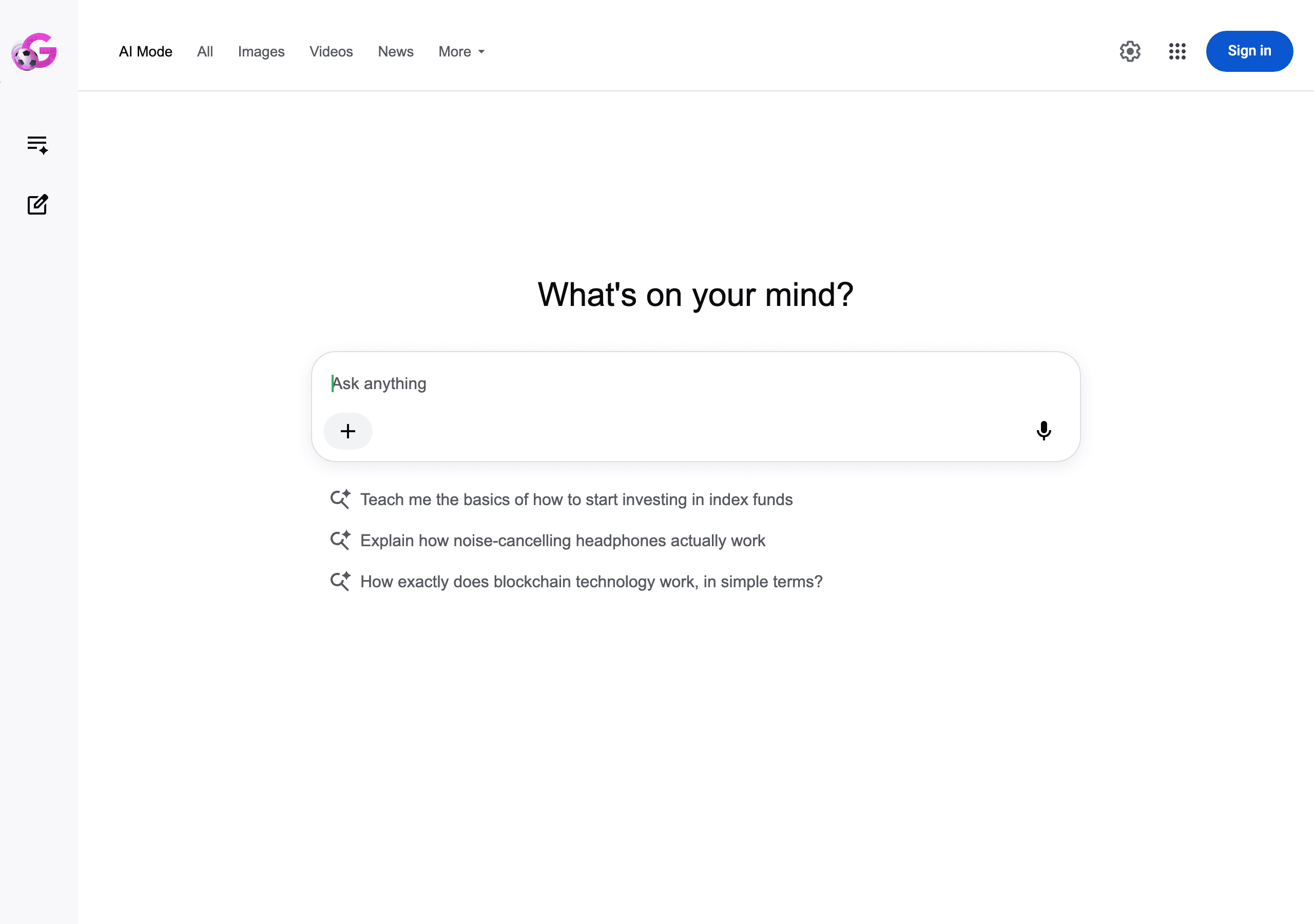
AI Mode is the fuller, conversational experience. Instead of a summary sitting above the links, it is a dedicated interface powered by Gemini that handles questions needing exploration, reasoning or multi-criteria comparison, and it supports follow-up questions. At Google I/O 2026 in May, Google upgraded AI Mode to run on Gemini 3.5 Flash and made the AI-first experience the global default across desktop and mobile, after Gemini 3 became the default model behind AI Overviews earlier in the year. By the announcement, AI Mode had passed one billion monthly users. Both surfaces draw on the same Search index and ranking systems, which is why a single optimisation approach serves both. For the wider engine landscape, see our roundup of the best AI search engines in 2026.
How Google grounds AI Overviews in trusted content
The core mechanism is retrieval-augmented generation, which Google also calls grounding. In Google's own words, it is a technique used to improve the quality, accuracy and freshness of AI responses by relying on its core Search ranking systems to retrieve relevant, up-to-date pages from the index. The model does not invent an answer from training data alone. It retrieves well-ranked pages and generates a response anchored to them, with links back to the supporting sources. Google sets this out in its guide to optimising for generative AI features, where it argues bluntly that optimising for generative AI search is still just optimising for Search.
The second mechanism is query fan-out. Rather than running your single query once, Google issues multiple concurrent, related searches across subtopics, then assembles an answer from the wider set of results. Google describes AI Mode as breaking your question into subtopics and issuing a multitude of queries simultaneously on your behalf, as set out in its AI in Search announcement. Industry analysis of the technique suggests a typical question fans out into roughly three to ten parallel sub-queries. The practical implication is significant: to be cited, your content has to satisfy not just the original phrasing but the related sub-questions the system spins off behind the scenes.
Two consequences follow. First, eligibility is downstream of ranking. Google's AI features documentation is explicit that to be shown as a supporting link, a page must be indexed and eligible to be shown in Search with a snippet. If you do not rank for the underlying sub-queries, you cannot be retrieved at all. Second, longer and more specific questions trigger these features more often than short ones, because they invite synthesis. Single-word lookups rarely warrant an overview, whereas detailed, comparison-style questions frequently do.
The eligibility funnel: from indexed to named
It helps to think of inclusion as a funnel with four gates, each narrower than the last. Most advice fixates on the first gate and ignores the rest.
- Indexed and snippet-eligible. The page is in the index, not blocked by robots rules, nosnippet or noindex. Fail here and nothing downstream matters.
- Retrieved. The page ranks for at least one of the fanned-out sub-queries, so the system pulls it into the candidate set.
- Cited. A passage on the page is clear, self-contained and trustworthy enough that the model anchors part of its answer to it and links out.
- Named. Your brand or product appears in the synthesised text itself, not just as a footnote link, which is the outcome that actually shapes perception.
Classical SEO gets you through the first two gates. Clarity, evidence and trust get you through the last two. The brands that lose are usually the ones that win the first two gates and assume the rest takes care of itself.
How prevalent are AI Overviews, and why visibility matters
Prevalence figures vary widely because every tracker uses a different keyword set, geography, device mix and detection method. Across 2026 trackers the share of queries showing an AI Overview runs from roughly a quarter on conservative non-branded samples to around half, and as high as 60 percent on broad US industry trackers. The direction of travel is not in doubt: overviews have grown steadily since their wider rollout and now appear on a substantial share of informational searches.
The reason visibility inside the overview matters is what happens to clicks. The Pew Research Center analysed the browsing of 900 US adults across 68,879 Google searches in March 2025 and found that AI summaries appeared on about 18 percent of searches. When a summary was present, users clicked a traditional result on just 8 percent of visits, against 15 percent when no summary appeared, and they clicked a link inside the summary itself only 1 percent of the time. The full breakdown is in Pew's report.
A year on, the trend has hardened. SparkToro's 2026 analysis of US Google searches from January to April, using Similarweb panel data, put the overall zero-click rate at 68 percent, with the open web receiving fewer clicks per thousand searches than in 2024. Read together, the two studies tell a clear story: the share of searches that end without a single click keeps rising, and AI summaries are a primary driver. You can see the 2026 figures at Search Engine Land.
The takeaway is not that organic traffic has vanished. It is that being the cited source in an overview, and being named in the synthesised text, is now a distinct outcome worth optimising for and worth measuring. That is the broader practice of generative engine optimisation, of which AI Overviews are one important surface.
Monthly searches (US)
Search demand for AI optimisation terms (US)
The factors that influence inclusion
Because AI features run on core ranking, the inputs are familiar, but their relative weighting shifts towards clarity, evidence and trust. The table below summarises the factors that move the needle, what Google has said about each, and the practical action.

Want to get recommended by AI?
Check your AI search visibility, then let the Honeyb agent write, fix, and earn what gets you recommended. Free to start.
| Factor | Why it matters for AI Overviews | What to do |
|---|---|---|
| Organic ranking | Pages must be indexed and snippet-eligible to be retrieved | Fix crawlability, indexation and page experience first |
| Extractable answers | Synthesis favours clear, self-contained passages | Lead sections with a direct answer in two to three sentences |
| E-E-A-T | Grounding leans on trusted, authoritative sources | Show authorship, credentials, citations and real expertise |
| Freshness | Grounding is used to improve the freshness of responses | Keep facts, dates and statistics current; update timestamps |
| Structured data | Helps machines parse meaning, though not strictly required | Add Article, FAQ and Product schema where genuinely relevant |
| Off-page authority | Models weight claims that recur across independent sources | Earn citations on authoritative third-party pages |
Build a strong organic foundation
Everything starts with being retrievable. Google's optimisation guide is blunt that established SEO best practices continue to be relevant precisely because the AI features are rooted in core Search ranking and quality systems. So the unglamorous work matters: a clean crawl, no orphaned or broken pages, a sensible site hierarchy, fast and mobile-friendly delivery, and content that is genuinely indexed with a usable snippet.
It is worth knowing what Google says you do not need, because a great deal of advice online sells the opposite. Google states that you do not need to create new machine-readable files such as an llms.txt, you do not need to chunk content into tiny pieces for the model, you do not need to rewrite pages in a special voice for AI, and there is no special structured data required to appear in generative features. None of this means structure and schema are worthless. It means they are amplifiers of good content, not substitutes for it, a distinction we draw out in schema markup for AI visibility.
Make sure you are not accidentally blocking the right access either; a free AI crawler access check shows per-bot verdicts from your live robots.txt in seconds. AI features rely on Google's own infrastructure, and your robots directives and meta tags such as nosnippet and noindex remain the primary controls over whether content can appear. If you intend to be visible, confirm you are not excluding Googlebot or suppressing snippets. Audit your robots rules against your actual intent so you are not silently excluding the very crawler that grounds these features.
Write clear, extractable answers
Grounding rewards content that a model can lift cleanly. The most reliable pattern is to answer the question directly and early, then expand. Open a section with a two or three sentence answer that would make sense quoted on its own, then provide the supporting detail, examples and nuance beneath it. Write the passage you would want pulled into the overview verbatim, and then earn the right to it with the depth underneath.
A few structural habits help the model extract you accurately:
- Use descriptive, question-shaped headings that mirror how people actually ask
- Lead each section with the direct answer before the explanation
- Summarise complex material as short, scannable lists or compact pro and con summaries
- Present comparisons and specifications in tables the model can parse
- Keep one clear claim per sentence so a passage can be quoted without distortion
Remember the query fan-out point. A page that answers one narrow question may be passed over for a page that addresses the original question and its obvious follow-ups in a single, well-organised resource. Depth and topical coverage, not keyword repetition, is what lets you satisfy the cluster of sub-queries Google generates from a single search.
Use structured data and E-E-A-T to earn trust
Structured data is not mandatory, but it lowers the cost of understanding your page, which matters when a model is deciding what a passage means and whether to trust it. Mark up the things that genuinely describe your content: Article for editorial pieces, FAQ for real question and answer blocks, Product for commerce, HowTo for procedures. Keep the markup accurate and matched to visible content.
Trust signals carry disproportionate weight because grounding deliberately leans on authoritative sources. Make expertise legible: name the author, show relevant credentials and experience, cite primary sources, and date your content so freshness is unambiguous. Original data, first-hand testing and clearly referenced statistics are exactly the kind of traceable material that synthesised answers favour, because the model can attribute them cleanly. Generic, derivative content that restates what is already abundant gives the system no reason to choose you over the dozen pages that say the same thing. This is the same logic that governs how AI models choose which brands to recommend across every engine, not just Google. For a plan that spans the other surfaces too, see how to rank in ChatGPT, AI Overviews and Perplexity.
Keep content fresh and earn external citations
Freshness is built into the mechanism. Google describes grounding as improving the freshness of AI responses, so up-to-date pages have a structural advantage on any topic where recency matters. Revisit cornerstone pages on a schedule, refresh statistics and examples, correct anything that has aged, and update the visible date when you make a substantive change rather than a cosmetic one.
Finally, look beyond your own domain. Models weight claims more heavily when they recur consistently across independent, authoritative sources. Being mentioned and cited on reputable third-party pages, industry references, well-moderated communities and credible reviews compounds your eligibility to be grounded. Off-page reputation is no longer just a ranking factor in the classical sense. It is part of how an AI system decides whether your claim is corroborated enough to repeat in its own voice.
Measure whether you actually appear
The hard truth in both the Pew and SparkToro data is that ranking, and even being cited, will not show up cleanly in your click numbers, because so few people click through from an overview. You cannot manage what you cannot see, and a single manual spot-check tells you almost nothing, because AI answers vary by phrasing, location, model version and time of day. To know whether you are being cited and named, you need scheduled tracking across the engines and queries that matter to you, watching share of voice and how you are described, not just whether a link appeared once. We make the case for this in why spot-checking AI visibility fails, and our AI Overviews tracker guide covers the setup end to end.
That is the gap Honeyb is built to close. It monitors how a brand is mentioned, cited and described across Google AI Overviews, AI Mode and the other answer engines, on a schedule rather than ad hoc, and benchmarks that against competitors. Optimise with the tactics above, then verify the outcome with measurement, because in a world where the click often does not happen, the citation is the result.
Sources cited in this report