
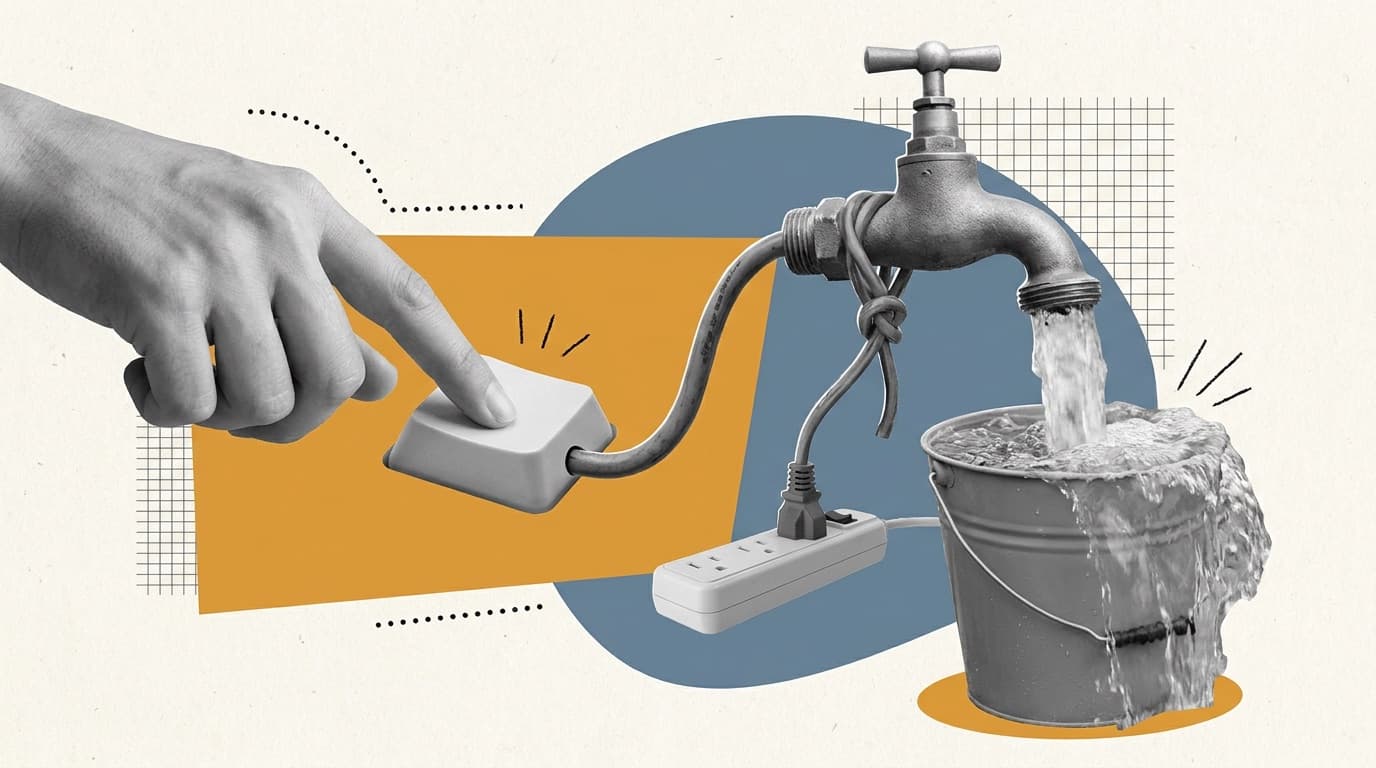
Ask the question plainly and the answer is small: by OpenAI's own account, one average ChatGPT query uses about 0.34 watt-hours of electricity and roughly 0.000085 gallons of water, which is about one fifteenth of a teaspoon. That figure comes directly from a June 2025 essay by OpenAI's chief executive, Sam Altman, and it sits an order of magnitude below the numbers that went viral in 2023. This piece sets out how much water does one ChatGPT search use, where the headline figures come from, why the scary versions were wrong, and the honest caveats that the small per-query number does not erase.
The topic is full of misinformation, in both directions. One camp insists every prompt drinks a bottle of water. Another camp waves the whole thing away as trivial. The accurate position is narrower and more useful than either. The per-query cost is genuinely small, the cost varies a lot by what you ask, and the thing that actually matters for the environment is where and when the water and power are drawn, not the teaspoon attached to your individual prompt.
How much water does one ChatGPT search use, in plain numbers
Start with the only figure OpenAI has published itself. In his essay *The Gentle Singularity*, dated 10 June 2025, Altman wrote that "the average query uses about 0.34 watt-hours, about what an oven would use in a little over one second, or a high-efficiency lightbulb would use in a couple of minutes. It also uses about 0.000085 gallons of water; roughly one fifteenth of a teaspoon" (Sam Altman, The Gentle Singularity). In millilitres, 0.000085 gallons is about 0.32 ml, so a handful of drops.
Two things are worth saying about that number before anyone leans on it. First, it is a single sentence from a blog post, not a peer-reviewed paper or an audited disclosure, and OpenAI has not published the methodology or the system boundary behind it. Second, "average query" is undefined. It is not clear whether deep-research runs, long documents or image generation are included, and the figure says nothing about the one-off energy and water spent training the model in the first place (Data Center Dynamics). Treat it as a credible order-of-magnitude claim from the operator, not a precise measurement you can audit.
The encouraging part is that an independent estimate landed in the same place before OpenAI said anything. In February 2025, Josh You at Epoch AI calculated that a typical ChatGPT query on GPT-4o used roughly 0.3 watt-hours, about ten times less than the 3-watt-hour figure that had been doing the rounds (Epoch AI). His working is transparent: roughly one second of an Nvidia H100 GPU per query, about 1,500 watts per chip at partial utilisation, around 500 output tokens, which comes out near 0.3 Wh. Altman's later 0.34 Wh corroborates it, and Google's own figure for Gemini, covered below, is in the same band. When the operator and an independent analyst converge from different directions, the central estimate is reasonably solid.
The viral 500 ml number, and why it was wrong
The figure most people remember is "a 500 ml bottle of water per ChatGPT conversation." It traces back to a real and serious 2023 paper, *Making AI Less Thirsty*, by Pengfei Li, Jianyi Yang, Mohammad A. Islam and Shaolei Ren, later accepted by *Communications of the ACM* (arXiv). That paper did pioneering work: it was among the first to account for both the water evaporated in data-centre cooling and the water consumed generating the electricity. Its training figure, that a roughly two-week GPT-3 training run in Microsoft's US data centres consumed about 700,000 litres of clean freshwater, is widely cited and not in dispute (UC Riverside).
The problem is how the per-query number got compressed for headlines. The research itself framed it as roughly 20 to 50 GPT-3 queries using about half a litre of water, not one query (UC Riverside). So even taken at face value, the original work pointed to something closer to 10 to 25 ml per query, and the popular "500 ml per prompt" version inflated that by a factor of twenty to fifty. Engineers who reworked the maths argue the real figure is smaller still, on the order of a few millilitres per conversation, partly because a power figure for the original GPT-3 was read as per-request rather than per-page, and partly because GPT-3 was far less efficient than the models running in 2025 (Sean Goedecke).
The cleaner way to read that same body of work comes from a later breakdown. One estimate puts a single GPT-3 text output of 150 to 300 words at about 16.9 ml of water in an average US data centre, split into 2.2 ml of onsite cooling water and 14.7 ml of offsite water for power generation (IEEE Spectrum). That split matters, and we will come back to it. The headline takeaway is simpler: the famous bottle-per-prompt number was a misreading of careful research, applied to an old model, and stretched across a single query when it described dozens.
What Google disclosed about Gemini, and why its number is bigger than it looks
In August 2025, Google did what OpenAI had not, publishing a full technical methodology rather than a sentence. It reported that the median Gemini Apps text prompt, on May 2025 data, used 0.24 watt-hours of energy, emitted 0.03 grams of CO2 equivalent, and consumed 0.26 millilitres of water, about five drops (Google Cloud). Those numbers sit right alongside the ChatGPT figures, which is reassuring for anyone trying to triangulate a true value.
The more important contribution is what Google said about boundaries. Its comprehensive figure of 0.24 Wh includes idle machines held in reserve for reliability, the host CPU and RAM that serve each request, and data-centre overhead such as cooling and power distribution. Strip those out and count only the active AI accelerator, the way many casual calculations do, and the same prompt reads as just 0.10 Wh and 0.12 ml of water. Google calls that narrow view "an optimistic scenario at best" that "substantially underestimates the real operational footprint of AI" (Google Cloud). The lesson for reading any of these claims is to ask what is counted. A number that looks lower may simply be drawn with a smaller boundary, not a cleaner data centre.
Here is how the main published figures line up.
| Source | Subject | Energy per query | Water per query | Basis |
|---|---|---|---|---|
| OpenAI (Sam Altman) | Average ChatGPT query | 0.34 Wh | ~0.32 ml (0.000085 gal) | Operator statement, June 2025, no methodology |
| Epoch AI (Josh You) | Typical GPT-4o query | ~0.3 Wh | Not estimated | Independent calculation, Feb 2025 |
| Median Gemini text prompt | 0.24 Wh | 0.26 ml | Full methodology, May 2025 data | |
| Google (narrow boundary) | Same Gemini prompt | 0.10 Wh | 0.12 ml | Active chip only, called an underestimate |
| UC Riverside (2023) | GPT-3 text output, 150-300 words | n/a | ~16.9 ml | Peer-reviewed, older and less efficient model |
The number that hides inside the average: it depends what you ask
A single average can mislead, because not all queries cost the same. Epoch AI's own analysis is explicit that the 0.3 Wh figure is for a short, ordinary text exchange. Feed in a long document of around 10,000 tokens and the cost rises to roughly 2.5 watt-hours. Push to a very long input of 100,000 tokens and it approaches 40 watt-hours, more than a hundred times the baseline (Epoch AI).

Want to get recommended by AI?
Check your AI search visibility, then let the Honeyb agent write, fix, and earn what gets you recommended. Free to start.
Reasoning modes widen the gap further. Models that "think" before answering generate far more tokens internally, and Epoch's informal testing found reasoning models producing roughly two and a half times the output of a standard model for the same prompt, with energy scaling broadly in line. Image generation and video are heavier again. So the honest answer to "how much does one ChatGPT search use" is a range, not a point. A quick factual question is a fraction of a teaspoon and a fraction of a watt-hour. A long research session that uploads documents, reasons hard and generates images can be one or two orders of magnitude more. Anyone quoting a single number for all of it, high or low, is rounding away the part that actually varies.
Why the per-query figure is the wrong thing to worry about anyway
Here is the part both camps tend to miss. The teaspoon attached to your individual prompt is not where the environmental question lives. Two facts move it elsewhere.
First, scale. OpenAI reported in February 2026 that ChatGPT had passed 900 million weekly active users, and the service handles on the order of 2.5 billion prompts a day. Multiply a small number by a number that large and you get a real industrial load. That is a statement about the fleet of data centres, not about your sentence, and it is the level at which the conversation should happen.
Second, and more sharply, location and timing. For most US data centres the indirect water, the water used to generate the electricity offsite, is far larger than the water evaporated onsite for cooling, which is exactly the 2.2 ml versus 14.7 ml split in the GPT-3 breakdown above. And the strain is concentrated. About two-thirds of US data centres built since 2022 sit in high water-stress areas, and demand can spike on hot days precisely when local households and farms need water most (IEEE Spectrum). A handful of drops averaged across a healthy national grid is trivial. The same drops drawn from a stressed aquifer in Arizona on a 40-degree afternoon are not. The harm is real, documentable and local, and a global per-query average is the wrong instrument for measuring it.
How to read any AI water or energy claim
Because this area attracts confident wrong numbers, a short checklist helps. It applies whether the claim comes from a vendor, a viral post or a study.
- Per query or per conversation or per training run? These differ by orders of magnitude. The 700,000-litre figure is a one-off training cost, not what your prompt does.
- Which model, and when? Efficiency has improved roughly tenfold since GPT-3 in 2020. A 2023 estimate built on a 2020 model overstates a 2026 query.
- What boundary? Active chip only, or idle capacity, CPUs, cooling and power generation too? Google's own numbers more than double when the boundary widens.
- Direct or total water? Onsite cooling water is a fraction of the total once offsite electricity-generation water is counted.
- Average or worst case? A long, reasoning-heavy, multimodal session is not the same as a one-line question.
Apply that and most of the scary headlines collapse into something defensible, while the genuinely important point, local concentration at scale, survives intact.
What this means if you work on a brand, not a data centre
Most readers here are not optimising data-centre cooling. They are trying to understand the tools their customers now use to make decisions, and increasingly those decisions happen inside an AI answer rather than a list of links. The environmental footprint of a single query turns out to be small and improving, which means the practical reason these tools matter to a marketing or brand team is unchanged: usage keeps climbing, and being named in the answer is the new visibility. For the demand picture, see our roundup of AI search statistics for 2026, and for why the channel matters at all, why AI search matters. If you are new to the category, start with what AI search is.
The honest bottom line
One ChatGPT search uses roughly 0.34 watt-hours and about one fifteenth of a teaspoon of water on average, per OpenAI, corroborated by an independent estimate near 0.3 Wh and by Google's 0.24 Wh and 0.26 ml for a comparable Gemini prompt. The viral "bottle of water per prompt" figure was a misread of solid research applied to an outdated model, and it overstated the truth by one to two orders of magnitude. The per-query cost is small and falling.
None of that makes the broader question go away. The real issues are aggregate scale, the larger offsite water tied to electricity generation, and the concentration of new data centres in places that can least spare the water at the times they can least spare it. Those are policy and siting problems measured in megawatts and watersheds, not in teaspoons. Quoting a tiny per-query number to dismiss them is as misleading as quoting a giant one to inflate them. Precision, in both directions, is the only honest position.
Sources cited in this report