Ask Perplexity a question and you do not get ten blue links to sift through. You get a written paragraph that answers it, with numbered footnotes after almost every sentence pointing to the pages it read. BrightEdge, in its first dedicated study of the platform, found Perplexity attaches an average of 5.28 citations to a response, more than any other AI search tool it measured. That single design choice, putting the source list inside the answer, is the whole story of what Perplexity is and why it matters. This post is a product and company overview: what Perplexity does, how its modes differ, what it costs, the browser it now ships, the company behind it, and why brand teams have started watching it closely.
If you want the narrower questions, we cover them separately. For what the word and the underlying metric mean, see what does Perplexity mean. For the retrieval and ranking mechanics, see how does Perplexity AI work. Here we stay on the product itself.
Answer engine, not search engine
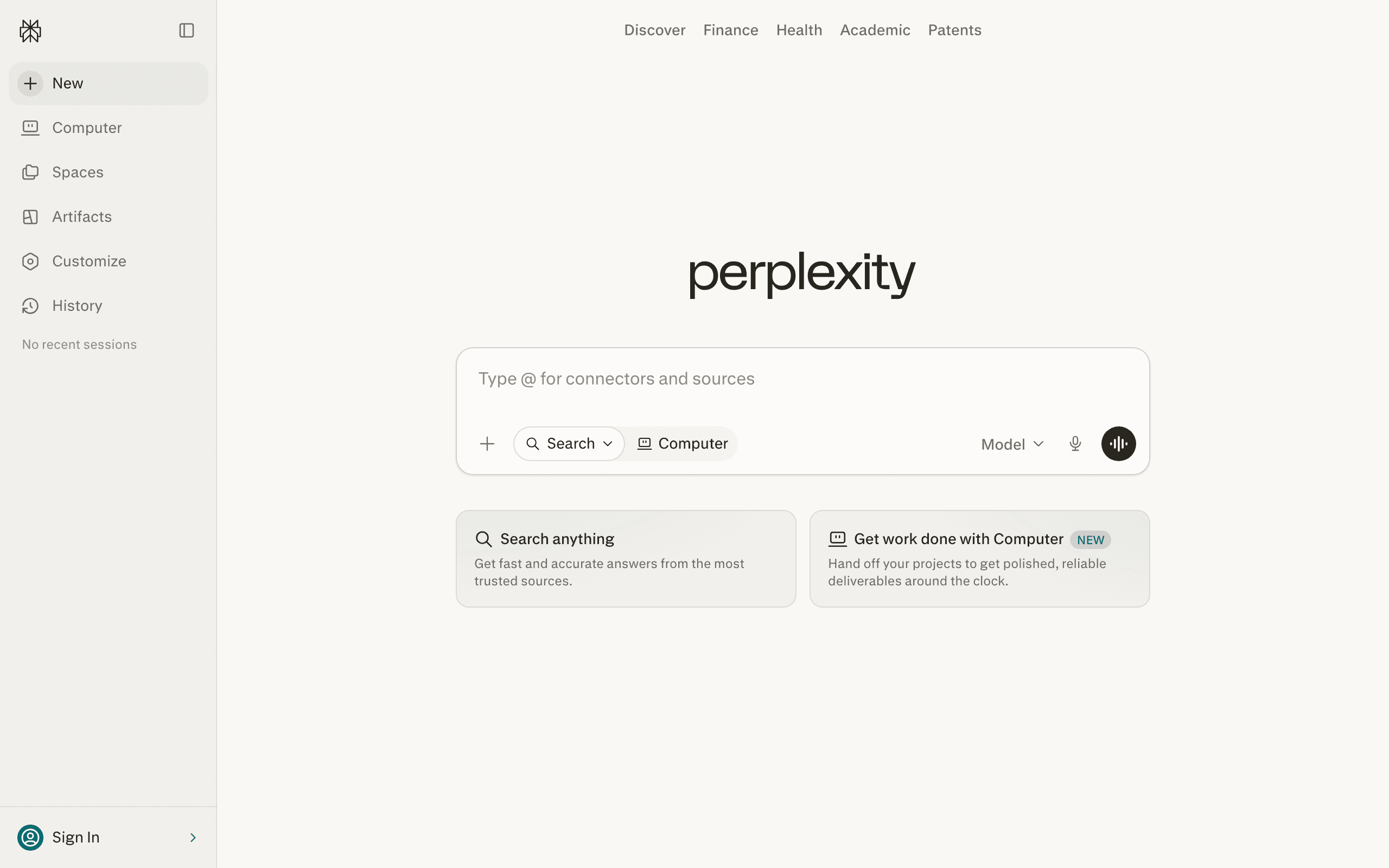
Perplexity calls itself an answer engine, and the label is doing real work. A traditional search engine matches your query to pages and ranks links, then leaves the reading to you. An answer engine does the reading: it runs searches in the background, pulls the relevant passages from several pages, and writes a direct response, with each claim tied to a citation you can open and check.
The order of the workflow is reversed, and that is the point. Classic search starts you with the links and ends with an answer you assemble yourself. Perplexity starts you with the answer and treats the links as evidence you can audit. For everyday lookups that flips ten open tabs into one cited paragraph. We unpack the wider contrast in AI search versus traditional search.
Under the hood Perplexity is not one model. It runs its own in-house Sonar family for fast grounded search and routes harder queries to frontier models from other labs, including current versions of GPT, Claude, Gemini and Grok, picking whichever suits search, reasoning or coding. A real-time web index sits on top of all of them. That retrieval layer is the difference from a standalone chatbot answering only from training data, and it is why a Perplexity answer can quote a price or a release date from this morning.
That same Sonar family is also available to developers, and the Perplexity MCP server exposes it to coding assistants like Claude and Cursor so they can run grounded, cited search from inside the tools they already use.
What people actually use it for
Most people reach for Perplexity to do the jobs they once did with a search engine, only faster and with the synthesis already done. The common patterns:
- Sourced factual answers, where you want one cited paragraph rather than ten tabs
- Comparing products, tools or approaches, with the evidence attached to each claim
- Getting oriented in an unfamiliar topic before going deep
- Pulling current information such as recent news, prices or release dates that a static model would miss
- Reading and interrogating your own uploaded documents or a specific web page
Because every answer carries footnotes, the habit becomes: read the synthesis, then click through to the one or two sources that actually decide the matter. The links are still there, they just come last.
The four modes, and when each earns its keep
Perplexity has grown from a single box into a small suite. The distinction that matters most is how much work each mode does before it answers.
| Mode | What it does | Best for |
|---|---|---|
| Quick Search | One fast cited answer to a single question | Everyday lookups |
| Pro Search | Breaks a question into sub-queries, searches iteratively, fetches specific pages, may ask a follow-up | Harder or multi-part questions |
| Deep Research | Runs many searches across many sources and returns a long structured report | Market scans, literature-style reviews |
| Spaces | Organised threads with uploaded files for a project or team | Recurring research, collaboration |
Citations are the through-line. Every mode footnotes the pages it drew from, which is what lets you trust or reject the answer, and it is also why Perplexity matters to brands: if your page is cited, you are inside the answer, not buried below it.
Pro Search is more than a slower lookup. Perplexity's own developer documentation describes it as Sonar Pro with "automated tool usage," where "the model automatically decides which tools to use and when," choosing between a web search and fetching a specific URL as the research unfolds. In the consumer app that shows up as the occasional clarifying question before it commits to an answer.
Deep Research is the most autonomous mode. Hand it a topic and it performs dozens of searches, reads a large set of sources, reasons across them, and returns a structured report with citations in minutes rather than the hours a person would spend. It suits the work where the deliverable is the document, not the quick fact.
Comet: betting that the browser is the product
In 2025 Perplexity stopped being just a website and shipped Comet, its own web browser. Per Wikipedia's record of the launch, Comet is built on Blink, the engine behind Chromium and Chrome, so existing sites and extensions behave as expected. It arrived on Windows and macOS on 9 July 2025, became free to download in October 2025, added Android on 20 November 2025 and reached iOS on 18 March 2026.

Want to get recommended by AI?
Check your AI search visibility, then let the Honeyb agent write, fix, and earn what gets you recommended. Free to start.
What separates Comet from a browser with an AI panel bolted on is that the assistant is the interface. It can summarise the page you are on, answer questions about its content, and run multi-step tasks across tabs, generating summaries, drafting emails, even buying products. The wager is plain: if search is becoming an answer engine, the browser and the answer engine should be the same product, with the address bar feeding the assistant directly.
A short history of the company
Perplexity was founded in August 2022 in San Francisco by Aravind Srinivas, Denis Yarats, Johnny Ho and Andy Konwinski. Srinivas had researched at OpenAI, Konwinski was a founding team member at Databricks, and the public search engine launched on 7 December 2022, in the first wave of consumer AI that followed the arrival of mainstream chatbots.
The trajectory from there was steep. Across 2024 and 2025 the company raised round after round and its reported valuation climbed from roughly one billion dollars into the tens of billions, reaching about twenty billion after a 200 million dollar raise in 2025, with later reporting in early 2026 putting it higher still. We keep the investors and founding story in a dedicated post: who owns Perplexity AI. Treat any single valuation figure as a snapshot, since these move quickly.
Monthly searches (US)
Search demand for "perplexity ai"
Usage rose with the funding. By early 2026 Perplexity reported crossing 100 million monthly active users once its agent products are counted, which is part of why the product turns up so often in buyer research now. That visibility is the reason brands track it at all.
Pricing and plans
Perplexity runs the familiar free-plus-paid shape. Exact limits drift, so confirm current figures on Perplexity's own pricing page, but as of mid-2026 the tiers are:
- Free: unlimited Quick Search with citations, plus a small daily allowance of Pro Search (around five a day)
- Pro (about 20 dollars a month): removes the Pro Search cap, unlocks the frontier-model switcher, and adds file uploads, image generation and a small monthly API credit
- Max (about 200 dollars a month): the heavy-user tier, bundling the most capable models, the most generous limits and the most autonomous agent features
- Enterprise and API: team plans plus the Sonar API for developers building search into their own products
For a deeper breakdown and how the tiers compare in practice, see Perplexity pricing and our Perplexity reviews roundup.
Who it is for, and who it is not
Perplexity suits anyone who treats search as research rather than navigation. Analysts, knowledge workers, students and curious generalists get the most from it, because the citation-first format rewards people who want to verify a claim and then go deeper. It is a poor fit for the navigational query, the moment you simply want the official login page for a site you already know, where a classic search engine is one keystroke faster.
It is also increasingly relevant to a second audience: marketers and brand teams, for the opposite reason. When Perplexity fields a buyer question such as "best tools in a category," it names a shortlist and cites the pages behind it. If your brand is missing from that shortlist, you are invisible at the exact moment of consideration. Working out which brands get recommended, and why, is now part of search strategy: see how AI models choose which brands to recommend.
How it compares to the other answer engines
Perplexity is one of several answer engines, and the right comparison depends on the job. ChatGPT is a general assistant with search added; Perplexity is search-first, with citations as the centre of the experience. Google's AI Mode and AI Overviews sit inside the dominant search engine and reach the largest audience by default. Gemini and Claude bring their own strengths in reasoning and integration. On AI-chatbot market share Perplexity sits third in most 2026 estimates, behind ChatGPT and Gemini and ahead of Microsoft Copilot, while leading the field on citation density.
The practical takeaway is that no single engine owns the answer. The same buyer question can return different shortlists across ChatGPT, Perplexity, Gemini and Google AI Mode, which is why brand teams monitor several at once rather than optimising for one. For the best-known head-to-head, read Perplexity versus ChatGPT, and to see where it fits among the field, the best AI search engines of 2026.
What it means for your brand's visibility
Perplexity put the citation at the centre of search, and that quietly redefined what visibility means. Ranking on page one of links is no longer the only target. The question now is whether the answer engines mention, cite and recommend your brand when buyers ask, and those are measurable outcomes. The catch is that they are scattered across several engines, they shift week to week, and a single spot check tells you almost nothing, as we argue in why spot-checking your AI visibility fails.
That gap is what Honeyb is built to close: tracking how your brand shows up across Perplexity and the other major answer engines over time, measuring share of voice and sentiment, and benchmarking you against competitors. You can see where you stand today with the free AI visibility checker.