
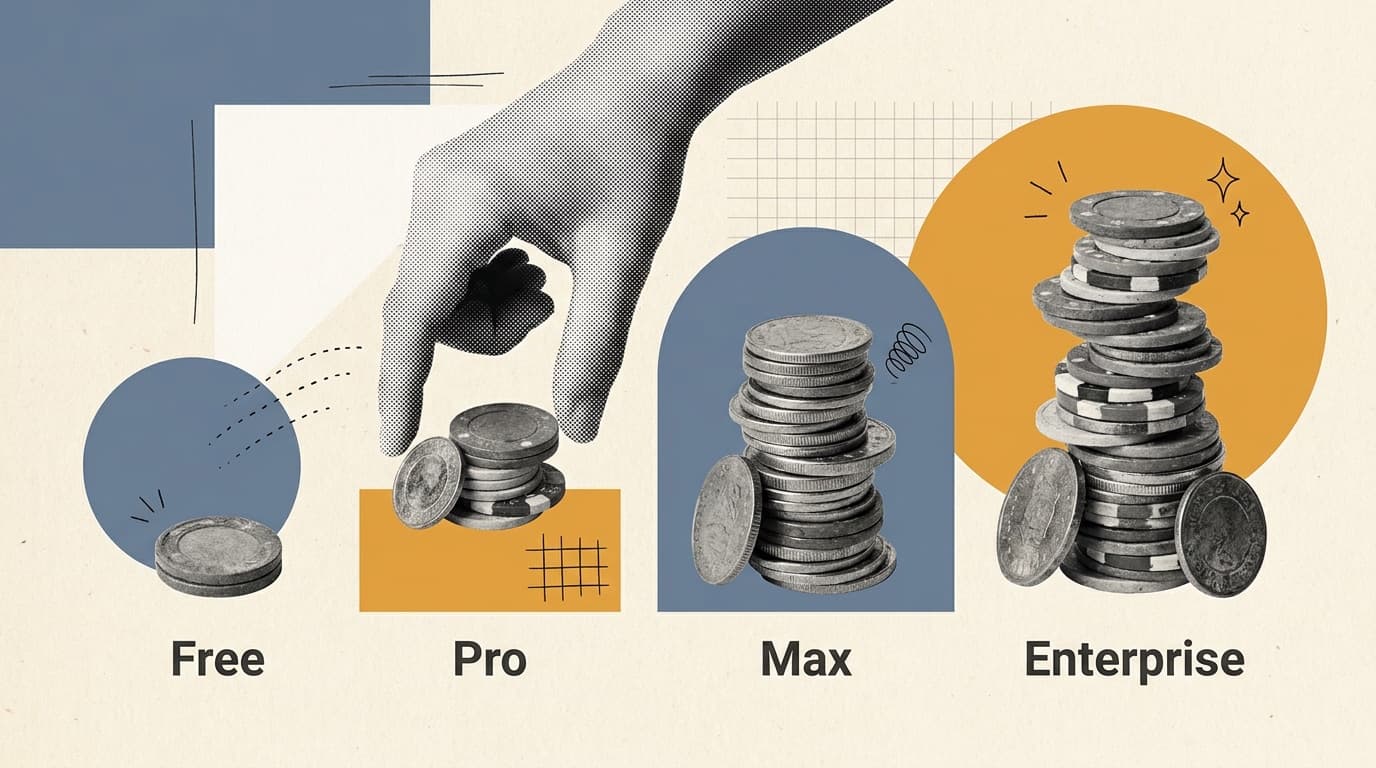
The single most expensive mistake with Perplexity pricing is overbuying the agent. Pro at $17 a month and Max at $167 (both billed annually) share almost the same answer engine and the same frontier models, and since Perplexity put Perplexity Computer, its autonomous agent, into Pro as well, the near tenfold price gap buys you agent volume rather than the agent itself: Max carries 10,000 Computer credits a month, Pro a one-off bonus of 4,000. Most people who upgrade to Max never exhaust those credits and would have been better served by Pro plus a few dollars of Sonar API.
This guide lays out what each plan costs, what genuinely separates them, and where the published limits are soft enough that you should check the in-app screen before you commit. Every price below was checked against Perplexity's own pricing pages, help center and developer docs on 11 October 2026.
A short word on method. AI products change their usage limits quietly and often, so the dollar figures here are verified against Perplexity's official documentation and the in-product checkout, while the per-day query caps are described as ranges where reporting disagrees. Treat the in-app limits page and the checkout total for your region and currency as the final word. Prices are in US dollars, the currency Perplexity's own pricing page shows ("US$17"). One change worth knowing: Perplexity's pricing pages now lead with the annual-billing figure expressed per month, and no longer print a month-to-month Pro price at all.
Perplexity pricing at a glance
Six SKUs, three audiences. Consumer plans are flat monthly or annual, with the annual rate now the headline number; Enterprise is per seat and usually negotiated against an annual commitment; the Sonar API is metered separately and billed by usage.
| Plan | Price (USD) | Best for |
|---|---|---|
| Free | $0 | Casual search, trying the product |
| Pro | $17/mo billed annually | Individuals who search daily |
| Max | $167/mo billed annually ($200 month to month, $2,000 a year) | Heavy users who run the Computer agent |
| Education Pro | $10/mo (verified students/educators) | Students and academics |
| Enterprise Pro | $34/seat/mo billed annually ($40 month to month) | Teams needing SSO and admin controls |
| Enterprise Max | $271/seat/mo billed annually | Large orgs wanting Max-level usage at scale |
Is Perplexity free? The free plan in 2026
Yes, the free tier is genuinely usable and for light users it is enough. You get unlimited standard searches, the conversational answer format with inline citations, and a small daily allowance of the deeper modes. The catch is that allowance: Perplexity's own plan comparison gives the free plan three Pro Searches a day and one Research query a month, so anyone leaning on the reading-heavy modes will hit the ceiling within minutes.
The free plan also auto-selects the model for every query. You do not get the model picker, so you cannot deliberately route a question to a specific frontier model the way paying users can. Higher file-upload limits, longer file retention, image and video generation, and priority routing are all reserved for paid tiers. The honest test is simple: if you run more than a few deep, multi-source queries on a typical day, the free plan will frustrate you fast.
Perplexity Pro: what $17 a month buys
Pro is where most individuals land. Perplexity lists it at $17 a month when billed annually, and that annual figure is now the only Pro price its pricing pages print; the month-to-month rate appears at checkout. The annual plan remains the only meaningful discount on the individual tiers.
Pro removes the friction that makes the free plan feel cramped. You get extended Pro Search and Research allowances (Perplexity describes both as limits set for "average use" rather than publishing a number), the model picker so you can send a question to a named model such as GPT-5.2, Claude Sonnet 4.6 or Gemini 3.1 Pro, image and video generation, far higher file-upload limits, and Create files and apps for assembling small reports, dashboards and mini-apps.
The bigger change since June is the agent. Pro now includes expanded access to Perplexity Computer with 4,000 bonus credits, and at the time of checking Perplexity was adding a limited-time US$40 of free Computer credits on top. That makes Pro the cheapest way to try the agent, and it moves the Pro versus Max decision from whether you get Computer to how much of it you use.
One feature that is no longer a paid differentiator: the Comet browser. Comet launched to Max subscribers in July 2025 but has been free worldwide since late 2025, with iOS rounding out the platforms in March 2026. If an older comparison tells you Comet is a Pro or Max perk, it is out of date. For how the two leading answer engines stack up on the questions that matter to brands, our analysis of how Perplexity and ChatGPT rank brands runs them side by side.
Perplexity Max: the agent tier, not a bigger Pro
Max costs $167 a month when billed annually, which is the $2,000 a year its help center lists, or $200 month to month. The instinct is to read it as Pro with higher limits, and that is the wrong mental model. The two plans share the same answer engine and the same frontier models. What the extra $150 a month on annual billing actually buys is volume: far more agent time and the highest limits on the heaviest features.
Max includes everything in Pro and gives Perplexity Computer, the cloud agent that launched in February 2026 and coordinates a stack of models to run multi-step tasks on your behalf, its maximum allowance: 10,000 Computer credits a month plus 35,000 bonus credits (and a limited-time US$450 in free credits at the time of checking), against Pro's 4,000 bonus credits. Max subscribers also get Brain, a research-preview memory that lets Computer build on your earlier work. and tasks consume credits by complexity: a quick job such as generating alt text might cost around 30 credits, while a long coding or research session can burn through thousands.
Max also lifts Create files and apps to its extended limits, gives the highest level of access to the newest models from OpenAI, Anthropic and others, and brings early access to new products before they reach Pro. Perplexity flagged the agent, unlimited Labs and early frontier-model access as the headline Max benefits when it launched the tier in July 2025.
Here is the decision in one line. If you are not running the agent hard or hitting Pro's Research limits most weeks, Max is paying $167 a month for headroom you will not touch. The break-even is usage of the agent, not the search box.
| Pro ($17/mo, annual) | Max ($167/mo, annual) | |
|---|---|---|
| Answer engine and citations | Yes | Yes |
| Model picker (GPT-5.2, Claude Sonnet 4.6, Gemini 3.1 Pro) | Yes | Yes, plus the most advanced models |
| Pro Search | Weekly limits, average use | Weekly limits, advanced use |
| Research queries | Monthly limits, average use | Monthly limits, advanced use |
| Perplexity Computer agent | Expanded access, 4,000 bonus credits | Maximum usage, 10,000 credits/mo plus 35,000 bonus |
| Brain memory for Computer | No | Yes (research preview) |
Education Pro: the student rate
Perplexity sells Education Pro to verified students and educators at $10 a month, with everything in Pro, Computer access included, plus Learn Mode. Verification runs through SheerID, and the discount holds for as long as your status stays valid.

Want to get recommended by AI?
Check your AI search visibility, then let the Honeyb agent write, fix, and earn what gets you recommended. Free to start.
On top of the standing rate, Perplexity periodically runs promotional student offers, including free months and referral-based extensions. These come and go and often carry expiry dates, so the accurate answer to "is Perplexity free for students" in 2026 is that the dependable option is the 10-dollar Education Pro rate, with occasional time-limited free promotions layered on. Confirm any current offer on Perplexity's own pages before you count on it.
Enterprise: Pro and Max for teams
Perplexity offers two Enterprise tiers for organizations that need centralised billing, security and admin controls. Enterprise Pro lists at $34 per seat per month billed annually ($40 month to month, $400 a year per seat), includes 500 Computer credits per seat each month, and adds SAML 2.0 single sign-on, user management, org-wide file repositories, cloud-storage connectors, higher per-seat research limits, SOC 2 compliance and a zero-data-training guarantee so team prompts are never used to train models. Enterprise Max is the top tier at $271 per seat per month billed annually, with 15,000 Computer credits per seat each month, and extends Max-level usage ceilings and agentic capabilities across the team, with the highest-tier model access. Perplexity also lists a custom-priced tier for organizations that need additional security and governance.
Two practical notes. First, some governance controls (audit logs, configurable data retention, SCIM provisioning) only switch on above a member threshold or once at least one Enterprise Max seat is in the account, so a small team on Enterprise Pro alone will not get every admin feature. Second, Enterprise is the tier most likely to be customized: the per-seat figures are list prices, and a large buyer on a multi-year commitment will negotiate from there. Treat them as the opening number in a procurement conversation, not the final one.
Perplexity API pricing (Sonar)
Separate from the consumer subscriptions, Perplexity sells API access to its Sonar models on a pay-as-you-go, token-based basis. This is what developers use to bake search-grounded answers into their own products. The pricing has two parts that catch people out: a per-token cost, and for the search-grounded models a per-request fee that scales with how much web context the model pulls in. The token figures below come straight from Perplexity's developer pricing documentation, checked on 11 October 2026, and they have not moved since June. One housekeeping note for developers: Sonar Chat Completions reached end of support on 27 September 2026, and Perplexity now reformulates those requests as calls to its newer Agent API, so new builds should start there.
| Model | Input ($/1M tokens) | Output ($/1M tokens) |
|---|---|---|
| Sonar | $1 | $1 |
| Sonar Pro | $3 | $15 |
| Sonar Reasoning Pro | $2 | $8 |
| Sonar Deep Research | $2 | $8 |
The per-request search fee is the part the headline token rate hides. For base Sonar it runs from 5 dollars per 1,000 requests at low context to 12 dollars at high context; for Sonar Pro and Sonar Reasoning Pro it runs from 6 to 14 dollars per 1,000 requests across the same low-to-high range. Sonar Deep Research adds further charges on top: 2 dollars per million citation tokens, 3 dollars per million reasoning tokens, and 5 dollars per 1,000 of the searches it runs autonomously.
The takeaway for budgeting is concrete: your true cost per query is token cost plus the search fee, and on the deep-research model the search and reasoning charges can dwarf the tokens. Perplexity publishes the full breakdown on its API pricing page.
Which Perplexity plan is right for you?
The decision turns on one question: how often you run deep, multi-source queries, and whether you need an agent. Light users stay free. Anyone searching daily for work will recoup Pro within the first week against time saved. Max only earns its price if you are running the Computer agent heavily or genuinely exhausting Pro's Research limits. Students take Education Pro. Teams that need SSO and admin controls move to Enterprise, where list price gives way to negotiated terms. Developers building search into a product use the Sonar API and budget tokens plus search fees.
- Free: occasional search, auto-selected model, 3 Pro Searches a day
- Pro ($17/mo billed annually): the default for daily individual users, now with Computer
- Max ($167/mo billed annually): maximum Computer usage, 10,000 credits a month
- Education Pro ($10/mo): verified students and educators
- Enterprise Pro / Max ($34 / $271 per seat a month, billed annually): SSO, admin, team controls
- Sonar API: pay-as-you-go for developers, tokens plus search fees
Why Perplexity pricing matters beyond your own subscription
There is a second reason to understand how Perplexity works, and it has nothing to do with your monthly bill. Perplexity has become a real channel for how buyers find brands. By mid-2026 it handles on the order of 50 million queries a week and ranks as the second-largest dedicated AI answer engine behind ChatGPT, and when someone asks it for the best CRM or the best running shoe, the reply is a shortlist with citations.
The scale of that shift is set out in our AI search statistics for 2026; being on the shortlist is now a measurable form of visibility. A free AI visibility checker shows where your brand stands on that shortlist today.
What Perplexity cites when it answers
14%
of Perplexity's citations came from Reddit
71 of 498 in our test; Semrush found Reddit the most-cited domain across AI engines. Honeyb, 13 July 2026.
8.3
sources cited per answer, the narrowest of four engines
Against ChatGPT's 15.0, so each slot counts for more.
43%
of the time its top pick changed between identical runs
One spot check is a single draw from a moving target.
That is the gap between paying Perplexity to do your research and understanding how Perplexity describes your brand in everyone else's. The two are related but distinct, and the second is invisible without monitoring, because spot-checking by hand misses how often and how inconsistently answers change.
If you want to understand the mechanics first, how AI models choose which brands to recommend explains what drives those shortlists, and our roundup of the best AI search engines in 2026 sets Perplexity in the wider field of answer engines pulling ahead of classic search.