
A buyer asks ChatGPT for the best wireless earbuds under $200 for running. The reply isn't a list of blue links. It's a product card carousel: five names, prices, star ratings, retailer links, and a one-line reason for each. The buyer taps one, lands on a retailer page, and converts. The full discovery-to-purchase journey happens inside a single conversation. The brands in those five slots earned them through specific, knowable mechanics. The brands that weren't there are invisible to a flow that already converts.
ChatGPT Shopping is the surface where that selection happens. Understanding how it's assembled is now table stakes for any brand selling a physical or digital product.
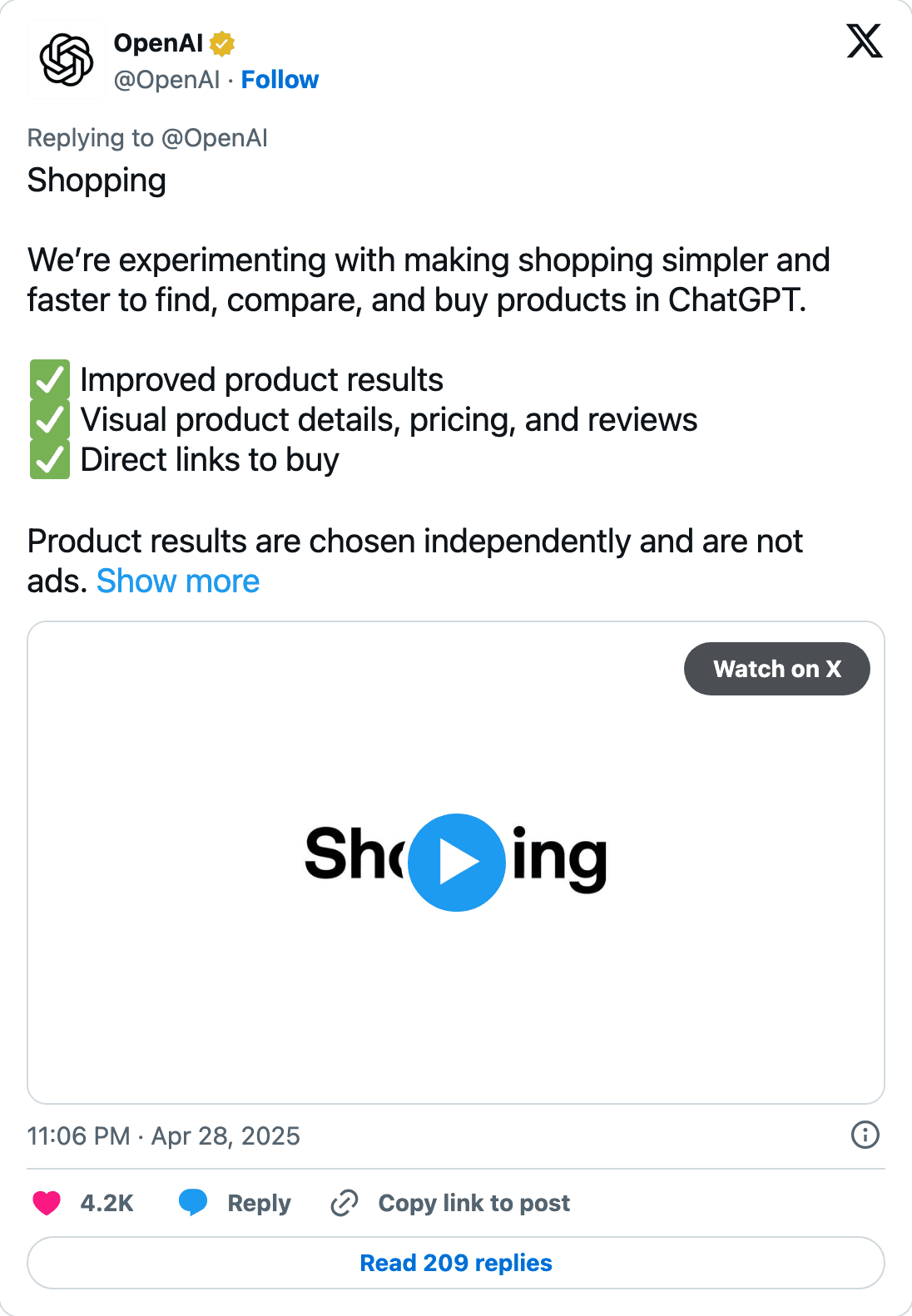
OpenAI announced the shopping experience on X, framing it as a way to find, compare and buy products directly inside ChatGPT.
What ChatGPT Shopping actually is
OpenAI rolled out ChatGPT Shopping as a native commerce layer inside the assistant. When a query has product intent, the model returns a structured product card alongside its text answer. Each card carries an image, a price, an aggregate rating, a retailer link, and a short editorial reason for the pick. There is no paid placement and no auction. The recommendation set is small, usually three to five products.
The competitive frame is not Google Shopping or Amazon search, although it overlaps with both. Google Shopping is a paid surface optimized by bid. Amazon search is a marketplace ranking optimized inside one walled garden. ChatGPT Shopping is a recommendation surface assembled from feeds, structured data, reviews, and the open web, weighted by what the model considers credible. The brand that wins a slot wins it on signals it earned everywhere else.
That no-auction position held until early 2026, when OpenAI opened a separate paid layer beneath the answer, and our piece on what ChatGPT ads mean for brands sets out how that sponsored slot sits alongside the organic shortlist a brand still has to earn.
Where the product data comes from
Three sources feed the cards, and they don't carry equal weight by query type.
OpenAI's product feed. Merchants can submit a structured product feed directly to OpenAI, similar in spirit to a Google Merchant Center feed. Title, description, price, availability, image, GTIN, category, and shipping data. This is the cleanest input ChatGPT has on your catalog. If you sell physical product and you haven't submitted, you're relying on the model inferring your catalog from your site, which it does imperfectly.
Retailer integrations. ChatGPT pulls product data from major retailers and marketplaces it has direct relationships with. For a query like 'best laptop for college,' marketplace and retailer data dominates because the model treats those sources as a neutral aggregator. For specific brand queries, retailer data is the price and availability layer underneath your own product page.
Web-grounded recall. When the model isn't confident, it searches the live web. This is where structured data on your product pages, review platforms, and editorial coverage do their work. Web grounding is also what pulls in the one-line reason next to each card, often paraphrased from a review or roundup.
For specific product queries ('MacBook Air 15 M4') the brand's own page is favored. For general queries ('best running shoes for flat feet') marketplaces, review sites, and editorial roundups dominate. Strategy needs to win both ends.
What gets a brand into the short list
Four signals do most of the work.
Structured data on product pages. Product, Offer, AggregateRating, and Review schema with accurate values. Missing schema doesn't block citation. It does make accurate citation less likely, and accuracy is what gets a card built correctly. Pin your price, currency, availability, average rating, and review count in machine-readable form, and check the result with a schema markup validator before assuming it reads correctly.
Review platform presence. For DTC and consumer brands, Trustpilot, Sitejabber, and category-specific platforms. For SaaS, G2 and Capterra. For consumer hardware, Amazon review depth. Brands with active profiles on third-party review platforms are cited by ChatGPT roughly three times as often as those without. Volume matters, but recency and review velocity matter more. A brand with 50 Trustpilot reviews from 2022 reads as stale. A brand with 5,000 reviews and a steady weekly cadence reads as a default option.

Want to get recommended by AI?
Check your AI search visibility, then let the Honeyb agent write, fix, and earn what gets you recommended. Free to start.
Editorial coverage. Inclusion in 'best of' roundups on publications buyers already trust. The model treats editorial roundups as pre-vetted shortlists. If a category-defining roundup names five brands, those five start with a meaningful advantage in any query that maps to the same intent.
Feed hygiene and llms.txt. A clean OpenAI product feed and a well-formed llms.txt at your domain root remove ambiguity. Neither guarantees a slot. Both remove reasons to skip you.
What changes for e-commerce, marketplace sellers, and SaaS
DTC brands. Your site is now a supporting document. The primary asset is what other domains say about you. The most leveraged investments are review-platform health, schema accuracy on product pages, and earned editorial in publications your buyers actually read. A DTC running-shoe brand asking why it doesn't show up for 'best shoes for flat feet' usually has the same diagnosis: thin Trustpilot profile, no editorial coverage in running publications, and Product schema missing AggregateRating.
Marketplace sellers. If most of your volume is on Amazon, your Amazon listing hygiene is your AI visibility. Review depth, accurate bullet points, A+ content, and category placement carry the load. For general queries, the model often surfaces the marketplace listing rather than your own site. Treat the listing as a primary asset, not an afterthought.
SaaS sellers. Less about merchant feeds, more about G2, Capterra, and category roundups. A SaaS brand with a strong G2 profile, a clean Organization schema, and inclusion in a few credible category roundups will outperform a brand with double the ad spend but no third-party footprint. Pricing and feature accuracy in schema also matters more here than most teams realize, because pricing is the single most-hallucinated SaaS fact.
The 30-day shipping list
If a brand can only commit a month to this work, these are the moves with the most leverage.
- Audit Trustpilot, G2, or Capterra profile health. Claim the profile, complete every field, and set up a post-purchase or post-onboarding review request flow tied to a clear milestone.
- Roll out Product, Offer, and AggregateRating schema across all product pages. Validate every page in Google's Rich Results Test. Fix what breaks.
- Submit a clean product feed to OpenAI. Match the field structure they publish.
Keep price, availability, and image URLs current. • Add an llms.txt at the domain root listing your canonical product, pricing, and category pages. • Publish at least two pieces of comparison content on your own domain. Direct, factual, with structured tables. 'X vs Y' and 'best X for Y' formats earn web-grounded citations because they answer the exact query shape buyers ask. • Clean up retailer and marketplace pages. Accurate titles, complete attributes, current pricing, fresh reviews. These pages are doing more work than your homepage in general-query results.
The two-year picture
ChatGPT Shopping is one surface of a much larger shift. Commercial intent has moved inside answer engines. 58% of consumers have already replaced traditional search with AI tools for product and service discovery, per Capgemini's 2025 research. 64% say they're ready to buy products AI recommends. Ahrefs projects AI-search visitors will overtake traditional search visitors by 2028.
The implication for any brand selling a product is direct. The buying journey is no longer a funnel that starts with Google and ends on your site. It increasingly starts and ends inside a conversation, with three or four named recommendations and a checkout link. Brands that aren't in the named set are not losing share visibly. They're losing share invisibly, in a flow that doesn't show up in their analytics because the click never happened.
The risk isn't theoretical. It's already priced in for the brands that started this work in 2025. The cost of catching up climbs every quarter the shortlist hardens around incumbents.
Closing
Get the diagnostic before you commit budget. Run a free AI visibility check on your top-selling categories to see where you currently surface, where you don't, and which competitors hold the slots. For the broader e-commerce playbook, see AI visibility for e-commerce brands.