

A buyer asks ChatGPT for the best meal-kit service for two people who cook three nights a week. The answer is the usual measured paragraph and a short shortlist. Underneath it, clearly labelled Sponsored and set apart from the rest of the reply, sits a card for a grocery-delivery brand. The organic answer and the paid slot are now on the same screen, in the same conversation, at the moment the buyer is deciding. That screen is new. For most of ChatGPT's life there was nothing to sell against the answer. As of early 2026 there is, and the question for brands is no longer whether ChatGPT ads are coming. It is how the paid layer sits on top of the organic one, and what that does to visibility you have spent two years earning.
This is a news-led read on what OpenAI has actually announced and shipped, not a forecast. We will set out what is live, who is running ads, how the format works, and then the part that matters most for brand teams: how ChatGPT advertising interacts with the organic recommendations that decide whether you get named in the first place.
What OpenAI has actually announced and shipped
Two dates anchor the story. On 16 January 2026, OpenAI published a post titled Our approach to advertising and expanding access to ChatGPT, authored by Fidji Simo, its CEO of Applications, first reported by TechCrunch. The post confirmed that OpenAI would begin testing ads and set out the principles it intended to hold to. The same day, OpenAI made ChatGPT Go available worldwide at around 8 dollars a month in the US, framing ads and a cheaper paid tier as two routes to the same goal of expanding access.
On 9 February 2026, the ads went live. TechCrunch reported that OpenAI began testing ads in the United States for logged-in adult users on the Free and Go tiers, with Plus, Pro, Business, Enterprise and Education subscriptions remaining ad-free. The placement is deliberately conservative. Ads appear at the bottom of an answer when there is a relevant sponsored product or service, are labelled Sponsored, and are visually separated from the organic reply rather than woven into it.
OpenAI's stated principle is the one every brand team should read twice. In its own words, Ads do not influence the answers ChatGPT gives you, and we keep your conversations with ChatGPT private from advertisers. Targeting is based on the subject of the current conversation, past chats and previous ad interactions. The example OpenAI gave is mundane on purpose: someone researching recipes might see ads for grocery delivery or meal kits. Advertisers receive only aggregate performance data such as views and clicks, not individual user data, and users can dismiss an ad, see why it was shown, and clear the data used to personalise it.
Who is running ChatGPT ads
The pilot did not launch into an empty room. Coverage from Retail TouchPoints and Digital Commerce 360 named early testers including Target, Williams-Sonoma and Albertsons among retailers, alongside Adobe and the agency holding company WPP. Reporting since has added consumer brands such as HelloFresh and Amazon's Audible to the list of advertisers signing on during the test. The early roster skews retail and commerce, which is consistent with where the format does its most natural work: queries with clear buying intent.
The buying side has moved quickly too. On 11 May 2026, Marketing Dive reported that OpenAI opened a self-serve ChatGPT Ads Manager in beta, letting advertisers register, add payment details, set budgets, bids and pacing, upload ads and review performance in a portal. It introduced cost-per-click bidding alongside the cost-per-impression model from the initial pilot, and named agency and ad-tech partners including Dentsu, Omnicom, Publicis, WPP, Adobe and Criteo. The same reporting noted the test was expanding beyond the US into markets including the United Kingdom, Mexico, Japan, Brazil and South Korea. We covered the self-serve ChatGPT ads rollout of May 2026 in detail, including the CPC bidding and measurement tools.
The scale behind this is the reason it matters. OpenAI said in February that ChatGPT had reached roughly 900 million weekly active users and 50 million paying subscribers. The ad-supported tiers are the Free and Go users, which is the large majority of that base. A new advertising surface in front of hundreds of millions of weekly users is not a side experiment, even if OpenAI is being cautious about how it looks.
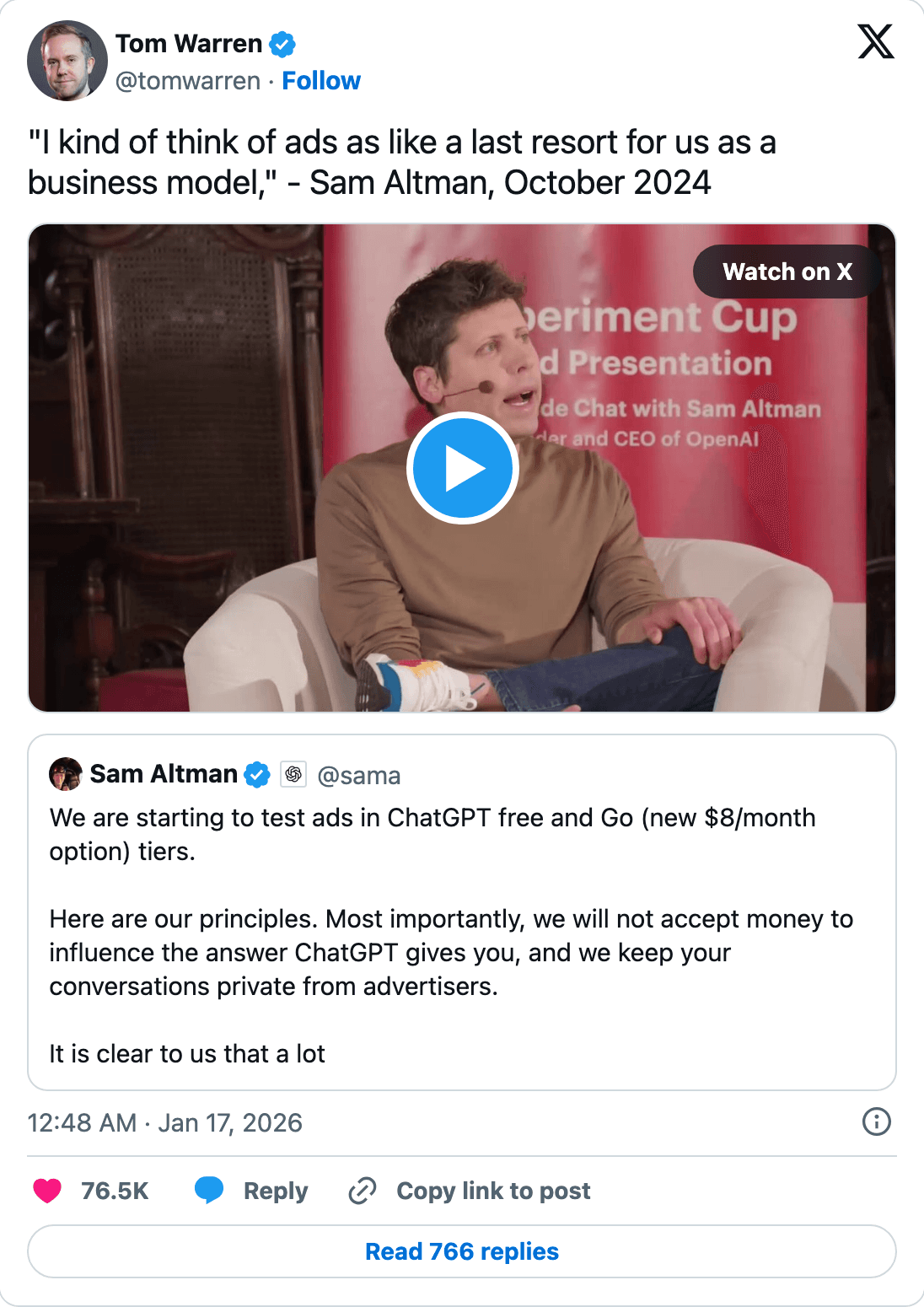
The move did not pass without comment. The Verge's Tom Warren resurfaced Sam Altman's own 2024 line that ads were a last resort for OpenAI's business model, a reminder of how far the position had shifted.
Where this sits in the wider AI advertising picture
ChatGPT is not the first answer engine to face the monetisation question, and the contrast with its rivals is instructive. Google has been steadily moving paid placements into its AI surfaces, putting ads inside AI Overviews and its conversational AI Mode, which now reaches more than a billion monthly users. At its May 2026 Marketing Live event it introduced new Gemini-powered ad formats built to live inside the AI response rather than beside it. Google's advantage is two decades of intent-based search advertising to lean on, and Simo has said ChatGPT's model will look more like Google's intent-based system than the Facebook ads machine she helped build at Meta.
Perplexity took the opposite path. It tested sponsored follow-up questions from late 2024 with partners including Indeed and Whole Foods, keeping the answers to those questions generated by Perplexity rather than the advertiser. By early 2026 it had stepped back from advertising on trust grounds, with the argument that once users suspect commercial influence they stop believing the answer is the best available one. Whether you read that as principle or as a smaller company protecting its core differentiator, the divergence is real, and it frames the strategic choice every answer engine now faces.
| Engine | Ads status, mid 2026 | Where ads appear | Stated stance on answer independence |
|---|---|---|---|
| ChatGPT | Testing on Free and Go tiers | Below the organic answer, labelled Sponsored | Ads do not influence the model's answers |
| Google AI Mode and AI Overviews | Live and expanding | Inside and alongside AI responses | Ads marked as sponsored within results |
| Perplexity | Stepped back from ads | Previously sponsored follow-up questions | Cited answer trust as the reason to pull back |
Market share (%)
ChatGPT market share (including Microsoft Copilot)
The chart above is a reminder of why OpenAI can afford to be measured. ChatGPT's share of the generative-AI assistant market has held near the top of the range for over two years even as rivals took incremental share. That dominance is the asset advertising is built on, and it is also the asset OpenAI risks if the ads erode the trust that keeps people asking ChatGPT in the first place.

Want to get recommended by AI?
Check your AI search visibility, then let the Honeyb agent write, fix, and earn what gets you recommended. Free to start.
How ads sit alongside organic AI recommendations
Here is the distinction that matters for brand teams, and it is easy to blur. There are now two separate ways to appear in a ChatGPT answer, and they run on completely different mechanics.
The first is the organic recommendation. When ChatGPT names brands in a shortlist, or surfaces product cards through ChatGPT Shopping, it is synthesising from product feeds, third-party reviews, editorial roundups and the open web. No money changes hands and there is no auction. We covered exactly how that selection works in ChatGPT Shopping and brand strategy, and the broader signal stack in how AI models choose which brands to recommend. This is the layer two years of GEO work has been aimed at.
The second is the sponsored slot. That is the paid placement at the bottom of the answer, bought through the Ads Manager, matched to the conversation by topic and history rather than earned through credibility. On OpenAI's own account, the model does not weigh the ad when it composes the answer, and Simo has said that if you ask ChatGPT directly about an advertised product it will give a neutral assessment rather than a sales pitch.
If OpenAI holds that line, the practical consequence is reassuring and demanding at once. Reassuring, because you cannot buy your way into the organic shortlist; the recommendation is still earned. Demanding, because a competitor can now buy a sponsored slot directly beneath an answer that recommends you, capturing the click at the decision point even when the model named you and not them. Being in the organic answer no longer guarantees you own the moment of choice on the screen.
What it means for visibility and trust
Three shifts follow from a two-layer answer, and none of them are hypothetical.
Earned visibility and paid visibility stop being the same conversation. For most of ChatGPT's life, getting named was the whole game. Now there is a paid surface that sits independently of whether you are named. Brand teams that have only ever tracked organic mentions need a view of both: are we in the recommendation, and is anyone buying a sponsored slot against the queries where we are. Those are different questions with different owners and different budgets.
The trust premium is the thing under tension. The reason a recommendation inside ChatGPT converts is that buyers read it as advice, not advertising. OpenAI knows this, which is why the labelling and separation are so deliberate. The risk for the channel is gradual: each additional sponsored slot makes the next one feel more normal, and survey evidence suggests ads in AI search would reduce user trust in the results. In one January 2026 survey of US adults, 63 per cent said ads in AI search results would lower their trust in those results. If that trust erodes, the value of every slot in the answer, paid and organic alike, erodes with it. Brands have a stake in OpenAI getting the balance right, not just in winning placements.
The organic answer is still the foundation, and it is still earned the same way. Nothing OpenAI has shipped changes what gets a brand into the recommendation. Third-party validation, review-platform health, editorial coverage, clean structured data and a strong community footprint are still the levers, because the model is still synthesising from those sources. If anything, the arrival of a paid layer raises the value of the earned one. A sponsored slot you rent for as long as you pay is worth less, strategically, than a default recommendation you hold because the model considers you credible. We set out how to compete for that organic ground in AI visibility for e-commerce brands and the recommendation mechanics in ChatGPT SEO: how to get your brand recommended.
What brands should do now
This is a moment to adjust posture, not to panic. The sensible response is to treat ChatGPT as a channel with two layers and to make sure you can see, and act on, both.
- Separate your reporting into earned and paid. Track whether ChatGPT names you organically for your priority queries, and separately whether sponsored slots are appearing against those same queries. Conflating the two hides which lever is actually moving.
- Audit the queries where you depend on being the organic recommendation. Those are the ones most exposed to a competitor buying a sponsored slot beneath the answer. Decide in advance whether you would defend them with paid placement or by widening your organic lead.
- Keep investing in the earned signals first. Review-platform presence, editorial coverage, structured data and community footprint still decide the recommendation, and the recommendation is the asset advertising cannot buy. Paid is a supplement to that work, not a replacement for it.
- If you test the Ads Manager, treat it as an experiment with measurement attached. The format is young, pricing is still settling, and the markets and rules are changing month to month. Spend like it is a pilot, because it is.
- Watch the labelling and the placement, not just your own metrics. The health of the whole channel depends on ads staying clearly marked and separate from advice. If that changes, the value of being recommended changes with it, and that is a strategic signal worth tracking deliberately.
The honest read
OpenAI has done something narrower than the headlines suggest and more significant than the cautious rollout implies. It has put a paid surface in front of hundreds of millions of weekly users while promising that the surface does not touch the answer. If it keeps that promise, the organic recommendation remains the prize and the sponsored slot is a way to compete for attention around it. If it does not, the line between advice and advertising blurs, and the trust that makes any placement in a ChatGPT answer valuable starts to thin.
For brand teams the practical takeaway is steady. The work that earns the organic recommendation has not changed, and it now matters more, not less, because it is the one position you hold on credibility rather than spend. The new layer is worth understanding and worth measuring. It is not yet worth reorganising your whole strategy around. Watch what ships next, keep earned and paid visibility on separate lines, and protect the queries where being the named recommendation is the difference between being chosen and being scrolled past.
Sources cited in this report