

"ChatGPT SEO" is an awkward phrase, because ChatGPT is not a search engine in the traditional sense. It does not return ten blue links. It reads the web, synthesises an answer, and often names a handful of specific brands or products inside it. That last behaviour is the one that pays your bills. When someone asks ChatGPT for the best project management tool, or the most reliable accountant in their city, the question is no longer whether you rank on page one. It is whether you get named at all, and whether the two or three brands it does name include yours.
The stakes have changed scale fast. ChatGPT crossed one billion monthly active users in 2026, the fastest app in history to reach that mark, on top of roughly 800 million weekly active users. A large slice of those conversations are commercial: people shortlisting vendors and asking for recommendations they would once have typed into a search box. This guide covers the angle that matters most, how to make your brand appear in the answers ChatGPT gives other people, and closes with a short, honest section on using ChatGPT as an assistant for your own SEO work. The two get filed under the same name, the strategies barely overlap, so we keep them apart.
Why ChatGPT mentions are worth chasing
When ChatGPT names three CRMs in response to "what is the best CRM for a small team", those three brands receive the kind of pre-qualified attention that used to require a top organic ranking, except there is no second page to scroll to and no list of alternatives below. The shortlist is the whole result. A brand left off it is not ranked tenth. It is absent.
For SaaS teams specifically, the slots tend to go to brands with active G2 and Capterra profiles and genuine community presence, which we break down in our guide to AI visibility for SaaS companies.
Demand for guidance on how to influence these answers has climbed in step with the engines themselves. Search interest in answer engine optimisation, AI search optimisation and ChatGPT SEO is real but volatile, as the chart below shows.
Monthly searches (US)
Search demand for AI optimisation terms (US)
The practical takeaway: visibility inside ChatGPT is now a distinct discipline. It shares foundations with classic SEO but is not the same thing, and the teams that run it as a separate workstream tend to get named more often. For where it sits in the wider landscape, see our explainer on how AI search differs from traditional search.
How ChatGPT chooses and cites sources
When ChatGPT answers a question that needs current information, it does not rely on training data alone. It browses. According to OpenAI's own ChatGPT Search documentation, responses that use search can carry inline citations a user can click, with a full list under a "Sources" link at the end. Those citations are the visible tip of a much larger retrieval process.
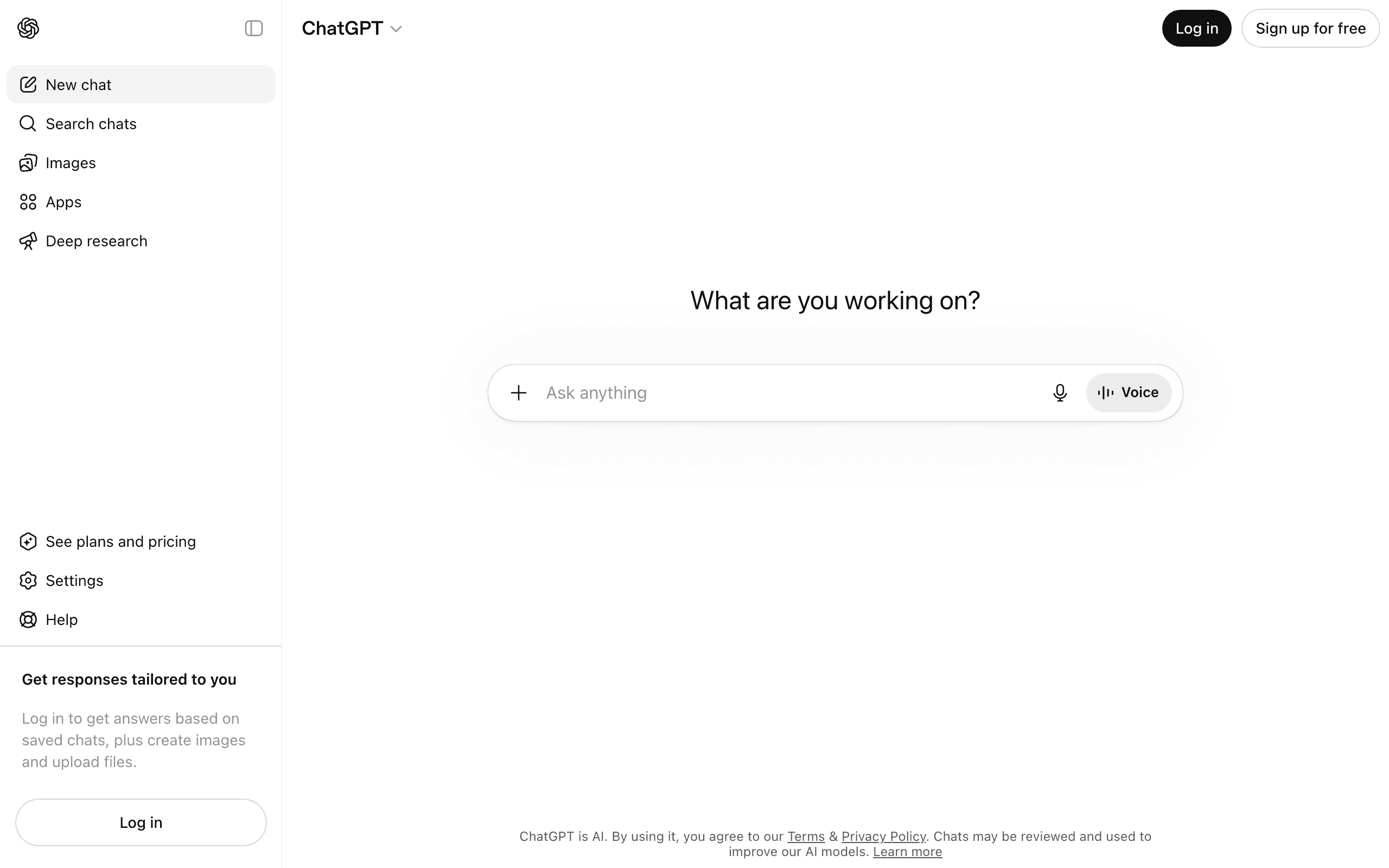
Under the hood, ChatGPT search leans heavily on Microsoft Bing's index to find candidate pages. A single prompt is typically fanned out into several sub-queries, each sent to the index. The model pulls a set of candidate pages, weighs them, and decides which to quote, paraphrase or cite. Only a fraction of what it retrieves reaches the visible answer. This matters twice over. First, your Bing visibility is a more direct lever here than your Google visibility: an Ahrefs study of 15,000 queries found that around 80% of the URLs AI assistants like ChatGPT cite do not appear in Google's top 100 for the same query. Second, being retrieved is not the same as being cited; the model still has to judge your page the most confident, relevant source for a specific claim.
Two browsing modes are worth separating. When ChatGPT is actively searching, its citations point to real pages it has just read. When it answers from training data alone, any source it names is reconstructed from memory and may not map to a live URL. For brand-visibility work, optimise for the browsing mode, because that is where genuine, clickable mentions are formed. For the underlying mechanics, see how AI search works.
If you want to read the signals yourself, our guide on whether ChatGPT can search the internet walks through when it browses, when it answers from memory, and how its citations are formed.
The three OpenAI crawlers, and why only one earns citations
Most teams that "open up their site to ChatGPT" allow the wrong bot. OpenAI runs three distinct crawlers, each with its own job and its own robots.txt control. Confusing them is the single most common reason a willing site stays invisible.
| Crawler | Job | Allow it if you want |
|---|---|---|
| OAI-SearchBot | Indexes pages for ChatGPT search and citations | To be cited in answers. This is the one that matters. |
| GPTBot | Collects data to train future models | Your content to inform the model's baseline knowledge |
| ChatGPT-User | Fetches a page when a user asks ChatGPT to read it | Live, user-initiated retrieval of your pages |
If you block OAI-SearchBot, you are invisible to ChatGPT search no matter how good your content is. If you allow only GPTBot, you have opted into training but not into citations. Allow OAI-SearchBot at minimum. We keep a full breakdown in our AI crawler user-agents reference.
What influences whether ChatGPT names your brand
Research into AI citations has converged on one clear conclusion: the strongest single signal is third-party validation, not your own marketing copy. The May 2026 edition of Muck Rack's Generative Pulse, built on more than 25 million links across ChatGPT, Claude and Gemini, found that earned media accounted for roughly 84% of all AI citations, with journalism alone near 27% and paid or advertorial content barely registering at 0.3%. The summary is in the Generative Pulse release. In plain terms, ChatGPT repeats what credible third parties say about you far more readily than what you say about yourself.

Want to get recommended by AI?
Check your AI search visibility, then let the Honeyb agent write, fix, and earn what gets you recommended. Free to start.
That single fact explains why some brands surface in answers despite modest websites, while others with glossy homepages stay invisible. The model is assembling a consensus from the wider web. If your brand is described, reviewed and compared on the domains ChatGPT trusts, you join that consensus. We go deeper into the selection logic in how AI models choose which brands to recommend.
The second well-evidenced factor is how your content is structured. The Princeton-led study that coined the term generative engine optimisation tested nine content tactics across thousands of queries. Its headline finding was a visibility lift of up to 40% in generative responses, but the granular numbers are more instructive: adding statistics lifted visibility by 41%, adding quotations by 28%, and citing external sources lifted lower-ranked pages by as much as 115%. The paper, GEO: Generative Engine Optimization, was published at KDD 2024 and is still one of the few peer-reviewed primary sources on the subject. Content that states clear, attributable facts is simply easier for a model to lift and cite than copy that is vague or purely promotional.
ChatGPT ranking factors at a glance
No factor guarantees placement. OpenAI is explicit that ranking depends on several signals and that there is no way to buy or guarantee a top position. The table summarises what the evidence suggests carries weight, and what to do about each.
| Factor | Why it matters | What to do |
|---|---|---|
| Third-party coverage | Earned media drives ~84% of AI citations | Earn reviews, press, listicles and mentions on trusted domains |
| Crawler access | A blocked page cannot be cited | Allow OAI-SearchBot in robots.txt; serve pre-rendered HTML |
| Structured, factual content | Statistics and quotes raise citation rates | Add data, named sources and clear claims near the top of pages |
| Bing visibility | ChatGPT retrieves from Bing's index | Verify in Bing Webmaster Tools; keep technical SEO solid |
| Presence on cited domains | Models reuse consensus from trusted sites | Be present and accurate on Wikipedia, Reddit and review sites |
| Freshness | Recently updated pages are cited more often | Keep key pages current and dated |
Where your brand needs to be present
ChatGPT does not weight every domain equally. Independent audits through 2026 keep finding that a small set of community and reference sites carries a disproportionate share of citations. A 5W Research audit of roughly 600,000 US citation events in early 2026 measured Wikipedia at 13.15% and Reddit at 11.97% of ChatGPT's US citations, more than a quarter from two domains alone, with no other single site clearing 3% (5W Research). Review platforms and established publications fill out the long tail. The lesson is not to spam these places, which rarely works and often backfires, but to make sure your brand is accurately represented where the model already looks.
Reddit earns extra attention because its threads are dense with the candid, comparative language models find useful, and that share is volatile, swinging hard from week to week as the model's weighting shifts. We unpack the reasons in why AI models cite Reddit. The implication is practical: genuine participation and honest mentions in relevant communities can feed how your brand is later described, while manufacturing it with fake accounts is against platform rules and easy for the model to discount. The same logic applies to the review sites that shape comparison answers, covered in how review sites drive AI recommendations.
A practical ChatGPT SEO checklist
Here is a concrete starting point. None of it is exotic, and most of it compounds with good traditional SEO rather than replacing it.
- Allow OAI-SearchBot in robots.txt so your pages can be cited, not just GPTBot, which only feeds training
- Serve content as pre-rendered HTML, since the crawler does not reliably execute JavaScript
- Put the answer to each key question in the first 200 to 300 words of the relevant page
- Add verifiable statistics, named sources and direct quotations to your most important pages
- Pursue earned coverage: reviews, comparison articles, podcasts and press on trusted domains
- Verify your site in Bing Webmaster Tools and keep Bing indexing healthy, because ChatGPT retrieves from Bing
- Keep your Wikipedia, Reddit and review-site presence accurate and current
- Refresh and re-date cornerstone pages so they read as live
- Track which prompts mention you and which name competitors instead
That last point is the one most teams skip, and it is where a single check falls down. ChatGPT's answers shift as the web and the underlying models change. Semrush tracking found Reddit's citation share alone collapse from roughly 60% to around 10% within weeks after OpenAI adjusted how heavily it leaned on the site. A lone screenshot tells you almost nothing. Monitoring the same buyer questions on a schedule, and comparing your share of mentions against rivals, is the only honest read on whether the work is moving the needle. We make the case in full in why spot-checking AI visibility fails, or you can run a single check now with our free AI visibility checker.
How this fits with GEO and traditional SEO
ChatGPT SEO is one application of the broader discipline of generative engine optimisation. The principles that earn you a place in ChatGPT also help in Perplexity, Google AI Mode and Gemini, because all of them reward credible, well-structured, widely-referenced content. For the conceptual foundation, our explainer on what generative engine optimisation is sets out the framework that ties these tactics together. Worth noting that the engines do not behave identically, ChatGPT favours Wikipedia while others lean harder on Reddit, which is why we track the differences in Perplexity versus ChatGPT brand ranking.
Classic SEO has not become irrelevant. Strong technical health, a crawlable site and authoritative content remain the base layer. What changes is the goal stacked on top. Instead of optimising solely for a ranked position, you are optimising to be the source a model reaches for when it composes an answer. The two efforts share most of their foundations and diverge mainly at the edges: structured claims, third-party validation, and consensus across trusted domains.
Using ChatGPT as an SEO assistant
The second, narrower meaning of "ChatGPT for SEO" is using the tool to support your own workflow rather than to win mentions. Here it is genuinely useful, with caveats. It can cluster keywords, draft outlines, generate schema markup, summarise competitor pages and suggest internal links. It is a capable drafting and analysis partner.
The caveats matter. ChatGPT can state things confidently that are wrong, so treat any fact, statistic or citation it produces as unverified until you check it against a primary source. It should not write your pages unsupervised, both because accuracy matters and because thin, obviously machine-generated content tends not to earn the third-party validation that drives AI visibility in the first place. Use it to move faster, not to replace judgement. The work that actually gets you recommended, the credible coverage and the structured, accurate content, still has to be real.
Sources cited in this report