
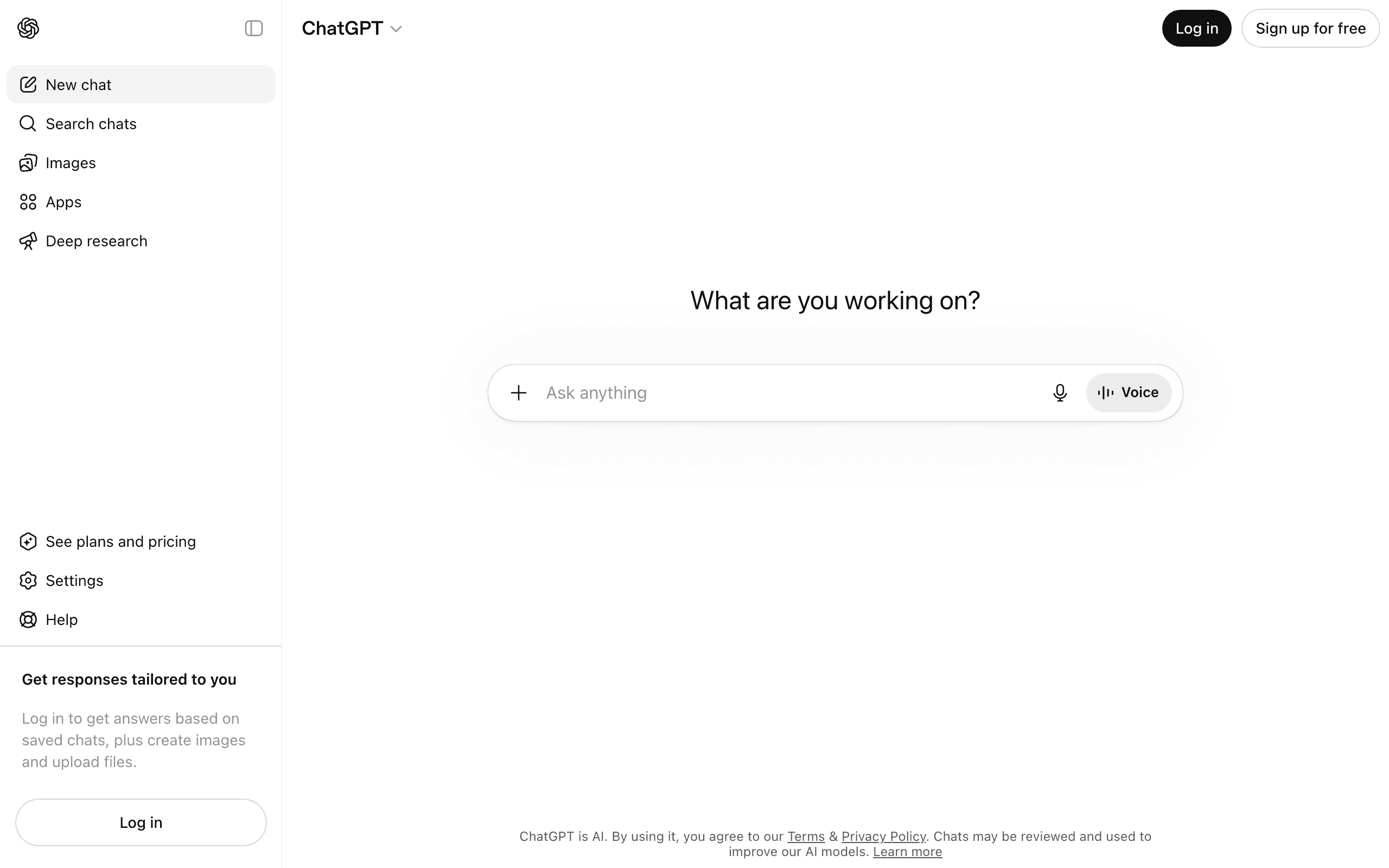
Yes, ChatGPT can search the internet, but it does not do so for every question. A lot of the confusion around this comes from treating ChatGPT as one fixed thing. It is really two systems sharing a chat box: a language model that answers from what it learned during training, and a web search tool the model can call when it judges that live information would help. So the honest answer to whether ChatGPT can search the internet is that it can, it often will, and sometimes it will not, all from the same prompt box. The skill worth having is knowing which mode you are in.
This post explains when ChatGPT searches versus answering from its training data, how to tell which one happened, how its citations actually work, and what all of that means if you want your brand to appear in those answers. We will check the current behaviour against OpenAI's own documentation rather than rely on how things worked a year ago, because this is a fast-moving surface. If the wider category is new to you, our primer on what AI search is sets the scene before we narrow in on ChatGPT specifically.
Can ChatGPT search the internet, or does it answer from memory?
Both, and the distinction matters more than most people realise. Every ChatGPT model ships with a knowledge cutoff, the date after which it has not seen the world. OpenAI's GPT-5.5, one of its current models, has a knowledge cutoff of 1 December 2025 (OpenAI developer docs). Ask it something well inside that window, like the difference between two long-established frameworks, and it can answer straight from training data without touching the web at all.
Ask it something that depends on recent or live information, and a second system kicks in. ChatGPT has a web search tool, and the model decides on a per-question basis whether to call it. OpenAI's documentation states that ChatGPT may automatically search the web when a prompt may benefit from current or recent information, and that you can also choose to search manually (OpenAI Help Center). When it browses, it does not read the open web directly the way a person clicks around. It rewrites your prompt into one or more search queries, retrieves a set of returned pages, and grounds its answer in what it fetched.
That retrieval layer is worth naming. OpenAI says ChatGPT search leverages third-party search providers alongside content provided directly by its partners, including news and data providers that supply categories like weather, stocks, sports, news and maps (OpenAI). It also reads from an index built by OpenAI's own crawler, OAI-SearchBot (OpenAI developer docs). So whether ChatGPT has internet access is really a question about that retrieval layer, not about the model browsing freely. The model asks for pages; the search infrastructure returns them.
When ChatGPT searches the web (and when it does not)
ChatGPT web browsing is not on or off in the way a switch is. The model makes a judgement call each time. In practice, three things decide whether a search happens.
First, the nature of the question. If a prompt looks like it needs current or recent information, ChatGPT tends to search automatically. OpenAI's own documentation says it may automatically search the web when a prompt may benefit from current or recent information (OpenAI Help Center). Questions about prices, news, schedules, recent releases, anything described as the latest, or specific named companies and products are common triggers.
Second, your explicit instruction. You can force a search by selecting the web search option (the globe icon) before sending, and you can suppress it by telling the model to answer without searching. Manual control overrides the model's default judgement, which is useful when you want a fast answer from memory or, conversely, when you do not trust the model to realise its training data is stale.
Third, settings you may not control. ChatGPT search became available to all logged-in users in supported regions on 16 December 2024, having first launched to paid tiers in October that year (OpenAI). But enterprise and education workspaces let admins enable or disable web search at the workspace level (OpenAI Help Center). So the same prompt can browse for one user and answer from memory for another, depending on a policy neither of them set.
The practical consequence is that there is no single ChatGPT answer to most questions. There is the answer with browsing and the answer without it, and they can differ substantially. We unpack why that volatility makes one-off testing unreliable in why spot-checking your AI visibility does not work.
How to tell whether ChatGPT searched the web
You do not have to guess. ChatGPT gives visible signals when it browses, and their absence is itself a signal.
The clearest live tell is the status line. Before a searched answer appears, ChatGPT shows a searching status, often followed by the specific queries it ran. If you see that, the answer in front of you is grounded in fetched pages rather than memory alone.
The second tell is in the finished answer. A searched response carries inline citations and a sources list. OpenAI notes that responses using search may include inline citations, that you can hover over a citation on desktop to preview the source and click through to it, and that a Sources panel beneath the response lists the cited pages (OpenAI Help Center). If an answer has no citations, no search status appeared, and no sources panel, you are almost certainly looking at a training-data answer. Treat any date-sensitive claim in it with suspicion.
Here is a simple way to read the three states you will encounter.

Want to get recommended by AI?
Check your AI search visibility, then let the Honeyb agent write, fix, and earn what gets you recommended. Free to start.
| What you see | What it means | How much to trust freshness |
|---|---|---|
| A searching status, then citations and a sources list | ChatGPT browsed and grounded the answer in live pages | Reasonably current, but still open the citations |
| No status, no citations, fluent prose | Answer came from training data, up to the model's cutoff | Stale for anything that has changed since the cutoff |
| You clicked the globe before sending | You forced a search regardless of the model's judgement | Current, and you control the mode |
One caveat worth stating plainly. A citation tells you ChatGPT read a page; it does not guarantee the page says what the answer claims. Grounding reduces invented facts but does not eliminate them, which is the broader hallucination risk we cover in one major risk of generative AI models. For anything consequential, the citation is an invitation to verify, not a substitute for doing so.
How ChatGPT citations work
When ChatGPT searches, it does three things in sequence: it retrieves a set of candidate pages, it selects which ones to lean on, and it attaches citations to the claims drawn from them. The selection step is the one that matters for visibility, and it is also the one OpenAI has said the least about. There is no published ranking formula. What we can say is grounded in OpenAI's own documentation about how content becomes eligible to be cited at all.
The gatekeeper is a crawler called OAI-SearchBot. This is the bot that builds the index ChatGPT search reads from. OpenAI is explicit about its role: "Sites that are opted out of OAI-SearchBot will not be shown in ChatGPT search answers, though can still appear as navigational links" (OpenAI developer docs). In other words, if you block OAI-SearchBot in your robots.txt, you remove yourself from the pool of pages ChatGPT can cite. To stay eligible, OpenAI recommends allowing it.
This trips up a lot of teams because OpenAI runs several crawlers that do different jobs, and they are easy to confuse.
| Crawler | What it is for | Affects ChatGPT search citations? |
|---|---|---|
| GPTBot | Crawls content for training OpenAI's foundation models | No |
| OAI-SearchBot | Builds the index behind ChatGPT search | Yes, this is the one that matters |
| ChatGPT-User | Fetches a page when a user explicitly asks ChatGPT to visit it | No, OpenAI states it "is not used to determine whether content may appear in Search" |
The takeaway is sharp. A site can block GPTBot to opt out of model training and still be fully visible and citable in ChatGPT search, as long as OAI-SearchBot is allowed. Plenty of publishers do exactly that. We map the major AI crawlers and the robots.txt patterns teams get wrong in our AI crawler user agents reference.
Beyond eligibility, which pages get cited follows the broader logic of AI search retrieval: relevance to the rewritten query, clarity and extractability of the content, and signals of authority and corroboration from across the web. ChatGPT leans heavily on third-party sources rather than brand-owned pages, a pattern that shows up consistently in citation studies. For the full mechanics of retrieval, selection and citation across engines, our walkthrough of how AI search works follows a question through the pipeline end to end. Perplexity does the same job with a citation-first design, which we contrast in how Perplexity AI works.
What it means for being cited by ChatGPT
If you want your brand to appear in ChatGPT's answers, the split between searched and unsearched responses defines two different problems, and you need to think about both.
The first is the searched answer. This is the one you can actually influence in something close to real time. Because searched answers pull from live pages, the levers are familiar to anyone who has done AI search work: keep OAI-SearchBot allowed, publish content that answers buyer questions directly and is easy to extract, and earn corroboration from the third-party sources ChatGPT tends to trust, including review platforms, comparison articles and community discussion. The scale makes this worth the effort. OpenAI reported ChatGPT passing 800 million weekly active users at its Dev Day in October 2025 (TechCrunch), and it has continued growing through 2026. Our ChatGPT SEO guide sets out the practical checklist for earning these citations.
The second is the unsearched answer, and it is harder. When ChatGPT answers from training data, there is no live page to optimise. Your presence depends on whether your brand was prominent and well-described across the web before the model's knowledge cutoff. You cannot edit that retroactively. What you can do is build the kind of consistent, widely referenced presence that gets baked into the next training run. This is slower work, closer to brand-building than to SEO, and it is why being named across the wider web, not just on your own site, has become a core discipline.
Two facts follow from this. First, you have to monitor both modes. A brand can be cited reliably when ChatGPT searches and be invisible when it answers from memory, or the reverse, and a single test will not reveal that gap. Second, the picture changes over time as models update their cutoffs and as live content shifts, which means visibility is something you track rather than something you win once. We make the broader case for treating this as ongoing measurement in what is AI search.
The takeaway
ChatGPT can search the web, but whether it does on any given question depends on the prompt, your instructions, and settings you may not see. When it searches, it shows a status line, grounds the answer in fetched pages, and attaches citations you can open. When it does not, it answers from training data that stops at the model's cutoff. Telling the two apart takes seconds once you know the signals, and it changes how much you should trust a date-sensitive answer. For brands, the same split defines the work: earn citations in the live, searched answers by staying crawlable and well corroborated, and build the durable, widely referenced presence that survives into what the model knows by heart. Either way, the answer is often written before anyone reaches your site, so it pays to know what it says.
Sources cited in this report