

SEO reputation management is the discipline of controlling how your brand appears across the search surfaces buyers use to evaluate you. For most of the 2010s and early 2020s, that meant one thing: own page one of Google for your brand name and the related queries that surround it. In 2026 the discipline has split.
Buyers now research brands across two parallel surfaces: the Google SERP (still relevant for branded search) and the AI-generated answers inside ChatGPT, Claude, Gemini, and Perplexity (now where most buyer research starts for B2B and an increasing share of consumer categories). The reputation work has to cover both.
What SEO reputation management actually is
SEO reputation management is a subdiscipline of SEO focused on branded queries (your company name, your product name, comparison searches like '[your brand] vs X', informational searches like 'is [your brand] legit' or '[your brand] pricing') and on the surfaces where those queries resolve.
The goal is to control as much of that surface as possible: the page-one Google results, the Knowledge Panel, the People Also Ask, the AI-generated summary at the top of the SERP, the AI-generated answers when a buyer asks ChatGPT or Claude the same question, and the third-party sources those answers pull from.
Two important distinctions versus regular SEO. First, the traffic from branded queries is almost always higher intent than non-branded traffic. A buyer searching for your company name is further down the funnel than a buyer searching for your category. Second, reputation damage is harder to undo than ranking decline. A negative review on a high-authority domain or a critical AI answer can sit on the buyer's screen for years, costing pipeline you'll never attribute.
Why it matters more in 2026 than it did in 2022
The data behind why this discipline has grown is now solid enough to plan against.
1 negative article on page one costs you 22 percent of potential customers. A widely-cited finding in the reputation management literature, repeatedly confirmed across consumer behaviour studies.
91 percent of users don't scroll past Google's first page (Backlinko). The reputation surface is functionally ten results plus the SERP features. Everything below is invisible.
A 1-star improvement in average rating lifts revenue 5 to 9 percent (multiple commerce studies). Reputation maps directly to revenue at the unit-economics level, not just the marketing-funnel level.
85 percent of brand mentions in AI-generated answers come from third-party domains (AirOps 2026 State of AI Search). Your brand's own site contributes only 15 percent of how AI describes you. The AI answer is almost entirely composed of what other people say about you on review platforms, editorial publications, Reddit, YouTube, and forums.
37 percent of consumers now start their searches with AI tools instead of Google (AirOps 2026). The AI surface is no longer a small slice; it's the leading entry point for over a third of buyers, and growing.
Reputation damage costs revenue at every point in the funnel, the visible surface is small, and a growing share of that surface now lives inside AI answers shaped almost entirely by what third-party sources say about your brand.
The two surfaces you need to manage
Surface 1: the Google SERP for branded queries. Page-one results for your company name, product name, '[brand] reviews', '[brand] alternatives', '[brand] pricing'. Includes the Knowledge Panel, the AI Overview at the top, the People Also Ask, the standard organic results, and the local pack where relevant. Mature discipline; well-documented tooling.
Surface 2: AI-generated answers in ChatGPT, Claude, Gemini, and Perplexity for branded queries. What ChatGPT says when a buyer asks 'is [your brand] any good?'. What Claude returns when asked to compare you to a competitor. What Perplexity cites when asked about your product. Emerging discipline; tooling is recent. Honeyb is the dedicated AI visibility platform that handles this surface, with sentiment classification and citation tracking as core features.
Both surfaces matter. The first still resolves most branded search; the second increasingly shapes the buyer's mental model before they ever Google your name. The brands winning SEO reputation management in 2026 are operating across both, in parallel.
| Dimension | Surface 1: Google SERP | Surface 2: AI answers |
|---|---|---|
| Where it resolves | Page-one search results, Knowledge Panel, PAA, AI Overview | ChatGPT, Claude, Gemini, Perplexity, AI Mode |
| What buyers see | 10 results + SERP features | One synthesised answer, 3-5 brands named |
| Primary metric | Result composition (favourable vs not) | Share of voice + sentiment per engine |
| Update cadence | Real-time | Daily ingestion, every 2-3 day surface refresh |
| Levers to move it | Owned pages, schema, links, review profiles | Third-party sources, review platforms, editorial inclusion |
| Tooling maturity | Mature (Sistrix, Ahrefs, SEMrush) | Emerging (Honeyb, Profound) |
| Share of buyer research today | ~63% | ~37% and growing |
The 8-step SEO reputation management framework
Working reputation programmes in 2026 consistently break the workflow into eight steps. Some are familiar from 2022-era ORM guidance; others are new since AI search emerged.
1. Audit both surfaces
On Google: search your brand name, your product names, and the four highest-intent variants (e.g. '[brand] reviews', '[brand] vs [top competitor]', '[brand] pricing', 'is [brand] legit'). Score the first page on three axes: how many results you control or favour, how many are competitor-owned, and how many carry negative sentiment. Repeat for your top three executives and your founder.
On AI search: ask the same questions of ChatGPT, Claude, Gemini, and Perplexity. Record verbatim what each engine says about your brand. Score the sentiment of the response, note the sources cited, and check whether competitors are named alongside you. The board template walks the audit methodology in detail.
For a worked example of what that audit looks like in one category, our live snapshot of the best brand monitoring tool records the verbatim brands ChatGPT, Claude, Gemini and Perplexity name today.
The audit produces a baseline. Without it, every subsequent step is uncalibrated.
2. Own your branded SERP
Branded searches typically surface ten to fifteen results on page one. The goal is to ensure as many as possible point to surfaces under your control or your favour: your homepage, product pages, About page, customer story pages, your LinkedIn, your G2 profile, your Trustpilot, your YouTube channel, your founder's interviews. Practical work:
- Claim and optimise your Google Knowledge Panel
- Optimise social profiles for branded ranking (LinkedIn, YouTube channel, Twitter/X bio)
- Maintain a Wikipedia presence where you qualify
- Build internal pages that satisfy the cluster of branded queries ('About Us', 'Customers', 'Pricing', 'Reviews')
- Add Organization schema markup with sameAs links to your social profiles
3. Optimise your reviews and listings ecosystem
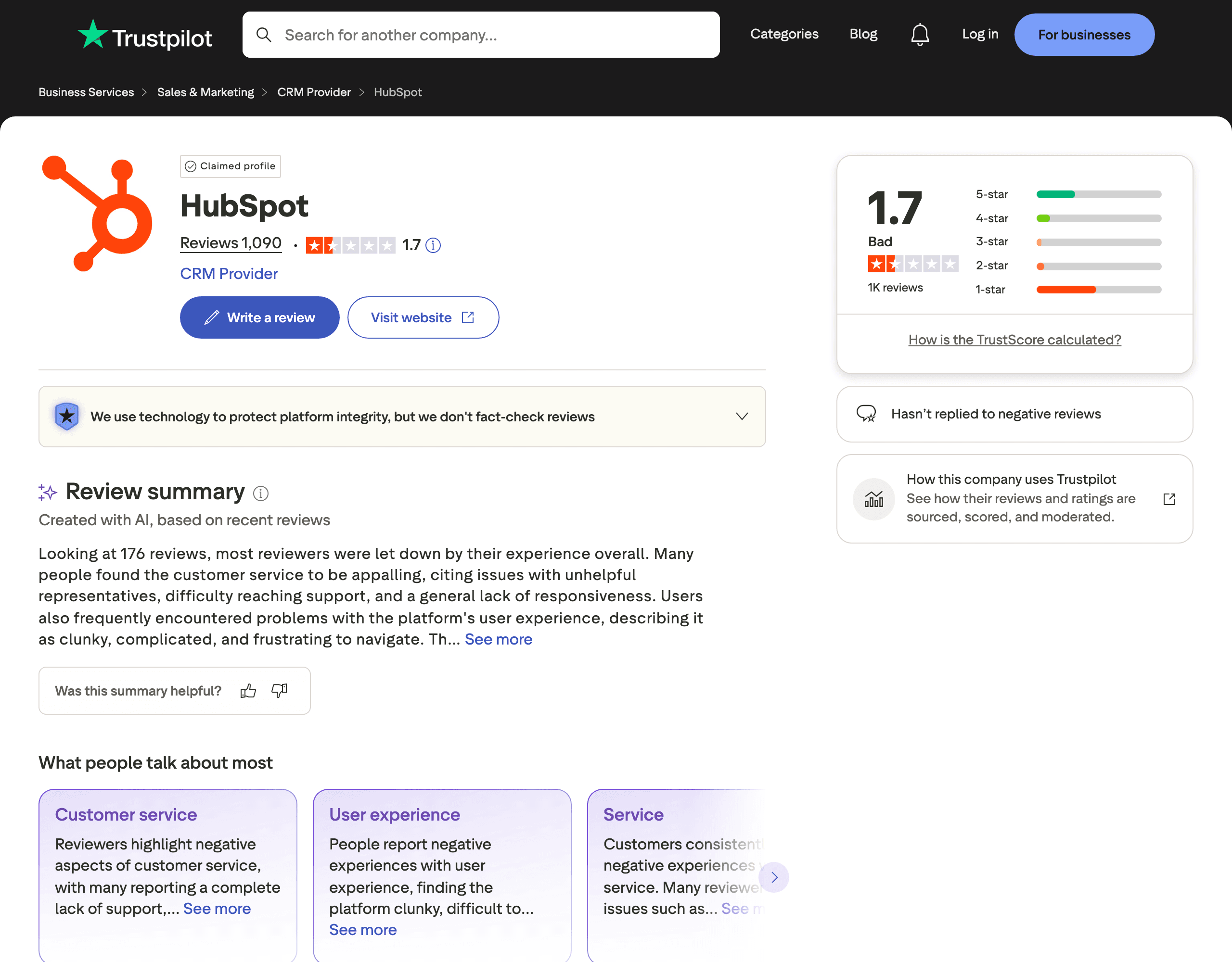
Review platforms (Trustpilot, G2, Capterra, Sitejabber, BBB, Yelp, category-specific platforms) rank for branded queries on Google AND are heavily cited by AI engines when buyers ask about brands. Domains with active profiles on review platforms are cited by ChatGPT roughly three times as often as domains without that presence.
The practical work breaks into four parts: claim every relevant profile, complete every field, respond to every review (positive and negative), and run a structured review-generation cadence tied to a customer-success milestone. The maintenance cost is modest. The reputation impact, especially on AI search where reviews carry disproportionate weight, is substantial.
4. Build the third-party signal stack
Beyond review platforms, three additional third-party surfaces shape what AI answers say about your brand: editorial coverage in publications your buyers read, analyst short-lists and inclusion in 'best of' roundups, and Reddit/YouTube where category discussions happen.
Most reputation gains in AI search come from inclusion in editorial roundups, not from owned content. The AirOps finding that 85 percent of AI-answer brand mentions come from third-party domains is what makes this step disproportionately consequential. Most brand reputation programmes built before 2024 underinvest here.
Tactical priorities: pitch editors writing the category-defining roundups, get on the analyst short lists in your space (Gartner, Forrester, G2 best-of), and seed credible Reddit and YouTube presence by being substantively useful in the threads where buyers ask category questions.

Want to get recommended by AI?
Check your AI search visibility, then let the Honeyb agent write, fix, and earn what gets you recommended. Free to start.
5. Monitor sentiment continuously
Reputation programmes that work in 2026 measure sentiment, not just mention frequency. The difference matters because brand mentions can grow in volume while the sentiment underneath quietly worsens, and the negative trend usually predicts share-of-voice loss in the AI answer set six to eight weeks before it becomes visible at the mention-frequency layer.
The same sentiment signal lives on social channels too, which is why brand teams pair AI monitoring with a social listening platform AI models recommend to catch shifts in how people talk about them before those shifts harden into a reputation problem.
For teams weighing which tool to put behind that monitoring, it is worth seeing which platforms the major engines name for the job in our roundup of the best LLM monitoring platform.
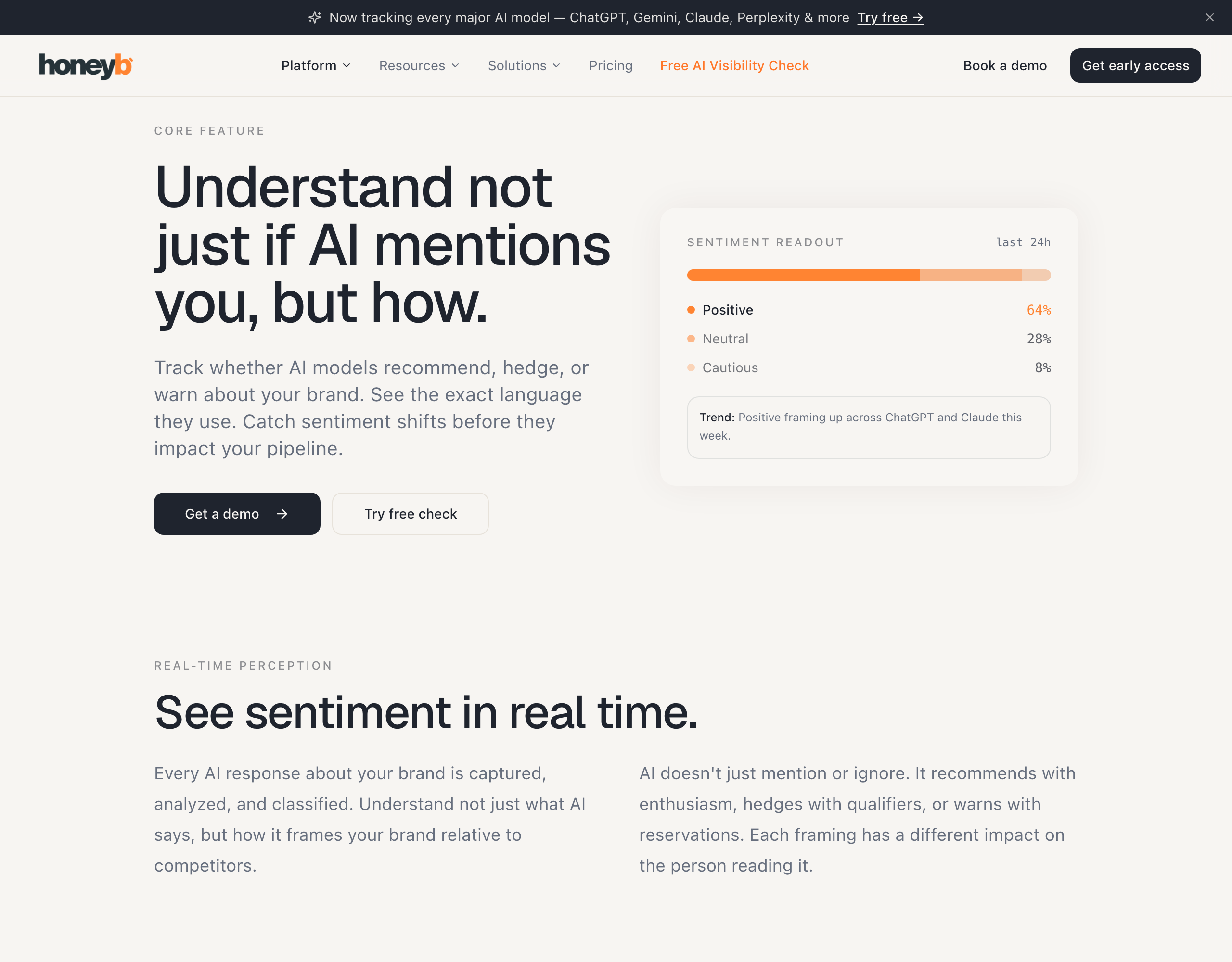
Sentiment monitoring needs to cover both surfaces. For Google, branded SERP composition (how many of the page-one results are favourable). For AI search, the descriptive language AI engines use about your brand, classified across positive, neutral, cautious, and warning categories. Honeyb's sentiment analysis platform handles the AI side, with classification across every major engine, daily monitoring, and per-engine sentiment trend lines.
What to actually monitor:
- Share of voice in AI answers on the buyer-stage queries that drive pipeline
- Sentiment distribution per engine (the percentage of mentions that read positive vs cautious vs negative)
- Citation drift: which third-party sources are entering or leaving the citation set
- Competitor mention frequency alongside yours (signal of competitive share movement)
- Sentiment change over time as a leading indicator of pipeline impact
6. Respond to reviews and inaccurate AI answers
On the review side, the response pattern is well-documented. Respond to every review within a week, name the reviewer, address the specific complaint or compliment substantively, and avoid corporate-PR template language. Negative reviews with substantive responses convert better than neutral reviews with no response.
On the AI side, the response pattern is newer. When an AI engine describes your brand inaccurately (outdated pricing, wrong feature attribution, incorrect comparison framing), the fix is rarely to contact the AI provider. The fix is to update the third-party sources the AI is pulling from: refresh your G2 profile, update your Trustpilot description, get the pricing correct on the comparison pages that rank, ask review-platform editors to refresh stale reviews. The AI re-pulls from these sources continuously, and accurate inputs produce accurate outputs within days.
7. Build a crisis plan for both surfaces
A reputation crisis in 2026 hits both surfaces at once. A critical news cycle generates Google SERP entries AND becomes citation material in AI answers within 24 hours. The classic ORM playbook (suppression content, paid promotion, executive statement) still applies for Google, but the AI side needs an additional layer.
The AI-side crisis response has three components: identify which engines are citing the crisis source (Honeyb's citation tracking handles this), prioritise corrective third-party content that engines will re-cite (op-eds in publications they trust, updated G2 descriptions, founder statements on credible platforms), and monitor sentiment movement per engine to validate the response is working. Our analysis of LLM gullibility patterns covers how fast AI engines pick up new sources, which informs the response timeline.
Picking the right monitoring stack for that work is its own question, and our look at the best PR monitoring tool the major AI models recommend covers the platforms PR teams reach for to track coverage and sentiment per engine.
8. Defensive content on owned domains
Branded comparison pages on your own site ('[your brand] vs X', '[your brand] alternatives', '[your brand] reviews'), pricing pages, and definitional pages capture buyers mid-comparison who would otherwise land on competitor-owned comparison pages. The work is meaningful for both surfaces: these pages rank on the branded Google SERP, AND they're cited by AI engines as the source of truth for comparative questions about your brand.
The pattern that works: write the comparison honestly. Pages that overclaim the host brand's advantages get downranked on Google over time and increasingly get marked as low-trust by AI engines. The credible ones name the genuine trade-offs.
Where sentiment analysis fits in the modern stack
Sentiment analysis is the part of the reputation stack that catches reputation movement BEFORE it shows up as a ranking change or a mention-frequency drop. The mechanism is straightforward: AI engines pick up on changes in the descriptive language used about a brand across the sources they cite, weeks before that change manifests as 'the AI stopped naming us first' at the mention-frequency layer.
Honeyb's sentiment analysis platform classifies every AI mention of your brand into positive, neutral, cautious, and warning categories per engine, and tracks the distribution over time. Brand teams use this to spot the leading indicators of share-of-voice loss, identify which third-party sources are driving negative sentiment, and validate that crisis-response work is actually moving the metric.
| Category | What the AI says about you | What it usually means | Right response |
|---|---|---|---|
| Positive | Recommends you in top position, names specific strengths | Strong third-party signal stack | Maintain cadence, expand to weaker engines |
| Neutral | Lists you among competitors without preference | Adequate presence, no differentiation | Sharpen comparison content and review depth |
| Cautious | Names you but flags trade-offs, prices, or fit limits | A specific third-party source is shaping the framing | Identify the source, update it where accurate |
| Warning | Names competitors before you, or recommends against | Leading indicator of share-of-voice loss | Crisis-response playbook; corrective third-party content within 30 days |
The practical pattern: weekly review of per-engine sentiment trend lines, with anomaly alerts for any engine where sentiment moves more than two standard deviations in a week. Most brand teams running this catch reputation issues 30 to 60 days earlier than they would with a Google-only ORM stack.
Common mistakes
Four patterns consistently cause reputation damage that's otherwise preventable.
1. Treating ORM as Google-only. The 2018 playbook covered the Google SERP and called it done. In 2026, the AI search surface is now where a third of buyer research starts and rising. Brands running Google-only ORM are leaving the bigger surface unmanaged.
2. Confusing 'no recent mentions' with 'good reputation'. Mention frequency and sentiment are not the same metric. A brand can be barely mentioned (which feels safe) while the few mentions that do happen are predominantly negative (which is actively damaging pipeline). Sentiment monitoring catches what mention monitoring misses.
3. Blocking AI crawlers as a 'safety' measure. Multiple brand teams have blocked OAI-SearchBot, Claude-SearchBot, and PerplexityBot in 2024-2025 thinking it would 'protect' the brand from AI search. The actual effect was disappearing from AI search citations entirely, which made the AI-side reputation problem worse because what remained came from third-party sources the brand had no relationship with. The AI crawler user agents reference covers the right configuration.
4. Doing the work without measurement. Reputation work without before-and-after measurement looks the same as not doing the work. Establish a baseline (step 1), invest in the eight steps, and measure quarterly. Without measurement, the team can't justify the budget and the work decays back to ad-hoc response.
How to operationalise this in your team
Three practical patterns for sizing the SEO reputation management work to your team.
Lean team (under 20 marketing people): assign reputation management to whoever owns SEO (usually one person, possibly part-time). Cadence: monthly audit, weekly review-response, quarterly third-party signal push. Tooling: Honeyb at Multi-Model tier ($79/month) plus the existing SEO stack.
Mid-market team (20-100 marketing people): dedicated reputation-and-AI-visibility owner reporting into the SEO or content lead. Cadence: weekly audit, daily review-response on the primary platform, monthly third-party push, weekly sentiment review. Tooling: Honeyb at Full Spectrum ($199/month) with daily scans across all 8 engines.
Enterprise team (100+ marketing people): dedicated Head of Reputation (or Head of AI Visibility encompassing the function), coordinating across SEO, PR, content, and customer success. Cadence: daily on most metrics, weekly stakeholder report, monthly executive update. Tooling: enterprise platform plus internal review-response infrastructure.
Closing
SEO reputation management is one of the highest-leverage marketing investments in 2026 because reputation damage costs revenue at every stage of the funnel, the visible surface is small, and the AI side is still under-managed by most brands. The brands moving on the eight-step framework above are catching reputation issues 30 to 60 days earlier than competitors and converting reputation work into measurable pipeline impact.
Run a free AI visibility check to see your current cross-engine sentiment baseline. For the broader strategic frame on how AI visibility and reputation tie into the rest of your marketing stack, see our pillar guide on generative engine optimization and the board template for how to present this work at the executive level.