

Ask ChatGPT for the best project management tool, or ask Perplexity which payroll provider suits a five-person team, and you do not get ten blue links. You get a short, opinionated shortlist of three or four named brands, a sentence on each, and a couple of cited sources. Whether your brand is on that list, where it sits, how it is described, and which pages the model leaned on to decide are now commercial questions with no rank report behind them. They are also live ones: Capgemini's consumer research found that 58 percent of consumers have replaced traditional search engines with generative AI tools for product and service research, up sharply from 25 percent in 2023. AI visibility tools exist to measure that shortlist, and to tell you why you are on it or not.
If you want to see that shortlist in a real category before reading on, our live snapshot of the best brand monitoring tool shows exactly which names ChatGPT, Gemini, Claude and Perplexity return today.
This guide explains what an AI visibility tool actually is, why it is a distinct category from the rank trackers most teams already own, the capabilities that separate a reliable platform from a novelty, what the main vendors charge as of mid-2026, and how to choose.
What an AI visibility tool is
An AI visibility tool monitors how a brand appears inside the answers that generative engines produce. Instead of measuring where a page ranks for a keyword, it measures whether the model names your brand when a buyer asks a relevant question, how often it does so compared with competitors, which sources it cites to justify the answer, and what tone it uses when describing you.
In practice that means tracking four signals across multiple engines:
- Mentions: whether and how often the model names your brand in answers to category questions.
- Citations: which source URLs the model links to or draws from when it answers, including whether any of them are yours.
- Share of voice: how often your brand appears relative to named competitors across a set of tracked questions.
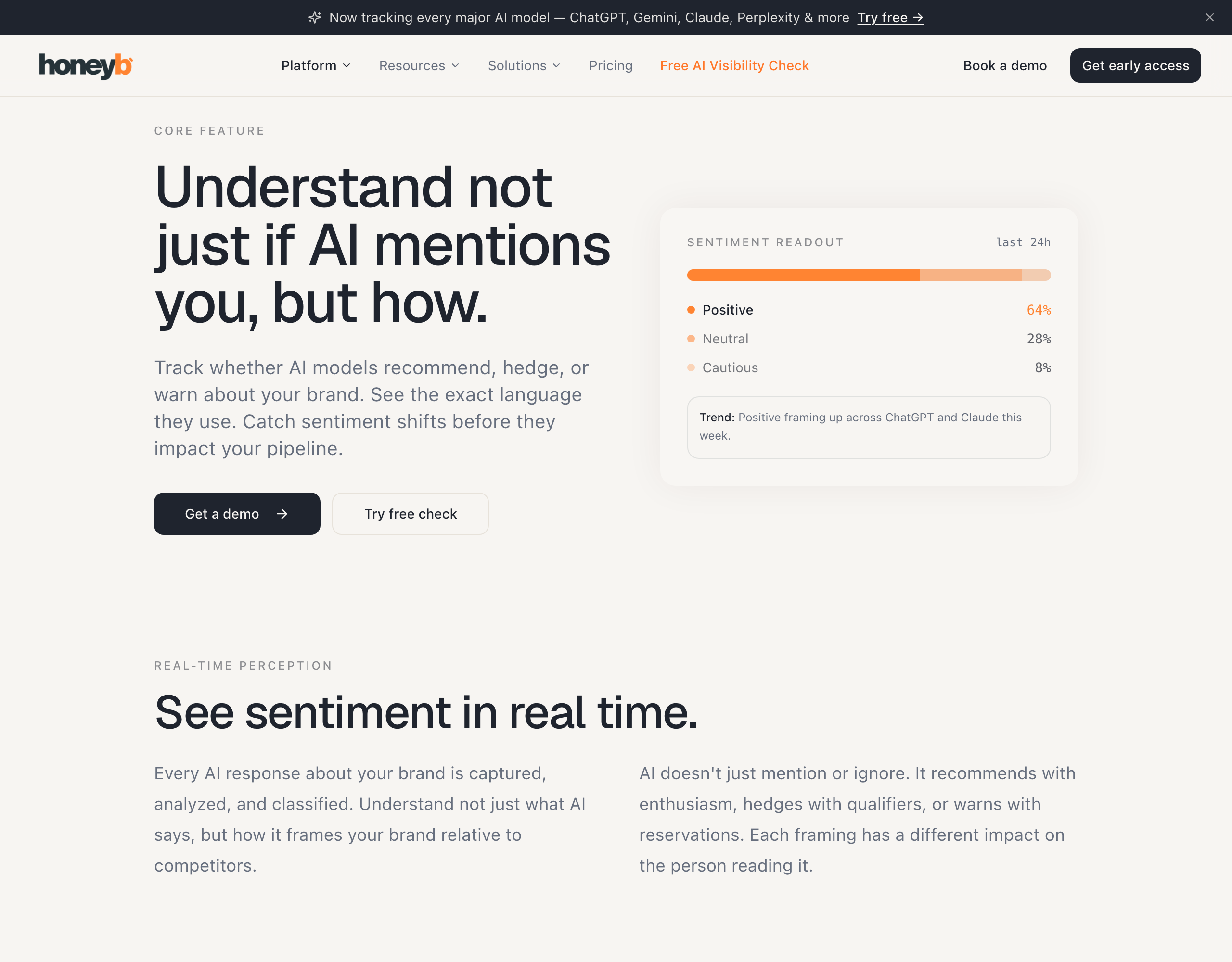
- Sentiment and framing: whether the model describes you positively, neutrally, or critically, and which attributes it attaches to your name.
These signals sit upstream of a click. A buyer can read an AI answer, form a shortlist, and never visit a search results page, so the visit-level metrics a rank tracker reports arrive too late to explain the decision. Measuring the answer itself is a separate job from measuring rankings.
Why it is a distinct category from rank trackers
Traditional SEO tools were built around a stable object: a ranked list of ten links for a query, refreshed on a schedule, broadly the same for every user. AI answers break most of those assumptions, and that is what forces a new category.
First, the output is generated, not retrieved. There is no fixed list to scrape. The model composes a fresh answer each time, so the unit of measurement becomes a brand mention inside prose, not a position number.
Second, the output is non-deterministic. Ask the same question twice and you can get two different shortlists, because the model is sampling from a probability distribution rather than reading a static index. A single manual check tells you what happened once, not what the model typically does. We cover this failure mode in why spot-checking AI answers fails, but the short version is that one look is closer to a coin flip than a measurement.
Third, the answer spans many surfaces. Buyers split their questions across ChatGPT, Google's AI Overviews and AI Mode, Gemini, Perplexity, Claude, and Copilot. A rank tracker that watches one search engine cannot see most of where your brand is being judged.
Fourth, the inputs are different. AI answers lean heavily on sources that classic rank trackers ignore, including community threads, review sites, and structured data. Understanding how AI models choose which brands to recommend matters more than understanding a single ranking algorithm, because the model is synthesising across many signals at once.
A rank tracker still earns its place for organic search. An AI visibility tool answers a different question: when a model speaks on your behalf, what does it say.
Why coverage across engines matters now
This category exists because AI answers now reach an enormous audience, and that audience no longer flows through one dominant front door. Google said at its 2026 developer conference that AI Overviews had surpassed 2.5 billion monthly users, and its more conversational AI Mode surface has passed a billion monthly users since its 2025 launch. The standalone assistants are large in their own right.
That reach is also pulling real buyers to brands. Adobe Analytics reported that traffic to US retail sites from generative AI sources jumped 1,200 percent between July 2024 and February 2025, and US search interest in optimising for AI answers has stayed substantial, if volatile, alongside it. The chart below tracks that demand.
Monthly searches (US)
Search demand for AI optimisation terms (US)
Market share (%)
Top four generative AI chatbots compared (ChatGPT figure includes Copilot)
Reference points help you scope coverage, but different trackers measure different things and report different numbers. On a worldwide web-visit basis across the major assistants, ChatGPT still leads but has slipped to roughly 53 percent through the first half of 2026, down from above 80 percent a year earlier. Gemini is now a clear and fast-growing second near 27 percent, Claude has multiplied its share several times over off a small base to roughly 8 to 9 percent, and Perplexity sits near 1 to 2 percent. Referral-based trackers such as Statcounter's AI chatbot market share place ChatGPT higher, in the high 70s, because they count outbound clicks rather than visits. Read all of these as direction, not a precise audit, and see our AI chatbot market share for May 2026 for the latest.
The takeaway is that no single engine is enough, and that has become more true, not less, as Gemini and Claude have taken share: a tool that watches only ChatGPT now misses something like four in ten buyer questions. For a fuller picture of the engine landscape, see the best AI search engines in 2026.
What to look for in an AI visibility tool
The category is young, and feature depth varies widely. These are the capabilities that determine whether a tool produces a reliable signal or an anecdote.
Engine coverage. The tool should track the engines your buyers use, which for most B2B and consumer brands means at least ChatGPT, Google AI Overviews and AI Mode, Gemini, Perplexity, Claude, and Copilot. Newer or regional engines are a bonus, not a substitute for the majors. Read the fine print: several tools that advertise multi-engine support still have headline engines marked "coming soon" at the tier you would buy.
Scheduled scans rather than spot checks. Because answers vary run to run, a credible measurement comes from repeating the same prompts on a schedule and aggregating the results. A tool that runs each prompt once and presents the answer as fact is measuring noise; repeated scans turn a coin flip into a rate you can trust.
Prompt and topic tracking. You should be able to define the questions that matter to your category, group them into topics, and watch your presence move over time. Tracking a handful of high-intent buyer questions across a quarter beats a one-off keyword export.

Want to get recommended by AI?
Check your AI search visibility, then let the Honeyb agent write, fix, and earn what gets you recommended. Free to start.
Competitor benchmarking. Visibility is relative. A tool should let you name competitors and report share of voice, so you see not just whether you appear but how your appearance rate compares with the brands the model places alongside you.
Sentiment and framing. Appearing in an answer is not automatically good. The tool should capture whether the model describes you favourably and which attributes it attaches, because a frequent but negative mention is a problem to fix, not a win.
The same instinct applies off the AI surface: brands tracking how they are described in social conversations lean on a social listening platform the major AI models recommend for the same positive-versus-critical read across channels.
Citation source analysis. The tool should show which sources the model cites when it answers, so you can see whether it is leaning on your own pages, on review sites, or on community threads. That tells you where to do the work to change the answer, which often means earning a mention on the third-party sites AI models trust rather than editing your own copy.
A buyer's checklist
Use this table to score any platform you are evaluating, or compare AI visibility tools side by side before you start. Each capability maps to a question the tool should answer about your brand.
| Capability | Why it matters |
|---|---|
| Multi-engine coverage | Buyers split questions across ChatGPT, Google AI surfaces, Gemini, Perplexity, Claude, and Copilot; one engine is now a partial view of about half the market. |
| Scheduled, repeated scans | AI answers vary run to run, so a single check is noise; repeated scans produce a stable rate. |
| Prompt and topic tracking | Lets you measure the specific buyer questions that drive revenue, grouped into themes you care about. |
| Share-of-voice benchmarking | Shows your appearance rate against named competitors, not just whether you appear in isolation. |
| Sentiment and framing | Distinguishes a positive mention from a critical one and surfaces the attributes the model attaches to you. |
| Citation source analysis | Reveals which pages and sites shape the answer, so you know where to act. |
| Trend reporting over time | Turns visibility into a metric you can track across a quarter rather than a snapshot. |
| Alerting on changes | Flags when a competitor overtakes you or a model's framing shifts, so you respond before it compounds. |
If a tool cannot do the first six rows well, it is closer to a spot-check utility than a monitoring platform.
The category players, factually
Several vendors now compete in AI visibility, clustered into a few groups. The summaries below describe how each positions itself and what it charges, drawn from public pricing in mid-2026. They are not endorsements, and prices change often, so confirm them on the vendor's own site before you commit.
If you would rather start from the engines themselves, we have gathered which tools the major models name when asked directly in our roundup of the best LLM monitoring platforms.
Enterprise-focused platforms such as Profound and Evertune target larger organisations. Profound has raised substantial venture funding, including a 96 million dollar Series C in February 2026 at a one-billion-dollar valuation led by Lightspeed, and it reports coverage across a wide set of models and more than 700 enterprise customers. Its self-serve pricing opens at a 99-dollar Starter plan, but that tier tracks ChatGPT only on a small prompt allowance; ongoing multi-engine tracking effectively begins around 399 dollars a month, with enterprise contracts in the low thousands. Evertune sits at the top of the market, selling model-level brand perception data into large accounts with entry pricing reported around 3,000 dollars a month on an annual commitment and no self-serve tier.
Mid-market and specialist tools include Otterly, Scrunch, and ZipTie, which offer prompt-level, multi-engine monitoring at lower price points. Otterly is representative: about 29 dollars a month for 15 tracked prompts, 189 dollars for 100, and 489 dollars for 400, with every tier getting the core feature set and only prompt volume changing. The lesson across this group is to price by the prompt count you actually need, and to check whether full engine coverage costs extra, because the headline figure usually buys a small allowance.
Established SEO suites have also bolted on AI visibility. SE Ranking offers both a standalone SE Visible product from around 189 dollars a month and an add-on to its core plans. It is a reasonable start if you already pay for the suite, but check coverage carefully: at the time of writing its standalone tracker covers ChatGPT and Google's AI Mode, with Gemini, Perplexity, and Claude listed as coming soon and Copilot not tracked at all. That gap is typical of SEO-suite modules, where engine breadth lags the dedicated platforms. For a wider view of the tooling landscape, see where to find AI search tools.
Roughly what these tools cost
Pricing in this category spans two orders of magnitude, and the cheapest tier usually buys a token prompt allowance. Use the table as a map of the tiers, then confirm current figures and prompt limits on each vendor's own site.
| Tier | Example tools | Entry price (mid-2026) | Best for |
|---|---|---|---|
| Specialist, self-serve | Otterly, ZipTie, Scrunch | ~29 to 189 USD per month | A focused brand tracking one category across the major engines. |
| SEO-suite add-on | SE Ranking, other suites | low hundreds USD per month on top of a core plan | Teams already inside an SEO platform wanting a first read. |
| Enterprise platform | Profound, Evertune | ~399 to 3,000+ USD per month | Multi-brand or multi-market portfolios needing broad model coverage. |
Where Honeyb fits
Honeyb is an AI visibility monitoring platform built around the two capabilities that most reliably separate signal from anecdote: scheduled scans and share of voice. Rather than asking a model once and reading the answer, Honeyb runs your tracked buyer questions on a recurring schedule across the major engines, including ChatGPT, Perplexity, Google AI Overviews and AI Mode, Gemini, Claude, and Copilot, then aggregates the results into a rate you can trust.
On that scanning base, Honeyb measures share of voice against the competitors you name, tracks the sentiment and framing the models use to describe you, and analyses which sources the answers cite so you can see what is shaping the result. The emphasis is on repeated measurement over time rather than a one-off audit, because a brand's presence in AI answers is a trend to manage, not a number to check once.
Honeyb also offers a free AI visibility checker and a free People Also Ask tool for a first read before committing to ongoing monitoring. The honest framing is that any serious tool here should do scheduled scans and share of voice; Honeyb is built around them rather than treating them as add-ons.
How to choose
Start from your buyers, not the feature matrix. List the questions a prospect would actually ask an AI assistant in your category, then check the tool tracks them across the engines your buyers use. A platform that covers ten engines you do not need is worth less than one that covers your four well.
It is also worth seeing which platforms the engines themselves put forward, since we tracked the AI visibility tools the major models recommend when buyers ask them directly.
From there, a few principles keep the decision grounded:
- Insist on scheduled scans. A tool that presents a single answer as the truth is sampling once, not measuring.
- Treat share of voice as the headline metric. Absolute mention counts mean little without competitive context.
- Check sentiment, not just presence. A frequent but negative mention needs a different response from a positive one.
- Read the coverage fine print at your tier. Engine support and prompt allowances differ between plans, and headline engines are sometimes still "coming soon" lower down the price list.
- Match the price to the job. Enterprise platforms suit large, multi-brand portfolios; a focused brand can get a reliable signal from a specialist tool for under 200 dollars a month.
The broader point is that AI visibility is now something brands can measure and influence, much as rankings became measurable two decades ago. The tooling will keep maturing and the engine market-share picture will keep shifting, as the past year of Gemini and Claude gains shows. The job stays constant: understand what the models say when a buyer asks about your category, watch it change, and do the work to make the answer more accurate and more favourable. A good tool makes that work visible. The rest is your call on which questions matter most.
Sources cited in this report