

An AI model tracking dashboard shows how ChatGPT, Gemini, Claude, Perplexity and the other engines answer questions about your category: which brands they recommend, which sources they cite, and how that changes over time. Before comparing the tools, we measured why the dashboard format matters at all. On 13 July 2026 we ran 20 buyer-intent prompts three times each through four engines via API (gpt-5-mini, gemini-2.5-flash, claude-haiku-4-5 and Perplexity's sonar), 240 answers in total.
The number-one recommended brand changed between consecutive identical runs 44 per cent of the time on Gemini, 43 per cent on Perplexity, 35 per cent on ChatGPT and 28 per cent on Claude. A single manual check is a coin flip wearing a lab coat. This roundup covers the nine dashboards that turn that noise into a trend line; Honeyb is ours and is disclosed as such.
What our measurement shows a dashboard has to handle
Top-pick change rate
How often the top recommendation changes between identical runs
| Item | Top-pick change rate |
|---|---|
| Gemini | 44.1% |
| Perplexity | 42.5% |
| ChatGPT | 35% |
| Claude | 27.5% |
The volatility inside one engine is only half the problem. Across engines, the answers barely agree: ChatGPT and Perplexity named the same number-one brand on just 20 per cent of prompts and shared only a quarter of their recommended brands overall. Even the closest pair, Gemini and Claude, agreed on the top pick 53 per cent of the time. Watching one engine tells you almost nothing about the others.
| Engine | Top pick changed between identical runs | Brand overlap between consecutive runs | Average sources cited per answer |
|---|---|---|---|
| Gemini | 44% | 54% | 10.7 |
| Perplexity | 43% | 61% | 8.3 |
| ChatGPT | 35% | 42% | 15.0 |
| Claude | 28% | 67% | 8.8 |
The sourcing side is just as uneven, which is why a dashboard needs a citations view and not just a mention counter. ChatGPT pulled its 900 citations from 445 distinct domains, a long tail with no single gatekeeper: its top three domains carry under 8 per cent of citations. Perplexity concentrates: Reddit alone is 14 per cent of its citations and YouTube another 8 per cent.
Gemini returned 74 per cent of its source links wrapped in Google's grounding redirect URLs, masking the underlying site. And one cross-engine constant: Forbes was the only domain to appear in the top-cited list of all four engines. Different engines, different sources, different volatility; that spread is exactly what the tools below exist to track. Our guide to why spot-checking fails covers the statistics in more depth.
The nine dashboards compared
Prices are in US dollars as each vendor shows them to a US visitor, all read on 2 October 2026. Full cost detail, including per-prompt normalisation, is in our AI brand monitoring cost guide.
| Tool | AI engines on entry tier | Metering | Entry price | Free door |
|---|---|---|---|---|
| Honeyb (ours) | 1 model of choice; all 8 on the top tier | 10 prompts, scanned daily | $29 | Free AI visibility check |
| Otterly | ChatGPT, Google AI Overviews, Perplexity, Copilot | 15 prompts | $29 | Free trial |
| Sight | ChatGPT, Claude, Gemini, Perplexity, Grok | 5,000 AI credits; no prompt count stated | $99 Pro | 7-day trial, card required |
| LLM Pulse | ChatGPT, Perplexity, AI Mode, AI Overviews, Gemini | 50 prompts | About $59 (about $49 annual) | 14-day trial |
| Dageno | 9 models, not named on its pricing page | 50 prompts | $49 Starter (shown as a cut from $89) | 7-day trial |
| Profound | Not published | Not published | Pricing on request (custom Enterprise) | Free trial |
| Peec | 3 models chosen from ChatGPT, AI Mode, AI Overviews, Copilot, Perplexity, Gemini | 50 prompts | $95 Starter | Not stated |
| Athena | 11 models on Starter | Credits, 1 per AI response | $295 Starter | Free plan |
| Semrush | Google, ChatGPT, Perplexity, Gemini and more | Counts not stated | $199 SEO + AI Search Starter | 7-day trial |
Honeyb
Honeyb is our tool, so judge this entry accordingly. The dashboard tracks how often each engine recommends your brand against named competitors, the share of voice that produces, the sentiment of the mention, and the sources behind each answer. Prompts are scanned daily, which matters given the change rates above: a daily series is what separates a real shift from the 28 to 44 per cent baseline churn we measured.
Engine coverage is priced directly, 1 model at $29, 3 at $79, all 8 at $199, and a free AI visibility check shows the dashboard on your own brand before any payment.
Otterly
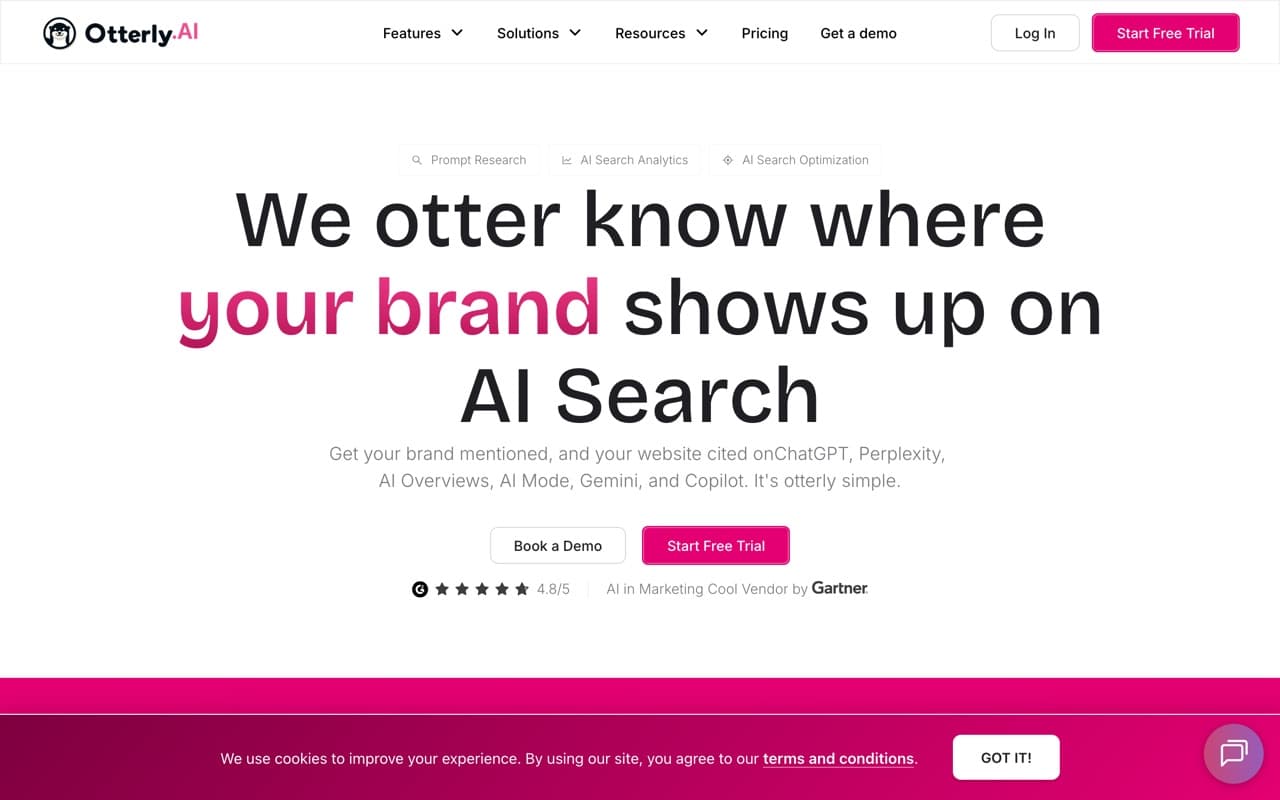
Otterly's entry tier covers four surfaces (ChatGPT, Google AI Overviews, Perplexity and Microsoft Copilot) at $29 a month for 15 prompts, with unlimited seats at every tier. The four-engine entry coverage is the widest at this price point in the market. Prompt counts are the meter, and the jump to 100 prompts costs $189 a month.
Sight
Sight's Pro plan starts at $99 a month for 5,000 AI credits, 1 site and 1 seat, covering ChatGPT, Claude, Gemini, Perplexity and Grok. It is one of the few tools covering Grok at entry. Credits rather than prompts are the meter and the page states no tracked-prompt count; each additional site costs $59 a month and Enterprise starts at $2,500.

Want to get recommended by AI?
Check your AI search visibility, then let the Honeyb agent write, fix, and earn what gets you recommended. Free to start.
LLM Pulse
LLM Pulse lists its prices in euros and shows its own approximate US-dollar conversion: about $59 a month (about $49 on annual billing) for 50 prompts across five surfaces, including Google AI Mode and AI Overviews, with unlimited seats and a 14-day trial that requires a card. One project per plan is the constraint to check if you run several brands.
Dageno
Dageno's Starter is $49 a month, shown as a cut from $89, for 50 prompts on one brand across 9 AI models that its pricing page does not name. Growth is $199 for 250 prompts and 2 brands, and Scale is $410 for 600 prompts with API access. Paid plans start with a 7-day free trial and annual billing takes about 15 per cent off.
Profound
Profound publishes no price: there is a free trial, then custom Enterprise pricing on request. The deeper analytics, API and white-label options are what that contract buys. It is the strongest fit for enterprise analytics budgets, and the hardest to compare with the self-serve tiers here until you have a quote that states engines and response volumes.
Peec
Peec's Starter is $95 a month for 50 prompts on three models you choose from six surfaces (ChatGPT, AI Mode, AI Overviews, Copilot, Perplexity, Gemini). Pro is $245 a month for 150 prompts and Advanced is $495.
Athena
Athena meters by credits, one credit per AI response, rather than by fixed prompt counts. A free plan is the way in; the $295 Starter carries 3,600 responses across 11 models with unlimited seats. Flexible in heavy months, harder to budget, and the per-response cost of 8.2 cents at Starter is mid-market.
Semrush
Semrush bundles AI visibility into its wider suite from the $199 SEO + AI Search Starter plan ($165.17 a month billed annually), tracking prompts across Google, ChatGPT, Perplexity, Gemini and more; exact prompt counts are not stated on the pricing page. The sensible buy if you want one contract for SEO and AI tracking together, and the expensive one if you only need the AI dashboard.
How to choose
Match the dashboard to the engines your buyers actually use, not to the longest coverage list. If your category answers concentrate on ChatGPT and Perplexity, note that those two engines agreed on the top recommendation just 20 per cent of the time in our measurement, so covering both is not optional. Check the meter next: fixed prompt counts (Otterly, Dageno, LLM Pulse, Honeyb) are predictable, credits (Athena, Sight) flex, and unstated counts (Semrush) need a trial to size.
Then check refresh cadence against the churn numbers above; a weekly scan under a 44 per cent per-run change rate is mostly noise. For the wider tool landscape beyond dashboards, see the best LLM monitoring tools and the best AI brand monitoring tools.
The takeaway
The measurement is the argument: identical prompts change their top recommendation 28 to 44 per cent of the time within a single engine, engines agree with each other as little as 20 per cent of the time, and their citation diets range from a 445-domain long tail to Reddit-heavy concentration. A tracking dashboard is how that noise becomes a decision. Entry costs run $29 to $295 a month with verified coverage in the table above. Start with the free option: run a free AI visibility check and see what Gemini is already saying about your brand.