

The future of AI search is taking shape along five lines: answer engines are becoming agents that complete tasks, search is dissolving into the operating systems and browsers people already use, commerce is moving inside the answer itself, citations are replacing rankings as the visibility metric that matters, and volatility is becoming the normal operating condition. None of this is speculation. Each shift is already visible in shipped products and measurable behavior.
This post is about what comes next, so it skips the basics. If you want a grounding in how answer engines work, start with the pillar guide on what AI search is. The starting point for everything below is that the behavior change has already happened: 58% of consumers say generative AI has replaced traditional search for them, a Capgemini Research Institute finding we unpacked in our AI search statistics round-up. The open question is not whether AI search wins usage. It is what shape that usage takes.
Shift 1: from answers to agents
The first generation of AI search did one thing well: it turned a question into a cited answer. The next generation acts. Every major assistant now ships a deep research mode that takes a single request, splits it into sub-questions, runs dozens of searches, reads the sources, and returns a structured report with citations. Work that used to mean an afternoon of open tabs has become a background job you check on later.
Research is only the first step. The direction of travel is task completion. Agents are starting to compare options against stated constraints, assemble shortlists, draft the follow-up message, and hand back a decision rather than a reading list. The request shifts from 'find me information about this' to 'handle this for me'. When that happens, the person never touches the open web. The agent visits it on their behalf.
That changes who your content is for. An agent reads far more pages than a person would, and it ignores everything that does not survive text extraction: layout, branding, imagery, the tone of the hero section. It also discards most of what it reads. Ahrefs found that ChatGPT cites only around 50% of the URLs it retrieves, a filtering step we examined in our breakdown of Ahrefs' AI search findings. Being fetched is not the same as being used. Content has to be worth quoting, not just worth ranking.
Shift 2: search disappears into the products you already use
The second shift is about where searching happens. The destination model, where you open a search engine and type, is giving way to assistance embedded in whatever is already on screen. Copilot is grounded in Bing and built directly into Windows, Edge, and Microsoft 365. Google's AI Mode is not a separate destination; it is a surface inside Google Search itself. Perplexity moved into work contexts early, launching Enterprise Pro back in April 2024. A fuller map of where these tools live, including the privacy-focused options, is in where to find AI search tools.
Embedding matters because defaults decide usage. Few people deliberately choose a search engine each morning; they use what sits in front of them. When the answer engine is the sidebar of your browser, a system-level assistant, or a tab on the search page you already had open, switching cost falls to zero and the habit forms on its own.
The market-share data shows how quickly that compounding works when distribution meets a strong model release.
Market share (%)
Google Gemini market share
| Period | Google Gemini market share |
|---|---|
| Jan 24 | 16.2% |
| Feb 24 | 15.5% |
| Mar 24 | 14.8% |
| Apr 24 | 14.9% |
| May 24 | 14.5% |
| Jun 24 | 13.8% |
| Jul 24 | 13.3% |
| Aug 24 | 13.8% |
| Sep 24 | 13.6% |
| Oct 24 | 13.5% |
| Nov 24 | 13.5% |
| Dec 24 | 13.4% |
| Jan 25 | 13.5% |
| Feb 25 | 13.5% |
| Mar 25 | 13.7% |
| Apr 25 | 13.4% |
| May 25 | 13.4% |
| Jun 25 | 13.5% |
| Jul 25 | 13.5% |
| Aug 25 | 13.4% |
| Sep 25 | 13.5% |
| Oct 25 | 13.4% |
| Nov 25 | 14.6% |
| Dec 25 | 14.8% |
| Jan 26 | 15% |
| Feb 26 | 15.2% |
| Mar 26 | 15.3% |
| Apr 26 | 15.1% |
Gemini held roughly 16% of generative-AI chatbot usage in early 2024, eased to around 15%, then began regaining share from November 2025 after Gemini 3 launched into surfaces people already had open. Over the same window Perplexity grew from about 2.7% to between 5% and 6%, Claude from around 2.1% to 5%, and ChatGPT including Copilot drifted from roughly 76% to 73%. None of this is settled. A capable model with built-in distribution can bend a share curve within weeks, a pattern we follow in our chatbot market share tracker.
Shift 3: commerce moves inside the answer
Commercial queries are the next territory. ChatGPT Shopping already surfaces product cards inside commercial answers, so the comparison happens within the conversation rather than across ten retailer tabs. The shortlist moment, the point where a buyer narrows from many options to a few, is moving inside the answer.
The headroom is visible in the data. Ahrefs measured that 99.9% of Google's AI Overviews appear on informational queries, with shopping queries at just 3.2%. Informational coverage came first because it carries little monetization risk. Commercial coverage is where the incentives point, and every engine can see it.
For brands this rewires the funnel. By the time a buyer clicks anything, the engine has already assembled a shortlist from product data, reviews, and third-party comparisons. What feeds those cards becomes a commercial question rather than a technical afterthought. We covered the mechanics, and how to respond, in our guide to ChatGPT Shopping strategy.
Shift 4: the citation economy and GEO
For two decades the unit of search visibility was the ranking. Its replacement is the citation: whether the engine names you, quotes you, or links to you inside the answer. The economics forcing the change are blunt. An AI Overview cuts clicks to the #1 organic result by 58%, up from 34.5% only ten months earlier. A top ranking is worth less when the answer above it absorbs the click.

Want to get recommended by AI?
Check your AI search visibility, then let the Honeyb agent write, fix, and earn what gets you recommended. Free to start.
The citation map also looks nothing like the traffic map. In the same Ahrefs research, 67% of ChatGPT's top citations come from sources marketers cannot directly influence, and 28.3% of its most-cited pages receive zero Google organic traffic. Off-site presence carries unusual weight too: YouTube brand mentions correlate at 0.737 with AI brand visibility. Pages and channels that never won the old game are winning the new one.
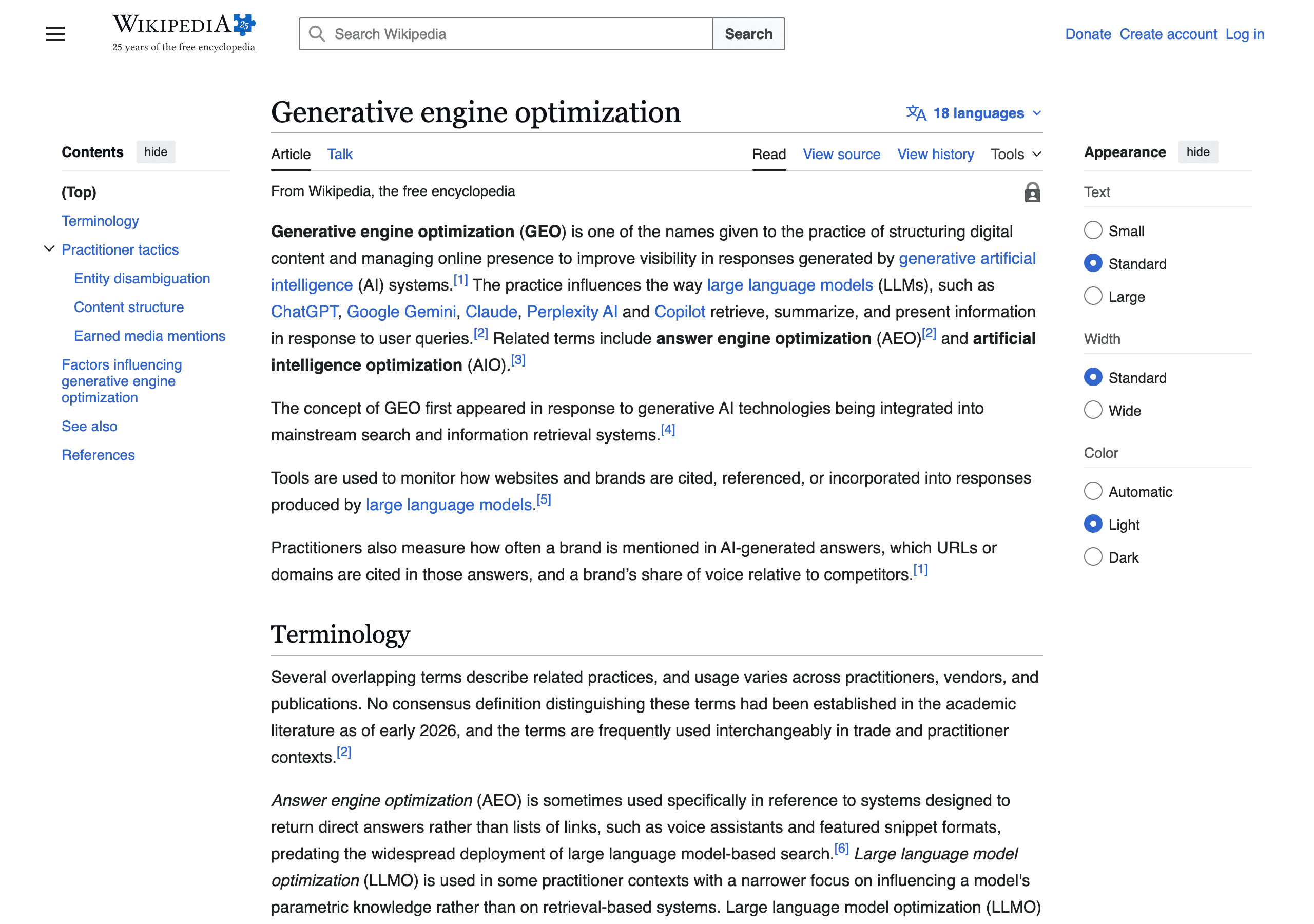
A discipline has formed around this scoreboard: GEO, or generative engine optimization, with answer engine optimization as its close sibling. The work is recognisable to anyone with an SEO background: clear factual claims, quotable passages, structured pages, and earned presence on the third-party sources engines trust. It is not a checklist exercise; the same Ahrefs research found that broad schema markup showed no meaningful citation lift. If the field is new to you, start with our explainers on what GEO is and answer engine optimization.
Shift 5: volatility becomes normal
The fifth shift is the least discussed and the most operationally important. AI answers are not stable. Ahrefs measured that AI Overviews change every 2.15 days on average, with a 70% chance of changing from one observation to the next, one of the findings we decoded in our Ahrefs research breakdown. The answer one prospect sees on Monday is not the answer another sees on Thursday.
The inconsistency runs across surfaces as well as time. The same research found that Google's AI Mode and AI Overviews reach the same conclusion 86% of the time, yet their citations overlap by only 13.7%. Same company, same query, different sources. Add phrasing variations and the differences between engines, and brand presence in AI search stops being a position you hold. It becomes a probability distribution you influence.
That has a direct consequence for measurement. Checking one answer once and treating it as the state of the world is like judging a climate from a single photograph. We laid out the failure modes in why spot-checking AI visibility fails. The workable approach is sampling: the same prompts, across engines, on a schedule, with trends rather than snapshots as the output.
What to do now
For individual searchers and professionals, the sensible move is to build the habit deliberately rather than drift into it.
- Use deep research modes for genuinely multi-source questions, and notice which tasks they collapse from hours to minutes.
- Keep checking citations on anything that feeds a real decision; engines synthesise confidently even when their sources disagree.
- Learn where traditional search still wins, which we cover in when to use AI search.
For brands, the priority is a baseline. None of these shifts shows up in your own numbers until you measure how engines describe you today.
- Run the prompts your buyers actually ask across ChatGPT, Gemini, Perplexity, and Copilot, and record who gets named.
- Audit retrievability: crawlable pages, clean structure, and factual claims an engine can lift verbatim.
- Map the third-party sources engines cite in your category, then earn presence on them.
- Track weekly rather than quarterly. When answers shift every few days, a quarterly check measures history.
Continuous tracking is the part that is hard to do by hand, and it is what Honeyb is built for: it runs buyer prompts across the major engines on a schedule and records mentions, sentiment, and the sources behind each answer over time. For a quick read on where you stand, run a free AI visibility check and see how a live engine currently describes your brand.
Frequently asked questions
Will AI search replace traditional search engines? Not as a clean swap. Google is folding AI answers into its existing results page rather than replacing it, and tasks like navigation, local lookups, and quick fact checks still suit a list of links. What is being replaced is the habit: a growing share of people now ask full questions and act on the synthesised answer, especially for informational queries.
What is agentic AI search? Agentic search is when an AI system carries out multi-step work on your behalf instead of returning a single answer. It breaks a request into sub-questions, runs many searches, reads and filters sources, and returns a structured output, sometimes with completed actions such as a comparison table or a drafted document. The deep research modes in current assistants are the early form of this.
How should brands prepare for the future of AI search? Start with measurement, because every later decision depends on knowing how engines describe and recommend you today. Then improve retrievability and quotability on your own site, and build presence on the third-party sources engines cite in your category. Treat it as a continuous program rather than a one-off project, since AI answers change every few days.
Does SEO still matter if AI search takes over? Yes. Answer engines find content through crawling and indexing, so technical SEO remains the entry ticket. What changes is the scoreboard. Instead of optimizing for a ranking position, you optimize to be retrieved, trusted, and cited inside answers. Generative engine optimization extends SEO rather than replacing it.