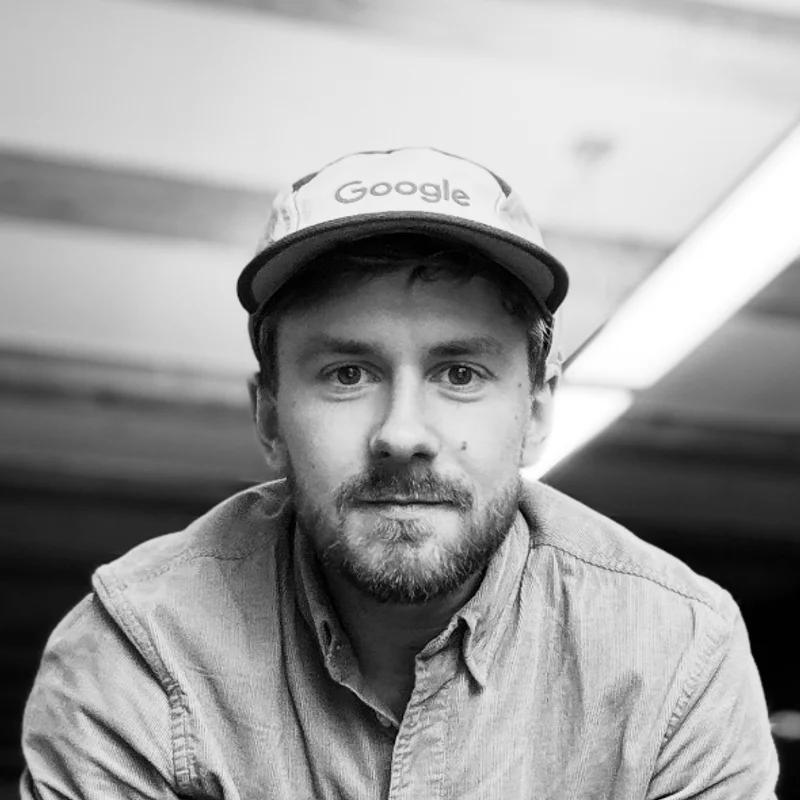
The Perplexity CEO is Aravind Srinivas, the co-founder who has become the public face of one of the most closely watched companies in AI search. He is a UC Berkeley computer-science PhD and a former OpenAI researcher who, alongside three other engineers, built Perplexity into an answer engine valued at roughly 21 billion dollars in under four years. But a company is more than its chief executive, and the question of who is Perplexity CEO usually opens onto a wider one: who actually runs the place. This piece is a factual profile of Srinivas and the founding team, the roles each holds, the backgrounds that shaped the product, and the senior leaders who joined later. Every biographical claim is tied to a named, dated source.
Who is Perplexity's CEO?
Aravind Srinivas is the chief executive and a co-founder of Perplexity AI. According to the Perplexity AI entry on Wikipedia, he has held the CEO role since the company was founded in August 2022, and he remains the figure most associated with the brand in interviews, on stage and across the company's public communications. When commentators ask who is Perplexity CEO, the answer has not changed since founding: it is Srinivas.
Srinivas was 28 when he started the company in the autumn of 2022, which places his birth around 1994 (Fortune, July 2025). He grew up in Chennai, India, in what Fortune described as a lower-middle-class household, before a route through two of the most selective institutions in computing took him to the front of the answer-engine race. He is hands-on with the product and unusually active in public, a style that has made him one of the more recognisable founders in the current AI cycle.
Aravind Srinivas: education and research background
The detail that recurs in almost every profile of Aravind Srinivas is his research pedigree, because it is central to how Perplexity was built and why the company is so often, and wrongly, assumed to be tied to a larger lab. He earned a dual bachelor's and master's degree in electrical engineering from the Indian Institute of Technology Madras, completing it in 2017. He then moved to the University of California, Berkeley, where he completed a PhD in computer science in 2021 under the supervision of Pieter Abbeel, a leading figure in reinforcement learning. Berkeley Engineering records the advising relationship directly, quoting Abbeel describing Srinivas as a student who brought "great execution" and "great vision" (Berkeley Engineering, March 2025).
His industry experience came alongside that academic track. He interned at OpenAI during his time at Berkeley and at Google's AI labs, including a summer internship at Google DeepMind in London, with an earlier research internship under Turing Award winner Yoshua Bengio at the Montreal Institute for Learning Algorithms. He then worked full time at OpenAI for roughly a year after finishing his doctorate (Berkeley Engineering, March 2025; Fortune, July 2025). Wikipedia summarises those roles as research positions at OpenAI and Google DeepMind, and the spread of labs on his CV is part of why the company's lineage is so often misread.
That background matters for one practical reason. A chief executive who trained inside OpenAI and Google is exactly why people keep assuming those companies own or control Perplexity. They do not. We unpack the ownership picture in full in who owns Perplexity AI, but the short version is that having worked somewhere is not the same as being owned by it.
How Srinivas describes the product
Srinivas has a consistent way of framing what Perplexity is for, and it doubles as a useful description of the product's design. He has called it the result of "Wikipedia and ChatGPT having a baby together," an answer engine that synthesises information and shows its sources rather than returning a page of links (Berkeley Engineering, March 2025). That framing is more than a soundbite. It captures the retrieval-first architecture that distinguishes Perplexity from a plain chatbot, which we walk through in how does Perplexity AI work and in our broader explainer, what is Perplexity AI.
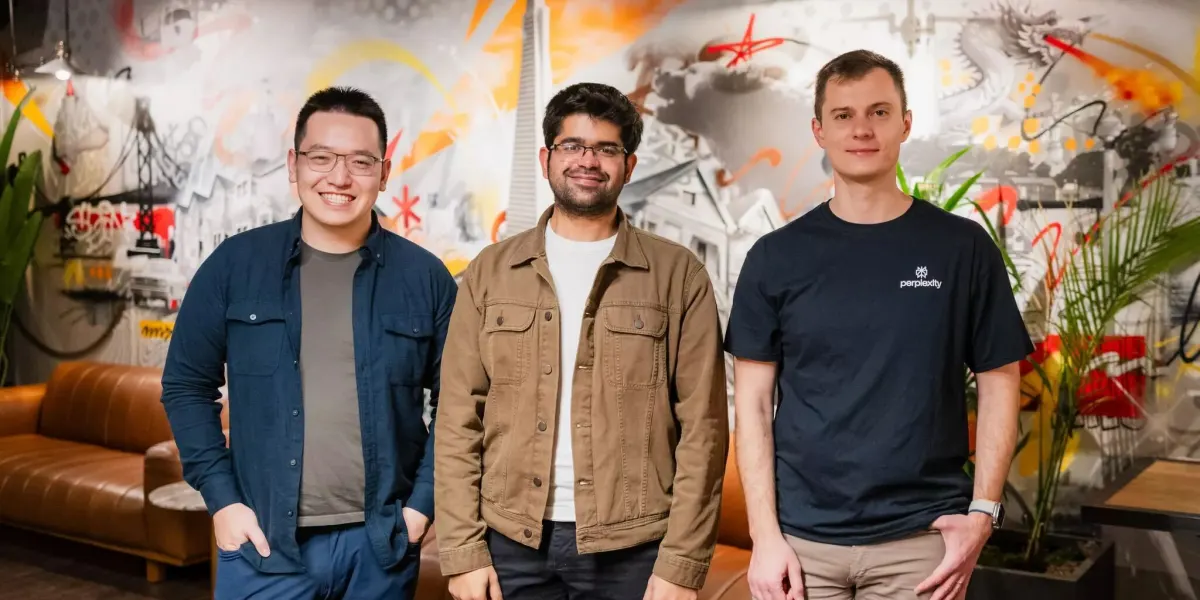
The Perplexity founders: the four-person team
Perplexity AI was founded in August 2022 by four engineers, and the same four remain its central figures. Per the Perplexity AI entry on Wikipedia, the Perplexity founders are Aravind Srinivas, Denis Yarats, Johnny Ho and Andy Konwinski. The company is headquartered in San Francisco, and it launched its public product on 7 December 2022, weeks after ChatGPT's debut. The table below sets out who does what.
| Founder | Role at Perplexity | Background |
|---|---|---|
| Aravind Srinivas | CEO and co-founder | PhD, UC Berkeley; researcher at OpenAI and Google DeepMind |
| Denis Yarats | CTO and co-founder | Former AI research scientist at Meta |
| Johnny Ho | Chief strategy officer and co-founder | Former engineer at Quora; quantitative trader at Tower Research Capital |
| Andy Konwinski | President, co-founder and board member | Co-founder of Databricks; worked on Apache Spark |
Denis Yarats is the chief technology officer, responsible for the engineering and model work behind the product, and was previously an AI research scientist at Meta, per his Wikipedia entry. Johnny Ho is the chief strategy officer, with earlier roles as an engineer at Quora and as a quantitative trader at Tower Research Capital. Andy Konwinski is president and sits on the board; he is a computer scientist who worked on Apache Spark and co-founded the data platform Databricks, a company that later also turns up among Perplexity's investors. Konwinski holds a PhD in computer science from Berkeley, the same institution as Srinivas.

Want to get recommended by AI?
Check your AI search visibility, then let the Honeyb agent write, fix, and earn what gets you recommended. Free to start.
The split of founder equity between the four has never been disclosed, and like every venture-backed startup their combined stake has been diluted as outside investors bought in. What is clear is that the company is run day to day by Srinivas, with Yarats, Ho and Konwinski in senior operating roles. The founders set strategy, not any single investor.
The wider Perplexity AI leadership team
A company valued in the tens of billions runs on more than four people, and Perplexity has hired senior leaders to scale its commercial and operational sides. The most prominent is Dmitry Shevelenko, who joined as chief business officer in October 2023 and oversees the company's commercial operations and partnerships. Before Perplexity he held senior roles at Uber, LinkedIn and Meta, and in September 2025 he was also appointed to the board of directors of the financial advisory firm Lazard (Lazard, September 2025).
Below the executive line the company has grown from a handful of staff in 2024 into a larger organisation spanning research, engineering, enterprise sales and partnerships. Perplexity has not published a full executive roster, so the picture beyond Srinivas and Shevelenko is partial. We describe the named, sourced roles and avoid asserting titles that the company has not confirmed.
How the CEO's choices shaped the company
Two strategic patterns under Srinivas are worth understanding, because they explain a lot about how Perplexity behaves as a business and as an answer engine.
The first is aggressive distribution over near-term revenue. The Comet AI browser, launched to 200-dollar-a-month Max subscribers in July 2025, was made free worldwide on 2 October 2025, a land-grab that traded immediate income for reach (CNBC, October 2025). The second is a rapid fundraising cadence that has tracked rising consumer demand. The chart below shows US search interest in Perplexity over the past year, a rough proxy for adoption, which has moved broadly in step with the company's climbing valuation.
Monthly searches (US)
Search demand for "perplexity ai"
The market context tempers the picture. By usage share in mid-2026, ChatGPT including Microsoft Copilot still leads the generative-AI field by a wide margin, with Gemini in the mid-teens and Perplexity closer to the mid-single digits, so Srinivas is running a fast-growing challenger rather than a market leader. The fundraising has been relentless: Perplexity's reported valuation rose from roughly 121 million dollars in 2023 to around 21 billion dollars by early 2026, a trajectory we document round by round in who owns Perplexity AI. For readers asking whether they can take a position in that growth, the answer is covered in can you invest in Perplexity AI: the company is private, so there is no public ticker.
A public-facing chief executive
Srinivas is unusually visible for a founder at this stage, regularly giving interviews on the AI race and the future of search. In a June 2026 CNBC interview he argued that efficiency, which he framed as "token value per watt per user", will decide which AI companies endure, a theme he has returned to repeatedly as inference costs become a central competitive question across the sector (CNBC, June 2026). That visibility is a deliberate part of the strategy. For a challenger competing with Google, OpenAI and Microsoft for attention, a recognisable, accessible chief executive is itself a distribution channel, and it is part of why the question of who is Perplexity CEO has such a clear public answer.
What this means for brands watching Perplexity
For most marketers the leadership story is context, not the task. The task is whether your brand actually surfaces inside Perplexity's answers, and the founders' choices shape that more than their CVs do. Srinivas's retrieval-first, multi-model design means Perplexity grounds answers in live web sources and can diverge sharply from ChatGPT, Gemini or Claude, so a citation in one engine does not guarantee a citation in another. Understanding how each engine selects sources matters far more here than who sits in which chair, which is why we keep a separate guide to how Perplexity AI works and a primer on what Perplexity AI is. The leadership tells you how durable the platform is likely to be. Monitoring tells you whether your brand shows up inside it.
The bottom line on Perplexity's CEO
Perplexity's CEO is Aravind Srinivas, a UC Berkeley computer-science PhD and former OpenAI researcher who co-founded the company in August 2022 and has led it since. He runs it alongside three co-founders: Denis Yarats as chief technology officer, Johnny Ho as chief strategy officer and Andy Konwinski as president and board member, with chief business officer Dmitry Shevelenko leading the commercial side from late 2023. The company is private, independent and headquartered in San Francisco, and despite its CEO's roots at OpenAI and Google, it is not owned or controlled by either. Srinivas's research background and his bias toward aggressive distribution explain a great deal about how the answer engine is built and how it competes.
Sources cited in this report