AI citation tracking tools follow the sources behind an AI answer: the specific domains and pages a model cites when it recommends a brand, not just whether your name shows up. That distinction is the whole point. When ChatGPT or Perplexity builds a recommendation, it leans on a concentrated set of cited sources, and if you cannot see those sources you cannot change the answer.
This guide ranks the seven best AI citation tracking tools for 2026 by how deeply each one exposes and lets you analyse the cited domains. Honeyb, first on the list, is our own tool, so weigh the rest on their merits. For the wider category see the best AI visibility tools.
Why the cited sources matter more than the mention
A mention tracker answers one question: were you named. A citation tracker answers the more useful one: what did the model read to decide. The gap between those two is large. Semrush found that 62 per cent of AI citations never name the brand behind them, so a tool that only watches for your name misses most of what is shaping the answer. And the citations are not spread evenly. Reddit alone accounts for 40.1 per cent of all AI citations, the single most-cited source in AI answers (Semrush).
Share of AI citations
Most-cited domains in AI answers
This is why source-level data is the lever. AI visibility correlates most strongly with third-party mentions and video, not with on-page work, according to Ahrefs. In other words, what earns you a citation happens off your own site, on the domains the model already trusts. A citation tracker shows you which of those domains cited your competitors and not you, which is a to-do list. A mention tracker just shows you a score.
What a citation tracker does that a mention tracker cannot
Three things. It surfaces the actual cited domains, so you can see whether an answer leaned on a Reddit thread, a review roundup or a competitor's own page. It attributes unbranded citations, the 62 per cent that recommend a category without naming a company, so you learn where the model forms an opinion before it picks a name. And it lets you analyse the sources over time, so you can watch a domain gain or lose influence in your category rather than reacting to a single screenshot. The same outputs are available as data: an AI mentions API returns every cited page with its domain, page type and position in the answer, for teams that would rather trend the sources in their own warehouse.
How we ranked them
We weighted four things specific to citation work: whether the tool exposes the actual cited domains rather than a summary score, whether it offers source-level analysis you can filter and trend, whether it captures the unbranded citations that never name a company, and price relative to who each tool serves. Model coverage matters too, but a tool that watches five engines and hides the sources is worth less here than one that watches four and shows them.
| Tool | Exposes cited domains | Source-level analysis | Tracks unbranded citations | Models covered | Starting price |
|---|---|---|---|---|---|
| Honeyb | Yes | Yes | Yes | ChatGPT, Gemini, Claude, Perplexity | Free check |
| Profound | Yes | Yes, deepest | Yes | Major engines | Pricing on request |
| Semrush AI Visibility | Yes | Yes | Yes | Major engines | Free checker |
| Ahrefs Brand Radar | Yes | Yes | Yes | AI answers, YouTube, Reddit | Ahrefs plans |
| AthenaHQ | Partial | Partial | Partial | Major engines | $295/mo |
| Peec AI | Partial | Partial | Partial | Major engines, multilingual | $95/mo |
| Scrunch AI | Yes | Partial | Partial | Major engines | $250/mo |
| SE Ranking | No | No | No | AI Overviews, ChatGPT, Gemini | $129/mo |
| Otterly AI | No | No | No | ChatGPT, Perplexity, AI Overviews, Gemini, Copilot | $29/mo |
The 7 best AI citation tracking tools
1. Honeyb
Honeyb monitors all four major models daily, ChatGPT, Gemini, Claude and Perplexity, and tracks the source citations behind each answer, so you see which pages the model trusted and which of them named a competitor instead of you. It ties those citations to sentiment, competitor tracking and recommendations, and turns the gaps into fixes. You can start with a free check. This is our own tool.
2. Profound
Profound is the enterprise standard, with the deepest source-level analytics in the category and more than $155M in funding behind it. It exposes cited domains, attributes unbranded citations and lets large teams slice the data at scale. It publishes no price: a free trial, then custom Enterprise pricing on request. See how the two compare in Honeyb vs Profound.
3. Semrush AI Visibility
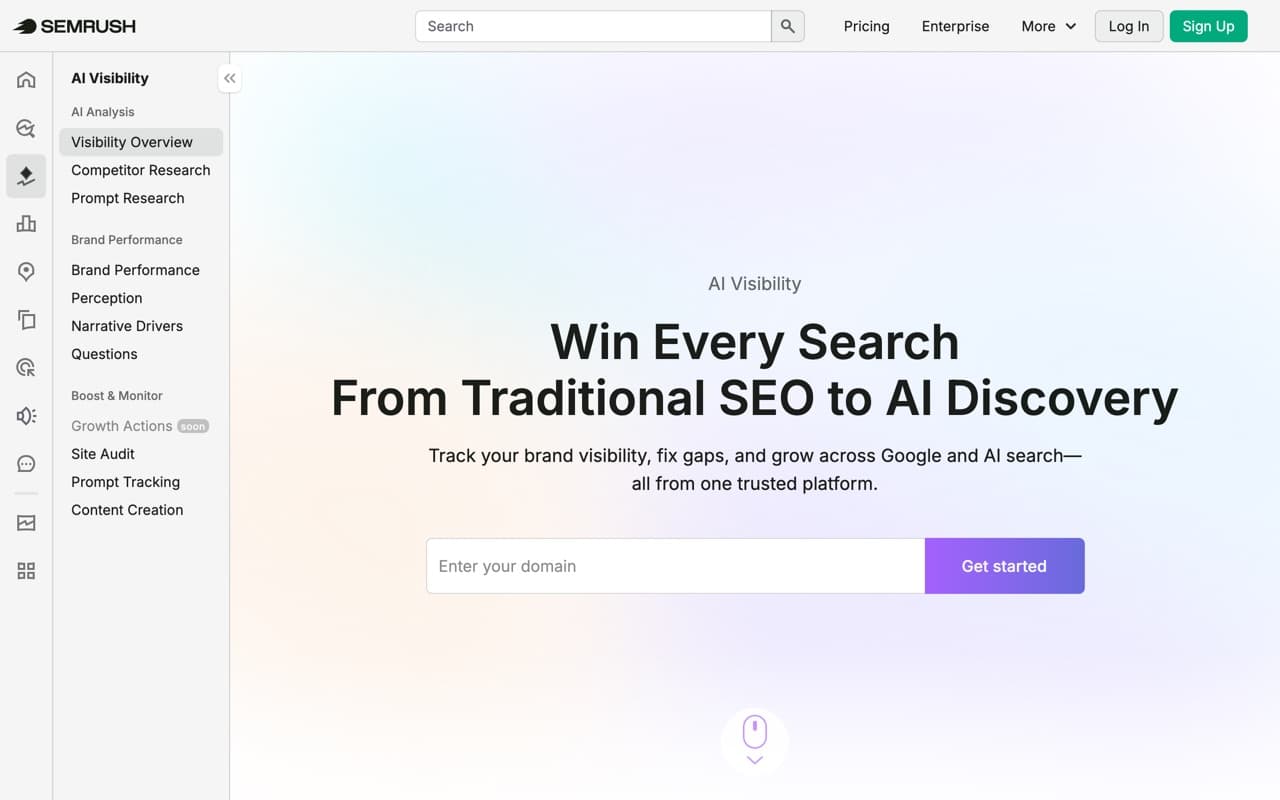
Semrush is the source of the citation benchmarks this article cites, including the Reddit 40.1 per cent figure, and its AI Visibility toolkit brings that same source-level tracking into the SEO suite. It exposes cited domains and captures unbranded citations, with a free checker to start. It fits teams already living in Semrush who want AI citation data in the same place as their keyword work.

Want to get recommended by AI?
Check your AI search visibility, then let the Honeyb agent write, fix, and earn what gets you recommended. Free to start.
4. Ahrefs Brand Radar
Ahrefs Brand Radar tracks AI share of voice and the citations behind it across AI answers, YouTube and Reddit, drawing on the web-mention and backlink data Ahrefs is built on. Because it already indexes Reddit and YouTube, both of which feature heavily in AI citations, it is well placed to show where citations originate. It is included in Ahrefs plans.
5. AthenaHQ
AthenaHQ builds generative engine optimisation workflows for teams and agencies, with partial citation tracking sitting inside that process. It suits groups who want to move from spotting a citation gap to assigning and shipping the work, rather than analysing sources in isolation. It offers a free 10-minute audit, with plans from $295 a month.
6. Peec AI
Peec AI is the multilingual mid-market option, covering the major engines with partial citation tracking across languages. For brands that operate in several markets, seeing which sources are cited in each language is the differentiator, since the most-cited domains shift by region. It offers a trial, with pricing from $95 a month.
7. Scrunch AI
Scrunch AI is built around answer-engine optimisation, with a focus on surfacing the sources an engine cites so you can target them. It exposes cited domains, with source analysis geared toward acting on the result rather than deep historical reporting. Pricing is custom, which points it at teams that want a scoped engagement over a self-serve dashboard.
What about the budget, mention-only tools
Two well-known tools sit outside this list for a reason. Otterly AI, from $29 a month, is the cheapest way to start and covers ChatGPT, Perplexity, AI Overviews, Gemini and Copilot, and SE Ranking, from $129 a month, folds AI visibility into an affordable SEO suite. Both are solid at telling you whether you appear. Neither exposes the cited sources behind the answer, so they track the mention rather than the citation.
If your only question is presence, they fit. If you need to change what the model reads, they will not show you where to start.
How to choose
If you want the deepest source analysis and have the budget, Profound leads. If you already pay for Semrush or Ahrefs, their citation tracking is the fastest path to source data without a new tool. If you want GEO workflows or multilingual coverage, AthenaHQ and Peec fit. If you want AEO-focused source targeting, Scrunch fits. And if you want daily all-model citation tracking with sentiment, competitors and recommendations without enterprise pricing, that is where Honeyb sits, and you can check your citations free to see the data before you commit.
The caveat for every citation tool
AI citations are volatile, so read the trend, not the reading. The same query changes roughly 70 per cent of the time, and two identical queries return the same brand list under a 1-in-100 chance (SparkToro). The sources move too: Reddit's share of ChatGPT citations fell from around 60 per cent to around 10 per cent in a fortnight in late 2025 before recovering (Semrush).
A single snapshot of your cited sources can be misleading. Track a fixed prompt set over time so you can tell a real shift from noise.
See exactly which sources are shaping your AI answers with a free AI visibility check, and to go deeper on the numbers behind AI presence see how to measure your AI share of voice.