Ask ChatGPT which espresso machine to buy and it shows product cards with prices. Ask Google how heat pumps work and an AI Overview appears above the organic results. Ask Perplexity to recommend a CRM and it names specific brands, with numbered citations showing where each name came from.
This post walks through seven of those moments, one per surface, using the kinds of queries people actually run. If you want definitions first, start with our pillar on what AI search is. If you want the engines compared head to head, we did that in the best AI search engines for 2026. The focus here is the answers themselves: what each engine returns, and what that means if you want your brand inside them.
1. ChatGPT: a buyer-stage product question
Ask ChatGPT for the best compact espresso machine for a small kitchen on a set budget and you no longer get a paragraph of generic advice. On commercial questions, ChatGPT Shopping surfaces product cards inside the answer: images, prices, and merchant links, arranged alongside prose that explains the trade-offs. The model narrows by your constraints. Mention the small kitchen and it favors compact machines. Mention the budget and the cards respect it.
The follow-up behavior separates this from a shopping aggregator. Ask which of the shortlisted machines is quietest and it re-ranks the same set rather than starting over. For brands, the mechanics behind the cards matter. Ahrefs found that 43.8% of ChatGPT-cited pages are Best X listicles, a strong signal of the kind of content ChatGPT leans on when it recommends products. We unpacked that research in our breakdown of Ahrefs' AI search findings, and the product-card layer in ChatGPT Shopping and brand strategy.
2. Google AI Overviews: an informational query
Search Google for how a heat pump works below freezing and an AI Overview sits above the organic results: a synthesised explanation a few sentences long, with source chips linking to the pages it drew from. You read the answer without clicking anything. The ten blue links are still there underneath, but the question is usually settled before you reach them.
This is overwhelmingly an informational surface. The Ahrefs research above found that 99.9% of AI Overviews appear on informational queries, against just 3.2% of shopping queries. The same study measured a 58% drop in clicks to the top organic result when an Overview is present. If your strategy leans on how-to and explainer traffic, this is the example to study.
3. Google AI Mode: a follow-up conversation
AI Mode is the conversational surface inside Google Search, the udm=50 tab that sits next to regular results. Where an AI Overview answers once, AI Mode holds context. Ask whether to install a home charger for an electric car, then follow up with the fact that you rent your flat, then ask if a standard socket is safe overnight. Each answer builds on the last. You never restate the situation, and the engine retrieves fresh sources on every turn.
The relationship between Google's two AI surfaces is stranger than it looks. Ahrefs measured that AI Mode and AI Overviews reach the same conclusion 86% of the time while sharing only 13.7% of their citations. Same verdict, almost entirely different sources. A brand can be cited in one Google AI surface and invisible in the other.
4. Perplexity: a research question with citations
Perplexity treats every query as a small research project. Ask for the best CRM for a SaaS startup and it searches the live web, reads what it finds, and writes a structured answer naming specific products, with a numbered citation after nearly every claim. The sources sit in plain view, so you can check any recommendation in one click.
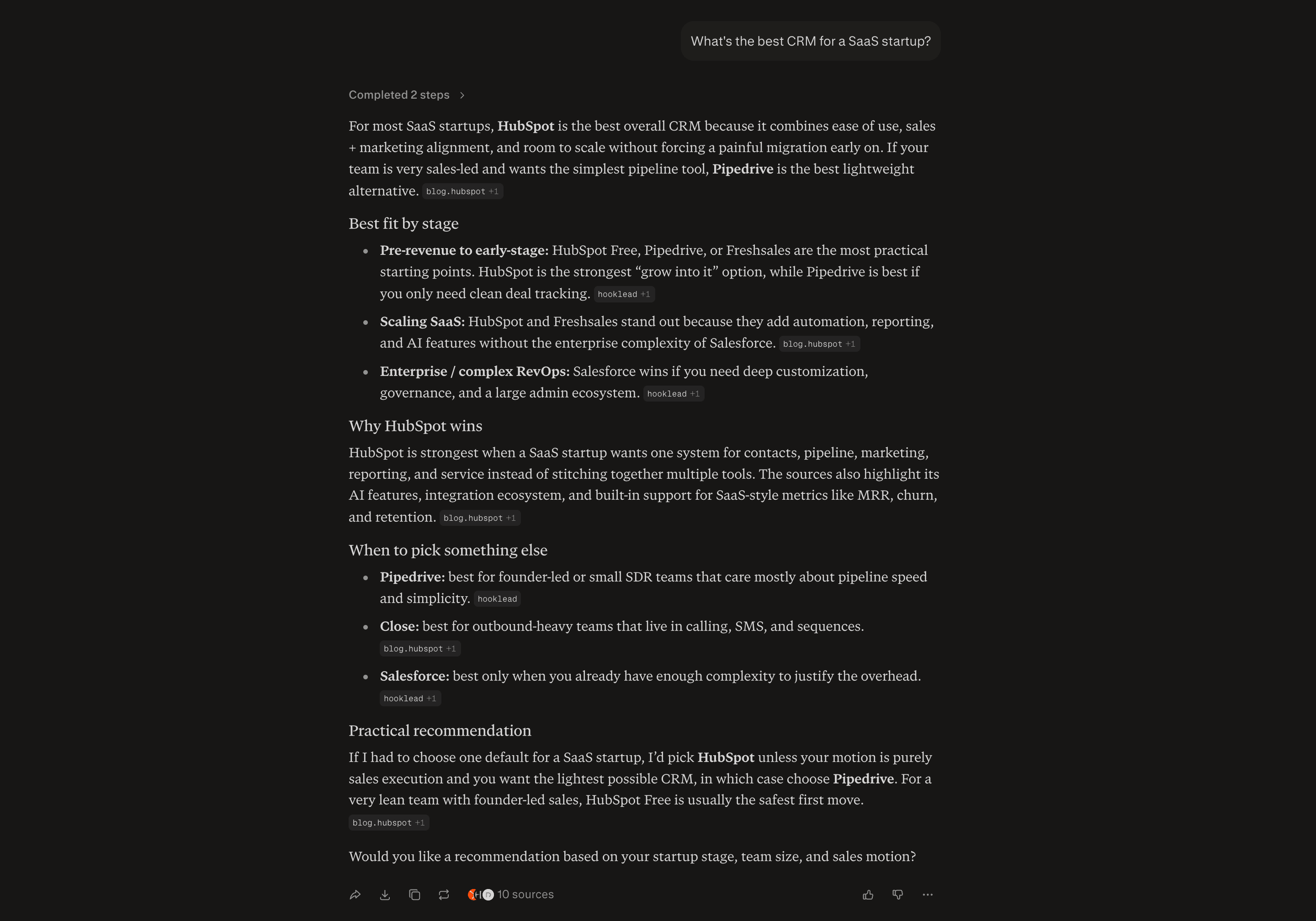
The traceability is the point. The brands in that screenshot were not picked on a whim; they were lifted from the comparison posts and review pages Perplexity retrieved. Change the sources and you change the shortlist. That is the entire logic of generative engine optimization captured in a single screenshot.
5. Brave: AI Answers from an independent index
Brave Search answers from its own independent index rather than borrowing Google's or Bing's, which makes it unusual among the engines that are not Google or Microsoft. Run a definitional query and an AI Answers summary appears above the results, built from pages Brave crawled itself. For follow-ups there is Ask Brave, a conversational mode, plus the Leo assistant inside the Brave browser.
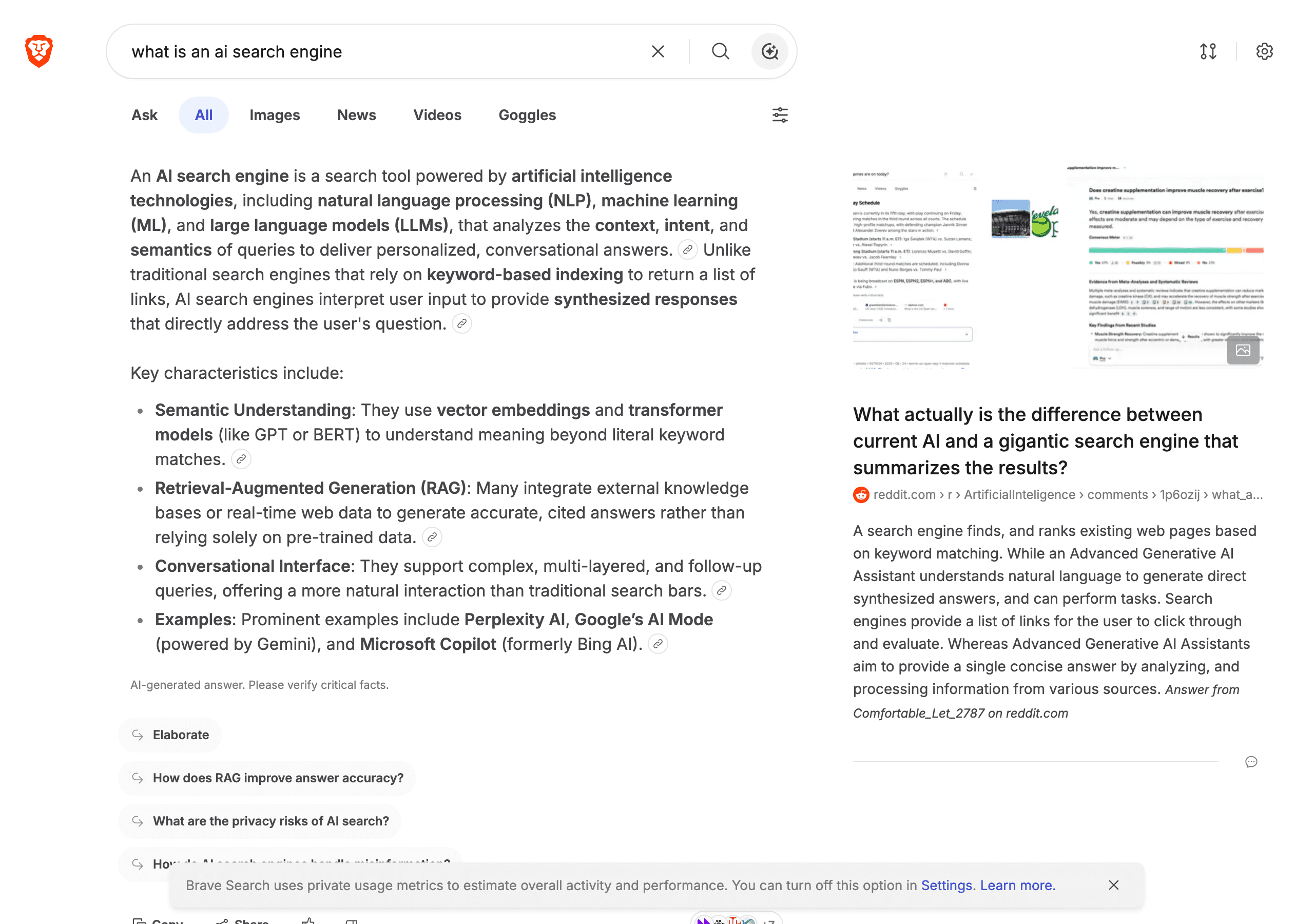
The independent index matters more than it first appears. A page that ranks well on Google is not automatically visible to Brave's crawler. The same question can therefore produce a different set of sources, and a different set of named brands, than it does anywhere else.
6. Grok: a breaking-news question
Grok's distinguishing feature is its connection to live conversation on X. Ask about a story that broke an hour ago and it pulls recent posts alongside web sources, then synthesises a running summary: what is confirmed, what is claimed, and who is saying it. Traditional engines lag here because their indexes refresh on a crawl schedule. Grok reads the discussion as it happens.

Want to get recommended by AI?
Check your AI search visibility, then let the Honeyb agent write, fix, and earn what gets you recommended. Free to start.
Access is simple: a rate-limited free tier, with heavier capabilities in xAI's paid SuperGrok tiers. The honest caveat is that speed and verification pull in opposite directions, and early answers on a developing story can change within hours. Treat Grok as a first read, not a final source. Our guide on when to use AI search maps where traditional search still wins.
7. Copilot: search inside a Windows workflow
The most common Copilot search is one nobody would call a search. You are drafting a proposal in Word or reading a dense page in Edge, you open the Copilot sidebar, and you ask it to summarize the page or pull background on a company you are about to email. Copilot is grounded in Bing and built into Windows, Edge, and Microsoft 365, so retrieval happens where the work already is. No new tab, no query box, no results page.
For visibility, this changes the surface area. A meaningful share of professional queries now run through Bing's index without anyone visiting a search engine at all. If your brand is thin in Bing, it is thin in every Copilot answer across the Microsoft estate.
What the examples have in common
Seven surfaces, seven query types, one pattern underneath.
- The answer comes first. Links are supporting evidence, not the destination.
- Commercial questions produce shortlists. A handful of named brands, not a ranked page of links.
- Citations are concentrated. A small set of review sites, comparison listicles, and forum threads feeds most answers.
- Follow-ups replace query refinement. Context carries across turns instead of being retyped into the box.
- The same question returns different shortlists on different engines, because each retrieves from a different index and weighs sources differently.
- Answers move. The Ahrefs research found AI Overviews change every 2.15 days on average, with a 70% chance of changing from one observation to the next.
If you want the pipeline behind these behaviors, from typed question to cited answer, how AI search works walks through it step by step.
What each of these answers means for your brand
Look back at examples one, four, and five. Each ended with a shortlist of named brands, and that shortlist is the modern equivalent of page one. Brands that are named win consideration. Brands that are absent were never in the running. What feeds those shortlists is knowable: models lean heavily on community discussion, which is why AI models cite Reddit so often, and on third-party comparisons, covered in how review sites shape AI recommendations. The Ahrefs research puts 67% of ChatGPT's top citations on sources marketers cannot influence directly, which makes the remaining third worth competing for properly.
This is the gap Honeyb measures. It runs the prompts your buyers actually ask across ChatGPT, Gemini, Perplexity, and Claude on a schedule, records which brands each engine names, and tracks how those answers shift over time. A single screenshot shows where you stood on one day. The trend shows whether you are gaining ground or losing it.
To see which of these answer types mention your brand today, run a free AI visibility check. It takes a few minutes and shows the shortlists you currently appear in, and the ones you are missing from.
Frequently asked questions
What is an example of AI search? Asking Perplexity for the best CRM for a SaaS startup is a clean example. The engine searches the live web, reads the results, and writes an answer naming specific products, with citations showing which page each recommendation came from. Google AI Overviews, ChatGPT product cards, and Copilot sidebar answers are all variations on the same pattern: a written answer first, sources attached.
Which AI search engine should I try first? Match the engine to the task. Perplexity is strongest for cited research, ChatGPT for buying decisions and conversational depth, Google AI Mode for follow-ups inside ordinary search, and Grok for anything that happened in the last hour. Our comparison of the best AI search engines covers all ten in detail.
Are AI search answers reliable? They are usually well sourced but never fixed. Most engines cite as they write, which makes verification a one-click job, and that click is worth taking for anything important. Answers also shift as the underlying retrieval changes, so what an engine says about your category this week may differ from what it says next month.
How do I get my brand into answers like these? Work on the sources the engines cite rather than the engines themselves. That means earning places in comparison listicles, review platforms, and community discussion, then measuring which prompts already name you. The discipline is called generative engine optimization, and it starts with an honest read of your current visibility.