
Free is a real starting line, not a marketing trick
You do not need a budget to find out how ChatGPT, Gemini, Claude and Perplexity describe your brand. Several tools let you start for nothing, and a few let you start without even handing over a card. The catch is that "free" covers at least four different things, and they are not interchangeable. A free check runs once and shows you a snapshot. A free tier keeps running but caps what you see.
A free audit is a one-off report. A no-card trial is the full product on a clock. This page maps the genuinely free entry points, tells you which type each one is, and is honest about the two well-known tools that have no free self-serve door at all.
For the full paid picture once you have decided to commit, see our AI visibility software pricing guide. For broader roundups of the category, see the best AI visibility tools and the best AI brand monitoring tools. This piece is only about starting for free.
The free entry points at a glance
| Tool | Free entry | Card required | Type of free |
|---|---|---|---|
| Honeyb (ours) | Free check across all four models | No card | One-off check |
| Semrush AI Visibility | Free checker | Suite account | Free checker, add-on |
| AthenaHQ | Free 10-minute audit | Varies | One-off audit |
| Otterly AI | Free trial | Yes | Time-limited trial |
| SE Ranking | No-card trial | No card | Time-limited trial |
| Peec AI | Trial | Yes | Time-limited trial |
| Profound | Demo only | Sales-led | No free self-serve |
| Scrunch AI | Custom pricing | Sales-led | No free self-serve |
We list our own product first and disclose that plainly. Honeyb is ours. Everything below is described on the same terms as the rest, using each tool's own stated entry point, so you can judge for yourself.
Four kinds of free, and why the difference matters
A free check is a snapshot, not a subscription
A free check runs your brand through the AI models once and returns what they say right now. Honeyb offers a free check with no card, covering all four major models, ChatGPT, Gemini, Claude and Perplexity, with sentiment, citations, competitor context and recommendations in the result. Use a check to answer one question fast: do the models mention me, and do they get me right. It will not track change over time on its own, which is the job of a paid plan.
A free checker or free tier keeps running but caps the view
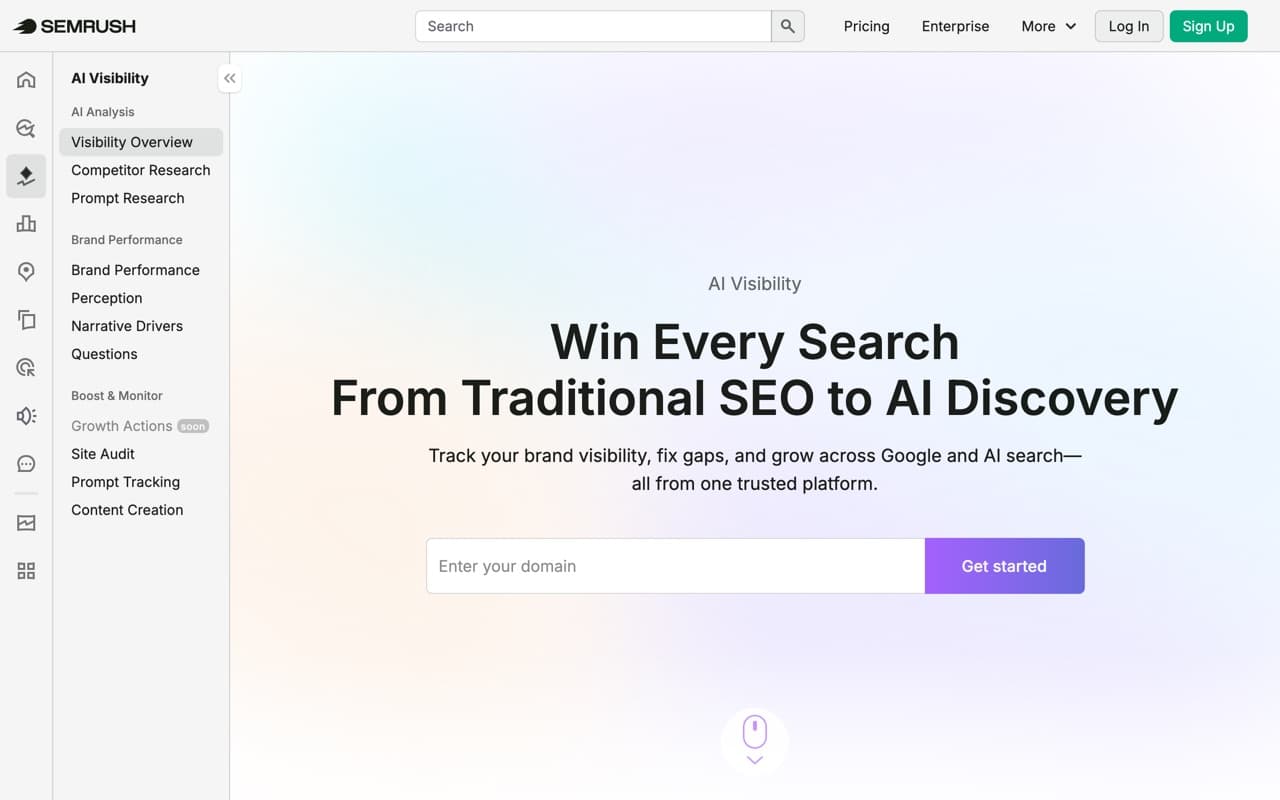
Semrush AI Visibility ships a free checker as part of the wider Semrush suite. It sits inside an SEO account you may already hold, so the entry cost is effectively zero if you are a Semrush user. The trade-off with any free checker is scope: you typically see a limited slice of prompts, models or history before the paid add-on unlocks the rest.
A free audit is a one-off report you keep
AthenaHQ offers a free 10-minute audit aimed at teams running GEO workflows. An audit differs from a check in framing: it is a structured report you walk away with, rather than a live dashboard. It is a good way to get a written baseline you can circulate internally, but it is a moment in time, not a monitor.
A no-card trial is the full product on a clock
Trials give you the paid product for a fixed window. The important line to read is whether a card is required. SE Ranking offers a no-card trial, so you can explore its AI visibility features inside the SEO suite without committing payment details. Otterly AI and Peec AI both offer trials that ask for a card, which is fine as long as you diarise the end date. The functional difference is friction and the risk of forgetting to cancel, not the quality of the tool.

Want to get recommended by AI?
Check your AI search visibility, then let the Honeyb agent write, fix, and earn what gets you recommended. Free to start.
Measure before you pay, because the target moves
The reason a free check is worth running before you buy anything is that AI answers are unstable, so a single manual look tells you almost nothing. The same AI query changes roughly 70% of the time, and two identical queries return the same brand list under a 1-in-100 chance (SparkToro). If you ask ChatGPT about your category once and feel reassured, you have measured noise. Structured monitoring exists because one look is not evidence.
Monthly searches (US)
Search demand for AI optimisation terms (US)
| Finding | Figure | Source |
|---|---|---|
| Reddit's share of all AI citations | 40.1%, the single most-cited source | Semrush |
| AI citations that never name the brand behind them | 62% | Semrush |
| Chance two identical AI queries return the same brand list | under 1 in 100 | SparkToro |
| How often a repeated AI query changes its answer | roughly 70% of the time | SparkToro |
| Reddit's share of ChatGPT citations, late 2025 | fell from about 60% to about 10% in a fortnight | Semrush |
Two numbers there should shape which free tool you pick. First, 62% of AI citations never name the brand behind them (Semrush), so a tool that only tracks explicit brand mentions will under-report your real presence; you want one that reads citations and sources. Second, Reddit's collapse from about 60% to about 10% of ChatGPT citations in a fortnight (Semrush) shows how fast the ground moves, which is why a one-off audit ages quickly and why the models you monitor matter.
AI visibility correlates most with third-party mentions and video, not on-page work (Ahrefs), so the free check that surfaces where you are cited is more useful than one that just grades your own pages.
Which models each free entry actually covers
Coverage is where free entries diverge most. ChatGPT and Gemini often hide their citations, while Perplexity and Claude expose theirs consistently, and Perplexity is source-first, shipping a numbered source list with every answer (Perplexity). A free tool that only reads ChatGPT will therefore miss the platform that most clearly shows you why you were cited. Honeyb's free check runs all four models. Otterly AI covers ChatGPT, Perplexity, AI Overviews, Gemini and Copilot.
Semrush, SE Ranking, Peec AI and AthenaHQ each define their own model set, so confirm the list covers the platforms your buyers actually use before you invest time in a trial. For a deeper method on this, see how to measure AI share of voice and how to track brand mentions across AI platforms.
Where there is no free door
Two well-known tools have no free self-serve entry, and it is fairer to say so than to imply otherwise. Profound starts from about 399 dollars a month, rising into the thousands, and is demo only; there is no self-serve free check, though it offers the deepest analytics in the category along with API access and white-label. Scrunch AI uses custom pricing and is AEO-focused, again with no public free tier.
Both are sales-led. If you want to understand where Profound sits before you book that demo, our Honeyb vs Profound comparison lays the two side by side without the sales call.
A free week, in order
Run it in sequence. Start with a no-card option so you owe nothing and risk nothing: run Honeyb's free AI visibility check to get a same-day baseline across all four models, and if you use Semrush already, run its free checker alongside for a second read. Next, take one time-limited trial that asks for a card, such as Otterly AI or Peec AI, and diarise the cancellation date the moment you sign up.
Use the trial to watch change across several days rather than to take one more snapshot, since the roughly 70% query-to-query variance (SparkToro) is exactly what a trial should expose. Only then book a demo with a sales-led tool if the free reads suggest you need enterprise depth. For ongoing practice once the free window closes, see how to monitor AI brand mentions.
Start with the free check
There is no reason to pay to find out whether the AI models mention you and whether they get you right. Run a free AI visibility check with no card, read what ChatGPT, Gemini, Claude and Perplexity actually say about your brand, then decide which trial, if any, is worth your card details.