
Most buyers who reach a Search Atlas comparison are not really shopping for software. They are trying to decide between two strategies: hand one platform a JavaScript pixel and let it auto-apply on-page changes, or keep optimisation in their own hands and buy a focused tool for the one job that actually bottlenecks them. Search Atlas is built for the first strategy. Its OTTO SEO agent will rewrite your metadata, inject schema and add internal links without you touching the CMS, and that is genuinely useful when it works. But the same pixel that makes it convenient is the one that, in documented cases, broke sitemaps and de-indexed pages. The question is not whether Search Atlas is good. It is whether automation-by-default is the trade you want, and if not, which narrower tool wins your real job.
This guide ranks the 7 best Search Atlas alternatives for 2026, each chosen because it beats Search Atlas at one specific job: AI visibility monitoring, SEO research and rank tracking, or content optimisation. Those are three distinct measurement problems, and no single platform leads all three at once. First the short version:
| # | Alternative | Best for | Entry price (verified mid-2026) | Pixel automation |
|---|---|---|---|---|
| 1 | Honeyb | AI visibility monitoring and action | from $29/mo | No, by design |
| 2 | Semrush | All-round SEO research | from ~$139/mo | No |
| 3 | Ahrefs | Backlink data depth | from ~$29/mo (Starter) | No |
| 4 | SE Ranking | Suite value for small agencies | from ~$65/mo | No |
| 5 | Surfer SEO | On-page content scoring | from ~$89/mo | No |
| 6 | Clearscope | Editorial content grading | from ~$129/mo | No |
| 7 | Frase | Budget content workflow | from ~$45/mo | No |
| - | Search Atlas | Automation-by-default in one login | from $99/mo | Yes, OTTO pixel |
What Search Atlas is and what it does well
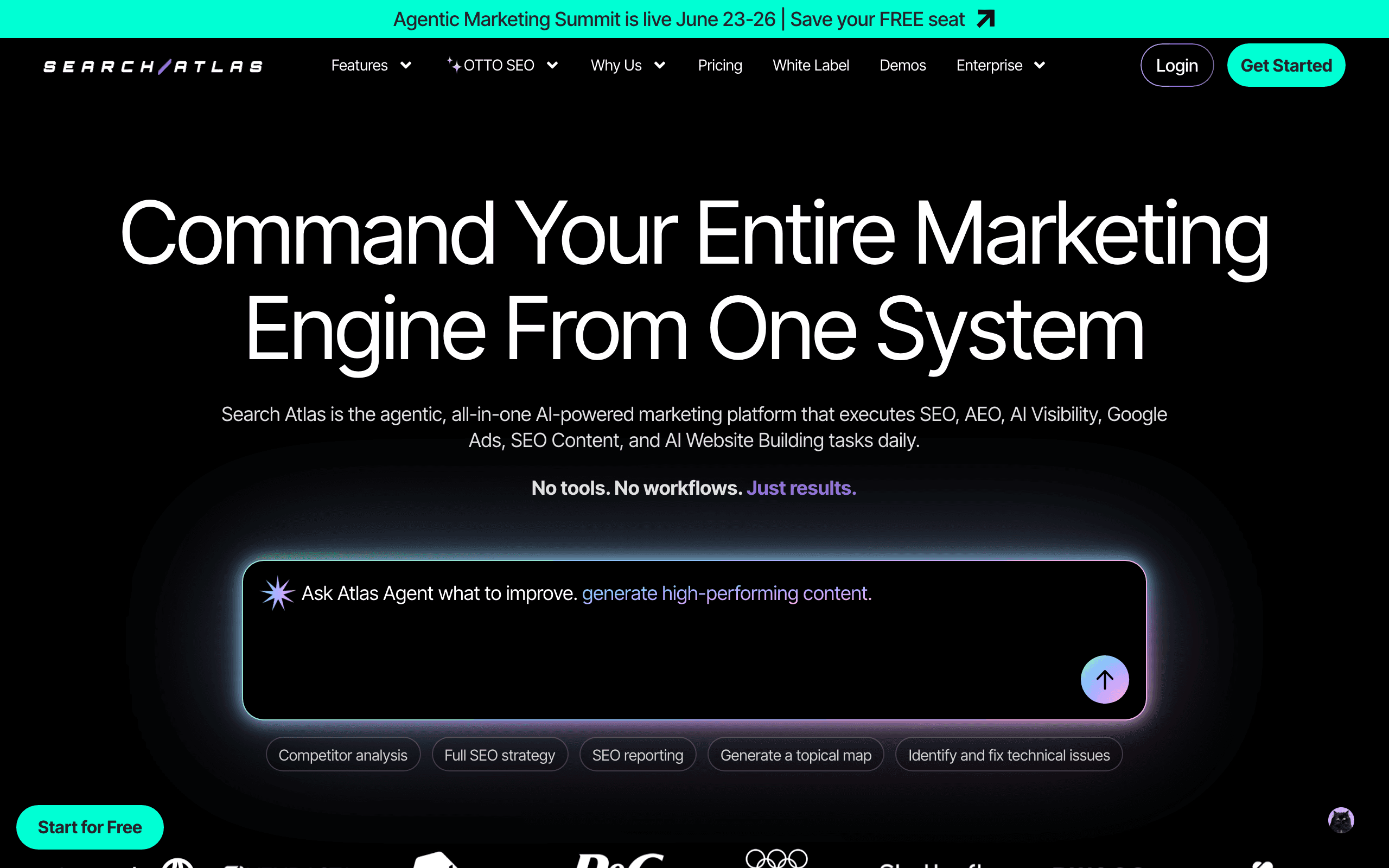
Search Atlas describes itself as an agentic, all-in-one AI marketing platform that executes SEO, answer engine optimisation, AI visibility, Google Ads, content and website-building tasks. Rather than a research tool you act on manually, it positions itself as a platform that does the work for you. Pricing on the official site runs from a Starter plan at $99 per month, through Growth at $199 and Pro at $399, up to an Agency tier at $999 per month, with a seven-day free trial, free onboarding and a discount on annual billing (Search Atlas pricing).
The centrepiece is OTTO SEO, marketed as an AI autopilot agent. You install a lightweight JavaScript pixel, OTTO scans for issues, and it can deploy approved changes to metadata, schema markup, internal links and on-page content through that layer rather than in your source files. Around it sit several modules: Content Genius for semantic editing and AI writing, OTTO Google Ads for paid campaigns, GBP Galactic for Google Business Profile automation, an Atlas Agent conversational interface, and a Website Studio for page generation. For a small agency that wants research, content and technical execution under one login, the breadth is real, and the white-label reporting at the Pro tier is a sensible fit for client work.
Where Search Atlas falls short
The all-in-one model has trade-offs, and independent reviews are worth reading before you commit. A neutral review by eesel AI documents users who hit technical problems after deploying the OTTO pixel, including a broken sitemap, slower load times and de-indexed pages that directly affected rankings (eesel AI review). Because changes are injected through a layer on top of your site rather than written into source, when something breaks the cause is harder to trace and you are reliant on the platform staying healthy. The practical mitigation is straightforward: test OTTO on a staging site first, start with low-risk changes, and keep the rollback within reach.
The breadth cuts both ways elsewhere too. Features such as Authority Builder and Cloud Stacks involve acquiring backlinks and generating linking content on cloud platforms, tactics that sit uncomfortably against Google's link spam guidance, so white-hat teams may prefer to leave them off. Reviewers also describe a steep learning curve, because the same surface area that makes the platform powerful makes it dense for newcomers. None of this makes Search Atlas a poor product. It means the platform suits teams who want execution-heavy automation and will supervise it closely, not buyers who want a single narrow job done cleanly and kept in their own stack.
The 7 best Search Atlas alternatives in 2026
Before comparing tools, separate the jobs. Search Atlas attempts everything, which is exactly why a focused alternative can beat it on any single discipline. Most teams are really buying for one of three needs: traditional SEO research and rank tracking, content optimisation, or AI visibility monitoring. The third is the newest and the one most SEO suites handle weakly, because it is a different measurement problem.
Each tool below is ranked by how decisively it beats Search Atlas at one of the three jobs, with entry pricing verified against the vendor's public pricing page. Prices change often, so confirm before buying.
1. Honeyb: best for AI visibility monitoring and action
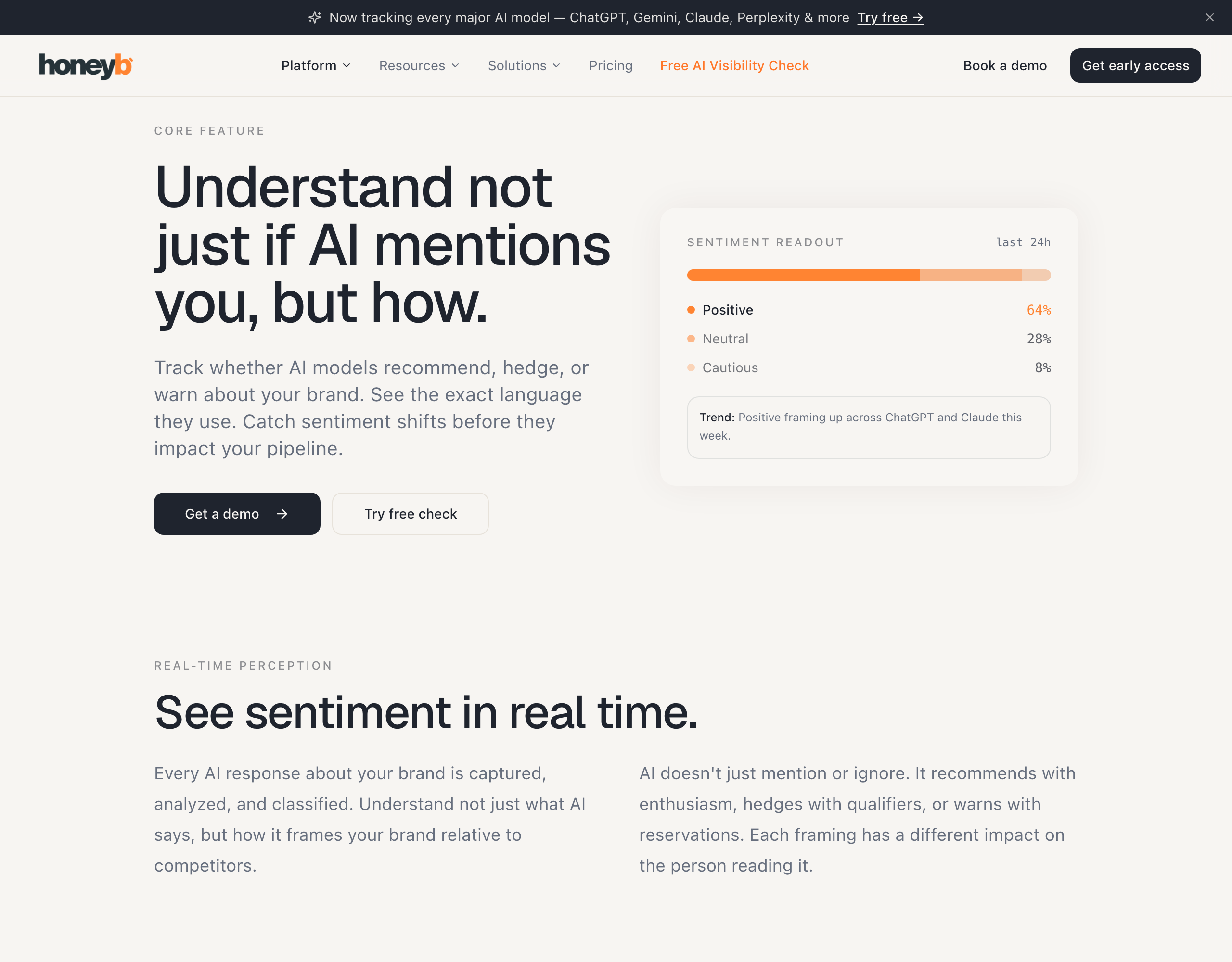
Disclosure: Honeyb is our product, so weigh this entry accordingly. It leads this list because AI visibility is the job where the gap to Search Atlas is widest, and the job growing fastest. AI answer engines do not return ten blue links. They synthesise an answer and cite a small handful of sources, typically two to seven domains per response, and research shows they favour earned third-party authority over self-promotional content on your own site (Search Engine Land). The question stops being where you rank and becomes whether ChatGPT, Perplexity, Gemini, Claude, Copilot and Google AI Mode mention you at all, which competitors they name instead, and whether the description is accurate. Understanding how AI models choose which brands to recommend is the new strategic layer.
Honeyb runs scheduled scans across the major AI engines rather than one-off spot checks, tracks how often your brand is mentioned and cited, measures share of voice against named competitors, and analyses sentiment. Then it acts on what it finds: it checks whether AI crawlers can reach your site, returns recommendations with the evidence attached, and writes the content those recommendations call for. Search Atlas touches this job with its LLM Visibility module, but full coverage of ChatGPT, Gemini, Google AI Mode, Copilot and Perplexity sits at the Pro tier at $399 per month (Search Atlas pricing). Honeyb starts at $29 per month, and the free AI visibility checker shows where your brand stands before you spend anything.
2. Semrush: best all-round SEO research suite
If your core need is research and rank tracking, Semrush remains a benchmark for raw data depth, with a mature keyword and backlink index and AI-assisted features added without abandoning the research workflows its users rely on. Entry pricing starts at $139 per month billed monthly, or $117.33 per month on annual billing (semrush.com/pricing, checked 5 August 2026). Crucially, there is no Search Atlas-style pixel automation, which is the point: changes stay in your hands and in your CMS, so the failure modes that worried OTTO reviewers simply do not exist.

Want to get recommended by AI?
Check your AI search visibility, then let the Honeyb agent write, fix, and earn what gets you recommended. Free to start.
3. Ahrefs: best backlink data
Ahrefs holds one of the largest live backlink indexes in the industry, and for link-led SEO work its Site Explorer remains the reference tool. Entry plans start around $29 per month for the Starter tier, with full plans above that. Like Semrush, it is a research tool you act on manually: no pixel, no injected changes, no automation layer to supervise.
4. SE Ranking: best suite value for small agencies
SE Ranking sits a tier down on price, from around $65 per month, with solid rank tracking and audits, and is a common pick for smaller agencies that want suite-grade data without an enterprise bill. It has also begun adding AI-search modules of its own. Always confirm what those AI features actually measure, because reporting that a brand appears in an answer is not the same as tracking citations, share of voice and sentiment across engines on a schedule. If you want to weigh that option directly, see our Honeyb vs SE Ranking comparison.
5. Surfer SEO: best on-page content scoring
When the job is producing pages that rank and read well, focused content tools beat all-in-one platforms on quality of guidance. Surfer SEO's on-page scoring remains a widely trusted benchmark for matching content to intent, with entry plans from around $89 per month. It does not handle technical execution or backlinks, so it is usually paired with a suite, and for teams whose bottleneck is content, that focus is a feature rather than a gap.
6. Clearscope: best editorial content grading
Clearscope, from roughly $129 per month, is known for clean, defensible content grading that editors find easy to work to, with seat allowances that suit larger content teams. It is the strongest pick when the constraint is editorial quality at scale rather than research or technical work.
7. Frase: best budget content workflow
Frase is the cheapest of the content tools, building research, outlining and drafting into one workflow from around $45 per month. It gives smaller teams a structured content process without a suite-level bill, and pairs well with a dedicated monitor for the AI answer side of the job.
Monthly searches (US)
Search demand for AI optimisation terms (US)
Search Atlas competitors, mapped to the three jobs
Stepping back from individual tools, the Search Atlas competitors above split cleanly by measurement problem. Suites (Semrush, Ahrefs, SE Ranking) measure classic rankings. Content tools (Surfer, Clearscope, Frase) grade what you write. AI visibility monitors (Honeyb, and enterprise options like Profound or Peec AI, compared in our comparison of AI visibility tools) measure how answer engines describe you. Gartner predicted that traditional search engine volume would fall 25% by 2026 as users shift to AI chatbots and other virtual agents (Gartner), which is why the third category is the one most worth pricing into your stack now, and why spot-checking a chatbot once will not tell you what you need to know.
The same distinction applies when teams replace a paid-search monitoring tool, which is the thread our guide to The Search Monitor alternatives follows as it weighs compliance tools against dedicated AI visibility monitors.
How to choose between Search Atlas and the alternatives
The decision comes down to which job dominates your time and budget. If you want one platform to research, write and automatically apply on-page changes, and you will supervise that automation closely, Search Atlas is a credible all-in-one option. If your real bottleneck is a single discipline, a focused tool will usually do that one job better and at lower risk.
- Choose a suite (Semrush, Ahrefs, SE Ranking) if research depth and rank tracking matter most and you control your own implementation.
- Choose a content tool (Surfer, Clearscope, Frase) if your constraint is producing high-quality, well-structured pages.
- Choose an AI visibility monitor (Honeyb, Profound, Peec AI) if you need to know how AI answer engines mention, cite and describe your brand over time.
- Choose Search Atlas if you genuinely want broad automation in one place and have the time to manage it.
Many teams end up running two complementary tools rather than one that claims to do everything: a research or content tool for the classic search job, and a dedicated monitor for the AI answer job. That pairing often costs less than a top all-in-one tier and gives clearer signal on each front. The honest position is that no single platform leads every category at once, so the strongest setup is the one matched to the work in front of you.
Whichever direction you choose, start by separating the jobs, then test each candidate against the one that matters most. A tool that wins your primary job and integrates cleanly with the rest of your stack will almost always beat a broader platform that does your priority job adequately and everything else as a bonus.
Sources cited in this report