
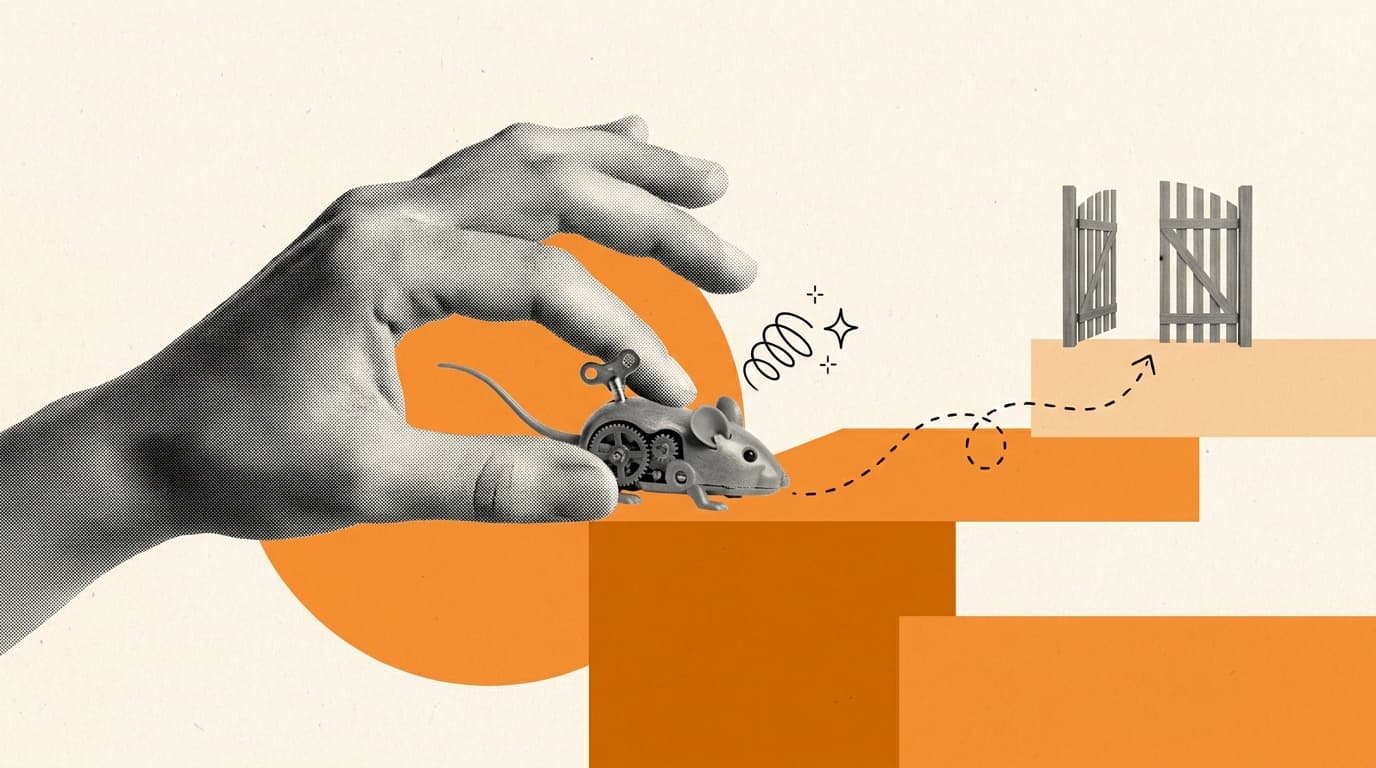
"Agentic AI" is the term of the year, and most explanations of it are either breathless or impenetrable. So here is the plain-English version. Agentic AI is software that does, not just says. A chatbot answers your question and stops. An agent takes a goal, breaks it into steps, calls real tools to carry those steps out, checks what happened, and keeps going until the job is done. The shift from generating text to taking action is the whole story, and it is why 2026 feels different from the two years of chatbot hype that preceded it. This guide defines agentic AI in one line, shows how it differs from the generative AI you already use, walks through how it actually works, and is honest about where it still breaks.
What "agentic" actually means
The cleanest working definition comes from MIT Sloan, which describes agentic AI as autonomous software systems that perceive, reason, and act in digital environments to achieve goals, including using tools and carrying out transactions (MIT Sloan). The agentic AI meaning hinges on autonomy and goal-direction. You give the system an objective rather than a single instruction, and it figures out the sequence of actions needed to reach it. IBM frames the contrast sharply: where generative AI produces content based on a prompt, agentic AI independently plans and executes multi-step tasks to achieve a defined outcome (IBM). The word to anchor on is "do." Generative models are extraordinary at producing language, images, and code, but they wait for you at every turn. An agent does not wait. It decides what to do next, acts in the world, and only comes back to you when it needs a decision or has finished.
Agentic AI vs generative AI vs chatbots
The easiest way to hold the distinction in your head is a three-rung ladder. The bottom rung is the chatbot: you ask, it answers, the conversation resets, and nothing happens in the outside world. The middle rung is the copilot or assistant, which helps with a task you are still driving, drafting an email or suggesting code that you then accept or reject. The top rung is the agent, which pursues a goal across many steps and tools with you supervising rather than steering. Thomson Reuters draws the same line, noting that generative AI reacts to prompts while agentic AI sets objectives and acts toward them with limited human oversight per step (Thomson Reuters). The same large language model can sit underneath all three rungs. What changes is the wrapper around it: whether it can plan, remember, and reach out to tools. If you want a refresher on the models doing the heavy lifting underneath, our piece on generative AI models explained covers the engine; this guide is about what gets built on top of it.
| Trait | Chatbot | Generative AI assistant | Agentic AI |
|---|---|---|---|
| Autonomy | None | Low | High |
| What it does | Answers questions | Creates content on request | Pursues a goal and acts |
| Tool use | No | Limited | Core to how it works |
| Multi-step work | No | Sometimes | Yes, that is the point |
| Human role | Drives every turn | Drives the task | Sets the goal, supervises |
| 2026 example | Basic FAQ bot | Copilot drafting a doc | ChatGPT agent, Claude Cowork |
How agentic AI works, step by step
Under the hood, an agent runs a loop. It perceives the current state of its environment, reasons about what to do, plans a step, acts by calling a tool, observes the result, and repeats until the goal is met or it gets stuck. Oracle describes this perceive-reason-act cycle as the core runtime behind autonomous AI systems (Oracle). The architecture is usually four pieces: a language model for reasoning, memory to track what has happened, a planning component to sequence steps, and tool access so the model can do something beyond talk. The most influential pattern for wiring this together is ReAct, which interleaves reasoning and action so the model thinks, acts, sees the result, and thinks again, rather than planning everything up front (MindStudio). The tools are what make it real. An agent that can call APIs, read and write files, drive a browser, or run code can change things in the world, which is exactly what separates it from a chatbot that can only describe what it would do.
What agentic AI looks like in 2026
The examples are no longer hypothetical. OpenAI launched Operator, a browser-controlling agent, in January 2025, and has since folded that capability into the ChatGPT agent that can navigate sites and complete tasks on a user's behalf (OpenAI). Anthropic shipped computer use with Claude 3.5 Sonnet on 22 October 2024, giving the model a vision-and-action loop that lets it look at a screen, move a cursor, and type (Anthropic)), and brought a goal-driven agent that works across local files, apps, and the browser to general availability as Claude Cowork on 9 April 2026. On the enterprise side, Salesforce reported its Agentforce agent platform reaching roughly $800M in annual recurring revenue by the close of its 2026 fiscal year, with thousands of paying customers, a sign that this is moving from demo to deployment. Gartner expects 40% of enterprise applications to embed task-specific AI agents by the end of 2026, up from less than 5% in 2025 (Gartner).

Want to get recommended by AI?
Check your AI search visibility, then let the Honeyb agent write, fix, and earn what gets you recommended. Free to start.
When agents start buying: agentic commerce
The most consequential thing about agents in 2026 is that they have started to buy, not just browse. The payment rails went live this year. Mastercard launched Agent Pay for Machines in June 2026 (Mastercard), Visa rolled out Intelligent Commerce (Visa), and Stripe shipped shared payment tokens alongside the Agentic Commerce Protocol that lets an agent complete a purchase on a buyer's behalf (Stripe). IBM reports that 45% of consumers now use AI for part of the buying journey, and McKinsey estimates agent-influenced commerce could touch $1T in US retail revenue by 2030. We unpack the mechanics in what is agentic commerce and the technical plumbing in agentic commerce protocols, and the live example most people have already met is covered in ChatGPT shopping. When an agent does the choosing and the paying, the question for a brand stops being whether it ranks and becomes whether the agent picks it, which is something you can only know if you measure it across engines.
The honest risks
The agentic story is genuinely useful and genuinely overhyped at the same time, and the honest version includes the failures. Gartner predicts that more than 40% of agentic AI projects will be cancelled by the end of 2027, citing unclear value, rising costs, and weak risk controls, and its 2026 CIO survey found only 17% of organisations have actually deployed AI agents even as a majority plan to within two years (Gartner). IDC reports that 88% of AI proofs of concept never reach wide deployment, a sober counterweight to the demo videos. The deeper concern is that agents act in the real world, so a mistake is not a bad sentence but a wrong action with no human review step in between, a risk flagged in the International AI Safety Report 2026 (arXiv). Security researchers have started to formalise the new attack surface: the OWASP Top 10 for Agentic Applications now catalogues failure modes like goal hijacking, tool misuse, identity abuse, memory poisoning, and cascading failures where one agent's error propagates to others. None of this means agents do not work. It means treating their autonomy as a property to be supervised, not trusted by default.
What it means for brands
For anyone responsible for how a brand shows up, agentic AI changes the shape of the problem. Search optimisation was about being found by a person who would then click and decide. Increasingly the decision-maker is an agent acting for that person, comparing options, reading reviews, and in the commerce case completing the purchase. We dig into the selection logic in how AI shopping agents choose products, but the headline is simple: the agent's choice is invisible to you unless you measure it. Asking one chatbot once and seeing your brand named tells you almost nothing, because answers vary by engine, by phrasing, and by the day. Tracking whether AI consistently picks you when it recommends and now when it acts is precisely the gap Honeyb exists to close. Agentic AI is not a buzzword with nothing underneath. It is a real shift from systems that describe the world to systems that change it, and the brands that treat being chosen by an agent as a measurable outcome will be the ones that understand what is happening to their visibility before their competitors do.
Sources cited in this report