Ahrefs Brand Radar is worth paying for if you already run Ahrefs and want a map of how AI answers your market: the AI Visibility Index costs $199 a month per platform, or $699 a month for all of them, and searches more than 470 million prompts modelled on real Google searches. It is a weaker buy as a daily tracker, because Ahrefs' own help centre says the AI chatbot data refreshes once a month and three-quarters of the index is Google's AI Overviews and AI Mode.
Ahrefs spent a decade building one of the largest link and keyword indexes on the web, and Brand Radar points that index at a new question: how often does a brand show up when someone asks an AI, and who shows up instead. This review covers what Brand Radar measures, how its data is collected, every current price, what reviewers say, and whether an SEO-suite add-on is the right home for AI visibility work in 2026.
A quick disclosure before we start. Honeyb builds an AI visibility tool, so Ahrefs is a competitor to us. We have tried to weigh Brand Radar on its merits, cite Ahrefs' own pages for every feature and price, and flag where a general roundup would serve you better. For the wider market, see our best AI visibility tools guide and our AI visibility software pricing breakdown.
What Ahrefs Brand Radar is
Brand Radar is Ahrefs' AI visibility module. It tracks how often a brand is mentioned or cited inside AI answers, calculates an AI Share of Voice figure, and benchmarks that against competitors in the same category. Per the Brand Radar page, it also extends beyond chat answers into YouTube, TikTok and Reddit-in-Google surfaces, which is a deliberate nod to where AI systems pull their sources from.
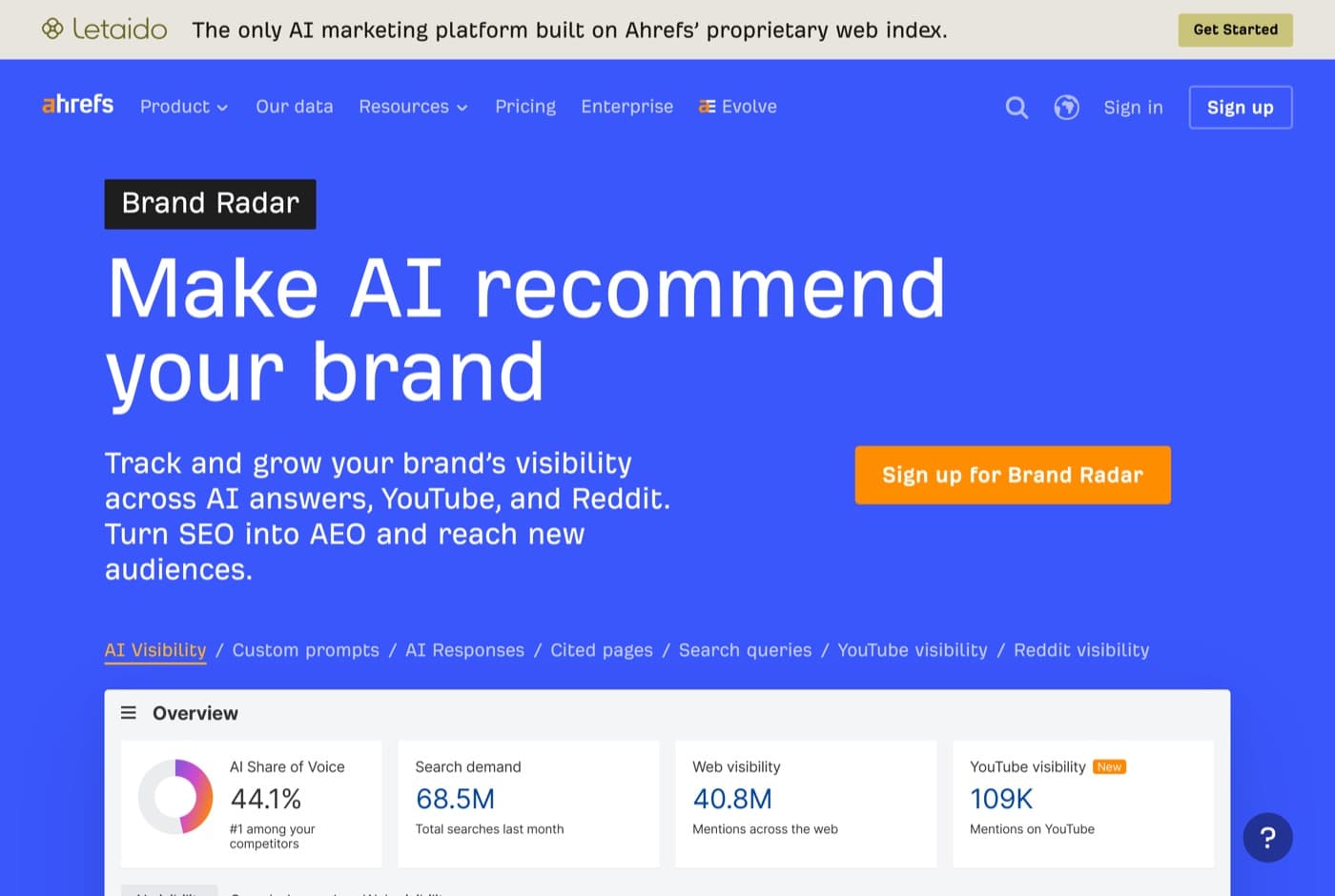
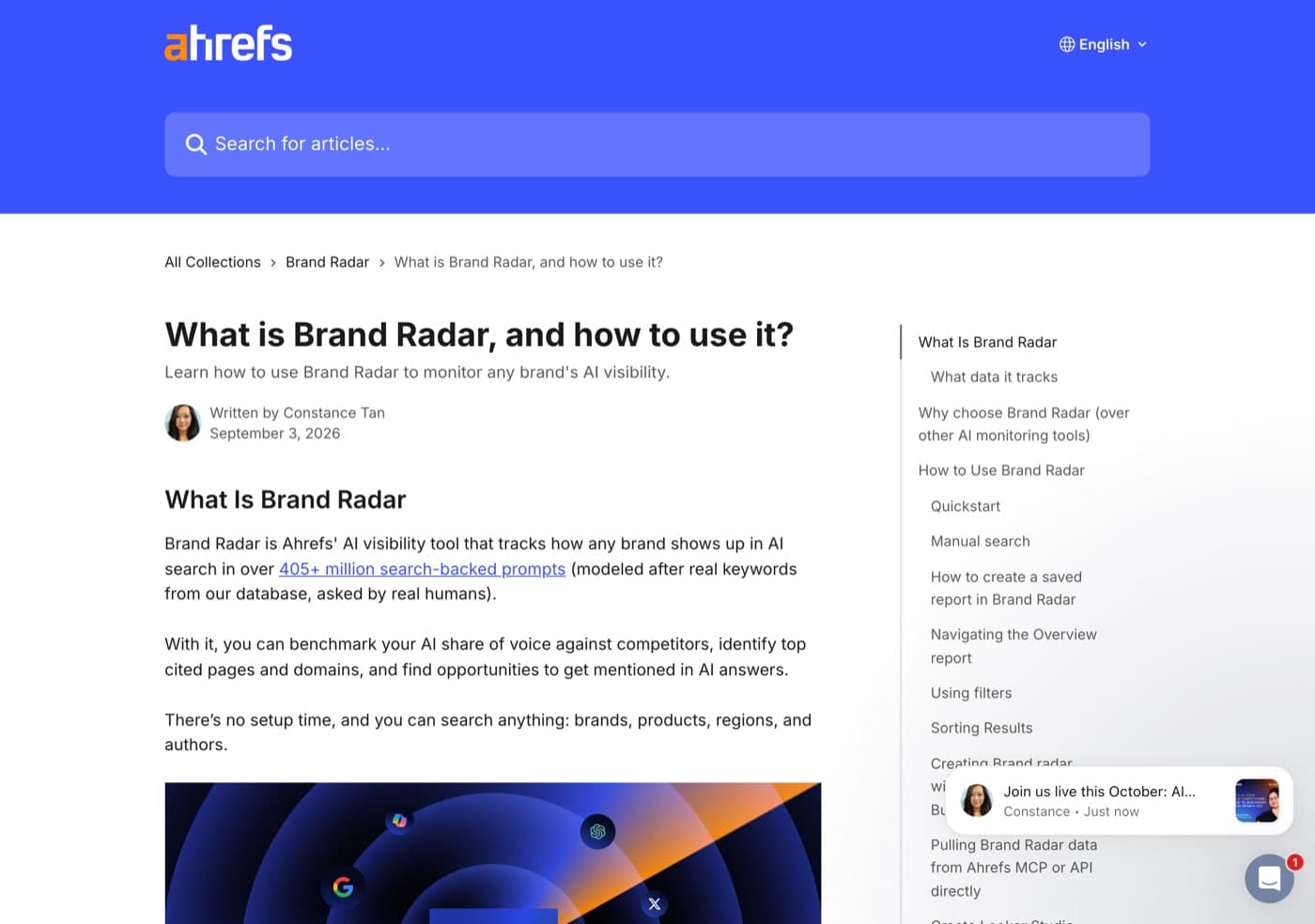
It comes in two parts that are easy to confuse. The AI Visibility Index is a pre-built database: type any brand, product or category and see how it appears across millions of AI answers Ahrefs has already collected, with history back to 2025 and no setup. Custom Prompts are the questions you choose, run on the platforms you pick, as often as daily. Per Ahrefs' help centre, the core metrics are mentions, citations, AI Share of Voice and impressions, the last weighted by the real search volume behind each prompt.
How Brand Radar collects its data
The data does not come from a handful of hand-typed prompts. Per the Brand Radar page, Ahrefs takes real queries from its keyword database, expands them into natural questions through People Also Ask and semantic fan-out, runs them through each AI platform and stores the responses. A second kind of index, for AI Overviews and AI Mode only, tracks the Google searches that trigger an AI answer and whether your brand appears in it.
The pitch is that visibility is measured against what people actually search, and that is a genuine methodological edge. The catch is in the split. On 10 October 2026 the index held 470,956,758 prompts, and 353,659,019 of them, or 75 percent, were Google's AI Overviews and AI Mode. ChatGPT accounted for 29 million, about 6 percent, level with Perplexity, Copilot and Gemini.
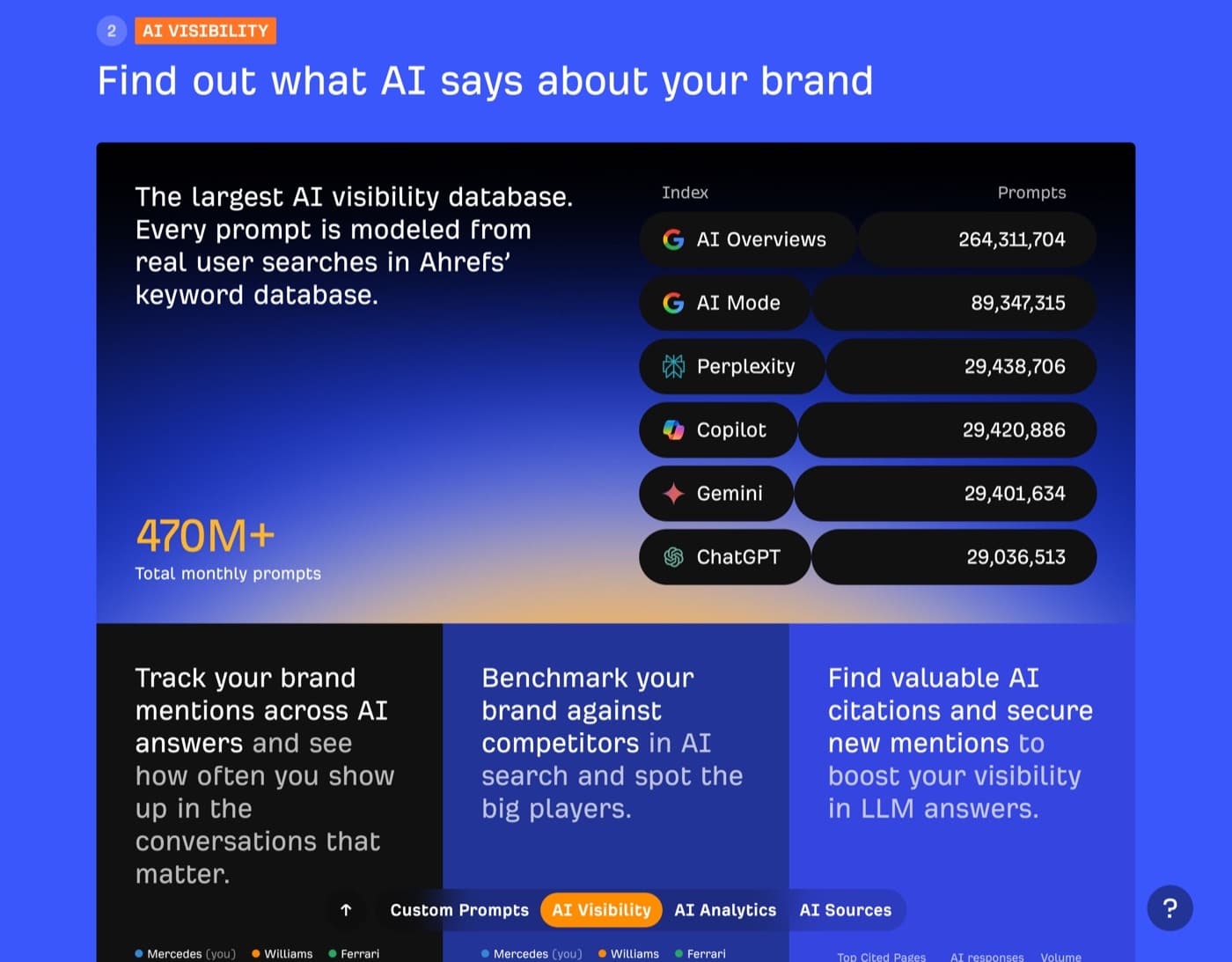
| Index | Prompts (10 Oct 2026) | Share of the index |
|---|---|---|
| Google AI Overviews | 264,311,704 | 56% |
| Google AI Mode | 89,347,315 | 19% |
| Perplexity | 29,438,706 | 6% |
| Microsoft Copilot | 29,420,886 | 6% |
| Gemini | 29,401,634 | 6% |
| ChatGPT | 29,036,513 | 6% |
| Total | 470,956,758 | 100% |
That skew follows from the method. Prompts seeded from Google searches map most naturally onto Google's own AI answers, so a brand that sells to people who research in ChatGPT is reading the thinnest slice of the index. Ahrefs' figures also move quickly: its help article quotes 405 million prompts, its Brand Radar pricing card quoted 462 million on 8 October, and the page quoted 470 million two days later.
Freshness is the second thing to know. Ahrefs' help centre lists the refresh rates plainly.
| Brand Radar data | Refresh, per Ahrefs' help centre |
|---|---|
| Web visibility (mentions across the web) | Every few minutes |
| Search demand | Every few days |
| AI Overviews | Every few days |
| AI chatbots (ChatGPT, Perplexity, Gemini, Copilot) | Once a month |
| Custom prompts | Your choice, from monthly to daily |
The Brand Radar page adds that question sets are re-tested monthly on a 90-day reporting window. For a market map that is fine, because categories do not reorder themselves overnight. For catching a bad ChatGPT answer the week you launch, the index is the wrong instrument, and custom prompts are the part of Brand Radar built for that job.
Who it is for
Brand Radar is aimed squarely at teams that already live inside Ahrefs. If you run keyword research, backlink audits and rank tracking in the tool every week, adding AI share of voice next to those reports is a low-friction way to start measuring the new surface. Agencies reporting to clients get an extra chart in a place clients already recognise.
It is a weaker fit if you do not use Ahrefs for SEO, or if AI visibility is the whole job rather than a line item. A dedicated platform will go deeper on prompt-level detail, sentiment and daily monitoring. If you are still scoping the category, start with how to monitor AI brand mentions and how to measure AI share of voice before committing to any single vendor.
The timing argument is real regardless of tool. The brand an engine names first changes between identical runs far more often than most teams assume, as our own measurement below shows, which is exactly why measurement stopped being optional.
Top-pick change rate
How often the top recommendation changes between identical runs
| Item | Top-pick change rate |
|---|---|
| Gemini | 44.1% |
| Perplexity | 42.5% |
| ChatGPT | 35% |
| Claude | 27.5% |
Ahrefs Brand Radar pricing
Ahrefs prices by region, so a European browser is shown euros. The figures below are the US-dollar prices Ahrefs served to US visitors, read from the archived US copies of its pricing and Brand Radar pages from 8 and 9 October 2026; the live pages we checked on 10 October carried the same structure, and the help centre states its Brand Radar prices in US dollars.
Brand Radar is sold three ways. The AI Visibility Index costs $199 a month per platform, or $699 a month for all models, and the help centre says the all-platform tier includes 2,500 custom prompt checks a month. Custom Prompts can be bought on their own as packages. And every paid Ahrefs plan from Lite up includes a small allowance of custom prompts at no extra cost.
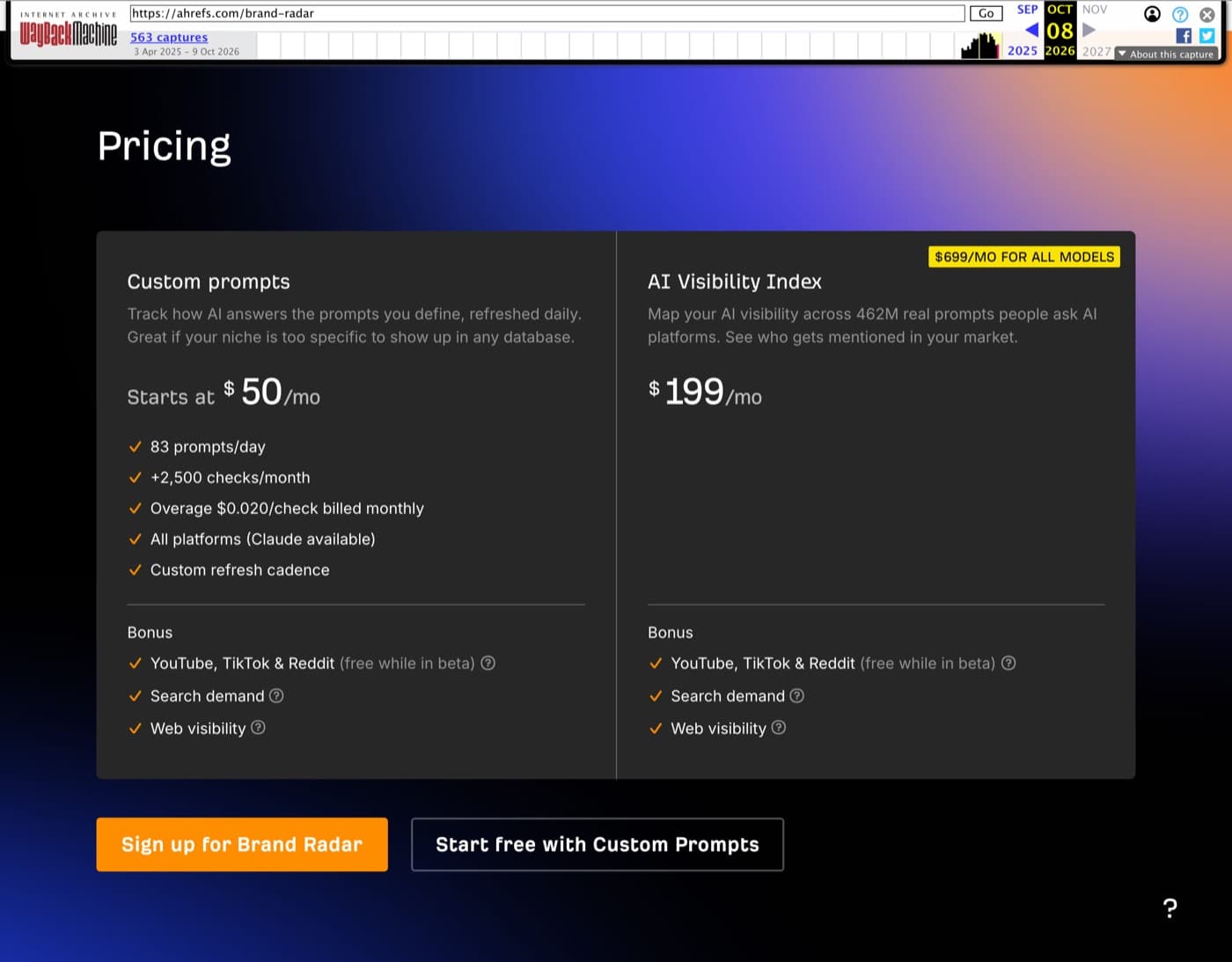
A check is one prompt, run once, on one platform, in one location, so the arithmetic is simple: 83 prompts a day on one platform uses about 2,500 checks a month. The exception is Claude, which the Brand Radar page says consumes eight checks per update, so 10 prompts tracked daily on Claude alone would use about 2,400 checks, nearly the whole Basic package.
| What you buy | Price (US dollars, monthly) | What it includes |
|---|---|---|
| AI Visibility Index, one platform | $199 | The pre-built index for one AI platform, history back to 2025 |
| AI Visibility Index, all models | $699 | All platforms, plus 2,500 custom prompt checks a month |
| Custom prompts: Basic | $50 | 2,500 checks (about 83 prompts a day on one platform); overage $0.020 a check |
| Custom prompts: Growth | $100 | 7,000 checks; overage $0.015 a check |
| Custom prompts: Scale | $250 | 25,000 checks; overage $0.010 a check |
| YouTube, TikTok and Reddit indexes | Free while in beta | On any paid Ahrefs plan |
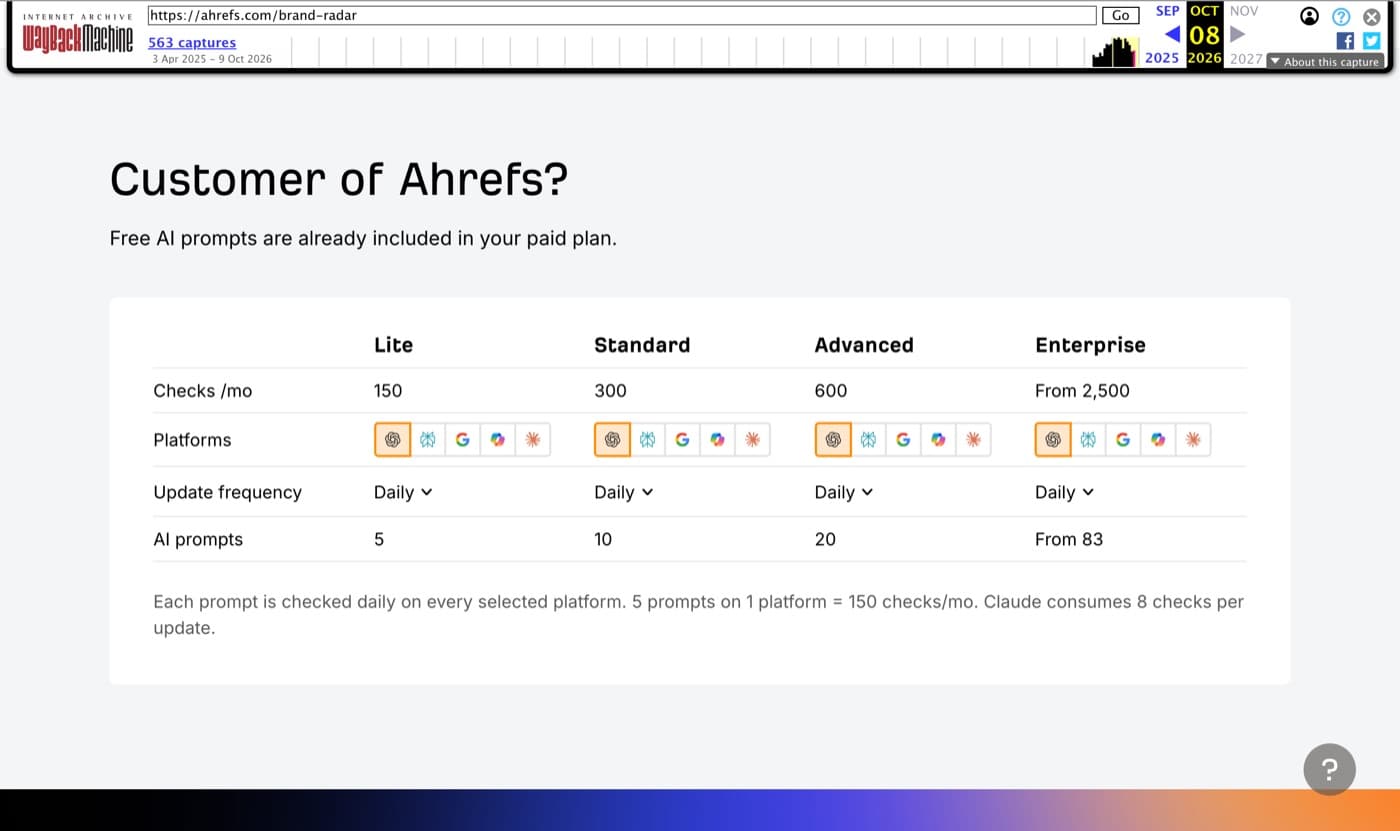
The included allowances are smaller than the headline suggests, though they are free.
| Ahrefs plan | Price (monthly) | AI prompts tracked daily | Checks a month |
|---|---|---|---|
| Lite | $129 | 5 | 150 |
| Standard | $249 | 10 | 300 |
| Advanced | $449 | 20 | 600 |
| Enterprise | $1,499 (annual commitment) | From 83 | From 2,500 |
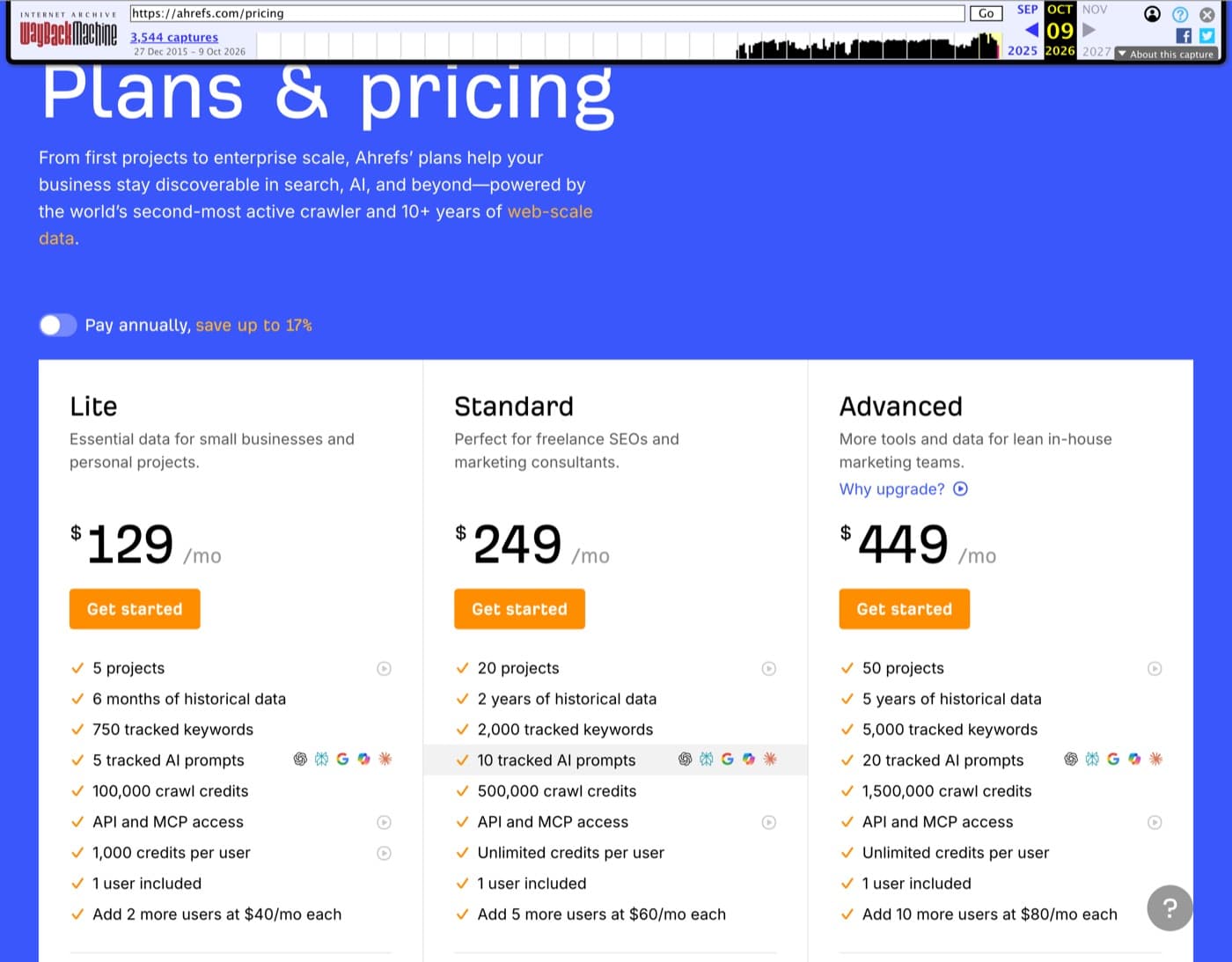
Two caveats on cost. First, the help centre says the AI indexes require the Brand Radar AI add-on, search demand requires the Starter plan ($29 a month) or above and web visibility requires Standard or above, while Ahrefs sells custom prompt packages to people who only need prompts. Neither page prints a single bundled price for the index plus a base plan, so confirm what your account needs at checkout. Second, annual billing saves up to 17 percent on the core plans, and prices change, so check the pricing page before you budget.

Want to get recommended by AI?
Check your AI search visibility, then let the Honeyb agent write, fix, and earn what gets you recommended. Free to start.
Is Ahrefs Brand Radar free?
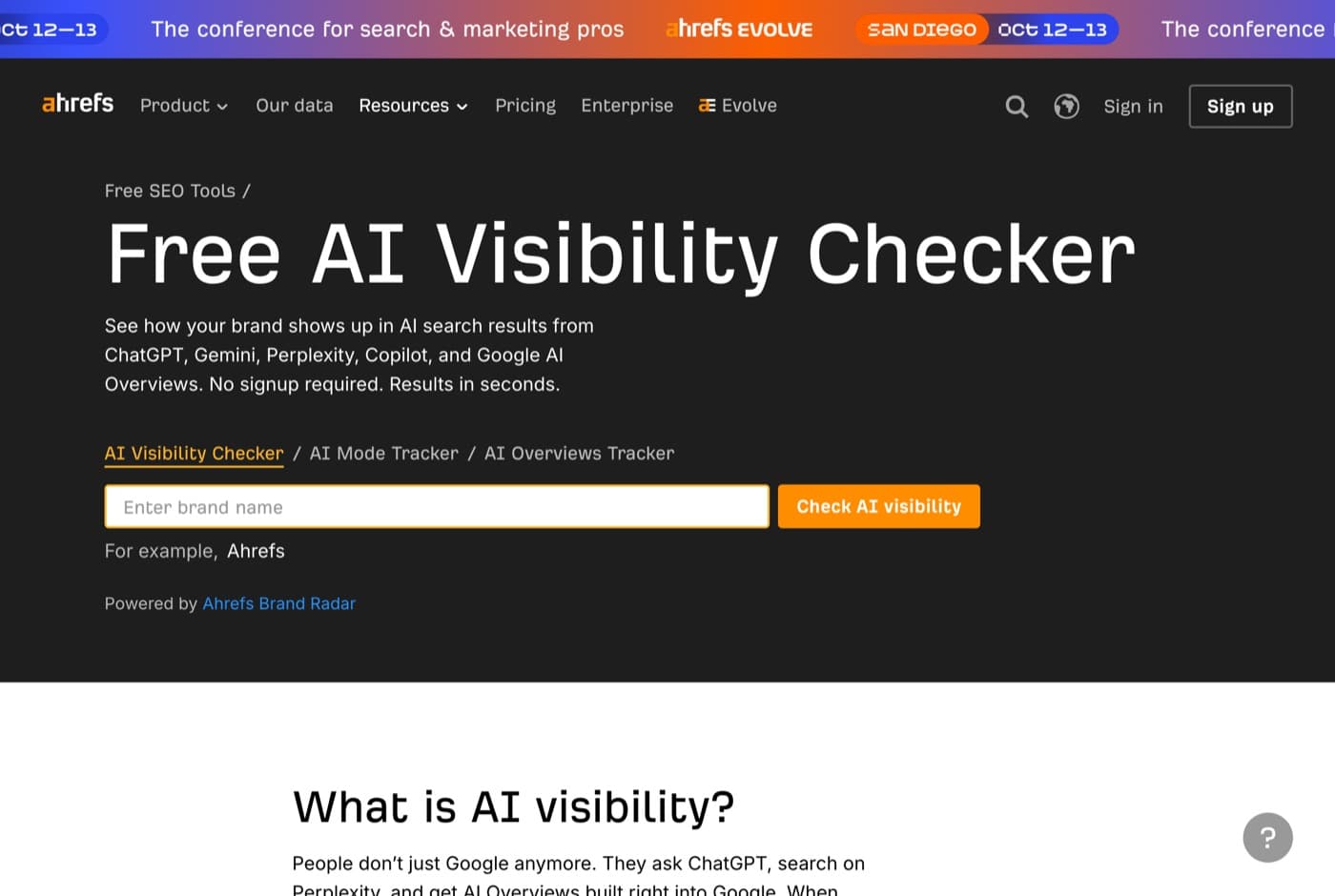
Partly. The free AI Visibility Checker needs no signup and shows how a brand appears in ChatGPT, Gemini, Perplexity, Copilot and Google AI Overviews, powered by Brand Radar's data. Paid Ahrefs plans include 5 to 20 custom prompts at no extra charge, and the YouTube, TikTok and Reddit indexes are free while in beta. The AI Visibility Index itself is paid, and we found no free trial on the Brand Radar or pricing pages.
Features
The core metrics are AI Mentions, AI Citations and AI Share of Voice. On top of those, Brand Radar leans on assets Ahrefs already owns: the keyword database for prompt seeding, and the web index for the source-discovery view that tells you which pages are being cited in answers. That last point aligns with Ahrefs' own published finding that AI visibility correlates most with third-party mentions and video rather than on-page work (Ahrefs), which is convenient given the tool surfaces exactly those signals.
| Capability | In Brand Radar | Detail |
|---|---|---|
| AI Share of Voice | Yes | Brand vs competitor visibility across supported AI answers (per Ahrefs' Brand Radar page) |
| Index platforms | Yes | AI Overviews, AI Mode, ChatGPT, Perplexity, Copilot, Gemini (per the Brand Radar page, 10 Oct 2026) |
| Anthropic Claude | Custom prompts only | "Claude available" on custom prompts at 8 checks per update; not in the pre-built index |
| Grok | Unclear | Listed in the help centre; absent from the Brand Radar page's index table |
| Citation and source discovery | Yes | Pages and domains cited in AI answers, built on the Ahrefs web index |
| Custom prompts | Yes | 5 to 20 daily on Lite to Advanced; packages from $50 for 2,500 checks |
| YouTube, TikTok, Reddit | Yes | Video and social surfaces, free while in beta |
| Sentiment analysis | Via an add-on skill | An "AI Brand Sentiment" skill is offered through Letaido, Ahrefs' separate AI platform; Brand Radar's own metrics are mentions, citations and share of voice |
What reviewers say
Review sites rate Ahrefs as a whole, and Brand Radar is too new to have its own review base, so these are a verdict on the company and suite you would be buying into. All three were read on 10 October 2026.
| Review site | Rating | Reviews and ratings | Sub-scores shown |
|---|---|---|---|
| G2 | 4.5 out of 5 | 717 | None on the summary |
| Capterra | 4.7 out of 5 | 585 | Ease of use 4.5, customer service 4.5 |
| TrustRadius | 8.8 out of 10 | 403 | None on the summary |
Ahrefs edges Semrush on all three sites (Semrush scores 4.4 on G2, 4.6 on Capterra and 8.5 on TrustRadius), on far fewer reviews. For Brand Radar specifically, the more useful evidence comes from hands-on tests, and the best known is unflattering. In a published test by Writesonic, the index reported three ChatGPT mentions for a brand that manual checking found 123 times, and six Perplexity mentions against an actual 212, while its AI Overviews count of 106 was close to reality.
That result fits the index split above: Google's surfaces are where the prompt pool is deepest, and the chatbots are where it is thinnest and refreshed least often. Writesonic sells a competing tool, as do we, so treat the exact figures with care, but the direction is consistent with Ahrefs' own numbers. Profound's review, from another competitor, reaches a similar conclusion about monthly chatbot data and the weight on AI Overviews.
Strengths
The index is the headline strength. Seeding prompts from real search data rather than a synthetic list is a genuine methodological edge, and very few competitors can match it. For a team that needs to see a whole category at once, including competitors it has never tracked, 470 million prompts with history back to 2025 is a real asset with real infrastructure behind it.
Coverage of YouTube and social sources is smarter than it first looks. Reddit was the most-cited domain in Semrush's June 2025 study of about 150,000 AI citations, and video is one of the two signals Ahrefs itself ties to AI visibility. A tool that watches those surfaces is watching where the citations are formed as well as the final answer.
The last strength is workflow and price for existing customers. If Ahrefs is already your reporting home, Brand Radar removes a separate login, invoice and export, and the included custom prompts mean an Ahrefs Lite customer can start tracking five questions daily without paying another cent.
Weaknesses
The first gap is freshness on the chatbots. Monthly refreshes for ChatGPT, Perplexity, Gemini and Copilot in the index mean the number you present today may describe answers from several weeks ago. Custom prompts fix this, at the cost of building and paying for your own prompt set.
The second is Claude. Brand Radar now offers Claude on custom prompts, but each Claude update costs eight checks and Claude is absent from the pre-built index. Claude is one of the engines that expose their citations consistently, alongside Perplexity, which ships a numbered source list with every answer, so missing it in the index is a real blind spot for citation work.
The third is sentiment. Brand Radar's own metrics are mentions, citations and share of voice; tone scoring arrives through a skill on Letaido, a separate Ahrefs product. Getting named is different from getting recommended, especially when 62% of AI citations never name the brand behind them (Semrush). If you need to know whether AI describes you well or badly, look at AI sentiment tracking platforms before assuming a visibility score covers it.
The fourth is volatility, which is a category problem Brand Radar inherits rather than causes. Two identical runs of the same question return the same brand list less than once in 100 tries (SparkToro). Sources shift fast too: Reddit's presence in ChatGPT answers fell from close to 60% of responses in early August 2025 to about 10% by mid-September (Semrush). A monthly snapshot of a surface that moves this fast needs to be read as a trend line.
Ahrefs Brand Radar vs Profound
The two are often compared because they sit at opposite ends of the same question. Brand Radar starts from a huge search-derived index and lets you add prompts; Profound starts from your prompts and goes deep on each engine. Per Profound's pricing page on 10 October 2026, Profound offers a 7-day free trial tracking 50 prompts on ChatGPT, Gemini and Google AI Overviews, and custom Enterprise pricing for up to nine engines, Claude, Copilot, DeepSeek and Perplexity among them.
| Ahrefs Brand Radar | Profound | |
|---|---|---|
| Starting price | $199 a month per index; custom prompts from $50 | Free 7-day trial, then custom Enterprise pricing |
| Data model | Pre-built 470M-prompt index plus your own prompts | Your own prompts, run daily |
| Engines | Six in the index; Claude on custom prompts | Up to nine on Enterprise, Claude included |
| Chatbot refresh | Monthly in the index; up to daily on custom prompts | Daily |
| Best for | Ahrefs customers mapping a category | Enterprises running AI visibility as a programme |
If you already pay for Ahrefs, start with Brand Radar's included prompts and the index for your category, and move to a dedicated platform when the monthly cadence starts to hurt. Our Profound review uses the same format if you want to compare like for like.
Alternatives
Brand Radar is one option in a crowded field. The table below lists the main tools with pricing as published, so you can weigh an SEO-suite add-on against purpose-built platforms. We build the first one, Honeyb, so read that row with appropriate scepticism and cross-check us against the best AI brand monitoring tools roundup.
| Tool | Starting price | Focus |
|---|---|---|
| Honeyb (ours) | Free check, then paid | Up to eight engines daily (ChatGPT, Gemini, Claude, Perplexity, Grok, DeepSeek, AI Mode, AI Overviews), with sentiment, citations, competitor tracking and recommendations |
| Ahrefs Brand Radar | $199/mo per index; $699/mo for all models; custom prompts from $50/mo | AI share of voice and mentions across AI answers, YouTube and the web, on the Ahrefs index |
| Profound | Free 7-day trial; custom Enterprise pricing | Deepest analytics, up to nine engines, API and white-label |
| Otterly AI | From $29/mo | ChatGPT, Perplexity, AI Overviews, Gemini and Copilot; free trial |
| Peec AI | From $95/mo | Multilingual tracking; trial available |
| SE Ranking | From $129/mo | AI visibility inside an SEO suite; no-card trial |
| Semrush AI Visibility | $99/mo per domain standalone; SEO + AI Search from $199/mo | AI visibility research and tracking with a free checker |
| AthenaHQ | From $295/mo | GEO workflows for teams; free plan |
| Scrunch AI | From $250/mo | AEO-focused; 7-day trial |
The closest like-for-like rival is Semrush. Its standalone AI Visibility toolkit costs $99 a month for 25 daily prompts and a 317-million-prompt research database, against Brand Radar's $199 index and free included prompts; our Semrush AI Visibility Toolkit review covers it in the same format.
Where Honeyb differs from Brand Radar is scope and depth rather than index size. Honeyb checks all four major answer engines daily, including Claude, and adds sentiment, citation tracking, competitor benchmarking and specific recommendations, whereas Brand Radar concentrates on share of voice and mentions inside the Ahrefs ecosystem, with Claude available only on custom prompts. Honeyb has no 470-million-prompt index, which is the caveat on our side. If you want to see the trade-off against the enterprise end of the market, Honeyb vs Profound sets the extremes.
Verdict
Brand Radar is a strong choice for one specific buyer: an SEO team already invested in Ahrefs that wants a credible, index-backed view of AI share of voice without adding another vendor. The prompt-seeding methodology is genuinely good, the YouTube and Reddit coverage is well aimed given where AI citations come from, the free included prompts lower the cost of starting, and the reporting lives where your team already works.
It is a weaker choice if AI visibility is the main event. An index that is three-quarters Google, chatbot data refreshed monthly, Claude only on custom prompts at eight checks a time, and sentiment through a separate product all point the same way: dedicated buyers will find deeper or more complete options in the tables above. Is it worth it? Yes, if you are an Ahrefs shop measuring a new surface. Probably not, if you are shopping for AI visibility on its own terms.
Whichever way you lean, measure before you commit. Run a free AI visibility check to see how ChatGPT, Gemini, Claude and Perplexity describe your brand today, then decide which tool fits. Start your free check.
Sources cited in this report