

An AI visibility tracker answers a question that rank tracking cannot: when a buyer asks ChatGPT, Perplexity, Gemini or Google AI Mode for a recommendation in your category, does your brand get named, cited and described accurately, or does a competitor? In 2026 there are broadly two ways to buy that answer. The first is an AI visibility add-on bolted onto a large SEO or analytics suite you may already pay for. The second is a dedicated platform that monitors nothing but AI answer engines. The difference is not marketing gloss. In one published test, an SEO-suite tracker reported three ChatGPT mentions for a brand that manual checking found 123 times, and six Perplexity mentions against an actual 212 (Writesonic). A tracker that undercounts by that margin will tell you that you are losing when you are winning, or the reverse. This guide compares the two categories honestly on the dimensions that decide outcomes: engine coverage, scan frequency, sentiment, citation analysis, competitor benchmarking and the real cost.
The shift driving this is not theoretical. In a Capgemini Research Institute survey of 12,000 consumers across 12 countries, conducted in October and November 2024, 58% said they had replaced traditional search engines with generative AI tools for product and service recommendations, up from 25% the year before (Capgemini). When more than half of buyers ask an AI engine instead of a search box, how those engines describe you stops being a curiosity and becomes a pipeline question.
The two categories, defined
The big-suite add-ons are AI visibility modules sold alongside an established product. Semrush ships its AI Visibility Toolkit next to its SEO Toolkit. SE Ranking offers AI tracking inside its suite and a standalone product, SE Visible. Ahrefs added custom AI prompt tracking to Brand Radar. Similarweb folds AI brand visibility into its GenAI intelligence alongside web-traffic analytics. The appeal is obvious: one login, one invoice, and AI data sitting next to the keyword and backlink data your team already reads.
The specialists are platforms built only for AI answer engines, such as Profound and Honeyb, plus a wider field of newer entrants. They tend to track more engines, scan more often, and treat sentiment and citation analysis as first-class features rather than line items. The trade-off is that they sit outside your existing SEO stack, so you run two tools instead of one.
Neither category is universally better, and the honest way to choose is to name the job. A small team already living in Semrush that wants a directional read on AI mentions has a genuinely sensible option in the add-on. A brand whose pipeline now depends on being recommended by AI, and which needs to know not just whether it appears but how it is described and which sources drive that, is usually better served by a dedicated platform. The rest of this article is about telling those two situations apart.
For a different angle on the same decision, it helps to look at which AI visibility tool the engines themselves name when prospects ask ChatGPT, Gemini, Claude and Perplexity to recommend one.
Engine coverage: how many answer engines, and which
Coverage is the first place the two categories diverge. Suite add-ons tend to concentrate on the engines closest to Google, because that is where their existing data and customers live. Semrush's AI Visibility Toolkit centres its prompt tracking on ChatGPT, Google AI Mode and Gemini, with Perplexity and AI Overviews in the wider picture. Ahrefs Brand Radar covers ChatGPT, Google AI Overviews, AI Mode, Gemini, Perplexity and Copilot. Similarweb's index measures mention share across ChatGPT, Gemini, Copilot and Perplexity. SE Ranking is a useful caution against reading the marketing rather than the changelog: SE Visible launched on ChatGPT and Google AI Mode, with Perplexity, Gemini and Claude listed on the roadmap, so a brand that wants all five engines its buyers use is buying a partial map today and a promise for the rest.
Dedicated platforms generally cast a wider net. Profound says it shows how a brand appears across up to ten engines on its top tier, naming ChatGPT, Perplexity, Claude, Gemini, Copilot, Grok, DeepSeek, Meta AI and Google AI Overviews and AI Mode, though its lower tiers track far fewer and its entry plan covers ChatGPT alone. Honeyb tracks ChatGPT, Perplexity, Google AI Mode and AI Overviews, Gemini, Claude and Copilot. Why does breadth matter when ChatGPT dominates volume? Because category buyers do not distribute the way the overall market does. By usage share in mid-2026, ChatGPT including Copilot still leads the field at roughly three-quarters of generative AI chatbot traffic, with Gemini in the mid-teens and Perplexity and Claude each closer to five per cent, though different trackers measure this differently and the numbers should be read as direction rather than gospel (First Page Sage). A developer-tools brand may be discussed far more on Claude than that headline share suggests, and a research-led category may skew to Perplexity. If a tracker does not cover the engine your buyers actually use, the rest of its features are moot. For the full split, see our AI chatbot market share breakdown.
Market share (%)
The four leading AI assistants by market share
Scan frequency: scheduled monitoring vs spot checks
AI answers are not static. The same prompt can return a different brand shortlist a week later as models refresh and citations shift. That makes scan cadence a core feature, not a footnote. The Writesonic test above is the clearest illustration of the cost of getting cadence wrong: the undercounting was not a rounding error but a structural artefact of a static prompt library refreshed on an infrequent timer, so the reported numbers were floor estimates rather than counts (Writesonic). A snapshot taken once a month can miss movement that has already cost you a recommendation, and a snapshot built from a thin sample can misstate it outright.
Industry guidance in 2026 has converged on weekly tracking as the sensible default for most brands, with daily scans reserved for high-risk or fast-moving moments such as a product launch. Dedicated platforms typically run predefined prompts on an automated schedule and timestamp every result, so you can see the week a competitor displaced you rather than discovering it at the next manual review. We have written before about why occasional manual checks miss this entirely, in why spot-checking fails. The practical test when you evaluate any tool: ask how often the underlying prompts are actually re-run, how large the sample behind each number is, and whether you can set the cadence yourself.
Sentiment and citation analysis: the deeper signals
Appearing in an AI answer is the floor, not the ceiling. Two further questions decide whether a mention helps or hurts. First, sentiment: is the engine describing you favourably, neutrally, or with a caveat that quietly steers the buyer elsewhere? Second, citation analysis: which sources is the engine reading to form its answer, so you know where to earn coverage. These are the features that separate a count of mentions from a plan of action.
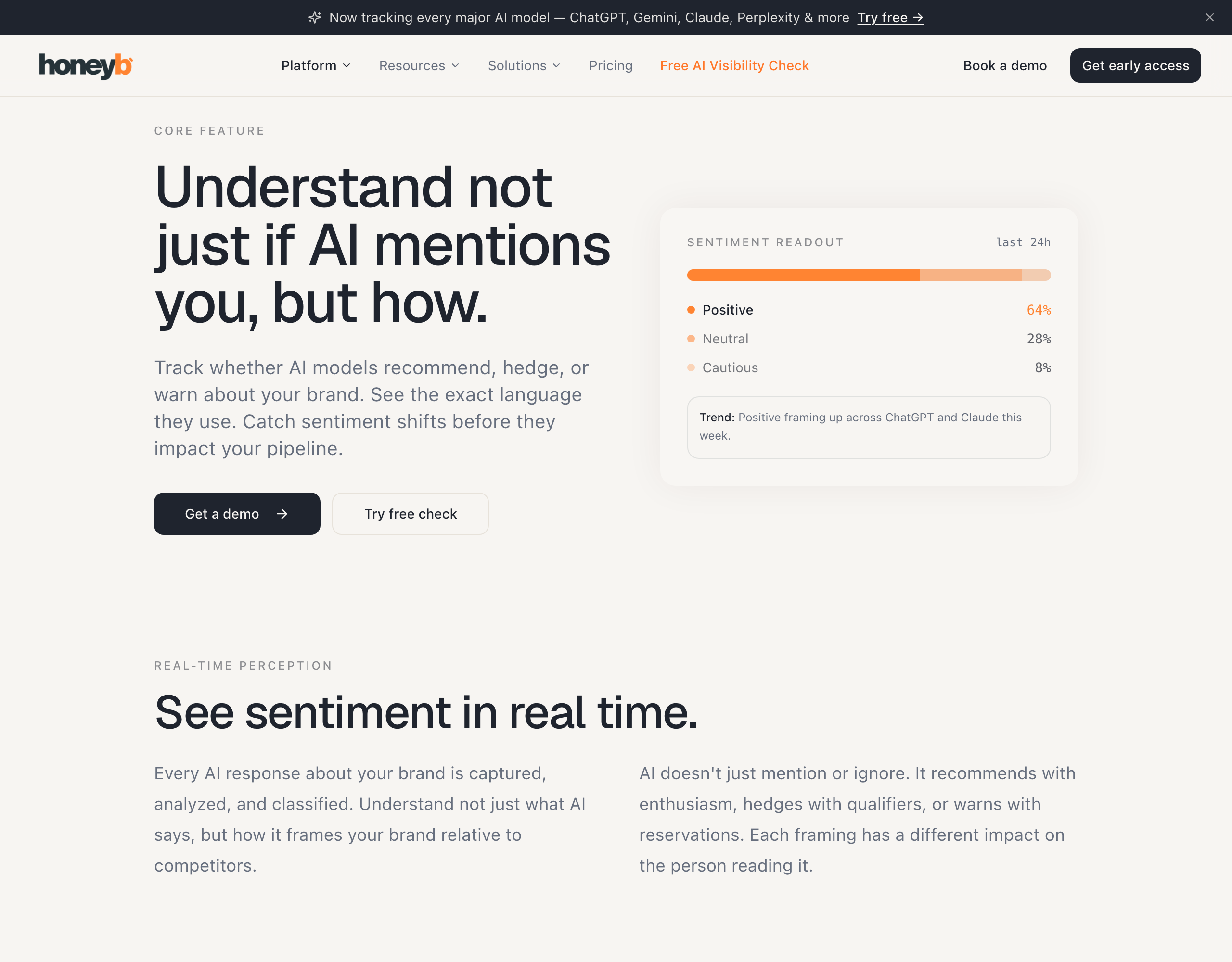
Here the categories split again. Semrush's toolkit does report overall sentiment and share of voice alongside cited pages. SE Ranking is strong on mention and link tracking, including unlinked mentions, and on competitor benchmarking across topics and sub-topics, and its SE Visible dashboard surfaces a net sentiment score. Ahrefs Brand Radar leans on its large prompt and web index for mention discovery, but the undercounting documented above means its sentiment and share figures inherit the same sampling problem on ChatGPT and Perplexity. The specialists tend to go deeper: Profound tracks sentiment at the prompt level, broken down by topic, tag and platform, so you can see which attributes stick to your brand and where the portrayal is inaccurate. Honeyb measures sentiment and share of voice and shows the citations behind each answer, so you can connect a ranking change to the source that caused it.
A useful way to read citation data is as a worklist rather than a report. Each cited source is a place you can earn or improve coverage, and the engines lean heavily on a small set of high-authority sites, so the work concentrates fast. If you want the wider context on how models pick their sources, our explainer on how AI models choose which brands to recommend and the piece on why AI models cite Reddit cover the patterns that show up most often in citation panels.

Want to get recommended by AI?
Check your AI search visibility, then let the Honeyb agent write, fix, and earn what gets you recommended. Free to start.
Competitor benchmarking: relative position, not just your own score
A visibility score in isolation is almost meaningless. What matters is share of voice: of all the times an AI engine answers a buying question in your category, what proportion name you versus each rival. Both categories now offer some form of this. SE Ranking benchmarks competitors across topics and sub-topics. Semrush surfaces where competitors appear and you do not. Similarweb's entire proposition is a comparative index, ranking who dominates AI search across sectors and flagging the brands quietly losing ground.
The difference is usually depth and freshness rather than presence. A suite that refreshes monthly gives you a benchmark that is real but lagging. A specialist running weekly or daily scans lets you watch a rival's share climb in near real time and respond before the gap widens. For a direct head-to-head on how a dedicated platform compares with a suite tracker on exactly these axes, see Honeyb vs SE Ranking, or browse the full comparison hub.
Feature comparison at a glance
| Capability | Big-suite add-ons | Dedicated platforms |
|---|---|---|
| Engine coverage | Often 4-6, Google-adjacent first | Up to 7-10, including Claude, Copilot, Grok |
| Scan frequency | Sometimes monthly or static-sample refresh | Scheduled weekly or daily, timestamped |
| Counting accuracy | Floor estimates in thin-sample cases | Live-query reads aim for fuller counts |
| Sentiment analysis | Present in some, varies by suite | First-class, prompt or theme level |
| Citation analysis | Cited-page lists, depth varies | Source-level, tied to ranking changes |
| Competitor benchmarking | Yes, freshness varies | Yes, near real-time share of voice |
| Lives in your SEO stack | Yes, one login and invoice | No, separate tool |
Read the table as a description of tendencies, not absolutes. The best suite add-ons cover the basics competently, and the field of specialists is uneven, with some newer entrants thin on coverage or accuracy. The point is that the two categories optimise for different jobs, and the gap is widest on counting accuracy, where a static sample and a live read can disagree by an order of magnitude.
Pricing: the real cost of an add-on
Headline pricing misleads in both directions. Suite add-ons can look cheaper because the marginal price sits on top of a base subscription you already pay, and they can look dearer once seats multiply. Semrush's AI Visibility Toolkit is reported at around 99 US dollars per user per month, charged separately from a Semrush plan and per seat, so three people needing access is closer to 297 dollars a month before any extra prompts or domains (Trakkr). Ahrefs Brand Radar is sold per engine, reportedly around 199 dollars per engine per month, so tracking six engines bundles to roughly 699 dollars on top of a base Ahrefs plan that itself starts near 129 dollars. SE Ranking includes AI tracking in its suite and sells SE Visible both standalone and as an add-on.
So the true comparison is rarely add-on price versus specialist price. It is the all-in cost of the suite plus the add-on plus any per-seat, per-engine and prompt-overage charges, set against a specialist's standalone fee. If you already run the suite for SEO and only need a directional AI read, the add-on can be the cheaper path. If AI visibility is the job to be done and you would otherwise be paying for SEO features you do not use, a dedicated platform often comes out ahead on both cost and capability.
How to choose
Match the tool to the decision it has to support. Use the questions below as a buying filter rather than a feature wishlist.
- Coverage: does the tool track the specific engines your buyers use, not just the highest-volume ones
- Cadence: how often are prompts actually re-run, and can you set the schedule yourself
- Accuracy: how large is the sample behind each number, and is it a live read or a floor estimate
- Sentiment: can you see how you are described, not only whether you appear
- Citations: does it show which sources drive each answer so you know where to act
- Benchmarking: can you watch competitor share of voice move over time, not just at one snapshot
- Total cost: what is the all-in price including base subscription, per-seat and per-engine charges and prompt overages
- Workflow: is one login worth more to your team than deeper, fresher AI data
If most of your answers point toward depth, freshness, accuracy and breadth of engines, a dedicated platform fits. If they point toward consolidation and a directional read inside tools you already use, a suite add-on is a reasonable, honest choice. The wrong move is assuming the add-on you already pay for is equivalent to a purpose-built tracker, or that every specialist is automatically deeper. Run the same set of your own category prompts through both and compare the counts against what you find by hand before you commit. You can start that test for free with the AI visibility checker.
The bottom line
Big suites brought AI visibility to millions of marketers already inside their products, which is a real and useful thing. Specialists answer a narrower question more completely: across the engines your buyers use, how often, how favourably and on the strength of which sources does AI recommend you, measured accurately enough to act on. As more buying journeys begin in an AI answer rather than a search results page, that narrower question is the one more brands need answered well. Decide which job you are buying for, check that the numbers behind it hold up, then choose the category built for it.
Sources cited in this report