
AI search monitoring tools track where your brand appears when people ask ChatGPT, Gemini, Claude, Perplexity, Copilot or Google's AI Overviews a question, and they alert you when that answer changes. Most comparison guides rank these tools on their feature lists. This one uses a single, narrower lens: how many AI surfaces each tool actually watches, and how often it refreshes. That is the part that decides whether you find out about a change in a day or a quarter.
One of the nine tools below, Honeyb, is our own, so we have disclosed that clearly and held it to the same two criteria as everything else. For a wider feature-by-feature view, read our guide to the best AI visibility tools.
Why the surface you watch matters more than the score
AI answers are not stable, and they do not spread the credit evenly. The same query returns a different answer roughly 70% of the time, and two identical questions land on the same brand list less than 1-in-100 times (SparkToro). So a monitoring tool that samples one surface once a month is measuring noise. Coverage compounds the problem: 62% of AI citations never name the brand behind them (Semrush), so you can be the source an answer is built on and still be invisible in it.
The surfaces also disagree with each other. Reddit is the single most-cited source across AI answers at 40.1% of all citations (Semrush), yet its share of ChatGPT citations alone fell from around 60% to roughly 10% inside a fortnight in late 2025 (Semrush). A tool watching one engine would have missed that entirely. This is why the two questions that matter are which surfaces a tool covers and how frequently it checks them, and why we sort the field on exactly that.
It also explains where the wins come from: AI visibility correlates most with third-party mentions and video, not on-page work (Ahrefs), so you need to see citations across communities and engines, not just your own pages.
Monthly searches (US)
Search demand for "ai search"
The 9 best AI search monitoring tools at a glance
We ranked the field on two things and two things only: the breadth of AI surfaces a tool monitors, and how often it refreshes them. Price and analytics depth break ties but do not move a tool up the order. One honest note on the table below: most vendors publish which engines they cover but not their refresh cadence, so we have marked cadence as stated only where it is genuinely disclosed rather than guess. Honeyb states a daily refresh across four assistants, which is why it leads on this specific lens.
| Tool | AI surfaces monitored | Refresh cadence | Starting price | Free entry point |
|---|---|---|---|---|
| Honeyb (our tool) | ChatGPT, Gemini, Claude, Perplexity | Daily (stated) | Free check to start | Free AI visibility check |
| Otterly AI | ChatGPT, Perplexity, AI Overviews, Gemini, Copilot | Not publicly stated | From $29/mo | Free trial |
| Profound | Enterprise, multi-surface | Not publicly stated | Pricing on request | Free trial |
| Peec AI | Core assistants, multilingual | Not publicly stated | From $95/mo | Trial |
| SE Ranking | AI visibility inside an SEO suite | Not publicly stated | From $129/mo | No-card trial |
| Semrush AI Visibility | Inside Semrush's SEO + AI Search plans | Not publicly stated | From $199/mo | Free checker |
| AthenaHQ | GEO workflow surfaces | Not publicly stated | From $295/mo | Free 10-minute audit |
| Ahrefs Brand Radar | AI share of voice and mentions in Ahrefs | Not publicly stated | On Ahrefs plans | On Ahrefs plans |
| Scrunch AI | AEO-focused surfaces | Not publicly stated | From $250/mo | 7-day trial |
1. Honeyb (our own tool)
Honeyb, which is our product, watches four assistants together, ChatGPT, Gemini, Claude and Perplexity, and refreshes them daily. Among the tools here it is the one that treats Claude as a first-class surface alongside the other three, which matters because the engines disagree with each other and a brand can lead on one while dropping off another. On top of coverage it tracks sentiment, the citations behind each answer, competitor visibility and specific recommendations, so you can see not just that a mention moved but what it was built on.
It reads across to our companion guides on measuring AI share of voice and AI sentiment tracking. You can start with a free AI visibility check before committing to anything, and we compare it head to head in Honeyb vs Profound.

Want to get recommended by AI?
Check your AI search visibility, then let the Honeyb agent write, fix, and earn what gets you recommended. Free to start.
2. Otterly AI
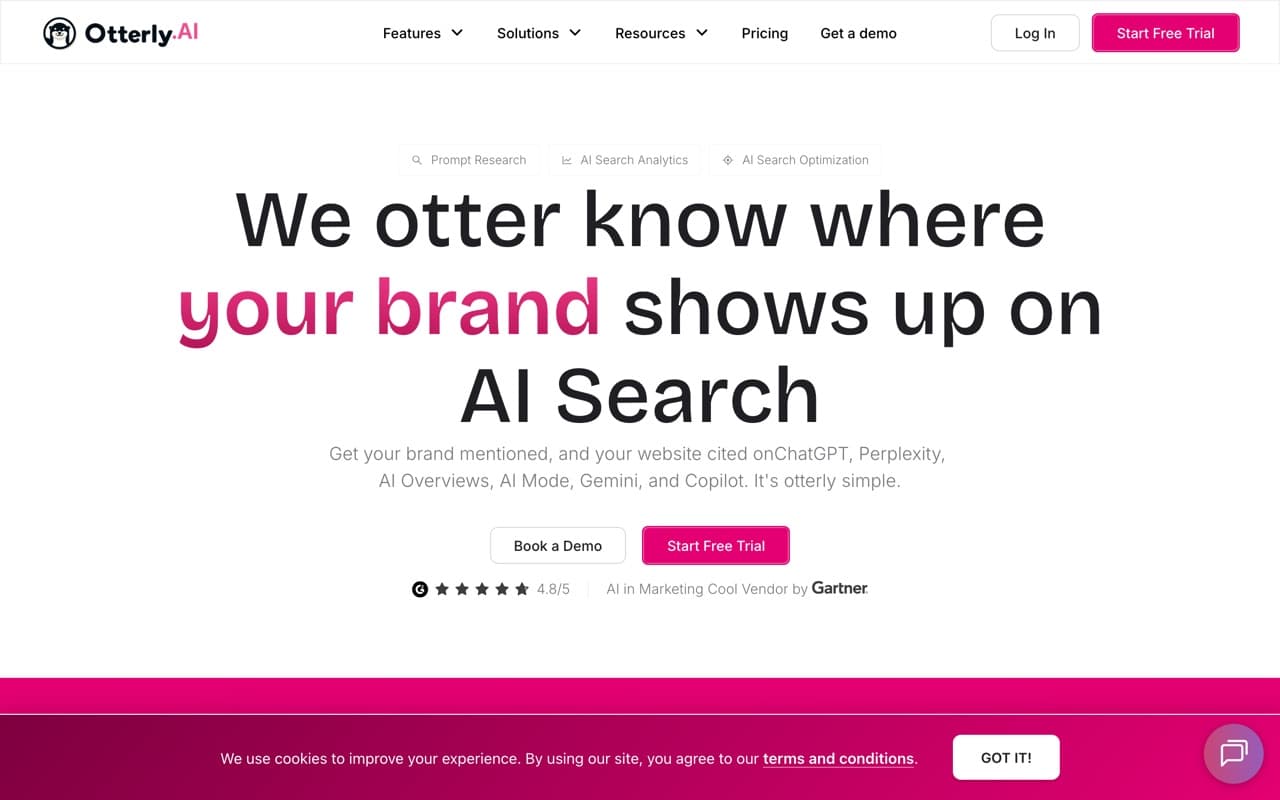
Otterly AI publishes the broadest surface list in this comparison: ChatGPT, Perplexity, Google's AI Overviews, Gemini and Copilot. It is also the cheapest way in, from $29/mo with a free trial, and it carries a Gartner Cool Vendor recognition and a 4.9 rating on G2. If your priority is touching as many named engines as possible on a small budget, this is the widest published footprint here. It sits close to the general-purpose brand mention tracking tools category if you want mentions across more than the core assistants.
3. Profound
Profound is the enterprise standard and has the deepest analytics of the group, backed by $155M in funding. It is built for large teams that want to slice AI visibility across many prompts and segments, and it publishes no price: a free trial, then custom Enterprise terms on request. If your monitoring programme has an analyst behind it and a budget to match, this is the depth ceiling. We put the two side by side in Honeyb vs Profound.
4. Peec AI
Peec AI targets mid-market teams that need to monitor across languages, which is a genuine gap if your buyers ask AI questions in more than English. It starts from $95/mo with a trial. Coverage of the core assistants plus its multilingual focus makes it a sensible pick for brands operating in several markets rather than a single one.
5 to 9. The rest of the field: SE Ranking, Semrush AI Visibility, AthenaHQ, Ahrefs Brand Radar and Scrunch AI
The remaining four earn their place but suit narrower needs. SE Ranking folds AI visibility into an affordable SEO suite from $129/mo with a no-card trial, which is the easy option if you already want classic rank tracking in the same tab. Semrush AI Visibility comes with Semrush's SEO + AI Search plans from $199/mo, with a free checker, and it is worth noting Semrush produced much of the citation data in this guide, so its own tooling sits close to that research.
AthenaHQ is built around GEO workflows for teams, from $295/mo, with a free 10-minute audit to try before you buy. Ahrefs Brand Radar reports AI share of voice and mentions inside Ahrefs on existing Ahrefs plans, a natural fit given Ahrefs research tied AI visibility to third-party mentions and video rather than on-page work. Scrunch AI is AEO-focused, with a $250/mo Core plan for teams that want answer-engine optimisation as the centre of gravity. For a monitoring-only shortlist, these also appear in our best LLM monitoring tools and best AI brand monitoring tools guides.
Which one fits your surface mix
Start from where your buyers actually ask their questions, then work back to the tool. If ChatGPT and Perplexity drive your category, prioritise a tool that watches both on a stated, frequent cadence rather than one that samples them occasionally, because a 70% answer-change rate (SparkToro) turns a monthly check into guesswork. If you need the widest set of named engines cheaply, Otterly's five surfaces are the broadest published list.
If you need enterprise depth, Profound sets the ceiling. If you want four assistants including Claude refreshed daily, plus the citations and sentiment behind each answer, that is where Honeyb, our tool, fits. The cheapest way to find out where you stand today is to run a free AI visibility check and see which surfaces already mention you and which do not.