Every agency that sells SEO is now being asked the same question by clients: are we showing up in ChatGPT. It is a fair question, and answering it by hand does not scale past your first two clients. The problem is not just the volume of prompts. It is that the answer moves. The same AI query returns a different brand list roughly 70% of the time, and two identical queries land on the same list under a 1-in-100 chance (SparkToro).
A single screenshot in a monthly report is not a measurement, it is a coin flip. That is the gap AI visibility tools close, and it is why agencies need a different set of features from the ones an in-house brand team cares about.
This guide ranks seven tools on agency fit specifically: how well they handle multiple clients, whether the reporting stands up in front of a client, and where the pricing lands when you are paying per account rather than for one brand. If you want the general landscape instead, we cover it in our roundup of the best AI visibility tools and the best AI brand monitoring tools. This piece is narrower on purpose. It is for the agency deciding what to actually deploy across a book of clients.
What agencies need that in-house teams do not
An in-house team measures one brand. An agency measures ten, reports on all of them on a schedule, and has to defend every number to a client who did not see the underlying data. That changes the buying criteria. Three things matter more than raw feature count. First, multi-client structure: can you separate accounts cleanly and pull each client's data without cross-contamination.
Second, reporting you can hand over: exports, or white-label from the one tool that offers it, so the number arrives with your logo on it and not the vendor's. Third, the ability to explain volatility, because a client who sees their score drop will assume you broke something. The honest answer is that AI answers are noisy by design, and your tool has to smooth that noise with frequent sampling rather than hide it.
The reporting problem is sharper than most agencies expect because of where AI answers pull from and whether the source is even visible. Around 62% of AI citations never name the brand behind them, so a mention can be working for a client without the client ever seeing their name in the answer (Semrush). And the engines disagree on transparency: ChatGPT and Gemini often hide their citations, while Perplexity and Claude expose theirs consistently.
That means the same client can look invisible in one engine and well cited in another, purely because of what each engine chooses to show. A tool that captures citations across engines is what lets you tell that story instead of guessing at it.
Monthly searches (US)
Search demand for "ai search"
The other number every agency should have ready for a client meeting is source concentration. Reddit alone accounts for 40.1% of all AI citations, the single most-cited source across the answers Semrush studied (Semrush). And it is not stable: Reddit's share of ChatGPT citations fell from roughly 60% to around 10% inside a fortnight in late 2025 (Semrush). If your reporting cannot survive a swing that large, the client will lose confidence in it.
The strategic takeaway is the same one Ahrefs found in its own analysis: AI visibility correlates most with third-party mentions and video, not on-page work (Ahrefs). That reframes what an agency is actually selling here, and it is closer to digital PR than to technical SEO. We go deeper on the measurement mechanics in how to measure AI share of voice and how to monitor AI brand mentions.
The 7 best AI visibility tools for agencies in 2026
Prices below are as listed by each vendor and are the starting point, not the agency all-in. Read the middle two columns closely, because trial terms and multi-client fit are usually what decides a rollout, not headline price.
| Tool | From | Trial / free check | Agency-relevant strengths | Best fit |
|---|---|---|---|---|
| Honeyb | Free check | Free check, no card | All four models tracked daily, sentiment, citations, competitor tracking, recommendations | Agencies wanting daily data and a zero-friction client demo |
| Profound | Pricing on request | Free trial | Deepest analytics, API access, white-label; $155M funded | Larger agencies productising AI visibility reporting |
| AthenaHQ | $295/mo | Free 10-minute audit | GEO workflows built for teams | Teams running a repeatable GEO process across clients |
| Otterly AI | $29/mo | Free trial | Low entry price; Gartner Cool Vendor, 4.9 on G2 | Small agencies starting cheap across many clients |
| Peec AI | $95/mo | Free trial | Multilingual tracking | Agencies with non-English or multi-market clients |
| SE Ranking | $129/mo | No-card trial | AI visibility inside a full SEO suite | Agencies already running client SEO in one platform |
| Semrush AI Visibility | From $199/mo (SEO + AI Search) | Free checker | AI visibility bolted onto an existing Semrush workflow | Agencies already standardised on Semrush |
1. Honeyb
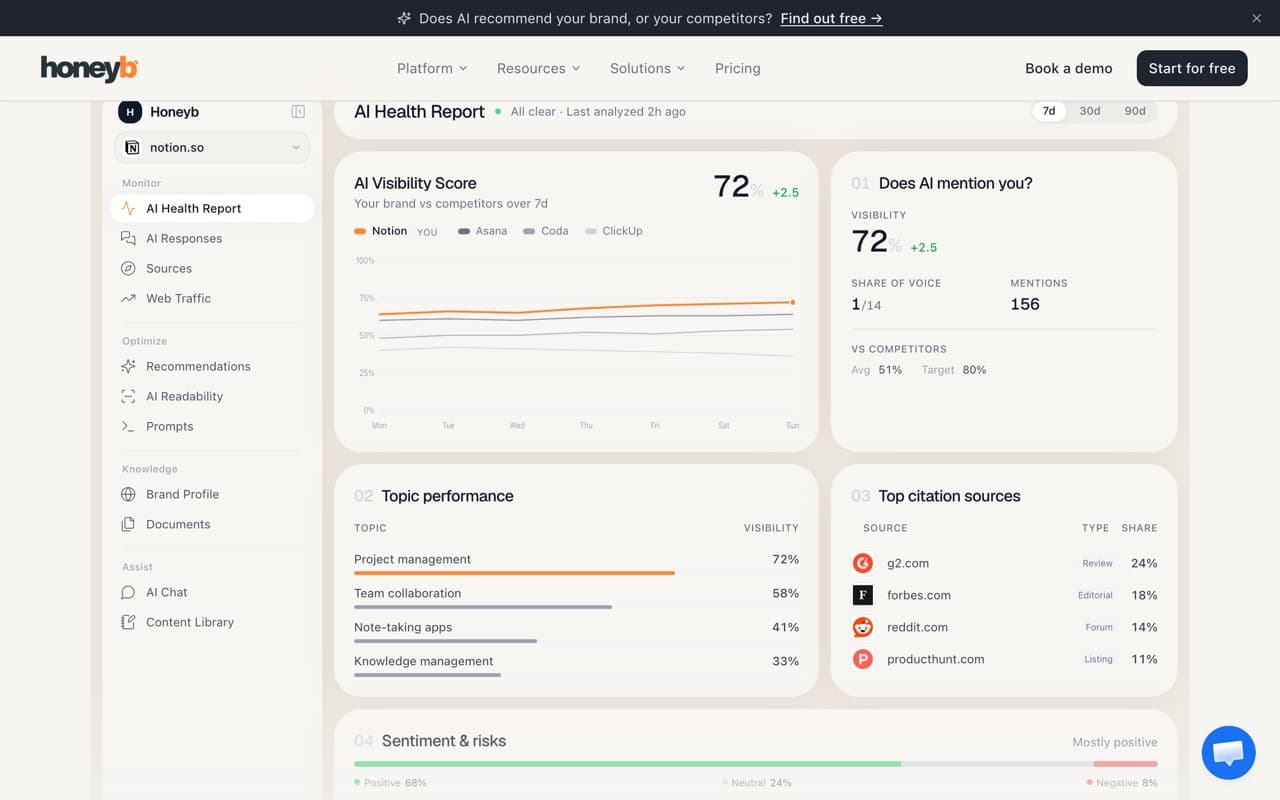
Disclosure: Honeyb is our product, so weigh this section accordingly. It is listed first because it is ours, not because we are ranking it above the others. Honeyb tracks all four major models daily rather than sampling occasionally, which is the direct answer to the 70% query-variance problem (SparkToro): more frequent sampling is how you turn a noisy signal into a trend a client will believe. It covers sentiment, citations, competitor tracking and specific recommendations, and the citation capture matters given that ChatGPT and Gemini often hide sources while Perplexity and Claude expose them. For agencies the useful part is the free check, which lets you run a prospect's domain live in a pitch without provisioning anything. If you are weighing us directly against the enterprise option, we lay it out in Honeyb vs Profound, and our agency solutions page covers how teams run it across a book of clients.
2. Profound
Profound is the enterprise end of this market. It publishes no price: there is a free trial, then custom Enterprise pricing on request, and it is backed by $155M in funding. It offers the deepest analytics in this list, and critically for agencies it is the one tool here with both stated API access and white-label. That combination is what lets a larger agency productise AI visibility: pull data through the API into your own reporting stack and put it in front of the client under your own brand. The trade-off is cost and commitment, so it tends to fit agencies with enough enterprise clients to amortise the seat. For the rest of this list, treat white-label as not available unless the tool explicitly says so, because Profound is the only one that does.

Want to get recommended by AI?
Check your AI search visibility, then let the Honeyb agent write, fix, and earn what gets you recommended. Free to start.
3. AthenaHQ
AthenaHQ's Starter is $295 a month and is built around GEO workflows designed for teams, which is a more agency-shaped proposition than a single-brand dashboard. The free 10-minute audit is a genuinely useful pitch asset: you can run a prospect's brand and walk into the meeting with a finding rather than a promise. It sits in the mid-market band alongside a Profound-style analytics depth but without the enterprise price of entry. Judge it on whether its team workflow maps to how your account managers actually work, because a workflow tool is only as good as the process it enforces.
4. Otterly AI
Otterly AI is the lowest starting price in this list at $29 a month, with a free trial, a Gartner Cool Vendor designation and a 4.9 rating on G2. For a small agency taking on AI visibility across several clients at once, that entry price is the difference between piloting it on every account and piloting it on one. It is a focused tool rather than a full suite, so set expectations accordingly: it is a strong way to start measuring and reporting without a large commitment, and you can move clients up to heavier tooling as the retainer grows.
5. Peec AI
Peec AI's Starter is $95 a month, with a trial, and its distinguishing feature is multilingual tracking. For most agencies that is a niche requirement, but for the ones it fits it is decisive: if you run clients in several markets or non-English languages, a tool that only measures English answers will misreport half your book. Peec sits in the affordable mid-tier, so it is a reasonable default for agencies whose client base is genuinely international rather than a single market.
6. SE Ranking
SE Ranking puts AI visibility inside a full SEO suite: its Core plan is $129 a month with 100 prompts tracked daily, and the 14-day trial needs no card. The pitch for agencies is consolidation. If you already run client keyword tracking, audits and reporting in SE Ranking, adding AI visibility in the same platform means one login, one report and one bill per client rather than bolting on a separate subscription. That convenience is worth real money at agency scale. If your SEO stack lives elsewhere, the case is weaker, and you are effectively evaluating it as a standalone AI tool rather than for the integration.
7. Semrush AI Visibility
Semrush offers AI visibility as an add-on to its main suite, plus a free checker anyone can run. The logic mirrors SE Ranking: if your agency has already standardised on Semrush, adding AI visibility where your team already reports is lower-friction than introducing a new vendor. The free checker is also a fast way to sanity-check a prospect before you commit any tooling to them. Evaluate it as part of your existing Semrush spend rather than in isolation, because the value is largely in the fact that it lives next to the reports you already send.
How to choose the one you deploy
There is no single winner here, only the right fit for your book. If most of your clients already sit in one SEO platform, the consolidation play (SE Ranking or Semrush) usually wins on total cost and reporting effort. If you are productising AI visibility as its own line item for enterprise clients, Profound's API and white-label are the only stated route to putting the data out under your own brand. Outside these seven, the other route is to build the report on an AI visibility API, which returns mentions, position, sentiment and cited pages per answer at $0.08 an answer, for the agency's own dashboard.
If you want daily data and a free check you can run live in a pitch, that is where we would point you at Honeyb. Whichever you pick, the operational rules are the same: sample frequently because answers change 70% of the time (SparkToro), capture citations because 62% of them never name the brand (Semrush), and set client expectations that this measures third-party presence more than on-page work (Ahrefs).
For the adjacent buying decisions, see our guides to ChatGPT brand monitoring tools and AI search competitive analysis tools. Ready to test one on a live client domain? Run a free AI visibility check and take the result into your next pitch.