People line up DeepSeek vs ChatGPT as if it were a straight fight between two assistants, but the more useful framing is that they sit at opposite ends of how an AI product can be built. ChatGPT is a closed, tightly integrated assistant from a US lab, running OpenAI's own models and reaching for the web only when a question seems to need it. DeepSeek is the open challenger: a Chinese lab that releases its frontier model weights under a permissive licence, so anyone can download, inspect, or self-host them, at a fraction of the cost per token. That single architectural choice ripples through almost everything that matters when you choose between them, from price and privacy to which one a brand should even worry about appearing in. This guide compares the two across how each is built, web access and citations, capabilities, pricing, and context windows, then gives a clear verdict and what it all means for brand visibility.
How each one is built, and why it matters
The clearest way to understand the difference is to look at who controls the model and where it runs.
ChatGPT is a closed product. OpenAI builds the models, hosts them, and decides which variants you can reach. Its current frontier model is GPT-5.5, which became ChatGPT's default model in May 2026 and which OpenAI describes as a new class of intelligence for coding and professional work, with heavier reasoning and Pro variants reserved for paid tiers (OpenAI GPT-5.5 model page, TechCrunch). You never see the weights, you cannot run the model on your own hardware, and your conversations pass through OpenAI's infrastructure. In return you get a polished, multimodal assistant with voice, image understanding, and native computer use built in.
DeepSeek takes the opposite stance. It is an open-weight lab founded in July 2023 by Liang Wenfeng and owned by the Chinese quantitative hedge fund High-Flyer, headquartered in Hangzhou (Wikipedia: DeepSeek). In April 2026 it released the V4 series, the 1.6-trillion-parameter V4-Pro and the 284-billion-parameter V4-Flash, both under the permissive MIT licence, meaning anyone can download, modify, or self-host them, including for commercial use (DeepSeek API pricing docs). That is the heart of the comparison. You can use DeepSeek as a hosted chat app like ChatGPT, or you can run the same model entirely on your own infrastructure so that no data leaves your servers. For a deeper look at how it behaves as a search tool, see our piece on DeepSeek as an AI search engine.
It was this openness, paired with a low reported training cost, that made DeepSeek a global story in January 2025. The launch of its R1 reasoning model sent shock waves through the market, and Nvidia's share price fell sharply, losing roughly 600 billion US dollars of value in a single day, the largest single-company decline in US stock-market history (Wikipedia: DeepSeek). The point was not that DeepSeek had beaten ChatGPT on quality. It was that a frontier-class model could be built and given away far more cheaply than the market had assumed.
Web access and citations
This is where the deepseek vs chatgpt comparison gets practical, because both now search the live web, but they do it differently.
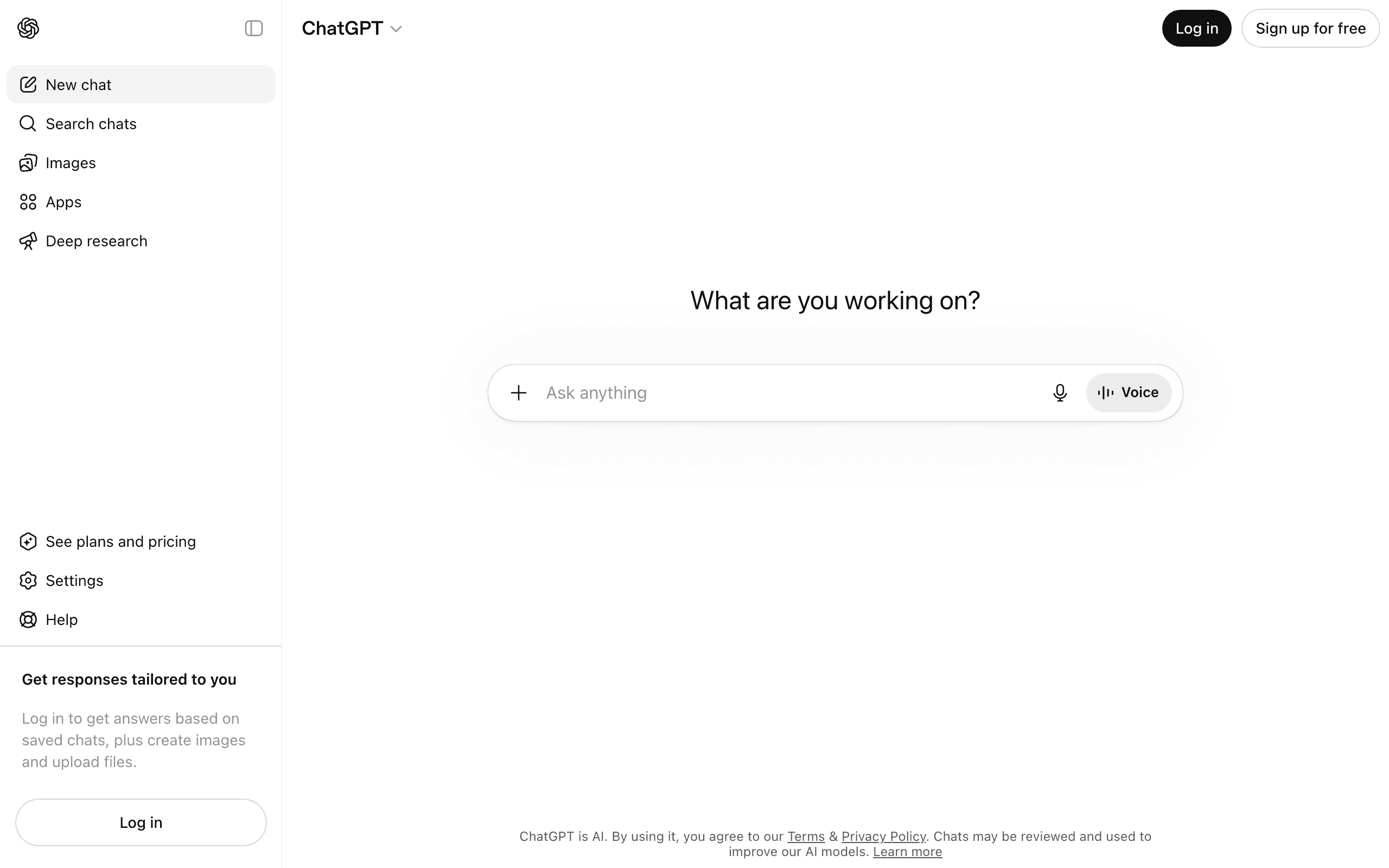
ChatGPT answers from the model's own knowledge by default and reaches out to the web only when a question clearly needs fresh or specific information, or when you turn search on. When it does search, OpenAI's ChatGPT Search documentation describes inline citations you can hover and click, with a sources panel beneath the answer. The trade-off is consistency: because it searches selectively, a given reply may be fully sourced, partly sourced, or generated entirely from training data with no citations at all, so for anything you plan to rely on you have to check whether it actually searched.
DeepSeek added real-time web search to its app and, when that mode is on, it scans live sources and attaches links or references you can verify, which makes it usable for current questions rather than only those inside its training cut-off. In practice its search behaviour sits closer to ChatGPT's than to a citation-first answer engine: search is a mode you invoke, not the default frame around every answer. If your interest is purely in cited, search-first answers, a dedicated answer engine is a closer fit, which is the contrast we draw in Perplexity vs ChatGPT. The same split separates DeepSeek from a citation-first tool: Perplexity is built so that every answer carries numbered citations by default, whereas DeepSeek and ChatGPT both treat web search as something they reach for rather than their core design.
One caution applies to all of them. A citation proves where a passage came from, not that the sentence above it is faithful to the source. Treat links as a head start on verification, not a substitute for it.
Capabilities, and where each one is strong
Both are capable across writing, coding, and reasoning, but they were tuned with different priorities.
ChatGPT is the broader generalist. GPT-5.5 leads on agentic coding and ships with native computer use, and the wider ChatGPT product layers in voice, image generation, image and document understanding, memory across a conversation, and a large ecosystem of connectors and apps. For most people the appeal is that one subscription handles writing, coding, brainstorming, and multimodal work without leaving the app.
DeepSeek's reputation was built on strong reasoning, maths, and coding at a low cost, and the V4 models continue that line while adding a 1-million-token context window. It is a text-first model: it does not match ChatGPT's breadth of native voice, image generation, or live multimodal features in the hosted app. Two further caveats matter for any serious deployment. First, because DeepSeek is a China-based service, its hosted app applies content controls and declines to engage with politically sensitive topics such as the 1989 Tiananmen Square protests or the status of Taiwan, as documented by The Dispatch. Second, the hosted app stores user data on servers in China, which has prompted regulatory scrutiny in several jurisdictions, including a block by Italy's data-protection authority over its handling of users' personal data (Euronews). The open weights are the escape hatch: self-hosting the model removes the data-residency concern, though the model's trained-in content behaviour travels with the weights.
Pricing and access, DeepSeek vs ChatGPT (verified June 2026)
This is the dimension where the open-versus-closed split is starkest, and it is the main reason people ask whether DeepSeek is better than ChatGPT for cost-sensitive work.
ChatGPT spans Free, Go at around 8 US dollars a month, Plus at around 20 US dollars a month, a Pro line around 200 US dollars a month, plus Business per seat and custom Enterprise pricing. On the API, GPT-5.5 is priced at 5 US dollars per million input tokens and 30 US dollars per million output tokens, with a context window of roughly 1.05 million tokens (OpenAI GPT-5.5 model page).

Want to get recommended by AI?
Check your AI search visibility, then let the Honeyb agent write, fix, and earn what gets you recommended. Free to start.
DeepSeek offers a free chat app and pay-as-you-go API access that is dramatically cheaper. V4-Flash is priced at 0.14 US dollars per million input tokens and 0.28 US dollars per million output tokens, with cache hits an order of magnitude cheaper again; the larger V4-Pro runs at 0.435 and 0.87 US dollars per million (DeepSeek API pricing docs). On output tokens that puts V4-Flash at roughly one-hundredth of GPT-5.5's rate. For high-volume or budget-constrained workloads the gap is decisive, and that is before you factor in the option to self-host the weights and pay only for your own compute.
| Feature | DeepSeek | ChatGPT |
|---|---|---|
| Model and licensing | Open weights (MIT), self-hostable | Closed, OpenAI-hosted only |
| Latest model | V4-Pro / V4-Flash (April 2026) | GPT-5.5 (default since May 2026) |
| Web access | Real-time search as a mode | Searches on demand when needed |
| Citations | Links when search mode is on | Inline citations when it searches |
| Multimodal | Text-first; limited native media | Voice, images, documents, computer use |
| Context window | 1M tokens | ~1.05M tokens |
| API price (input / output per 1M) | $0.14 / $0.28 (V4-Flash) | $5.00 / $30.00 |
| Data residency | Hosted app stores data in China | OpenAI infrastructure (US-led) |
| Strongest at | Cost-efficient reasoning, coding, self-hosting | Broad multimodal assistance, ecosystem |
Market share (%)
The four leading AI assistants by market share
DeepSeek does not register as a distinct slice in most Western chatbot market-share trackers, which still centre on ChatGPT, Gemini, Claude, and Perplexity. Its footprint is largest as a hosted app in Asia and, more importantly, as an open model that other products and self-hosters build on quietly. For the latest distribution among the engines Western buyers use most, see our AI chatbot market share breakdown.
If your buyers mostly live on those mainstream Western engines, the more pressing question is how they stack up against each other, which we work through in ChatGPT vs Gemini vs Claude.
Microsoft Copilot is the other surface worth weighing here, since it runs the same OpenAI models behind a search-first wrapper, a contrast we unpack in Copilot vs ChatGPT.
Which to use when
Rather than crown a single winner, match the job to the tool. The split is clean once you separate questions of breadth and convenience from questions of cost and control.
- Broad day-to-day assistance, writing, brainstorming, mixed media: ChatGPT, for its multimodal range and polished app.
- Voice, image generation, document and screenshot analysis: ChatGPT, which has the native multimodal features DeepSeek lacks in its hosted app.
- Cost-sensitive, high-volume API work: DeepSeek, where V4-Flash undercuts GPT-5.5 by roughly two orders of magnitude on output tokens.
- Maths, logic, and competitive coding on a budget: DeepSeek, the use case its reasoning line was tuned for.
- Data that must never leave your own infrastructure: self-hosted DeepSeek, which the MIT-licensed weights make possible.
- Regulated work, or anything touching China-sensitive topics: ChatGPT, unless you are running DeepSeek's weights yourself and accept the trained-in behaviour.
The honest summary is that they rarely compete for the exact same job. ChatGPT is the better default when you want one well-supported assistant that does everything. DeepSeek is the better default when cost, openness, or self-hosting outweigh breadth of features.
The verdict
Is DeepSeek better than ChatGPT? For raw capability across the widest range of tasks, with the deepest multimodal and ecosystem support, ChatGPT remains ahead. For cost per token, transparency, and the freedom to run the model yourself, DeepSeek is in a class of its own among frontier-class models. So the answer depends on what you are optimising for, not on a single benchmark.
Choose ChatGPT when you want a polished generalist with voice, images, computer use, and a large app ecosystem, and you are comfortable with a closed, US-hosted stack. Choose DeepSeek when budget, openness, or data control are the priority, especially for high-volume API use or self-hosting where its pricing and MIT licence are hard to beat. Many teams will use both: ChatGPT for everyday assistant work, DeepSeek for cost-sensitive automation or on-premise deployments. For how these two sit among the wider field, our list of AI search engines and the comparison of Perplexity, Claude and Gemini put them in context.
What this means for brand visibility in AI answers
If you are a marketer or founder rather than a developer, the comparison reframes itself. Each engine is a surface where buyers form opinions about your brand, and the open-versus-closed split changes where your attention should go.
ChatGPT is the surface most Western buyers actually use to ask for recommendations, so being well-represented across the wider web that trains and grounds it is the higher-leverage work for most brands. It rewards companies that are credible and widely referenced across the third-party sites, reviews, and communities these models lean on, so that you get named even when no live search runs. The signals that move it are covered in how AI models choose which brands to recommend.
DeepSeek matters differently. Because its weights are open and cheap to run, it is increasingly embedded inside other products and internal tools rather than encountered as a branded app, which means it can shape recommendations in places you never see. When its web-search mode is on, the same fundamentals apply: clear, current, well-structured pages that are easy to retrieve and cite. The practical risk is that good visibility in one engine does not carry to another, because they decide differently and draw on different sources.
The takeaway for a brand is to treat these as separate surfaces and measure each over time rather than spot-checking once. A quick way to see where you stand is our free AI visibility checker, which reads how the major engines describe and rank you. The comparison that matters for a brand is not which engine is better, but whether you show up well across all the ones your buyers use.
Sources cited in this report