

If you have spent any time researching how to track your brand inside ChatGPT, Perplexity or Gemini answers, you have almost certainly run into Profound. The New York company has become one of the most visible names in the young market for AI visibility and answer engine optimisation, helped along by a fast run of venture funding that culminated in a one-billion-dollar valuation in early 2026. This piece is a plain, factual brief on what Profound is, what its platform actually does, how it is funded, who it suits, and where the honest trade-offs sit. It also covers the questions people search for around the company, including its competitors, its valuation and what it is like as an employer, and it is straight about where a lighter-weight tool such as Honeyb takes a different path.
What is Profound AI?
Profound is a software platform that helps brands measure and influence how they appear inside AI-generated answers. When a buyer asks ChatGPT, Perplexity, Gemini or Google's AI Overviews to recommend a product or compare vendors, the engine returns a short list of named brands rather than ten blue links. Profound's job is to tell a brand whether it is on that list, how often, how it is described, and what to do about it. The company files this work under the label answer engine optimisation, or AEO, and positions itself as a full marketing platform for the AI era.
It was founded in 2024 by James Cadwallader, the chief executive, and Dylan Babbs, who met at the incubator South Park Commons. The pitch from the start was that AI assistants would become a major channel for product discovery, and that brands would need a measurement layer for that channel in the same way they came to need rank trackers for Google. That bet has aged well: Profound now reports more than 700 enterprise customers, including roughly 10 per cent of the Fortune 500, with named accounts such as Target, Walmart, MongoDB, Ramp and U.S. Bank, according to Fortune's reporting.
If you want the wider context on this whole category before going deep on one vendor, our guide to AI visibility tools maps how the platforms differ and what they measure.
What Profound's platform actually does
Profound is broader than a pure monitoring tool. Its product is built around several connected modules, and understanding them is the clearest way to see what you are buying.
- Answer Engine Insights is the monitoring core. It tracks how AI engines mention, cite and describe a brand across a set of tracked prompts, reporting share of voice against competitors and the sources the models lean on.
- Prompt Volumes estimates how often real users are asking particular questions of AI assistants, so a team can prioritise the prompts that carry actual demand rather than guessing.
- Agent Analytics looks at the other side of the exchange: it tracks how AI crawlers and agents fetch and interpret a site, which is the input side of whether a brand gets cited at all.
- Agents is Profound's newer push into autonomous workers that carry out marketing tasks, reflecting the company's stated ambition to be a full marketing platform rather than a single dashboard.
On engine coverage, Profound is among the broadest in the market. Its own materials describe monitoring across more than ten engines, including ChatGPT, Perplexity, Claude, Gemini, Grok, Microsoft Copilot, Meta AI, DeepSeek and Google AI Overviews. That breadth matters, because buyers split their questions across many surfaces, and a tool that watches only one engine misses a large share of where a brand is being judged. We dig into why multi-engine coverage is now table stakes in our AI visibility tracker comparison.
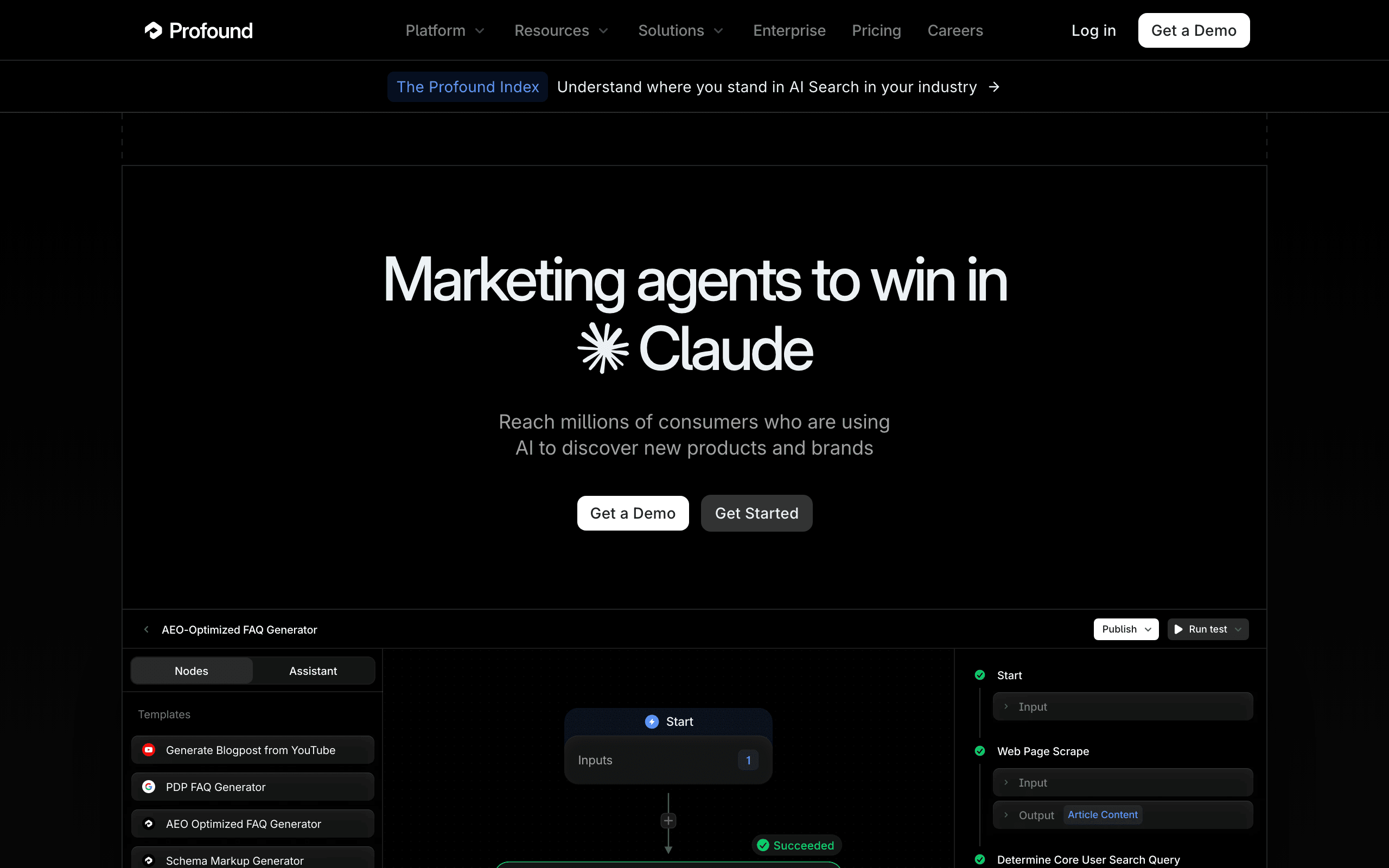
The thread running through these modules is that Profound wants to be a place where a marketing team can understand, analyse, build and measure its AI presence in one product. That is a deliberately wide remit, and it shapes both the platform's strengths and its trade-offs, which we come to below.
Profound AI funding and valuation
Profound's funding history is unusually fast, and it is a large part of why the company is so widely discussed. The progression, drawn from contemporaneous reporting, looks like this.
| Round | Date | Amount | Lead investor |
|---|---|---|---|
| Seed | August 2024 | ~$3.5M | Khosla Ventures |
| Series A | June 2025 | $20M | Kleiner Perkins |
| Series B | August 2025 | $35M | Sequoia Capital |
| Series C | February 2026 | $96M | Lightspeed Venture Partners |
The headline number people search for is the Profound AI valuation, and the answer is a one-billion-dollar valuation reached at the Series C. SiliconAngle reported that the $96 million round was led by Lightspeed Venture Partners, with Sequoia Capital and Kleiner Perkins also participating. Fortune put the company's total funding at around $155 million across those rounds, raised in roughly 18 months, which is one of the quicker ascents to unicorn status the enterprise software market has seen.
The Series B in August 2025 drew particular attention because Sequoia led it on the thesis that AI search would become a platform shift on the scale of the move to mobile, with Profound positioned to be a system of record for it. The size and pedigree of the backing is real, and worth weighing as a signal of category momentum. It is not, on its own, evidence that the product is the right fit for any particular brand, which is a separate question we address next.
Who Profound is built for
Profound is, by design, an enterprise platform. The clearest evidence is its customer base, which skews to large organisations and Fortune 500 names, and its pricing, which is sales-led for any serious deployment. The company employs fewer than 120 people and concentrates its effort on accounts that need broad model coverage, deep prompt volumes and the supporting analytics that a large marketing organisation can act on.
That focus suits a specific buyer well: a multi-brand or multi-market company with a dedicated team, a budget that treats AI visibility as a line item, and a need to cover many engines and many thousands of prompts. For that buyer, the breadth of the platform and the demand data behind Prompt Volumes are genuine advantages.
It fits less neatly for a smaller team. A single brand tracking one category, an agency piloting the discipline for a few clients, or a founder who wants a first read before committing budget will find the enterprise orientation, and the price that comes with it, heavier than the job requires. That is not a criticism of Profound; it is simply a question of fit. For a structured way to think about that decision, our guide to GEO services and tools walks through tool versus agency versus in-house and what each costs.

Want to get recommended by AI?
Check your AI search visibility, then let the Honeyb agent write, fix, and earn what gets you recommended. Free to start.
Profound pricing, honestly
Pricing is the place where the enterprise orientation shows most clearly, and it is worth being precise because Profound's public pricing has shifted over time. As of mid-2026, the company's pricing page points buyers toward customised enterprise pricing, while self-serve references that circulated earlier cite a tiered structure. Where tiers are quoted, an entry plan has been listed around $99 a month but tracks ChatGPT only on a small prompt allowance, a Growth plan around $399 a month adds engines such as Perplexity and AI Overviews, and full multi-engine coverage with the deeper analytics lands in enterprise territory, commonly reported in the low thousands of dollars a month and rising from there. These figures are best read as directional, because reporting on the lower tiers varies and the official page no longer lists them.
Two honest caveats. First, the cheapest tier is not a like-for-like version of the platform; single-engine, low-prompt tracking is a starter view, not the multi-engine monitoring most teams actually want. Second, meaningful deployments are sales-led rather than self-serve, so the real cost is whatever a contract negotiation produces. None of this is unusual for an enterprise tool, but it means the sticker price and the working price are different numbers, and you should confirm both with Profound directly before budgeting.
Profound AI competitors
Profound is the most prominent name in AI visibility, but it is not alone, and the people searching for Profound AI competitors are usually trying to scope the wider field. The market sorts into a few groups.
At the enterprise end, Evertune sells model-level brand perception data into large accounts and sits at the top of the price range, typically without a self-serve tier. Several SEO suites have added AI visibility to their core products: Semrush, Ahrefs through its Brand Radar add-on, SE Ranking and Similarweb all now offer some form of AI-answer tracking, though it is usually a module rather than the main product, and engine coverage varies. A cluster of specialist, self-serve tools, including Otterly, Scrunch and ZipTie, offer prompt-level monitoring at lower price points for focused brands. Honeyb sits in this dedicated-monitoring group, built around scheduled scans and share of voice across the major engines. We compare the big suites with the specialists in detail in the AI visibility tracker comparison.
Scrunch is worth a closer look here because it adds an edge-layer fix on top of monitoring rather than reporting alone; our Scrunch AI brief covers what the platform does, who it suits and its 2026 acquisition by Sitecore.
| Group | Examples | Typical buyer |
|---|---|---|
| Enterprise platforms | Profound, Evertune | Large, multi-brand organisations with a dedicated team and budget |
| SEO suites with AI modules | Semrush, Ahrefs, SE Ranking, Similarweb | Teams already inside a suite wanting a first read |
| Dedicated monitoring | Honeyb, Otterly, Scrunch, ZipTie | Focused brands and agencies wanting AI visibility as the core product |
The right comparison is not which vendor is best in the abstract, but which group matches your size, your engine needs and the way you want to buy.
Profound AI careers
Profound is hiring actively, which is the natural consequence of a company that raised $96 million and is trying to build a broad platform with a small team. Its careers page lists roles spanning engineering, data, design, AI strategy and customer success, concentrated in New York with further openings in San Francisco and London. The page sets out the offer in general terms, describing a strong base salary and significant equity rather than published bands, so candidates should treat specifics as a matter for the interview process. For anyone weighing the company as an employer, the relevant context is the one above: a well-funded, fast-growing, enterprise-focused startup in a category that is itself only a couple of years old, which carries both the upside and the volatility that profile implies.
The honest trade-offs
Profound's strengths are real. It has broad engine coverage, a genuinely wide product surface from monitoring through demand data to agents, deep funding that signals staying power, and a customer base that shows the platform works at enterprise scale. For a large organisation that needs all of that, it is a credible choice.
The trade-offs are the flip side of the same qualities. The platform's breadth means there is more to learn and configure than a focused team may want. The enterprise orientation shows up in sales-led pricing that is opaque until you talk to someone, and in a working cost that lands well above any headline starter figure once you turn on real multi-engine coverage. And the product's ambition to be a full marketing platform, including autonomous agents, is a larger bet than some buyers are looking to make when all they want is to know whether ChatGPT recommends them. None of these are flaws so much as consequences of who Profound is built for. If you are not that buyer, the fit loosens.
Where Honeyb differs
Honeyb works in the same category as Profound but starts from a narrower, more opinionated place. Rather than aiming to be a full marketing platform, Honeyb is built around the two capabilities that most reliably separate signal from anecdote in AI visibility: scheduled scans and share of voice. It runs your tracked buyer questions on a recurring schedule across the major engines, including ChatGPT, Perplexity, Google AI Overviews and AI Mode, Gemini, Claude and Copilot, then aggregates the results into a rate you can trust rather than a single sampled answer.
On that base, Honeyb measures share of voice against the competitors you name, tracks the sentiment and framing the models use to describe you, and shows which sources the answers cite. The orientation is toward a focused brand or agency that wants reliable monitoring without the weight or the enterprise contract, and it is transparent rather than sales-gated. If you are choosing between the two, the most useful next step is a direct, side-by-side read: see the Honeyb vs Profound comparison for the feature and pricing breakdown.
The broader point is the one that holds across this whole market. AI visibility is now something brands can measure and influence, much as rankings became measurable two decades ago. Profound is a serious, well-resourced answer to that need for large organisations. Whether it is the right answer for you comes down to your size, your engine and prompt requirements, and how you prefer to buy. Match the tool to the job, confirm the current pricing on the vendor's own site, and treat the funding headlines as a signal of category momentum rather than a verdict on fit.
Sources cited in this report