
Search "best AI SEO tools" and you get a single flat ranking that quietly mixes three different products. A backlink suite that recently bolted on an AI feature sits next to a content editor, which sits next to a tool that tracks whether ChatGPT recommends you. They all wear the "AI SEO" label, but they answer different questions, cost anywhere from 49 to over 800 dollars a month, and cannot be judged on one scale. This guide takes a different approach. It sorts the landscape by the job you are trying to do, names the strongest pick for each job with verified June 2026 pricing, and is straight about what each category genuinely cannot measure.
Three jobs hiding behind one search term
The label "AI SEO tool" has stretched to cover work that used to be separate. In 2026 it usually means one of three things, and the right tool depends entirely on which one you mean.
The first job is classic SEO with AI assistance: keyword research, backlink analysis, technical audits, and rank tracking, now sped up by AI-generated suggestions and summaries. The second is AI content optimisation: drafting and grading pages so they match what ranks for a query, increasingly with an eye on how AI answer engines read them. The third is the newest and least understood: AI visibility monitoring, which tracks how your brand is mentioned, cited, and ranked inside the answers that ChatGPT, Gemini, Perplexity, Google AI Mode, and Copilot give to real buyer questions.
These are not interchangeable. A keyword tool tells you where you sit in Google's blue links. A content grader tells you whether a draft covers a topic well. Neither tells you whether an AI engine names you when someone asks it to recommend a vendor in your category. That last question matters more every quarter, because a growing share of buying research now happens inside a chat answer that never sends a click to anyone. We cover the mechanics of that shift in what is AI search and the underlying methods in generative engine optimisation.
The pull toward that third job is not hypothetical. Search demand for the language buyers and marketers use to describe it is real if volatile, which is the clearest sign that AI search optimisation has hardened from a niche concern into a category teams now budget for.
Monthly searches (US)
Search demand for AI optimisation terms (US)
Category 1: Traditional SEO suites with AI features
These are the platforms most teams already pay for. They were built for the Google-ranking era and remain the strongest tools for that work. Through 2025 and 2026 every major suite added an AI layer, both AI-assisted research inside the product and, more recently, an add-on that tracks AI-answer mentions.
Ahrefs still runs one of the largest backlink indexes in the industry and is a dependable choice for link analysis, keyword research, and technical audits. Its Lite subscription is 129 dollars per month billed monthly (99 dollars on annual billing), and its AI visibility module, Brand Radar, is a paid add-on rather than part of that base plan. Each AI index runs about 199 dollars per month, with the bundle covering Google AI Overviews, Google AI Mode, ChatGPT, Perplexity, Gemini, and Copilot at roughly 699 dollars per month on top of the core subscription. So full AI coverage realistically lands around 828 dollars a month, not a free perk. One gap to weigh against that price: Ahrefs added Grok to Brand Radar in its April 2026 update, but it still does not track Claude natively, which matters if your buyers research there.
Semrush is the broadest all-in-one suite. Its AI Visibility Toolkit is sold per domain at 99 dollars per month and can be bolted onto a Classic SEO subscription, while the combined Semrush One bundle starts at 199 dollars per month and folds SEO tooling and AI tracking together. Watch the multipliers: the toolkit is priced per domain and per seat, so a three-person team accessing it is closer to 297 dollars a month than 99. Heavier prompt and keyword tracking, historical data, and API access sit on the higher tiers. Semrush is a sensible default if you want one vendor for both jobs and can live with the per-tier and per-seat limits.
SE Ranking is the value option in this group. Its core suite is inexpensive, and it offers a capable AI Visibility Tracker that monitors mentions, citations, and average position inside AI answers. The catch is the same as the others: meaningful AI coverage comes through a paid add-on at around 89 dollars per month (annual billing only) for existing subscribers, or its standalone SE Visible product starting near 189 dollars per month on a weekly refresh. So the realistic monthly cost lands well above the entry figure once you switch the AI tracking on. For teams already inside SE Ranking it remains one of the cheapest ways to get a first look at AI-answer data.
Moz Pro is strongest at its traditional metrics, Domain Authority and backlink analysis, and has added AI-powered keyword suggestions across its plans. Its AI visibility dashboard is newer: you enter your brand, define what counts as a mention, add up to three competitors, and it tracks how you appear in ChatGPT and Gemini responses, plotting your share of mentions against rivals over time. It covers only those two engines today, so if cross-engine tracking is your priority, Moz is the least mature of the major suites for that specific job.
The honest summary for this whole category: these suites are excellent at the work they were built for, and their AI visibility modules are improving fast. But AI tracking is almost always an add-on, not the core product, and the depth and engine coverage of that add-on vary a lot. If AI-answer visibility is your main reason for buying, read the module's engine list and prompt limits closely before assuming the suite covers it.
If the suite you are weighing is an all-in-one platform that applies on-page changes for you through a pixel, our guide to Search Atlas alternatives compared by job shows how that automation model trades off against narrower, lower-risk tools.
Category 2: AI content optimisation tools
This category helps you write pages that match search intent. The tools analyse what currently ranks for a query and tell you which terms, headings, and entities your draft is missing. The newer wrinkle is that several now also nod toward how AI answer engines read a page, not just how Google ranks it.
Surfer is a mature content editor with SERP analysis and on-page recommendations that content teams know well. In 2026 it added an AI Tracker module that sits alongside the writing tools and can monitor mentions across ChatGPT, Google AI Overviews, AI Mode, Gemini, and Perplexity. The smallest standalone block of 25 prompts is priced around 95 dollars per month, with larger bundles lowering the per-prompt cost; the Standard plan at 99 dollars per month also includes 25 tracked prompts on a weekly refresh. It is a reasonable bridge if you want optimisation and a light visibility check in one place, though the prompt counts at the lower blocks are small.
Frase is the AI-first, budget option. Where Clearscope keeps the focus on grading, Frase builds its workflow around AI-assisted research, outlining, and drafting, with plans starting at 49 dollars per month billed monthly (39 on annual billing). Its top Scale tier now folds in AI visibility tracking, which is unusual at the content end of the market. It suits cost-conscious teams and solo creators who want generation and optimisation tightly joined.
Clearscope is the enterprise-leaning choice. Its Essentials plan starts at 129 dollars per month with unlimited seats, so a founder, editor, and freelancer can share one account without a per-user charge. It is known for clean data and a content grade that maps closely to real ranking performance. Teams that publish at volume and care about editorial consistency tend to favour it.

Want to get recommended by AI?
Check your AI search visibility, then let the Honeyb agent write, fix, and earn what gets you recommended. Free to start.
The boundary to keep clear: content optimisation tools make a page better, and a few now sample AI answers as a feature. But sampling a handful of prompts inside a writing tool is not the same as continuous, competitive visibility monitoring across engines. The tracking modules here are bolt-ons to a content product, with prompt limits that reflect it. They are useful for a spot check, not for ongoing measurement of share-of-voice against rivals. We explain why spot-checking fails as a measurement method in more detail.
Category 3: AI visibility monitoring, the newest category
This is the job none of the above was built for. AI visibility monitoring answers a question your analytics cannot: when someone asks an AI engine to recommend or compare vendors in your category, are you in the answer, how are you described, and how do you compare with competitors over time?
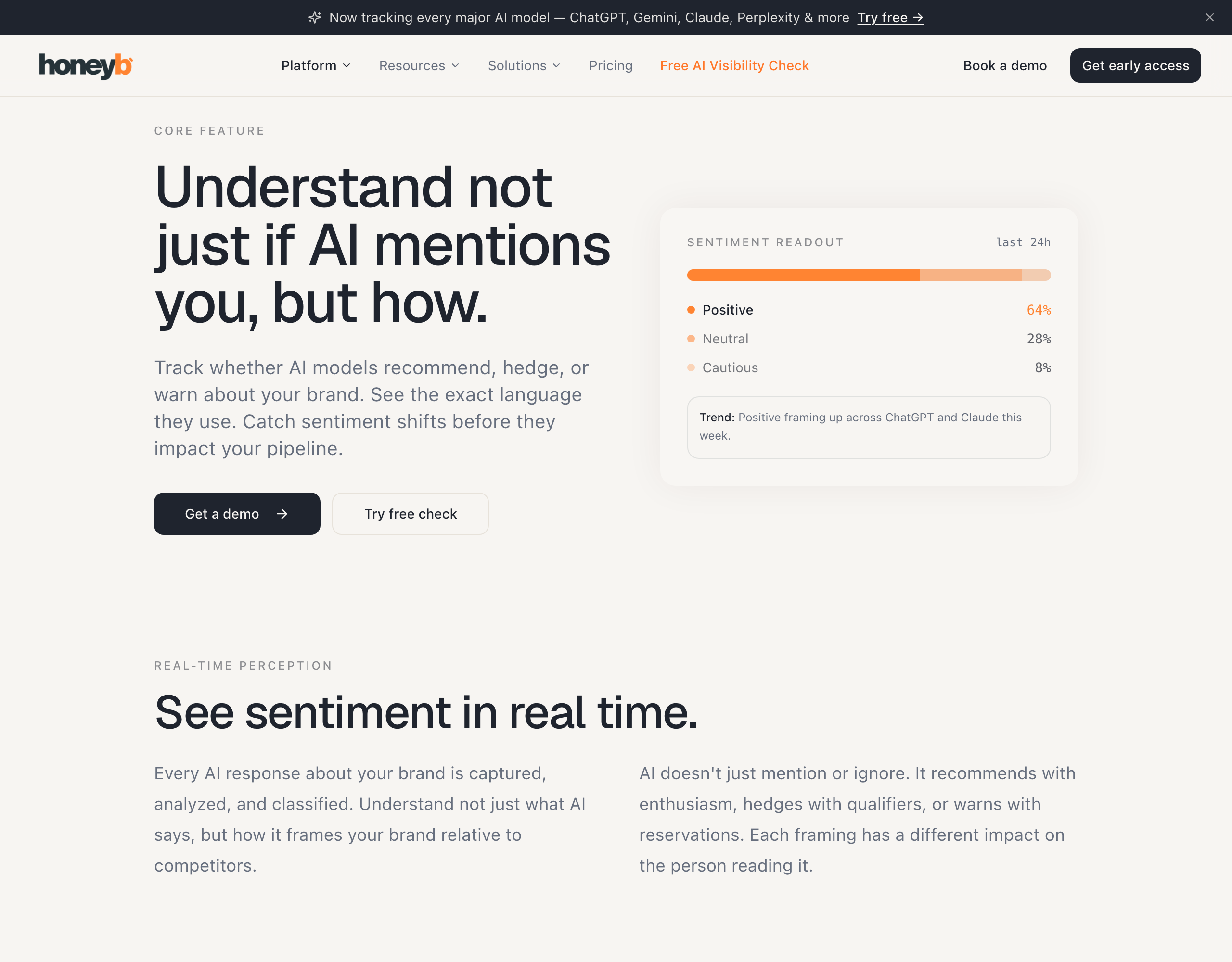
A proper tool in this category runs scheduled scans rather than one-off spot checks, because AI answers vary between runs and shift as models update. It tracks the metrics that actually matter in answer engines: mention rate, share-of-voice against named competitors, which pages get cited, average position within an answer, and sentiment, meaning how the model frames you when it does mention you. It does this across the engines buyers actually use, not just one. We go deeper on the buying criteria in AI visibility tools and the wider market in search engine visibility tools.
Honeyb is built for exactly this job. It tracks how a brand is mentioned, cited, ranked, and described across ChatGPT, Perplexity, Google AI Mode and AI Overviews, Gemini, Claude, and Copilot, including the engines, Claude in particular, that the suite add-ons still tend to miss. It runs scheduled scans rather than manual spot checks, measures share-of-voice and sentiment, and benchmarks you against named competitors rather than reporting your numbers in isolation. There is also a free AI visibility checker and a free People Also Ask tool for a first look before committing. If AI-answer visibility is the job you came here for, this is the category that does it as the core product rather than as an add-on.
Why does this need its own category rather than a feature inside a suite? Because the data source is different. Suites are built around crawl data, backlinks, and SERP positions. Visibility monitoring is built around sampling live AI answers at scale and parsing them for brand and competitor mentions. The two share a goal, getting found, but the measurement is not the same, which is why the bolt-on modules tend to be shallower than a purpose-built tool. For how engines actually pick the names they return, see how AI models choose which brands to recommend.
The comparison, by category
The table below keeps the three jobs separate so you compare like with like. The "what it does not do" column is the one most buyers skip and later regret.
| Tool | Category | Best for | What it does NOT do |
|---|---|---|---|
| Ahrefs | Traditional suite + AI add-on | Backlink analysis, keyword research, technical audits | AI visibility only via paid Brand Radar add-on (~828/mo for full coverage); no native Claude tracking |
| Semrush | Traditional suite + AI toolkit | All-in-one SEO with AI tracking in one vendor | Toolkit priced per domain and per seat, so team costs multiply |
| SE Ranking | Traditional suite + AI add-on | Cheapest entry to AI-answer data inside a suite | Real AI coverage needs a paid add-on (annual only), so true cost is higher |
| Moz Pro | Traditional suite + AI dashboard | Domain Authority, backlink analysis, keyword ideas | AI visibility covers ChatGPT and Gemini only; least mature of the suites |
| Surfer | Content optimisation + light tracker | On-page content scoring; a light AI tracker bolt-on | Deep, competitive, continuous visibility monitoring |
| Frase | Content optimisation (AI-first) | Budget AI-assisted research, outlining, drafting | Deep cross-engine share-of-voice tracking outside its top tier |
| Clearscope | Content optimisation (enterprise) | Clean content grading at publishing volume | AI-answer visibility measurement |
| Honeyb | AI visibility monitoring | Mentions, citations, share-of-voice, sentiment across all major engines | Backlink indexing, technical crawling, content grading |
Why AI visibility now sits beside the classics
Whether AI visibility belongs in your stack depends on where buyers in your market do their research, and the direction of travel is clear. Statcounter's referral data put ChatGPT at roughly 77 percent of the AI chatbot referral market in April 2026, an all-time low, with Gemini around 9 percent after overtaking Perplexity for the number-two spot, Perplexity close to 8 percent, Copilot near 4 percent, and Claude under 3 percent. ChatGPT's share has slipped for three straight months from over 84 percent a year earlier, so the field is broadening rather than consolidating. The exact split varies by measurement method, but the headline holds: AI assistants now handle a large and growing volume of the questions that used to start on a search results page. Demand is moving on the buyer side too. Capgemini's research found that 58 percent of consumers had replaced traditional search engines with generative AI for product recommendations, up from 25 percent in 2023.
Market share (%)
Top four generative AI chatbots compared (ChatGPT figure includes Copilot)
When a buyer asks an engine to compare CRMs, recommend an agency, or shortlist tools for a small team, the answer is a short list of named brands, often with no click to anyone's site. That is the moment classic SEO tooling cannot see. You can rank first in Google and still be absent from the answer a buyer actually reads, and you would never know it from a rank tracker. For a worked example of how this differs from blue-link search, see AI search versus traditional search.
How to choose without overbuying
Match the tool to the job, and resist buying a fourth product when you already own three. Most teams need one tool from at least two of these categories, rarely all of them at full depth.
Agencies that resell monitoring under their own brand have an extra criterion to weigh, and our guide to the best white-label SEO tool for agencies sets out which platforms the major AI engines name for client-branded resale.
- Pick a traditional suite if your core need is still keyword research, backlinks, and technical health. Most teams already have one, so audit what its AI add-on actually covers, and at what real cost, before paying extra for it.
- Add a content optimisation tool if you publish regularly and want drafts to match intent. Treat any AI-answer tracking inside it as a spot check, not as monitoring.
- Add a dedicated visibility monitor if buyers in your category research through AI answers and you need to know, on an ongoing basis, whether you appear and how you compare. This is the job a suite add-on does most shallowly.
A practical sequence: start with a free brand check to see whether AI engines mention you at all today. If you are absent or losing share to a competitor, that is the signal to invest in continuous monitoring rather than a one-off look. If you already appear consistently and only want to publish better pages, a content tool plus your existing suite may be enough for now. On a tight budget the sequence narrows further, and we set out what a small business should actually pay for separately.
How to think about visibility from here
The useful shift in 2026 is not picking a single "best" tool. It is recognising that "AI SEO" describes three jobs, and that no single product does all three deeply. Traditional suites remain the right choice for ranking work and are honestly improving their AI modules, but those modules are add-ons with real limits and uneven engine coverage. Content tools make pages better and offer a glimpse of AI answers, not sustained measurement. AI visibility monitoring is a separate category because the data and the question are different, which is the job Honeyb is built for.
Start by measuring what you actually have. Check whether AI engines mention you, how they describe you, and where you sit against competitors, then buy only the depth that gap justifies. The brands that handle this well are not the ones with the most tools. They are the ones who matched each tool to a real job and kept watching the answers that buyers now read instead of the rankings buyers increasingly skip.
Sources cited in this report