

Most content strategies are still built on a quiet assumption: that the page you publish is the thing the reader finds. Inside an AI answer, it usually is not. When ChatGPT or Gemini fields a buyer's question it does not hand over ten blue links to click through; it writes a paragraph and leans on a small handful of sources, most of which are not your website. Ahrefs' analysis of what actually moves AI visibility found the strongest correlation is with third-party mentions and video, the coverage other people publish about you, rather than the on-page work that most content plans are made of. That one finding reorders the whole exercise.
The citation data is blunter still. Across a Semrush study of roughly 150,000 citations drawn from about 5,000 keywords, the single most-cited source in AI answers is Reddit, at 40.1% of all citations, ahead of Wikipedia and YouTube. None of those three is a page you can publish for yourself.
Share of AI citations
Most-cited domains in AI answers
Read that as a map of leverage, and a slightly deflating one. A content team can write, optimise and publish on its own domain all day, and it should. But it cannot post to Reddit on its own behalf without being found out, cannot vote itself a Wikipedia citation, and cannot star in a YouTube review it produced itself. Those are the surfaces feeding the answer. Worse for the tidy-your-own-pages instinct, Semrush found that 62% of AI citations never name the brand at all, so a large slice of the influence never shows up in a page-level view. A content strategy built only around your own URLs is optimising the corner of the board it can reach, which is useful and incomplete.
What an AI content strategy actually is
An AI content strategy is a plan for what you publish, and where, so that AI answer engines name and cite your brand when a buyer asks them a question. Set next to a classic SEO content plan (write pages, rank pages, collect the clicks) it differs in three ways, and the differences are what make it a separate discipline rather than a rebrand. The unit of work is a buyer's question, phrased the way a person actually types it into a chatbot, not a keyword lifted from a volume tool. The goal is to be one of the sources a synthesised answer leans on, not to hold position one on a page of links. And success has to be read across several engines that routinely disagree with each other, rather than off a single results page. We took the definitional groundwork apart in our guide to what AI visibility actually is; this piece is about the plan that follows from it.
The framework, in four moves
Strip out the jargon and a workable AI content strategy is four moves, run as a loop rather than a straight line. The table is the whole thing on one screen; the sections below fill each row in.
| Move | The question it answers | What you produce | How you know it worked |
|---|---|---|---|
| 1. Map the prompts | What do buyers actually ask the engines? | A ranked list of real buyer questions, checked against live answers | The prompts match what the engines are asked, not what a keyword tool reports |
| 2. Earn the off-page surfaces | Where do the answers get sourced? | Presence in community threads, reviews, third-party lists and video, not just your blog | A rising share of your citations comes from domains you do not own |
| 3. Structure for extraction | Can a model lift a clean answer from the page? | Answer-first pages, plain claims, schema, quotable data | Engines quote your pages when they cite your domain |
| 4. Measure across engines | Are the engines naming you more than last month? | Mention rate, share of voice and sentiment, tracked on a schedule | A trend line across repeated runs, not a single lucky screenshot |
Move 1: map prompts, not keywords
A keyword is what someone types into a search box. A prompt is what they type into a chatbot, and the two rarely match. "crm software" is a keyword; "what is the best CRM for a five-person B2B team that hates data entry" is a prompt, and it is the prompt the answer engine is actually built to satisfy. So the first move is to write down the real questions buyers ask in your category, in their own words, then go and read what the engines currently say back. You are looking for two things: which brands get named, and which sources those answers cite. That list, not a spreadsheet of search volumes, is your content brief. Our note on how AI models choose which brands to recommend covers the mechanics of why the phrasing matters this much.
Move 2: earn the surfaces you cannot publish yourself
This is the move most content plans skip, because it is the least comfortable. If Reddit, Wikipedia and YouTube are where a large share of answers get sourced, then a strategy that only ships blog posts is aiming at the wrong target. Earning those surfaces is slower and less controllable than publishing your own page: it means being genuinely useful in the communities where your buyers already argue, getting into the third-party roundups and review sites the engines trust, and producing video worth citing. None of it is a growth hack, and that is rather the point.
It also comes with a warning against betting the strategy on any single platform. Semrush tracked Reddit's share of ChatGPT citations falling from roughly 60% to roughly 10% in the space of a fortnight in late 2025, after the commercial arrangement between the two shifted. A content plan that had gone all-in on Reddit that autumn would have watched its main channel evaporate in two weeks. Spread the off-page work across several credible surfaces, and treat the mix as something to monitor rather than set once. Perplexity, for what it is worth, leans on community and forum sources far more heavily than the other engines do, which is why the same off-page effort pays off differently depending on the assistant, a pattern we dug into in how to get mentioned in Perplexity.









Want to get recommended by AI?
Check your AI search visibility, then let the Honeyb agent write, fix, and earn what gets you recommended. Free to start.
Move 3: structure pages so a model can lift the answer
When an engine does reach for your own pages, it is not reading them the way a person does. It is skimming for a clean, liftable claim it can drop into a synthesised answer. That rewards a particular shape of writing: the answer stated plainly near the top rather than buried under a warm-up, specific and quotable data, clear headings, and structured markup (schema, the machine-readable labels that tell an engine what a page is) that spells out what it is looking at. The engines pull from more sources than most people assume, which is why being one clean, extractable option among many is worth the effort.
| Engine | Sources cited per answer |
|---|---|
| ChatGPT | 15.0 |
| Gemini | 10.7 |
| Claude | 8.8 |
| Perplexity | 8.3 |
Those are averages from a Honeyb measurement on 13 July 2026, across 20 buyer-intent prompts run three times each via the engines' APIs. Fifteen sources for a single ChatGPT answer is a crowded room, and it cuts both ways: plenty of slots to be cited in, and plenty of competition for each one. One practical wrinkle is that not every engine shows its working. ChatGPT and Gemini frequently answer without surfacing the citations behind the text, while Perplexity and Claude tend to expose theirs, so some of the sourcing you are optimising for happens where you cannot watch it directly. We covered that visibility gap in whether ChatGPT cites its sources.
Move 4: measure across engines, on a schedule, or not at all
Here is the move that turns the other three from a hopeful gesture into a strategy, and the one most content teams get wrong by taking a single triumphant screenshot. AI answers are not stable. SparkToro found the same query changes its answer roughly 70% of the time, and two identical queries return the same list of recommended brands less than once in a hundred attempts. So checking whether last month's work paid off by asking ChatGPT once is close to a coin toss: the same question five minutes earlier would have named a different set of brands.
The fix is not clever, it is just disciplined. Track three things, over repeated runs, across the engines your buyers actually use: your mention rate (how often you are named at all), your share of voice against named rivals (the proportion of all brand mentions that are yours), and the sentiment of the framing when you do appear. Multiply them rather than average them, because a brand named often but always last and always as the pricey option is not winning. We set out the arithmetic and the benchmark numbers in how to calculate an AI visibility score, and made the fuller case for why a one-off look tells you almost nothing in why spot-checking fails.
Where Honeyb fits, disclosed as ours
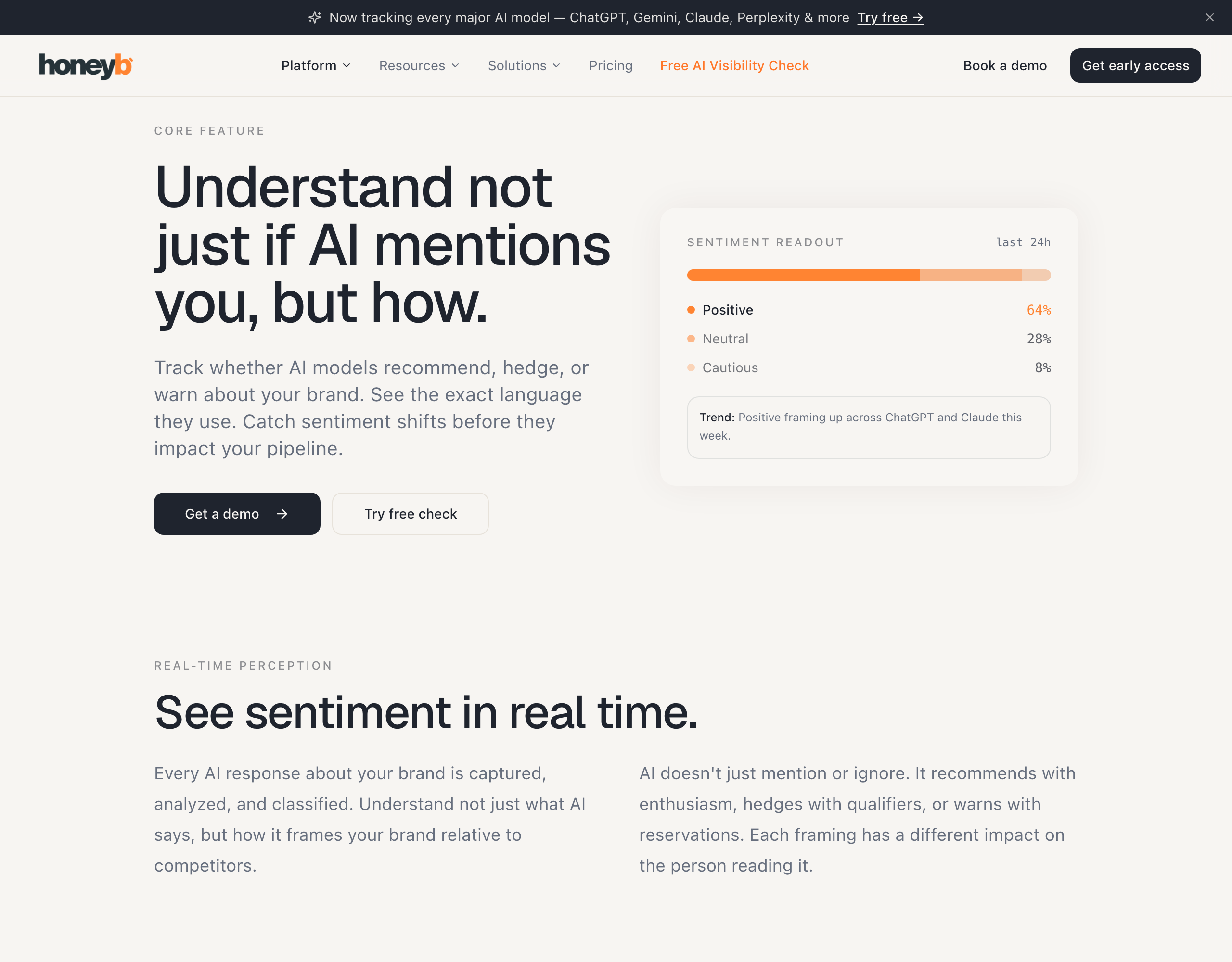
We build Honeyb, so read this as disclosure rather than a neutral verdict. The framework above is deliberately tool-agnostic; you can run all four moves with a spreadsheet, a lot of patience and a standing calendar reminder. What a tool buys you is the loop running on its own. Honeyb's content agent handles the writing half of move three, and its SEO agent maps the buyer prompts in move one and publishes against them. The part we care most about is move four: Honeyb runs scheduled scans across ChatGPT, Perplexity, Google AI Mode and AI Overviews, Gemini, Claude and Copilot, and tracks how often you are mentioned, your share of voice against named competitors, and the sentiment of the framing when you are, so the measurement is a trend line rather than a screenshot.
What this framework is not
A measured framework earns the adjective by being honest about its limits. It is not a fortnightly content-volume target dressed up in new language; publishing more pages, faster, is exactly the reflex it is meant to interrupt. It will not show results next week, because the off-page surfaces that move the needle are slow to earn and the engines are volatile enough that a fortnight of data is mostly noise. And it is not a promise that you can engineer your way into an answer through your own pages alone, because the evidence keeps pointing off your domain. What it does give you is a way to spend content effort where the leverage actually sits, and a number that tells you, honestly, whether it worked.
The place to start is not a new page. It is finding out where you stand today, so you have a baseline to measure move four against. Our free AI visibility checker shows how often the major AI engines mention your brand right now, across the assistants your buyers are already asking, in a couple of minutes and without a sign-up.