Site performance tool
WebPageTest
What is WebPageTest?
WebPageTest is an open-source web performance testing tool offering detailed waterfall analysis, filmstrip views and testing from many real locations, browsers and connection profiles. In Honeyb's measurements, AI names WebPageTest in 1 of 41 buyer questions we track, across 2 of 4 answer engines.
Best for: Deep performance diagnosis where the detail of a single test matters more than convenience.
Measured and analysed by the Honeyb research team. See the methodology.
WebPageTest pros and cons
Strengths
- The most configurable public performance test available
- Real devices, browsers and network conditions rather than simulations only
- Filmstrip and waterfall views make rendering behaviour visible
- Open source and self-hostable
Limitations
- Output is dense and assumes performance expertise
- Public test queues can be slow at busy times
- No native ongoing monitoring without the paid tier or self-hosting
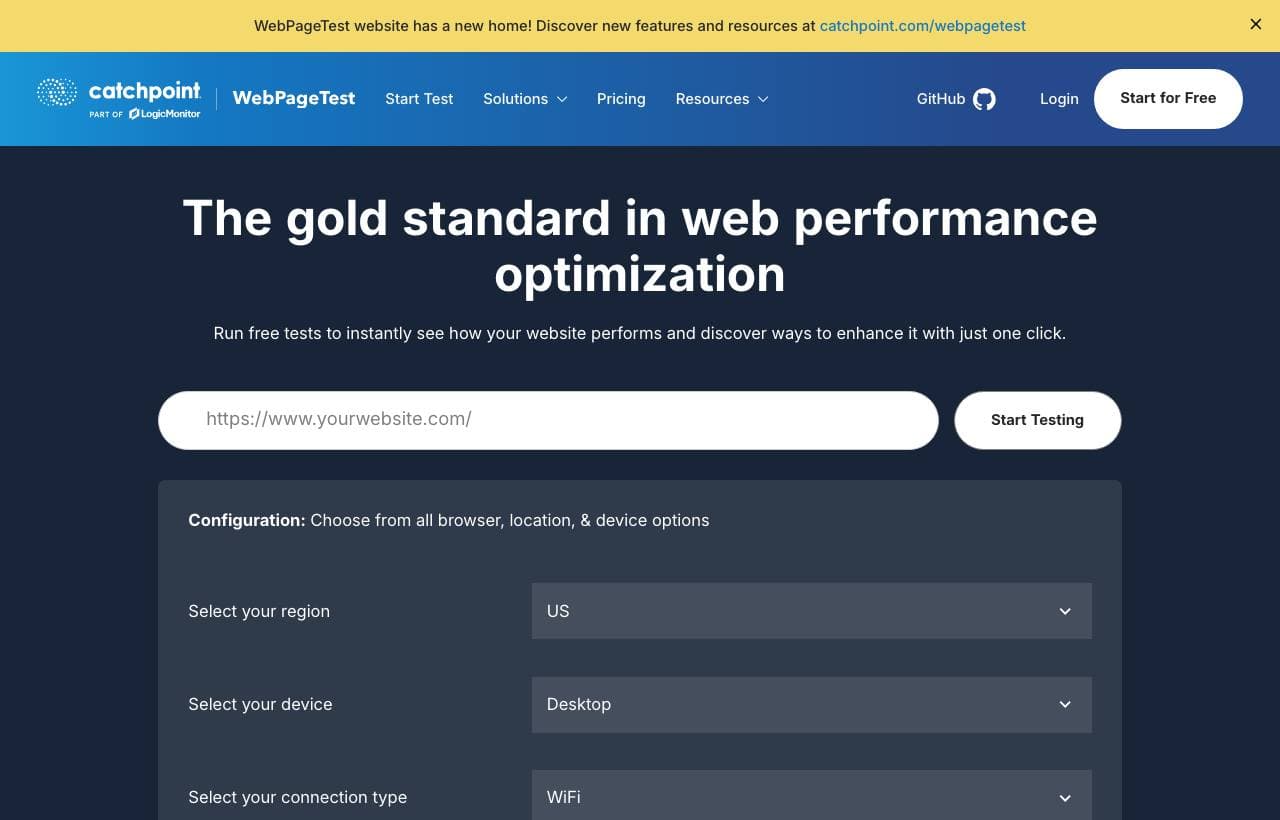 Homepage
Screenshots of webpagetest.org, captured by Honeyb.
AI visibility by engine
How many of the 41 buyer questions each engine named WebPageTest in.
1
of 41 questions
1
of 41 questions
Where AI answers name WebPageTest
The buyer questions where at least one AI model named WebPageTest, and how many of the four named it.
- What's the best page speed testing tool for SEO?
2 of 4 · Claude and Perplexity
AI visibility last measured 29 July 2026. How this is measured.
FAQ
- What is WebPageTest?
- WebPageTest is an open-source web performance testing tool offering detailed waterfall analysis, filmstrip views and testing from many real locations, browsers and connection profiles. Its website is webpagetest.org.
- Who is WebPageTest best for?
- Deep performance diagnosis where the detail of a single test matters more than convenience.
- What are the main strengths of WebPageTest?
- The most configurable public performance test available. Real devices, browsers and network conditions rather than simulations only. Filmstrip and waterfall views make rendering behaviour visible. Open source and self-hostable.
- What are the limitations of WebPageTest?
- Output is dense and assumes performance expertise. Public test queues can be slow at busy times. No native ongoing monitoring without the paid tier or self-hosting.
- Do AI models recommend WebPageTest?
- WebPageTest is an open-source web performance testing tool offering detailed waterfall analysis, filmstrip views and testing from many real locations, browsers and connection profiles. In Honeyb's measurements, AI names WebPageTest in 1 of 41 buyer questions we track, across 2 of 4 answer engines. It is named by Claude and Perplexity. Last measured 29 July 2026.
- Which AI answer engines name WebPageTest?
- Across the questions Honeyb measures, WebPageTest is named by Claude and Perplexity. Claude names it in 1 question, Perplexity names it in 1 question.
- What is WebPageTest most recommended for by AI?
- Its strongest appearance is the question "What's the best page speed testing tool for SEO?", where WebPageTest was named by 2 of 4 models.
- How is WebPageTest's AI visibility measured?
- Honeyb asks Claude and Perplexity real buyer questions and records which tools each names. This page aggregates those measurements for this tool. See the methodology page for the full method.
Other site performance tools

Google PageSpeed Insights
PageSpeed Insights is Google's free tool reporting Core Web Vitals and performance for a page, combining lab data from Lighthouse with real-user field data from the Chrome UX Report.
Named in 1 of 41 questions

GTmetrix
GTmetrix tests and monitors page performance using Lighthouse, generating scores and prioritised recommendations, with scheduled monitoring and multiple test locations.
Named in 1 of 41 questions

Pingdom
Pingdom Website Speed Test is a free tool analysing page load performance from several global locations, with a paid uptime and real-user monitoring product alongside.
Named in 1 of 41 questions

DebugBear
DebugBear monitors website performance and Core Web Vitals using both synthetic tests and real user monitoring, with regression alerting and detailed debugging data.
Google Mobile Friendly Test
Google's Mobile-Friendly Test checked whether a page met Google's mobile usability criteria. Google retired the standalone tool, and mobile usability is now assessed through Search Console and Lighthouse.

Free to start
Get recommended by AI search models.
Run a free AI search visibility check, then let the Honeyb agent do the work that gets you into the answers.
 ChatGPT
 Claude
 Gemini