

There is a simple test that sorts the SEO market in 2026, and almost nobody applies it before buying. Ask the tool that calls itself an "agent" one question: when you close the laptop, does it do anything? A real agent (software that takes actions on your behalf, not just software that talks) researches, writes, fixes and publishes while you are asleep. A great many products wearing the label do nothing of the sort. They wait for a prompt, hand you a task list, and leave every item on it for you to do by hand. That is a chatbot in a sidebar. It is not an agent, and the gap between the two is the difference between work that gets done and a backlog that gets longer.
This matters because the label has stretched to breaking point. "Agentic" is now stamped on keyword tools, content editors and audit dashboards that have not changed what they do, only how they describe it. So this guide does three things. It gives you the test for telling a real agent from a repainted one. It is honest about the part buyers most often miss, which is that the surface an on-page agent can touch is not the surface that decides whether an AI engine names you. And it compares the named tools, Honeyb included and disclosed as ours, by what they actually ship rather than what they claim.
The three levels of SEO agent autonomy
Strip away the branding and everything sold as an "AI SEO agent" sits at one of three levels of autonomy. The level, not the marketing, is what tells you how much work actually leaves your to-do list.
| Autonomy level | What it produces | Who actually acts | Where it usually breaks |
|---|---|---|---|
| Suggest | A task list: audit findings, keyword ideas, draft outlines | A human, on every single item | Nothing ships; the backlog just grows |
| Draft | Finished articles and fixes, left waiting for you | A human reviews and publishes each one | The bottleneck moves from writing to reviewing |
| Execute | Content published and technical fixes deployed on its own | The software, straight to your live site | Nobody checks whether it worked, or whether it broke something |
There is a fourth state the table cannot show, because nothing happens in it. Some agents have not shipped. Surfer, to its credit, labels this plainly: its Surfy Agent, promised to "optimize, and even publish for you", is marked "soon" on its own site rather than sold as though it were live. That is the honest version. The dishonest version is the same roadmap with the word "soon" quietly removed, and it is worth checking which one you are being shown before the card details go in.
The jump that counts is from Draft to Execute, and it is the one most vendors blur. A tool that writes a polished article and drops it into a folder has automated the typing, which is real but modest. A tool that publishes that article to your CMS, adds the schema and internal links, and pings the search engines to come and index it has automated the whole loop. The first saves an hour. The second removes a job. Most "agents" on sale are the first kind with the second kind's vocabulary.
Agent-washing: when a sidebar calls itself a colleague
The tell for a repainted tool is that it never moves until you tell it to. Classic SEO suites are the clearest example. Through 2025 and 2026 nearly every major platform bolted a conversational "AI assistant" onto its dashboard: ask it to summarise an audit, suggest keywords or draft a meta description, and it obliges. Useful, genuinely. But it is assistance, not agency. It produces suggestions at the suggest level, waits for your next instruction, and ships precisely nothing on its own. Calling that an agent is a bit like calling a very good waiter the chef.
The clearest evidence that this is a vocabulary problem rather than a product problem is that vendors sometimes contradict themselves on a single page. Nightwatch markets its SEO AI agent with the promise to "automate your SEO research, technical audits, SEO tasks, site changes", and states that it "implements optimizations automatically". Further down the same page, the FAQ describes the product resolving issues "with clear recommendations" and providing "structured content suggestions to help you create". Both passages were on the live page in early August 2026. Read as marketing it is an execute-tier agent. Read as documentation it is a suggest-tier tool.
This is less a scandal than a tell, and a genuinely useful one. Hero sections get written in the category's vocabulary, while FAQs and support pages get written by people who have to answer for what the software does on Monday morning. When the two disagree, believe the FAQ. It is the cheapest due diligence available and it takes about ninety seconds.
We pulled the suites apart by the job they actually do, and priced their AI modules honestly, in our roundup of the best AI SEO tools in 2026; the short version is that AI tracking is almost always an add-on rather than the core product. The reason the distinction is worth policing is money. An execute-tier agent is priced against the salary of the person it replaces, so it needs to actually replace the work, not just narrate it back to you. Before you pay agent prices, confirm you are buying an agent. For the wider question of which SEO tasks should ever run unattended in the first place, we mapped that in what to automate and what to never automate.
What an agent can touch, and what actually moves the answer
Here is the uncomfortable part, and it applies to even the most capable execute-tier agent. The thing most of them do best, publish and tidy on-page content, is not the thing that most decides whether an AI engine recommends you.
When ChatGPT, Gemini or Perplexity answers a buyer's question, it does not return ten blue links. It synthesises a reply and leans on a small handful of sources. Ahrefs' analysis of AI visibility found the strongest correlation is with third-party mentions and video, the coverage other people publish about you, not the on-page work an agent automates. The citation data says the same thing in sharper terms. Across a Semrush study of roughly 150,000 citations, the single most-cited source in AI answers is Reddit, at 40.1% of all citations, ahead of Wikipedia and YouTube.
Share of AI citations
Most-cited domains in AI answers
Read that chart as a map of leverage. An on-page agent can rewrite your title tags, add FAQ schema and publish a dozen tidy articles, and it should. But it cannot make Reddit talk about you, cannot earn a Wikipedia citation, and cannot put you in a YouTube review. Those are the surfaces feeding the answer. Worse for the tinkering instinct, Semrush found that 62% of AI citations never name the brand at all, so a chunk of the influence is invisible to a page-level view. An agent that only touches your own pages is optimising the corner of the board it can reach, which is useful and incomplete. The honest buyer holds both thoughts at once: execution on-page is worth automating, and it is not where most of the visibility is won.
The execute tier: the tools that actually ship
A handful of products genuinely operate at the execute level. They differ in what they execute, how much rope they give the automation, and what happens when it goes wrong. Named fairly, here is what they do.
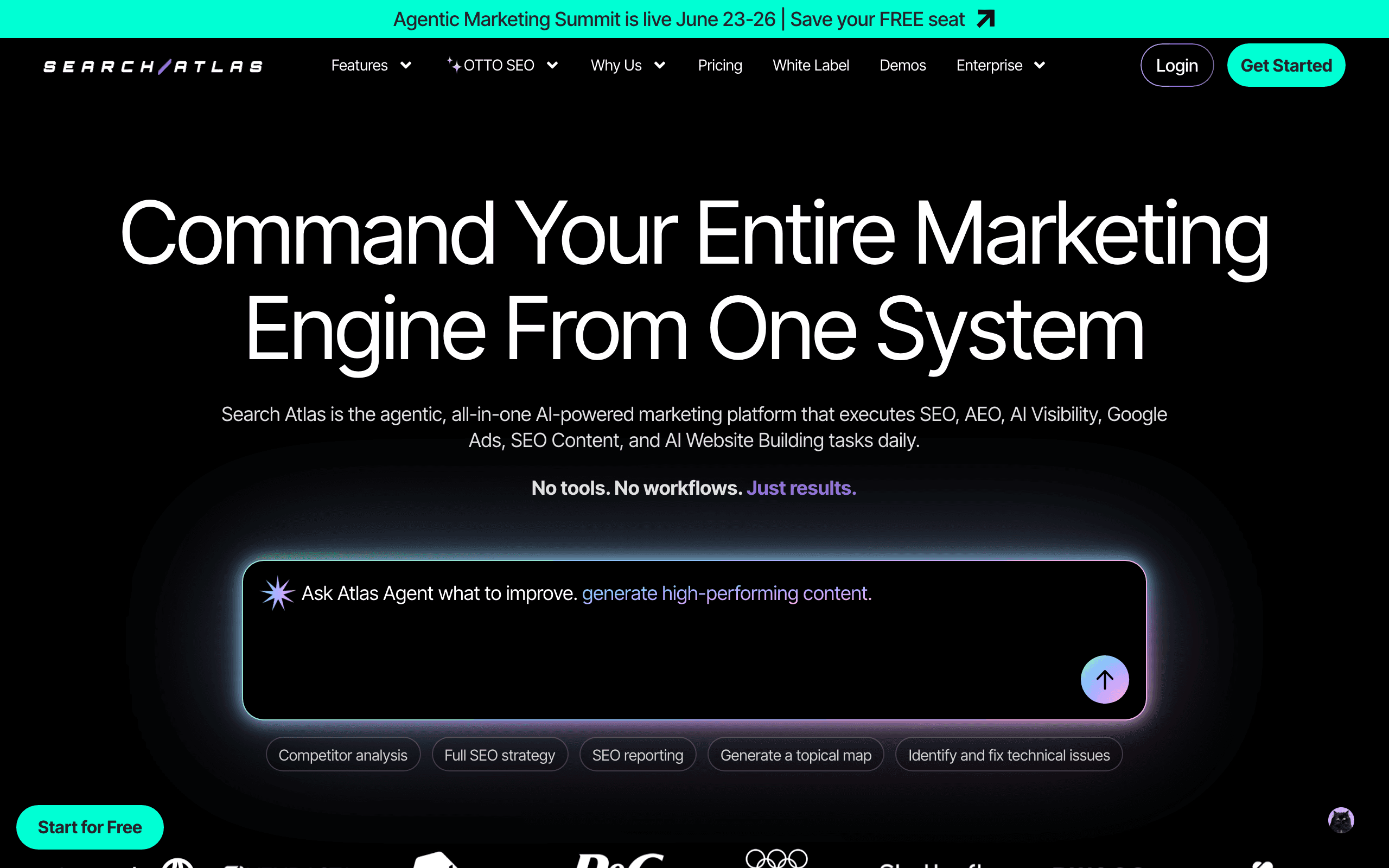
Search Atlas (OTTO) is the execute tier applied to technical and on-page SEO. You install a lightweight JavaScript pixel and OTTO can deploy metadata, schema and internal-link changes to your live site through that layer, without you opening the CMS. When it works it removes a real bottleneck for teams without a developer on call. The catch is the same pixel: an independent review documents cases where installing it broke a sitemap, slowed load times and de-indexed pages, and because the changes sit in a layer on top of your site rather than in your source, a break is harder to trace. Its own pricing runs from $99 to $999 a month across four tiers, with full five-engine AI visibility tracking arriving only at the $399 Pro plan (figures re-checked against the live pricing page in July 2026). We went through the trade-offs in full in our Search Atlas review.









Want to get recommended by AI?
Check your AI search visibility, then let the Honeyb agent write, fix, and earn what gets you recommended. Free to start.
SEO.ai and TheSEOAgent are the execute tier applied to content. Both run the loop from keyword to published article: research, draft, optimise, and push the finished piece to a CMS with schema, meta and internal links attached. SEO.ai lets you choose your comfort level, publishing automatically, saving as a draft, or holding for review, and connects to WordPress, Webflow, Shopify and most major platforms with no technical setup, per its own site (checked August 2026); it keeps human specialists spot-checking the output. TheSEOAgent leans further into hands-off, running a fact-check pass with citations and a quality gate that, by its own description, refuses to publish drafts below a threshold, pushing natively to WordPress, Webflow, Shopify and Ghost. The distinction to weigh is where the safety net sits: a human spot-check, or an automated gate that is the only thing between draft and live.
Writesonic sits across draft and execute, and has repositioned from an AI writer into a search-visibility platform. It bundles an SEO agent and a content agent with AI-visibility tracking across around ten engines, and its higher tiers add agentic workflows and an action centre that ships content and citation fixes, per the vendor (checked August 2026). It is a reasonable all-rounder, though reviewers note its AI-search optimisation is lighter than a dedicated monitor's. If you want the fuller taxonomy of what "AI SEO software" now spans, we laid it out in the category map.
Honeyb: execute, then measure the only number that matters
We build Honeyb, so treat this section as disclosure, not a neutral verdict. Honeyb's SEO agent runs at the execute level: it maps your market and the questions buyers actually ask Google and the AI assistants, builds a publishing calendar from real buyer prompts checked against the live results, then writes and publishes articles to your CMS and ships technical fixes, with you deciding what goes live. Its content agent handles the writing half of that loop. So far, that is the same promise the other execute-tier tools make.
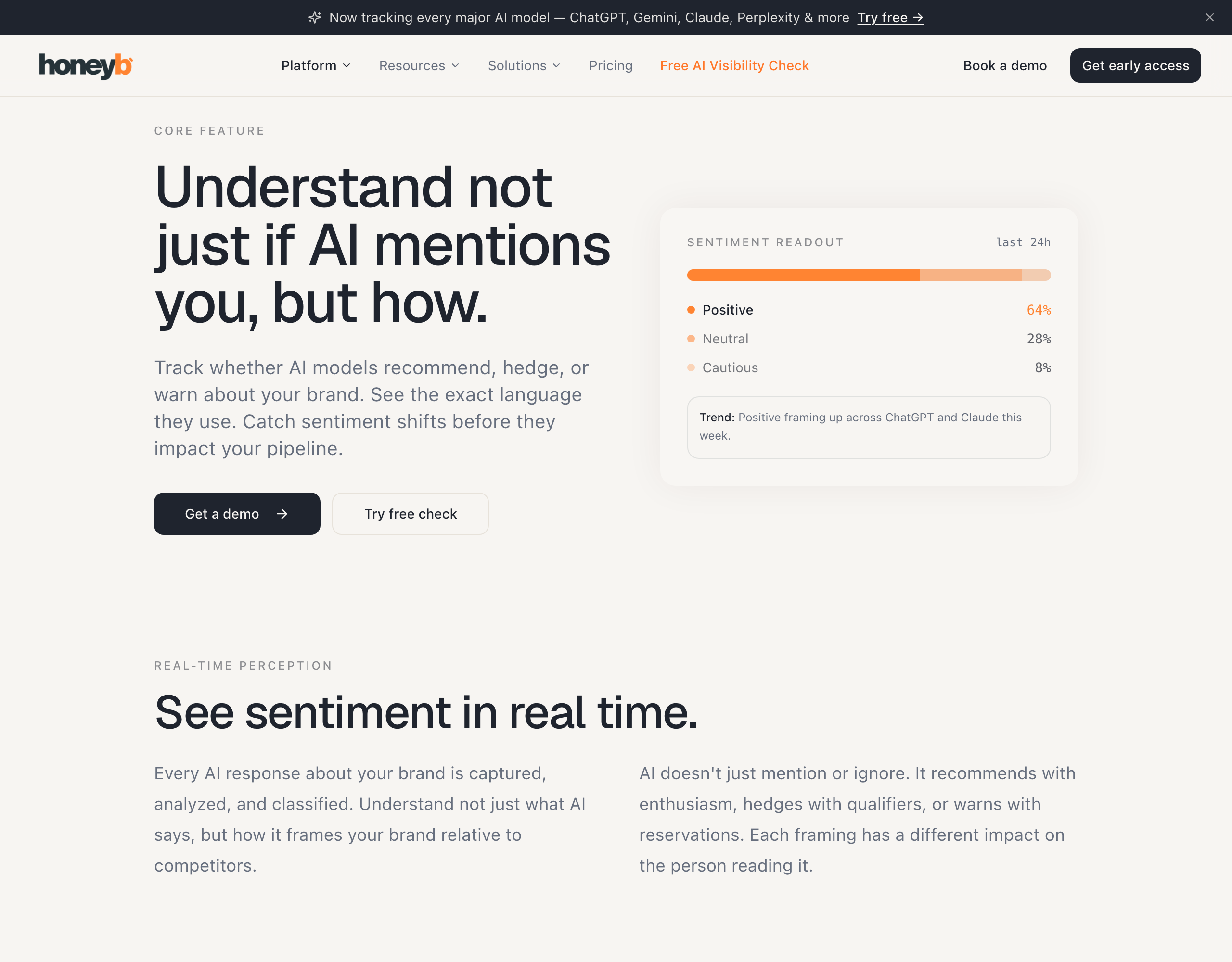
The difference is what happens after the work ships. Honeyb closes the loop on the metric the others mostly leave open: whether Google and the AI engines actually recommend you more than they did last month. It runs scheduled scans across ChatGPT, Perplexity, Google AI Mode and AI Overviews, Gemini, Claude and Copilot, and tracks how often your brand is mentioned and cited, your share of voice against named rivals, and the sentiment of the framing when you are mentioned. An agent that publishes but never measures is flying blind, and given what AI answers do next, blind is an expensive place to be.
Why an agent without measurement is dangerous, not just incomplete
AI answers are not stable, and this is the fact that breaks the naive autopilot pitch. SparkToro found the same query changes its answer roughly 70% of the time, and two identical queries match the same list of recommended brands less than one time in a hundred. So a single before-and-after check of "did the agent help" is close to a coin toss. You cannot tell whether last week's twelve published articles moved anything by glancing at ChatGPT once, because ChatGPT would have given a different answer five minutes earlier.
That is why the execute tier and continuous measurement belong together, and why a one-off look tells you almost nothing, a point we labour in why spot-checking fails. It is also why an agent left fully unsupervised is a real risk rather than a convenience. If it publishes thin pages or deploys a technical change that quietly de-indexes you, and nothing is watching the AI-answer and ranking signals on a schedule, the damage compounds silently. Autonomy without a feedback loop is not a time-saver. It is a slow leak you find out about a quarter too late. The strategic layer underneath all of this, how the models pick names in the first place, is covered in how AI models choose which brands to recommend.
The comparison, by what they actually do
The table keeps Honeyb first because it is ours, and sorts the field by autonomy level and the honest caveat, which is the column buyers skip and later regret. If pixel-based automation is the part giving you pause, our ranked guide to the best Search Atlas alternatives covers the no-pixel field in depth.
| Tool | Autonomy level | What it actually does | The honest caveat |
|---|---|---|---|
| Honeyb | Execute, then measure | Researches, writes and publishes to your CMS and ships technical fixes with your approval, then tracks whether Google and the AI engines recommend you more | Built around AI-answer visibility, not a general backlink index or classic rank tracker |
| Search Atlas (OTTO) | Execute (technical) | Deploys metadata, schema and internal-link changes to your live site through a JavaScript pixel | Documented cases of the pixel breaking sitemaps and de-indexing pages; test on staging first |
| SEO.ai | Execute or draft, your choice | Researches and writes, then publishes automatically, saves as a draft, or waits for review; connects to most major CMSs | Relies on human spot-checks rather than a hard automated quality gate |
| TheSEOAgent | Execute (content) | Runs the full loop to a published article with schema and meta, and blocks drafts below a quality-gate score | No human in the loop by default, so the gate is the only check before live |
| Writesonic | Draft to execute | An SEO agent and content agent plus AI-visibility tracking across around ten engines; agentic workflows on higher tiers | AI-search optimisation is lighter than a dedicated monitor's |
| Classic suite AI assistants | Suggest | A chat sidebar that summarises audits and drafts copy when asked | Waits for your prompt and ships nothing, which is assistance, not agency |
How to vet an SEO agent before you buy
The marketing will not tell you which tier a tool sits at, so ask it directly. A short, awkward checklist saves a lot of money.
- Does it act without me? Ask for a concrete example of something it publishes or deploys on its own. If the answer is "it suggests" or "it recommends", you are at the suggest tier, whatever the homepage says.
- Where do the changes live? Written into your CMS and source, or injected through a pixel layer you do not control? The pixel is convenient and harder to unwind when it breaks.
- What is the safety net? A human review step, an automated quality gate, or nothing? Know which, because on full autopilot the gate is all that stands between a draft and your live site.
- Does it measure what it changed? Publishing is half the loop. If the tool cannot show you, on a schedule, whether the AI engines and Google now recommend you more, you are automating output and guessing at outcome.
- Does it touch the surfaces that matter? An on-page agent cannot earn a Reddit thread or a YouTube review, and those feed the answer. Be clear about the corner of the board it can and cannot reach.
If the concept of agentic software itself is still fuzzy, we wrote a plain-English primer on what agentic AI actually means that untangles the term from the hype.
The honest bottom line
Real AI agents for SEO exist, and a few of them will genuinely take a chunk of production off your plate: publishing content, shipping technical fixes, running the loop while you do something else. That is worth having. But two truths sit alongside the promise. Most tools wearing the label are suggest-tier assistants in an agent costume, and even the real ones automate the surface they can reach, which is not the whole surface that decides whether an AI engine names you.
So buy the execution if it saves you real work, but do not buy the story that publishing equals visibility. The brands winning in AI answers pair the doing with the watching: ship the work, then measure, on a schedule, whether the engines that buyers now ask actually changed their minds. You can see where you stand today, before committing to any agent, with our free AI visibility checker, which shows how often the major AI engines mention you right now.