AI share of voice tools answer one competitive question: out of every AI answer that could have named you, what percentage actually did, and how does that compare with the rivals fighting for the same prompts. This post is not about the maths behind the metric (we cover that in how to measure AI share of voice).
It is about the tools themselves, and specifically how each one computes competitive share of voice: how it builds a competitor set, whether it weights citations differently from plain mentions, and how many models it samples before it hands you a number. Honeyb is our own tool, so we list it first and are upfront about that. For a broader field that includes tools built for other jobs, see our best AI visibility tools roundup.
What competitive share of voice actually measures
Ordinary visibility tracking tells you whether you appeared. Share of voice tells you how much of the available airtime you captured versus everyone else answering the same question. That distinction matters because most of the airtime is not branded at all. Semrush found that 62% of AI citations never name the brand behind them, so a tool that only counts explicit brand mentions will undercount your true presence and your competitors' presence alike.
The sourcing skews hard, too: Reddit alone accounts for 40.1% of all AI citations, the single most-cited source, which means a share of voice number is really a measure of who owns the third-party conversation, not who owns the best landing page. Ahrefs' own research points the same way, finding that AI visibility correlates most with third-party mentions and video rather than on-page work.
Community citation share
Community citation share by AI engine
The harder problem is stability. The same AI query changes its answer roughly 70% of the time, and two identical queries return the same brand list under a 1-in-100 chance (SparkToro). Sources move underneath you as well: Reddit's share of ChatGPT citations fell from around 60% to around 10% inside a fortnight in late 2025 (Semrush). A single spot check is therefore worthless for competitive comparison.
The tools worth paying for are the ones that sample the same prompts repeatedly across models and average the result, so your share of voice reflects a distribution rather than one lucky or unlucky roll.
The 7 best AI share of voice tools at a glance
| Tool | How it computes competitive SoV | Models sampled | Competitor set | Free entry point | Pricing |
|---|---|---|---|---|---|
| Honeyb (ours) | Your share of citations and mentions against a competitor set, with sentiment | ChatGPT, Gemini, Claude, Perplexity, daily | You define and edit; tracked over time | Free check | Free check, then paid |
| Profound | Enterprise share of voice analytics across a large prompt set | Multiple engines | Managed, enterprise scope | Free trial | Pricing on request |
| Ahrefs Brand Radar | AI share of voice plus mention volume inside Ahrefs | AI answers and overviews | Comparative, mention-led | Ahrefs account | On Ahrefs plans |
| Otterly AI | Prompt-level SoV per query across the widest model list | ChatGPT, Perplexity, AI Overviews, Gemini, Copilot | Per-prompt competitor detection | Free trial | From $29/mo |
| Peec AI | Competitive SoV for multilingual and mid-market brands | Multiple engines | Multi-market competitor sets | Trial | From $95/mo |
| AthenaHQ | SoV inside GEO workflows for teams | Multiple engines | Workflow-driven | Free 10-minute audit | From $295/mo |
| Semrush AI Visibility | SoV inside Semrush's SEO + AI Search plans | Multiple engines | Suite-linked | Free checker | From $199/mo |
1. Honeyb
Honeyb, our tool, checks ChatGPT, Gemini, Claude and Perplexity every day and computes your share of both citations and mentions against a competitor set you define and can edit as rivals change. Because 62% of AI citations never name a brand (Semrush), Honeyb counts the unbranded presence as well as explicit mentions, which keeps the comparison honest on both sides of the ledger.
Alongside the raw share it tracks sentiment and the exact sources each answer cited, so you can see not just how much airtime a competitor took but where it came from. Daily sampling across four models is the direct answer to the roughly 70% answer variance measured by SparkToro. You can start with a free check before committing to anything.

Want to get recommended by AI?
Check your AI search visibility, then let the Honeyb agent write, fix, and earn what gets you recommended. Free to start.
2. Profound
Profound is positioned as the enterprise standard, with the deepest analytics in the category and $155M in funding behind it. Its share of voice sits inside a wider analytics platform built for large prompt libraries and managed competitor scopes, which suits teams that want to slice results across many segments. It publishes no price: there is a free trial, then custom Enterprise pricing on request. If you are weighing the two directly, we lay out the differences in Honeyb vs Profound.
3. Ahrefs Brand Radar
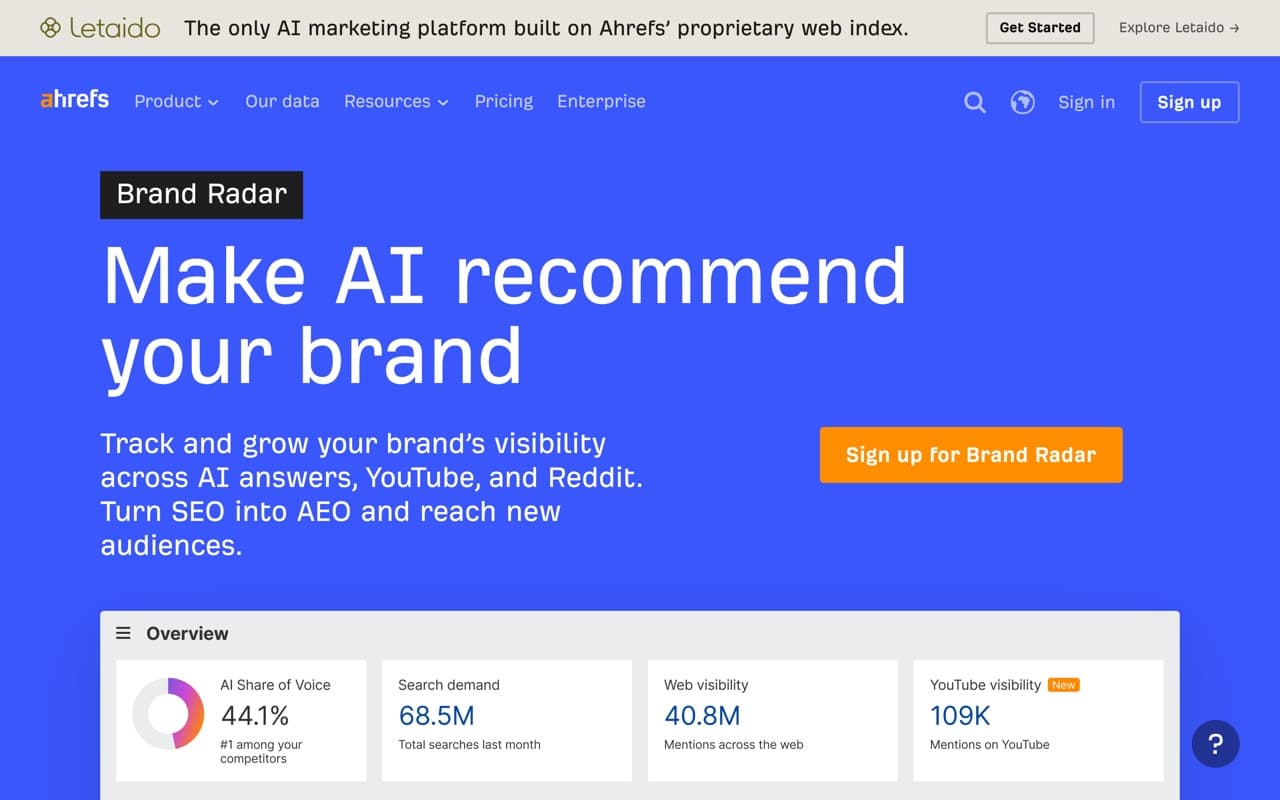
Ahrefs Brand Radar reports AI share of voice next to mention volume, all inside the Ahrefs platform on existing Ahrefs plans. The mention-led framing lines up with Ahrefs' own finding that AI visibility correlates most with third-party mentions and video rather than on-page work, so the tool effectively measures the input that moves the metric. For teams already paying for Ahrefs, it folds competitive AI share into the same account as backlinks and keywords rather than adding a separate subscription.
4 to 7. Otterly AI, Peec AI, AthenaHQ and Semrush AI Visibility
Otterly AI is the cheapest entry, from $29 per month with a free trial, and covers the widest model list of the group: ChatGPT, Perplexity, AI Overviews, Gemini and Copilot.
It reports share of voice at the level of individual prompts, it is a Gartner Cool Vendor and it holds a 4.9 rating on G2. Peec AI targets multilingual and mid-market brands from $95 per month with a trial, and builds competitor sets across markets rather than a single language. AthenaHQ wraps share of voice inside GEO workflows built for teams, from $295 per month, and offers a free 10-minute audit as a way in. Semrush AI Visibility comes with Semrush's SEO + AI Search plans from $199 per month, with a free checker, and Semrush is the source of the citation data cited throughout this post, including the 40.1% Reddit figure and the 62% unbranded-citation figure.
Two more tools sit just outside this list for the pure share of voice job: SE Ranking folds AI visibility into an affordable SEO suite from $129 per month with a no-card trial, and Scrunch AI takes an AEO-focused approach from $250 per month.
How to choose the right one
Match the tool to the shape of your competitive question. If you need daily competitor share across all four major models with sentiment and citation sources in one view, start with Honeyb. If you are an enterprise with a large managed prompt library, Profound is built for that scale. If you already live in Ahrefs, Brand Radar avoids a second subscription. If budget is the constraint or you want the widest model coverage cheaply, Otterly AI is the lowest-cost door in.
Whichever you pick, insist on repeated sampling: a share of voice figure from a single query is meaningless given roughly 70% answer variance (SparkToro). For adjacent jobs, see our guides to AI brand monitoring tools, brand mention tracking tools, AI sentiment tracking platforms and LLM monitoring tools. When you are ready to see your own numbers against named competitors, run a free AI visibility check.